
Beijing Communication Guide for Tourists (From a Local of 10 Years)
If you’re wondering how to communicate in Beijing as a foreign traveler, you’re not alone.
After living in Beijing for over 10 years, I can tell you that language can feel like a barrier at first — but in reality, it’s much easier than you think if you know a few simple tricks.
In this guide, I’ll show you exactly how to communicate in Beijing, from using translation apps to real-life tips I use every day.
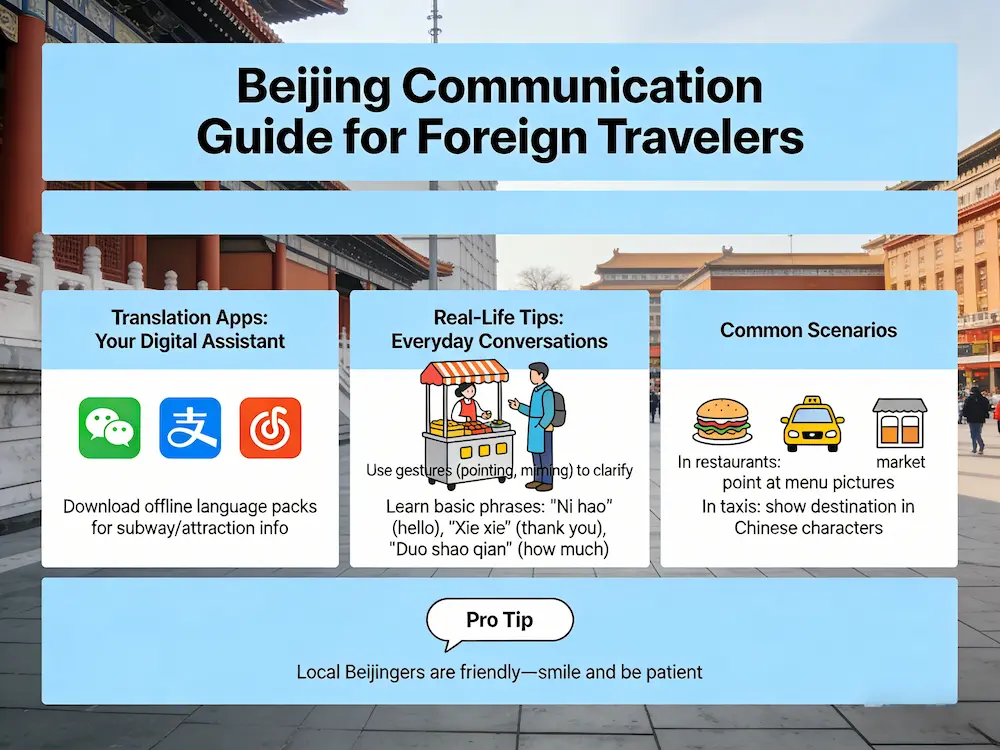
Table of Contents
Is It Hard to Communicate in Beijing?
Is it hard to communicate in Beijing? Actually, it’s not as difficult as you might think, but it’s not exactly easy either—the reality is quite different from what many tourists expect.
Many people worry about language barriers in Beijing, but the actual experience is this: communication is generally no problem at tourist attractions, hotels, and shopping districts, but it can be a bit of a challenge when you venture into the hutongs and small local shops.
Staff at popular attractions, subway stations, and large shopping malls can usually understand basic English, so asking for directions, buying tickets, and making inquiries are all straightforward. Young people on the streets also know a bit of basic English, which is more than enough for simple directions and conversations.
However, if you venture into old hutongs, street-side eateries, or local shops, most locals have limited English proficiency, making it difficult to have in-depth conversations in English. In these situations, using translation apps or gestures can actually be more effective.
Overall: If you stick to tourist attractions and shopping districts, communication is virtually stress-free; if you want to immerse yourself in local life, having some translation tools on hand is all you need.
Essential Communication Apps for Traveling in Beijing
The Translation Apps I Actually Use
Google Translate
Google Translate cannot be used online in real time within China; you must rely on offline language packs downloaded in advance. While it can handle simple text translation at tourist attractions, restaurants, and other locations, its functionality is limited, and the user experience isn’t as smooth as it is abroad.
Microsoft Translator
Microsoft Translator supports offline translation, two-way voice translation, and photo translation. It performs relatively stably under domestic network conditions, and its real-time group conversation translation is very practical, making it ideal for direct communication with locals.
Pleco
Designed specifically for Chinese language learning and travel, it offers highly accurate character lookup, word lookup, and photo-based Chinese character recognition. It’s especially useful when you can’t read road signs, menus, or shop signs, and is a tool that nearly every expat living long-term in Beijing has.
Practical Tips
– Download the Chinese offline package in advance before departure to avoid being unable to use the app due to a lack of internet access once you arrive.
– Use photo translation directly for restaurant menus, street signs, and product descriptions—it’s much faster than typing them out manually.
Simple Chinese Phrases That Actually Help
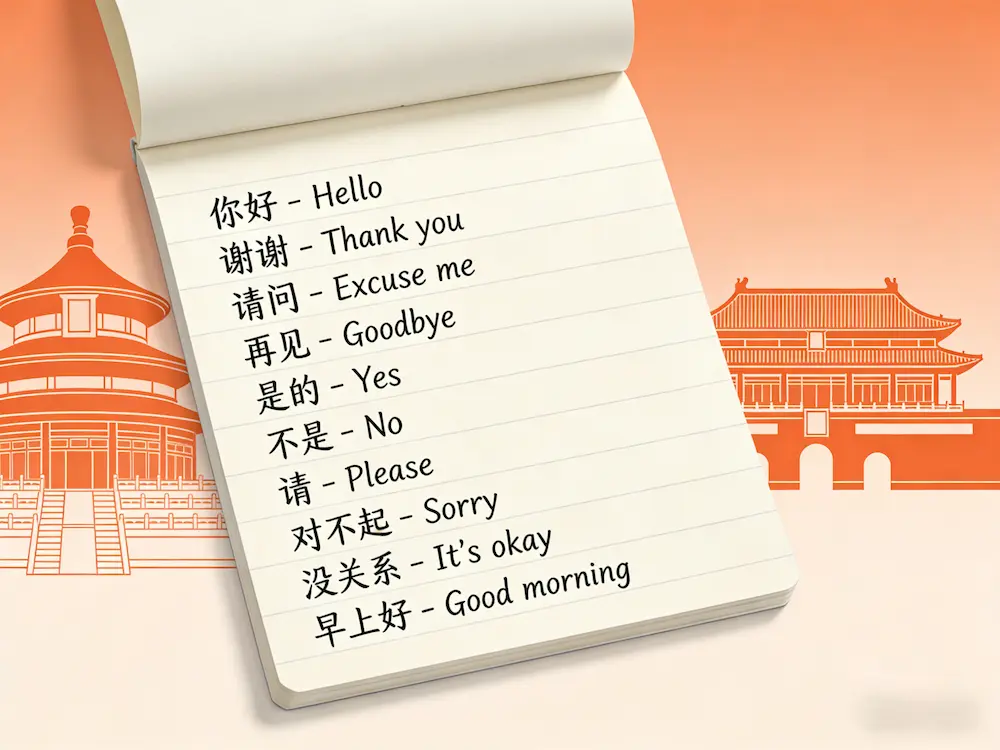
When traveling in Beijing, knowing a few authentic Chinese phrases is the perfect key to unlocking amazing experiences and connecting with locals. When you make the effort to speak their language, you’ll often be rewarded with warmer smiles and more enthusiastic assistance.
Remember, the key is to just go for it. Most Chinese people are incredibly friendly and genuinely appreciate the effort foreigners make to speak their language. Even if your pronunciation isn’t perfect, your attempt itself builds the strongest bridge of communication.
You don’t need to learn a lot; just a few will do.
1. Polite Opening: Excuse me! / Sorry!
Pronunciation: Láojià! / Bù hǎo yìsi!
When to use: When you need someone to move out of the way, get a server’s attention, or make a minor interruption.
Why it works: More natural and polite than a simple “hello,” it’s an ideal way to start a conversation.
2. The universal directions phrase: Qǐngwèn, zhège / dìfang zěnme zǒu?
Pronunciation: Qǐngwèn, zhège / dìfang zěnme zǒu?
When to use: Your lifesaver when lost. Point to a map, address on your phone, or any specific location.
Why it works: Starting with “Qǐngwèn” shows politeness, while “zěnme zǒu” is a natural way to ask for directions.
3. Quickly locating something: Where is…?
Pronunciation: … zài nǎr ne?
When to use: When looking for restrooms, subway stations, exits, or specific shops. (e.g., “Where is the restroom?”)
Why it works: The ending particle “ne” makes the question sound more natural and conversational, less stiff.
4. Ordering with ease: This one / One portion, please.
Pronunciation: Zhège / lái yí fèn, xièxie.
When to use: Ordering at restaurants or street food stalls. Point directly to the dish you want.
Why it works: “Lái yí fèn” is the most common ordering phrase, and ‘fèn’ is a versatile unit word.
5. Directly Asking the Price: Duō shao qián?
Pronunciation: Duōshao qián?
When to use: At markets, small shops, or anytime you need to ask the price or pay.
Why it works: This is the most direct and commonly used way to ask the price—everyone understands it.
6. Attempting to bargain: Can you make it cheaper? / Would a discount be possible?
Pronunciation: Néng piányi diǎn ma? / Piányi diǎn xíng ma?
Usage: When shopping at night markets, souvenir stalls, or other places where bargaining is common.
Why it works: Using the phrasing “…would be possible?” makes the request sound negotiable and more polite.
7. Requesting takeout or packing: Pack it up / Take it away.
Pronunciation: Dǎbāo / Dàizǒu.
When to use: When you can’t finish your meal at a restaurant or want to take food away.
Why it works: “Pack it up” is very authentic and commonly used; “Take it away” is equally clear and straightforward.
8. Using mobile payment: Scan the code (to pay).
Pronunciation: Sǎomǎ (zhīfù).
When to use: At checkout, to indicate your preference for paying via WeChat Pay or Alipay.
Why it works: Mobile payments are ubiquitous in China. Saying “scan the code” is the most efficient way to pay, and staff understand it instantly.
9. Connecting to Wi-Fi: Is there Wi-Fi? What’s the password?
Pronunciation: Yǒu Wi-Fi ma? Mìmǎ shì duōshao?
Use: Asking for wireless network access in cafes, restaurants, or hotels.
Why it works: This natural, direct question helps you connect quickly.
10. Expressing strong admiration: (This is) so…!
Pronunciation: (Zhège) Tài … le!
Usage Scenario: Expressing praise for food, scenery, or anything else. (e.g., “This is so delicious!” Tài hǎochī le! / “This is so beautiful!” Tài piàoliang le!)
Why It Works: A versatile phrase for conveying strong emotion, paired with a sincere expression, it makes the listener genuinely happy.
My Most Effective Communication Tips for Real Life (Proven to Work for 10 Years)
Actually, when it comes to getting by in Beijing, it’s totally fine if you don’t speak much Chinese. The tips I use most often in my daily life are these little tricks that require no speaking and are completely stress-free.
Show the Chinese address on your phone
My go-to move is to pull up the Chinese address or store name on my phone and show it to shop clerks, drivers, or passersby. No words needed—they get it instantly, which is way more efficient than struggling to explain it in English.
Show the map to the taxi driver
When hailing a cab, skip the hassle of describing your location. Just open a map app, show the driver your destination, and they’ll get it right away—seldom a mistake.
Communicate with your finger and simple gestures
When shopping, ordering food, or asking for directions, pointing at what you want + a smile + simple gestures is enough to get your point across. Often, actions speak louder than words.
Take photos of menus, signs, and street signs
If you can’t read something, snap a photo—either use a translation app to recognize the text or show it directly to someone. This is the most reliable and least error-prone method in Beijing.
How to Order Food in Beijing If You Don’t Speak Chinese?
Order by Picture
Nowadays, the vast majority of restaurants in Beijing have menus with pictures. You can simply look at the photos to choose your dishes—it’s simple and intuitive, and you don’t have to say a word.
Point to the Menu
The easiest and most foolproof method: just point to the dish you want to eat. The server will understand immediately—it’s faster than speaking English.
Use a translation app
If you come across dish names, ingredients, or dietary restrictions you don’t understand, simply take a photo with a translation app to translate them and easily avoid anything you can’t eat.
My personal experience (tested at a hutong eatery)
Having lived in Beijing for so many years, I’ve found that the small restaurants in the hutongs are actually the most welcoming.
Many of these small shops don’t have English menus, but as long as you point at the pictures and nod, the owner will understand immediately. Even if you don’t speak a word of Chinese, you can still enjoy a delicious meal.
How to Hail a Taxi / Use Didi When You Don’t Speak Chinese
Didi Chuxing (Didi)
Didi is the most widely used ride-hailing app in China. It works much like Uber, with a simple interface and support for registration using international phone numbers, making it ideal for foreign tourists.
Always Use Chinese Addresses
When hailing a taxi, be sure to provide the address in Chinese—don’t just give the English version.
Most drivers cannot read English, so showing them the Chinese address directly ensures the fastest and most accurate route to your destination.
Have Your Hotel Name (in Chinese) Ready in Advance
Before you leave, save your hotel’s Chinese name and address on your phone.
When you get in the car, simply show it to the driver. You won’t need to speak or communicate, and you’ll be safely taken to your hotel with almost no chance of error.
The Other Person Doesn’t Understand English
The Other Person Doesn’t Understand English
In Beijing, it’s quite common for taxi drivers, small shop owners, and ordinary passersby not to speak English.
Solution: Don’t force yourself to speak English. Instead, use Chinese addresses, pictures, gestures, or translation apps—this is more efficient.
Translation Errors
Machine translation can occasionally be inaccurate, especially with dialects, dish names, and street signs, which may lead to misunderstandings.
Solution: Use photo translation more often and avoid long sentences; if you’re unsure, point to the text and confirm the meaning before proceeding.
No Internet / No Signal
Subways, basements, and remote alleys often have poor or no internet connection, making online translation unusable.
Solution: Download offline translation packages in advance and save screenshots of the Chinese addresses for hotels and attractions; this way, you can use them even without an internet connection.
Final Advice from Someone Who Has Lived in Beijing for Many Years
People in Beijing are actually very warm-hearted and willing to help. Often, all you need to do is ask—even if there’s a language barrier, those around you will do their best to find a way to assist you.
Remember this simple rule: a smile + a little patience = 90% of communication problems solved.
Don’t be afraid of making mistakes, and don’t get nervous. Just relax a bit and be friendly—your trip to Beijing will go much more smoothly.
Important Tips: Make Your Chinese More Effective
Pay Attention to Tones: Chinese is a tonal language, where different tones change word meanings (e.g., “mā” means “mother,” while “mà” means “scold”). Listen and imitate native speakers often.
Use Body Language Wisely: When words fail you, gestures and a genuine smile speak a universal language.
Technology as Your Backup: Pre-install apps like Google Translate, Baidu Translate, or Youdao Translator on your phone. Their real-time conversation translation and photo translation features are your ultimate communication safety net.