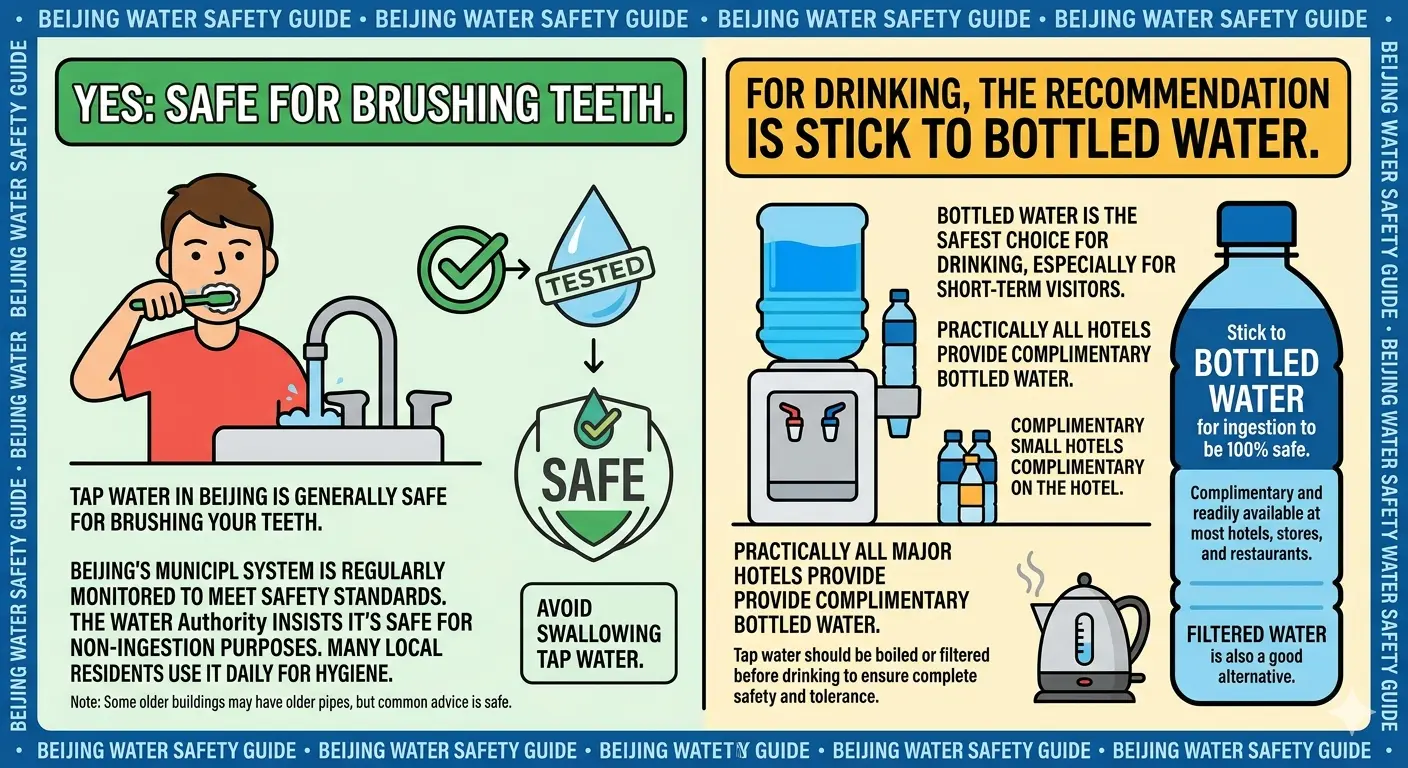
Can You Use Beijing Tap Water to Brush Your Teeth? A Practical Guide for Foreign Visitors (Tested in 2026)
If you’re planning a trip to Beijing or already live here, you’ve probably wondered: “Can I brush my teeth with tap water?” That’s an excellent question. Drawing on my personal experience living in Beijing and the latest official data, I’ll help you get a clear understanding of this issue.
This article covers everything you need to know—from brushing your teeth to drinking the water, from white scale to ice cubes—so you can feel at ease every day in Beijing.
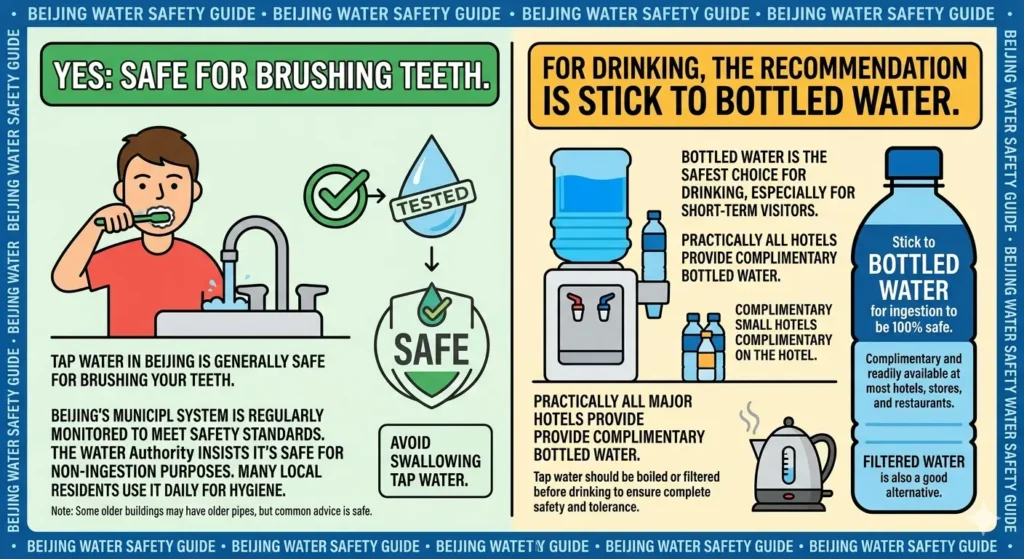
Table of Contents
Quick Summary
| Use | Is it safe? | Recommendation |
| Brushing teeth, rinsing mouth | Completely safe | Use tap water directly; mix with warm water in winter |
| Drinking (raw water) | Not recommended | Must be boiled, or buy bottled water |
| Boiling for drinking | Absolutely safe | Tastes better after boiling |
| Washing face, hands, or taking a shower | No problem | Use as normal |
| Ice at restaurants/street stalls | Use with caution | Chain restaurants are relatively safe; avoid street stalls |
My Personal Experience in Beijing
During my time living in Beijing, I consistently used tap water to brush my teeth, wash my face and hands, and rinse fruits and vegetables, and I never experienced any discomfort as a result. In fact, this is something that both local Beijing residents and long-term foreign residents do every day.
When someone asked online, “Is it harmful to brush your teeth with tap water?”, a dentist from a top-tier hospital in China gave a clear answer: tap water that meets the national “Sanitary Standards for Drinking Water” is perfectly safe to use for brushing teeth.
However, there is one small detail: Beijing’s tap water is very cold in the winter. It is recommended to brush your teeth with warm water, which not only prevents tooth sensitivity but also makes the brushing process more comfortable.
Why Isn’t It Recommended to Drink It Directly?
You might be wondering: If it’s safe to use for brushing your teeth, why can’t you drink it directly?
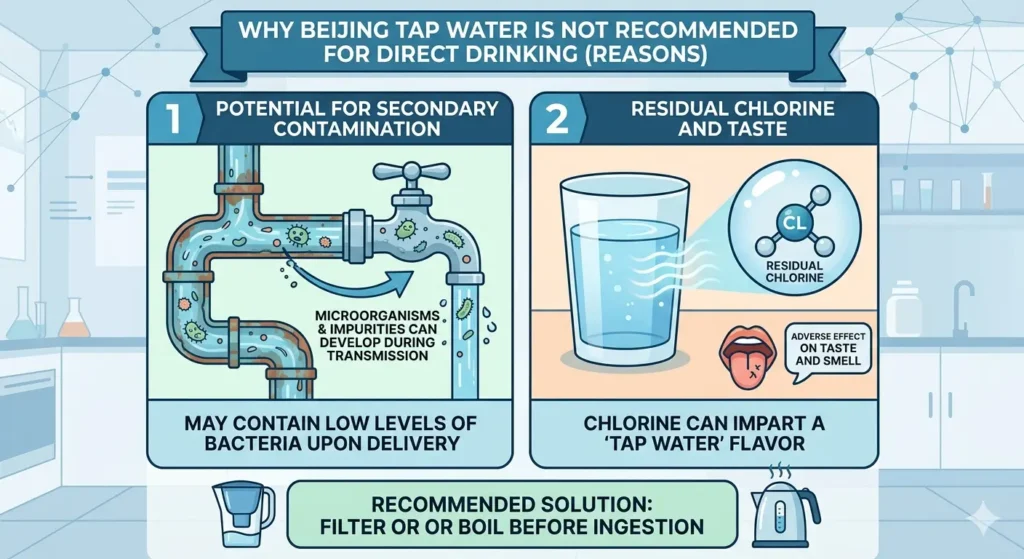
There are two reasons, neither of which is because the water is “toxic,” but rather because of potential risks:
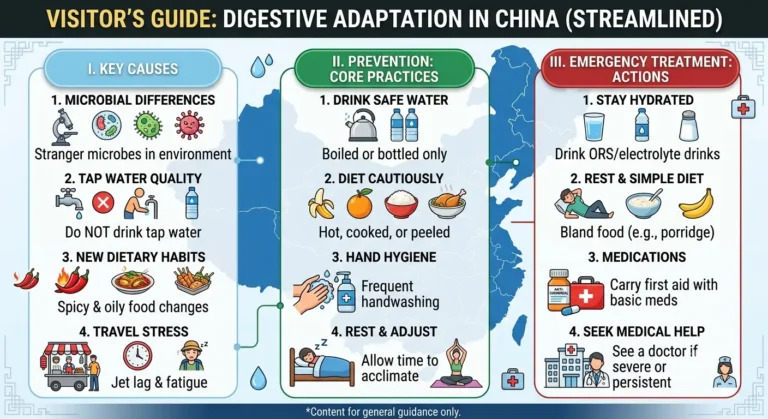
1. The possibility of secondary contamination. Tap water travels through long pipelines from the water treatment plant to your home’s faucet. Old pipes may be corroded or leak, and water tanks on the rooftops of apartment complexes may harbor small amounts of bacteria due to inadequate cleaning.
2. Residual chlorine affects the taste. To ensure tap water isn’t contaminated during distribution, water treatment plants add chlorine (which gives it that bleach-like smell). This dosage is safe for humans (the government has strict limits on residual chlorine levels), but it does make the water taste unpleasant.
To put it another way: it’s like the water in a swimming pool—it’s fine for swimming in or having skin contact with, but you wouldn’t go out of your way to drink it. The logic for tap water is similar—it’s perfectly fine for washing and personal hygiene, but if you want to drink it, it’s still recommended to boil it or buy bottled water.
Boiling not only kills any small amounts of bacteria that may be present but also allows the residual chlorine to evaporate, ensuring both better taste and safety.
How Can You Feel More at Ease?
If you’re still worried, here are some tried-and-true tips that are simple and practical:
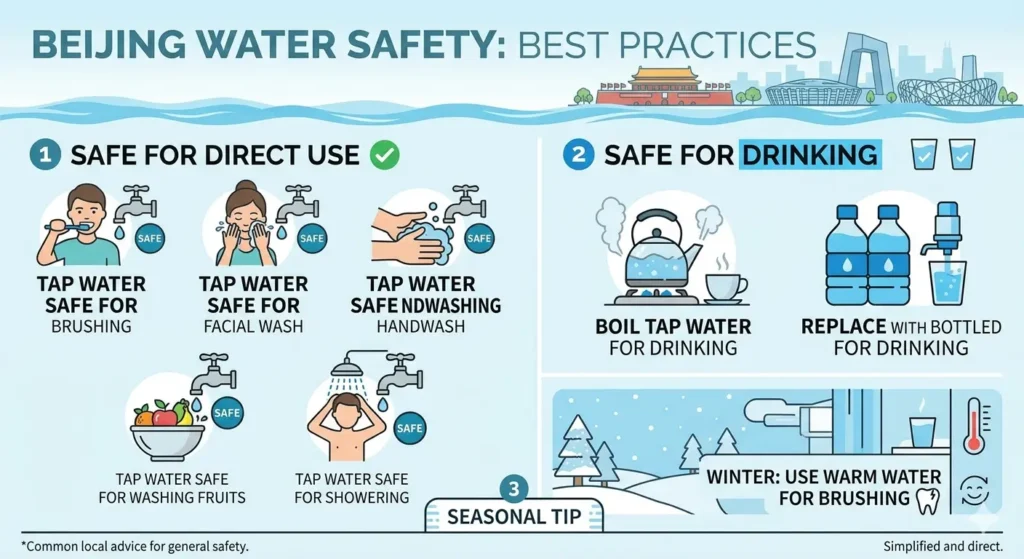
- Use tap water directly: Brushing your teeth, washing your face, washing your hands, washing fruit, and showering—none of these are a problem. Almost all foreigners living in Beijing do this. A foreign resident in Beijing wrote in her blog in 2021 that she still uses tap water to brush her teeth and wash fruits and vegetables, but she doesn’t drink it.
- Boil it before drinking: If your hotel or apartment has a kettle, boiling tap water and letting it cool makes for safe drinking water. Most hotel rooms in Beijing provide a kettle and free bottled water.
- Use bottled water instead: If you’re still concerned, you can use bottled water for brushing and rinsing. Bottled water is available at almost every convenience store and supermarket in Beijing, costing about 2 RMB per bottle—very affordable. Official tourism websites also recommend that visitors use bottled water for brushing and boil tap water before drinking.
- Use warm water in winter: Tap water in Beijing is cold in winter, and brushing your teeth with cold water directly may irritate sensitive teeth. Boil the water to a moderate temperature before use—it will be much more comfortable.
About “White Limescale”—It’s Not Toxic, It’s Hard Water
You may have noticed that after boiling water in Beijing, a white substance forms at the bottom of the kettle. Many people are startled when they see this for the first time: “Is the water dirty?”
Rest assured: this is a normal phenomenon and does not indicate that the water is unsafe.
Beijing’s water is “hard water,” meaning it contains higher levels of calcium and magnesium minerals. When heated, these minerals precipitate out and form limescale. This is the same as the tap water in many parts of Europe (such as London and Paris).
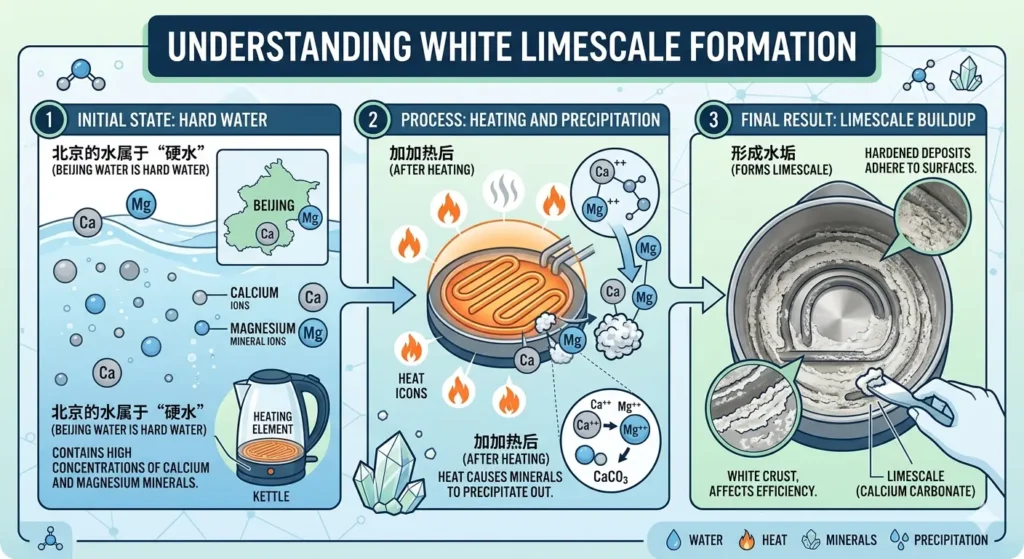
✅ Limescale is harmless; it’s simply mineral deposits and poses no health risks.
Removal method: Soak the kettle in white vinegar or citric acid to dissolve the limescale.
No impact on brushing your teeth: Hard water does not damage your teeth; it simply doesn’t taste as good as soft water.
If you’re particularly sensitive to hard water, you can use bottled water to brush your teeth, but it’s not necessary.
The Truth About Ice Cubes
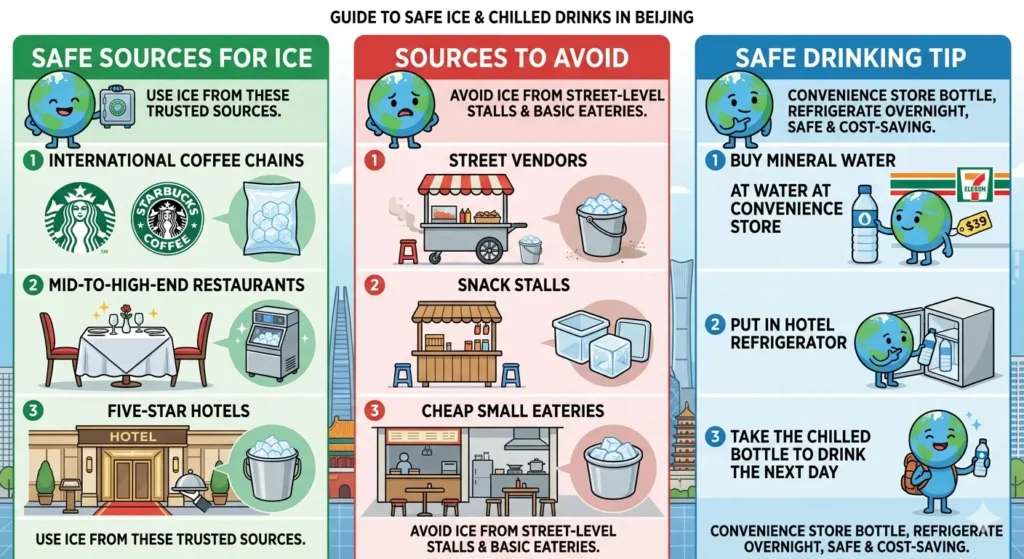
This is a pitfall that many foreign tourists tend to overlook. Not all ice cubes in Beijing are safe; it all comes down to the water source.
✅ Relatively Safe Ice Cubes (Safe to Consume)
International coffee chains: Starbucks, Costa, Luckin Coffee—these typically use filtered water to make ice
Mid-to-high-end restaurants: Restaurants with a per-person price of 150 yuan or more, most of which are equipped with water purification and ice-making systems
Five-star hotels: Ice machines are regularly disinfected, ensuring water quality
⚠ Ice to Avoid
Street stalls and snack shops: The source of the ice is unknown; it may be frozen directly from tap water, and the ice trays are rarely cleaned
Budget restaurants: If in doubt, ask for “no ice” when ordering a drink
Tip: If you love drinking iced water, buy a bottle of mineral water at a convenience store, chill it in the hotel fridge, and take it with you the next day. It’s safe and saves money.
How to Choose Bottled Water? 2 Yuan vs. 10 Yuan—Is There a Big Difference?
You can easily find bottled water at any convenience store (7-Eleven, Lawson, FamilyMart, or Bingfeng) or supermarket in Beijing, with prices ranging from 1 yuan to over 10 yuan. Most locals opt for standard brands priced around 2 yuan, which are already quite reliable.
| Type | Representative Brands | Price | Features |
| Purified Water | Yibao/Wahaha | 1.5–2.5 yuan | All minerals removed; smoothest taste |
| Mineral Water | Nongfu Spring/Baishui Mountain | 2–5 yuan | Contains natural minerals; sourced from specific springs |
| Mineral-Enriched Water | Master Kong | 1–2 yuan | Purified water with added minerals |
| Imported/Premium Water | Evian/San Pellegrino | 10–20 yuan | Imported brands: great taste, but not essential |
Recommendation: For daily consumption, choose Nongfu Spring or Yibao—they cost around 2 yuan and are clean and refreshing. Bring a bottle with you when exploring hutongs or tourist attractions; they’re widely available at convenience stores.
Beijing’s water quality is actually quite good—you can check the official reports
Although it’s not recommended to drink tap water directly, Beijing’s tap water quality is backed by official data and is much better than many tourists imagine. According to the “Sanitary Standards for Drinking Water” (GB 5749-2022)—a national standard updated in 2022—the number of testing parameters has increased from 106 to 102, reaching internationally advanced levels.
Beijing has 19 water treatment plants across the city. Every day, the water leaving the plants is tested for 43 routine parameters, and a comprehensive test covering all 97 parameters is conducted every six months. In the third quarter of 2025, the water quality compliance rate for water leaving these 19 plants was 100%.
After leaving the water treatment plants, tap water undergoes sampling and testing at 141 urban end-point monitoring stations across the city (including the end points of water pipes in your hotel or residential community).
In other words, every step of the process—from the source to your home’s faucet—is under constant monitoring. National standards are largely aligned with mainstream international drinking water standards, so you can rest assured.
If you wish to view the officially released water quality reports yourself, you can visit the official website of the Beijing Municipal Bureau of Ecology and Environment (sthjj.beijing.gov.cn), where detailed water quality monitoring data is published quarterly.
Choose the Best Approach Based on Your Accommodation Type
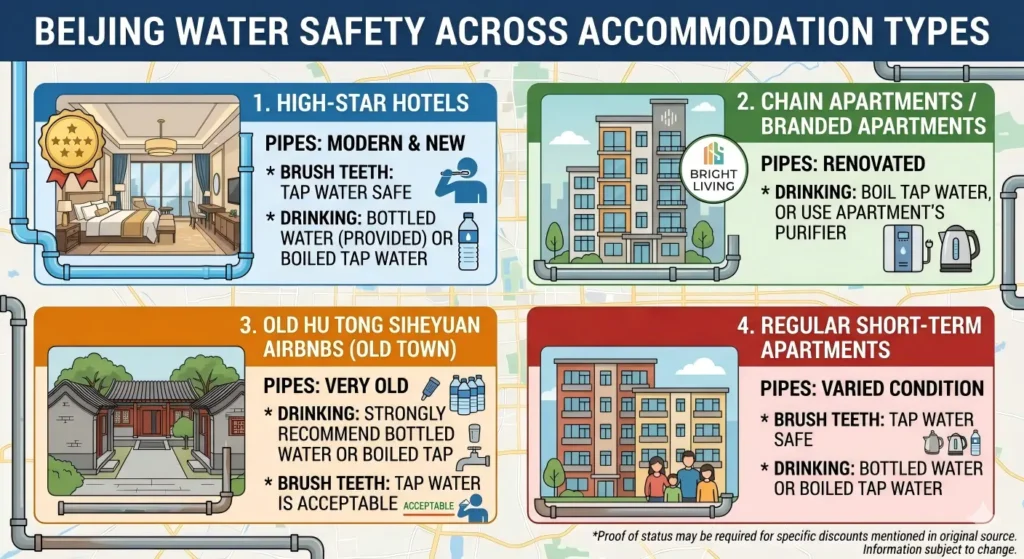
Plumbing systems vary in age depending on the type of accommodation, so we recommend adjusting your approach accordingly:
| Accommodation Type | Recommendations |
| High-end hotels | Many hotel rooms have secondary filtration systems or provide complimentary bottled water. You can safely use tap water to brush your teeth and drink either the bottled water provided by the hotel or boiled tap water. |
| Chain apartments/branded apartments | The plumbing is generally newer, and the tap water quality is good. We recommend boiling the water before drinking or using the water purifier provided by the apartment. |
| Old Town Hutong Guesthouses | Pipes in old hutongs may be older; we strongly recommend boiling the water before drinking or purchasing bottled water. It is safe to use tap water for brushing your teeth. |
| Standard Short-Term Rental Apartments | If you are unsure about the condition of the pipes, take the conservative approach: use tap water for brushing your teeth, and drink bottled water or boiled tap water. |
Myth Buster
Some outrageous rumors are circulating online about Beijing’s tap water, so let me set the record straight:
❌ “Brushing your teeth with tap water causes hair loss.”
This is a widely circulated joke. While water hardness can indeed make your hair feel dry and brittle after washing, this has nothing to do with brushing your teeth. The main causes of hair loss are genetics, stress, and hormones—not water.
❌ “Beijing’s water exceeds heavy metal limits.”
According to official test reports, the levels of heavy metals (lead, cadmium, mercury, etc.) in Beijing’s tap water are well below national standards. Limescale isn’t caused by heavy metals—it’s calcium and magnesium.
❌ “Boiling only kills bacteria; it doesn’t remove heavy metals.”
Boiling does not remove heavy metals. However, the issue is that the heavy metal levels in Beijing’s tap water are already within safe limits and do not need to be removed. The primary purpose of boiling is to kill any potential microorganisms (from secondary contamination in pipes) and to improve the taste.
✅ “Is bottled water definitely safer than tap water?”
Not necessarily. Bottled water also carries risks of contamination during production, transportation, and storage. Legitimate bottled water is safe, but there’s no need to mythologize it. Boiled tap water is just as safe, and it’s also eco-friendly and cost-effective.
FAQ
Summary: One chart covers all scenarios
| Situation | Tap Water | Bottled Water | Boiled Tap Water |
| Brushing Teeth | ✅Use as is | Not necessary | Can be mixed with warm water |
| Drinking | ❌Not recommended | ✅Most convenient | ✅Safe and economical |
| Cooking Rice/Instant Noodles | ✅No problem | A luxury | ✅Same as above |
| Washing Fruit | ✅Wash as usual | Wasteful | Not necessary |
| Making Ice | Not recommended | ✅Recommended | After cooling |
Finally, I’d like to say: Living in Beijing, brushing your teeth with tap water is something hundreds of thousands of expats around the world do every day. It’s safe, convenient, and comes with no psychological burden. I hope this article saves you the time spent worrying and helps you enjoy life in Beijing more easily.
If you have any other small questions about life in Beijing, feel free to leave a comment below, and I’ll continue to answer them based on my personal experience.
This article is based on my personal experience during my time in Beijing, the Beijing Municipal Bureau of Ecology and Environment’s 2025 quarterly water quality report, and recommendations from dentists at top-tier domestic hospitals. Prices and brand information in this article are subject to actual conditions in 2025–2026.