7 Major Challenges | Common Problems Faced by Foreign Tourists in Beijing and How to Deal with Them
In many overseas travel communities, travelers planning a visit to Beijing often share concerns about practical challenges they may face upon arrival. Having lived and worked in Beijing for over a decade, I’ve compiled this guide on Common Challenges Faced by Foreign Tourists in Beijing and How to Overcome Them, based on the travel difficulties most frequently discussed by international visitors.
This article describes situations that tourists frequently encounter, but this does not mean every traveler to China will face them; as domestic travel service regulations are constantly updated, please refer to the latest official information when planning your trip.
This article does not aim to sensationalize difficulties; rather, it breaks down each type of practical challenge, explains the scenarios in which they occur, and offers feasible solutions and alternative approaches to help make your trip to China less daunting.
Table of Contents
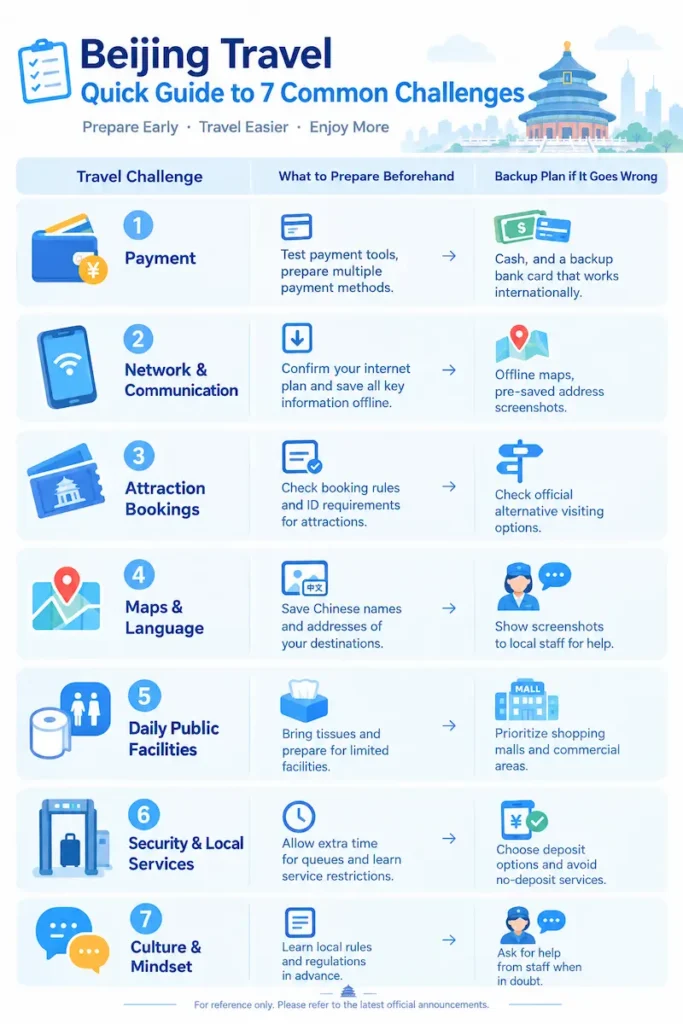
Quick Reference Chart: Overview of Travel Challenges (Feel free to take a screenshot and save it)
| Travel Challenge | Pre-trip Preparations | Alternative Solutions in Case of Problems |
| Payment | Test payment tools and have a variety of payment methods ready | Cash and a spare bank card in good working order |
| Internet & Communication | Confirm your internet plan and save all key information offline. | Offline maps; save screenshots of address verification in advance |
| Attraction Reservations | Review attraction reservation policies and ID requirements | Check official alternative visit options |
| Maps and Language | Save screenshots of the destination’s Chinese name and address | Show screenshots to on-site staff for assistance |
| Daily Public Facilities | Bring your own tissues; assess the condition of public facilities in advance | Prioritize public facilities in commercial districts and shopping malls |
| Security Checks and Local Services | Allow extra time for lines; understand usage restrictions for certain services | Choose deposit-based options; opt out of deposit-free benefits |
| Culture and Psychological Well-being | Familiarize yourself with local customs and norms in advance | Seek assistance from staff if you have questions |
Note: This table is for reference only; please refer to the latest official announcements from domestic authorities for all rules.
1. Payments: Common Challenges When Using Payment Methods in China
Many international visitors encounter difficulties when making payments: while they are accustomed to paying by credit card or cash, some merchants primarily recommend mobile payment via QR code scanning.
⚠Fact: It is not the case that cash or foreign credit cards cannot be used at all locations in China; there may be isolated instances where small shops have malfunctioning foreign card terminals and only support mobile QR code payments, but these are localized situations, not a widespread phenomenon.
Common Real-World Challenges
1. Some convenience stores, small street shops, and taxis may prioritize QR code payments.
2. Verification codes sent to overseas cell phone numbers may be delayed or not received at all.
3. The process of uploading a passport and undergoing facial recognition verification is cumbersome and may raise privacy concerns.
4. Even if an international credit card is successfully linked, payments may still fail in certain transaction scenarios.
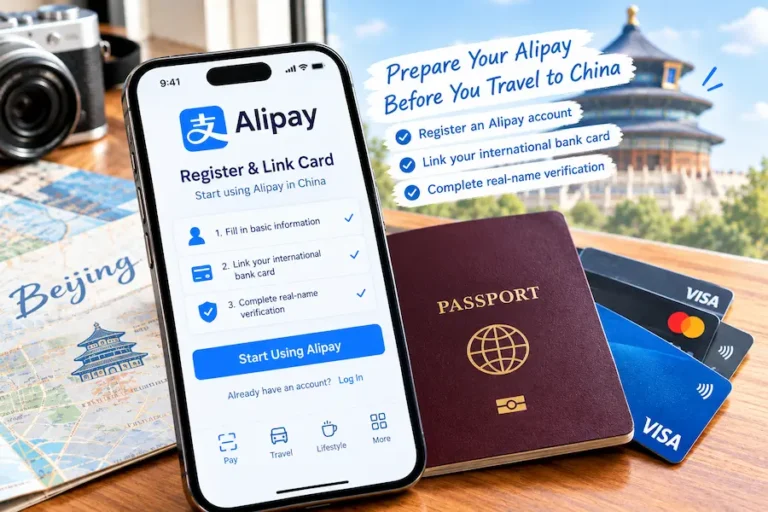
2026 Status Update: Alipay and WeChat Pay continue to optimize the user experience for international travelers, allowing users to link international cards such as Visa, Mastercard, and JCB, and supporting automatic currency conversion and settlement. However, a successful card link does not guarantee that transactions will be completed successfully in all scenarios; there is still a risk of transaction errors. TourCard-related services have limited coverage; verify before your trip whether the platform still offers this feature, and do not assume that everyone can use it.
✅ Practical Preparation Tips
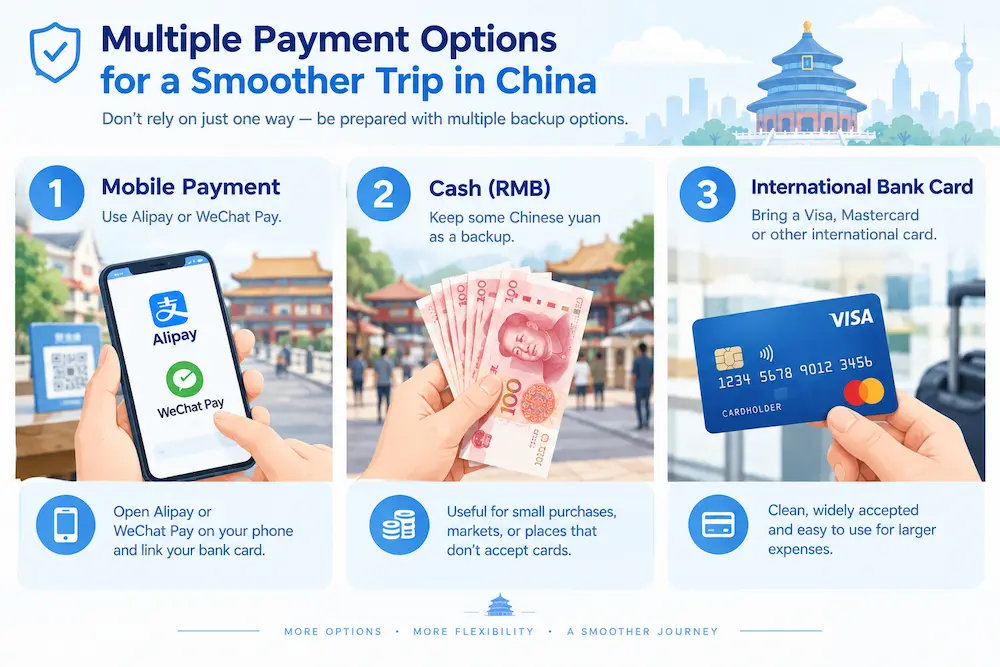
- Download Alipay and WeChat Pay before departure. Follow the platform instructions to verify your identity using your passport and link an international bank card; if possible, make a small test transaction.
- Carry 200–300 RMB in cash with you as a backup in case of system failures.
- Have a backup international bank card on hand in case your primary card becomes invalid.
Check out the [Complete Guide to Using Alipay for Foreigners (Step-by-Step Instructions, Troubleshooting)]
2. Internet and Cell Phone Connectivity: Prevent Your Cell Phone from Becoming a Weak Link on Your Trip
The key goal isn’t to worry about which overseas apps might or might not work, but to ensure three things:
①You can stay in touch with the outside world;
②You can access important booking information;
③You have offline backup materials on hand in case of internet outages.
Common Issues You May Encounter
- Popular international navigation, email, and social media apps may be restricted when accessed via standard public networks in China.
- eSIM international roaming plans allow access to overseas services, but typically do not provide a local mainland China phone number.
- Without a local phone number, you may encounter difficulties registering for certain mini-programs or using shared devices, as well as receiving verification codes.
✅ Practical Preparation Tips
1. Local SIM Card Option: Upon arrival at Beijing Capital International Airport or Beijing Daxing International Airport, you can purchase short-term SIM cards designed for international visitors. These provide a domestic phone number, addressing both the need to receive verification codes and access local internet.
2. eSIM Roaming as a Backup: You may keep this option, but be aware that the lack of a domestic phone number will limit your use of certain local services.
3. Familiarize yourself with GO BEIJING, the official service platform for inbound tourists. The platform supports multiple languages and can serve as a backup resource for your trip.
Note: The use of internet tools must comply with China’s relevant internet regulations.
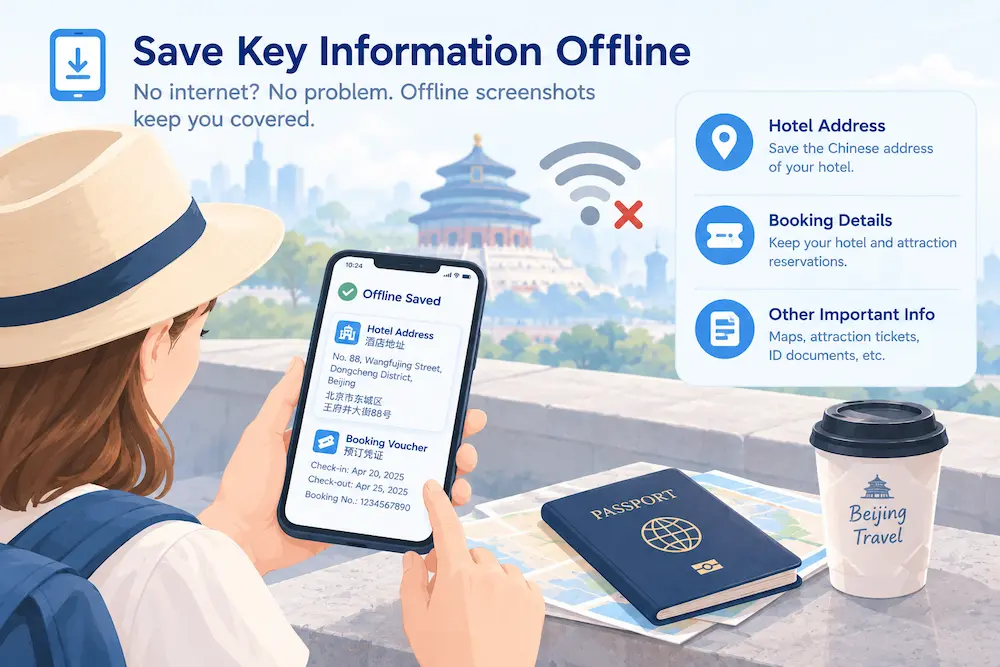
Important Step: Take screenshots of all hotel addresses, booking confirmations, and attraction addresses, and save them offline to prevent losing this information entirely in the event of an internet outage.
🛒 Click here to book your China eSIM Data Plan on KKday
Check out the [Guide to Internet Access and Essential Apps in China]
3. Attraction Reservations: You Can No Longer Just “Drop Everything and Go” to Visit Attractions
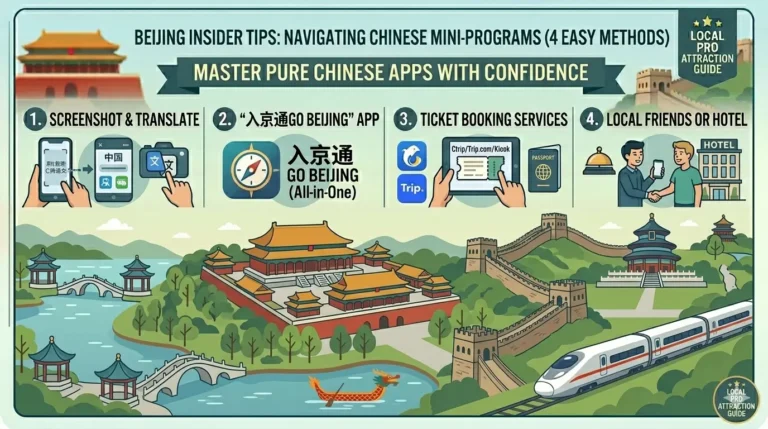
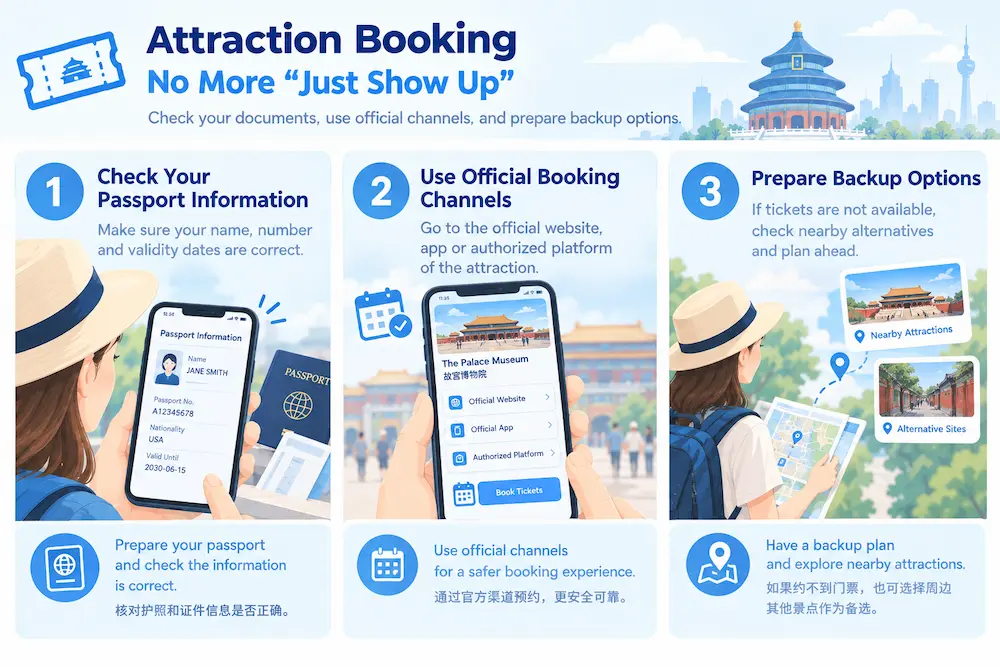
Many popular domestic attractions have implemented a real-name reservation system, and rules vary significantly from one attraction to another: some allow foreign visitors to purchase tickets through their English-language websites, while others only provide access via Chinese-language mini-programs; a few attractions still offer on-site ticket purchases, and not all attractions require you to secure tickets days in advance.
Real-World Challenges
- At top attractions like the Forbidden City, tickets are extremely limited during peak season, so advance planning is essential.
- The Chinese-language mini-program interface presents a high barrier to entry for international visitors who are not familiar with Chinese.
- Reservations require passport information; entering an incorrect passport number will result in immediate denial of entry.
✅Practical Preparation Tips
1. Confirm your destination in advance: Check whether reservations are required, the booking channels available, and whether there are dedicated entrances for international visitors. For example, the Forbidden City offers an English-language ticketing channel for international tourists.
2. When making a reservation, ensure your passport information matches your physical document exactly, and save a screenshot of your booking confirmation.
3. Plan alternative itineraries; if you cannot secure tickets, consider visiting similar nearby attractions instead.
4. If you encounter significant difficulties, you may book through an official third-party platform, but be sure to verify the service provider’s credentials.
See [Complete Guide to Booking Beijing’s Top Attractions (Channels, ID Requirements, Workarounds)]
4. Map Navigation and Language Communication: Challenges with Navigation and Location Tracking, and Language Understanding
The GCJ-02 Geographical Encryption System can interfere with location tracking in overseas map services; the extent of this interference varies depending on the device and scenario, and severe misalignment does not occur during every navigation session.
Real-World Challenges
1. Overseas mapping apps may experience location inaccuracies when used for navigation within China, which can negatively impact the walking navigation experience.
2. Amap and Baidu Maps provide detailed information, but their full English-language support is limited; searching for English place names often yields no results.
3. You may encounter language barriers when ordering food, asking for directions, or communicating with drivers.
✅ Practical Preparation Tips
1. Navigation: Prioritize using Apple Maps (powered by AutoNavi data with an English interface) or Maps.me offline maps.
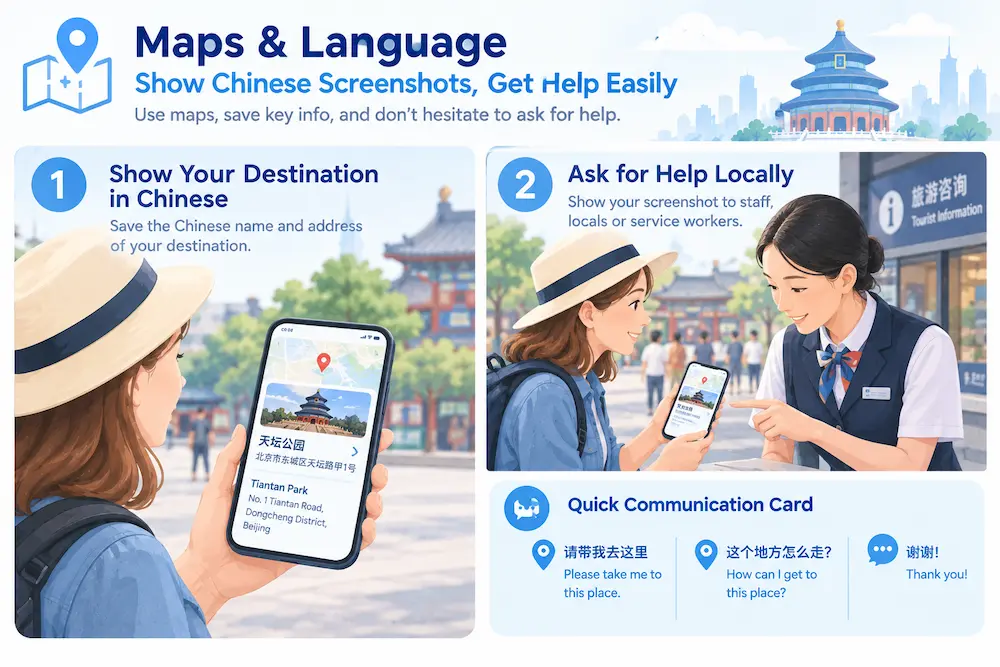
2. Top Priority: Take screenshots of the Chinese names and addresses for all your destinations. When hailing a taxi or asking for directions, show the screenshots directly—don’t rely solely on verbal descriptions or English place names.
3. Translation Apps: Download offline translation packages in advance to prepare for poor network conditions.
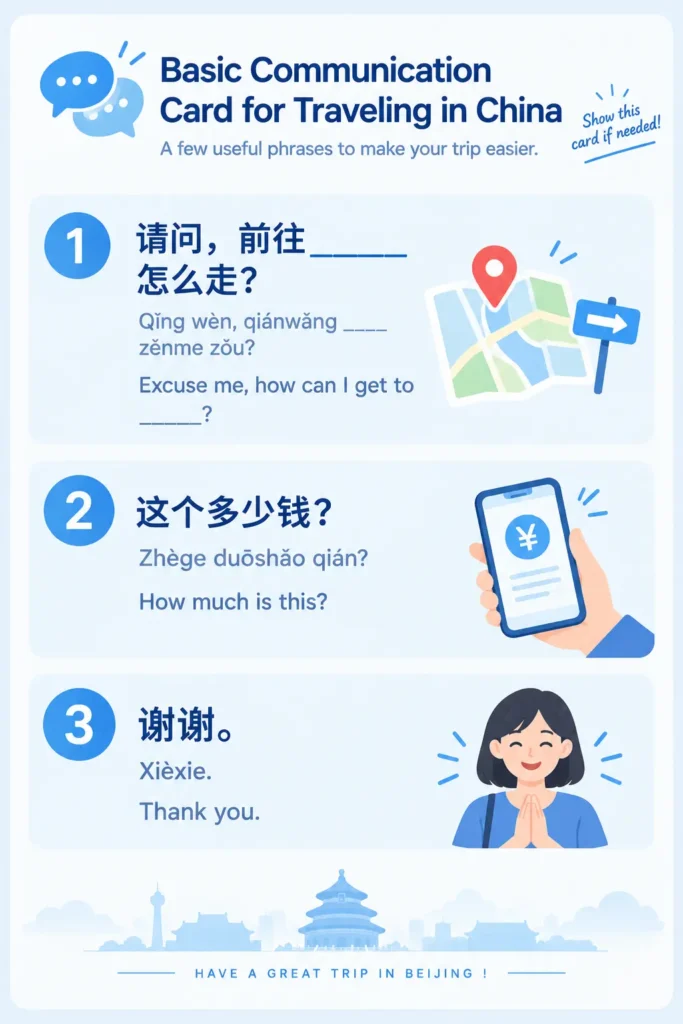
Simple Communication Cards (Save as screenshots)
- (You can take a screenshot to show locals)
- Excuse me, how do I get to ____?
- How much is this?
- Thank you.
Check out the [Language and Navigation Survival Guide]
5. Everyday Amenities, Security Checks, and Local Service Barriers
5‑1 Everyday Public Amenities: Restrooms, Personal Supplies
- A high proportion of public restrooms in China feature squat toilets, while upscale shopping malls and locations like Starbucks tend to have more sit-down toilets.
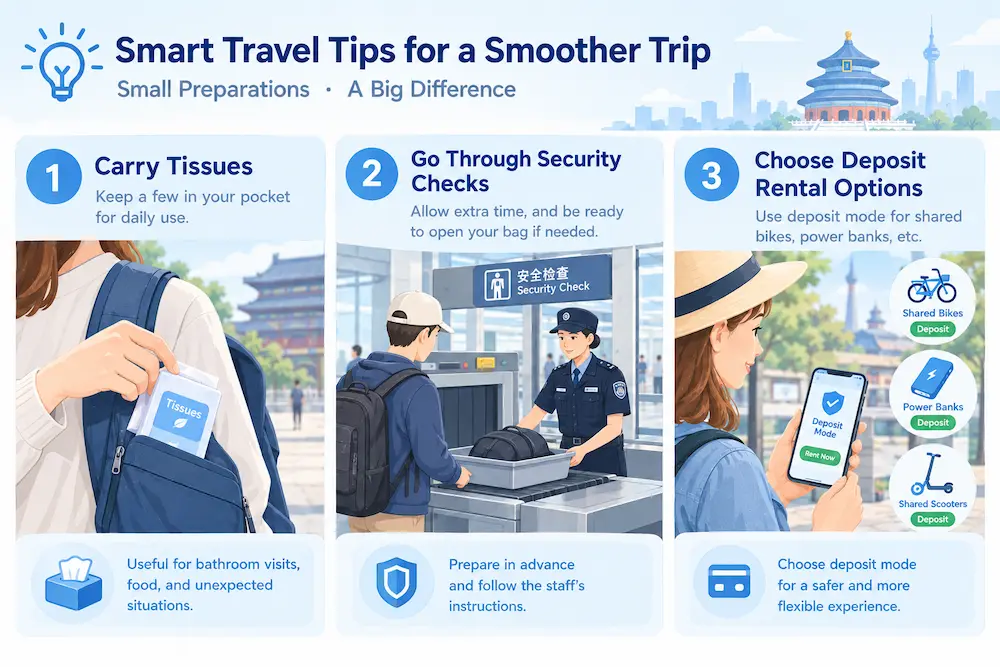
- Many public restrooms do not provide toilet paper; it is recommended to carry your own tissues or wet wipes.
- Restrooms in popular tourist attractions are generally well-maintained; conditions at long-distance bus stations and in older neighborhoods vary widely.
5‑2 Security Checks, Verification, and Deposit-Free Sharing Services
Baggage security checks are required when entering subways, train stations, museums, and some commercial districts. These are general management requirements for all visitors and are not specifically targeted at foreign tourists.
Some shared power banks and deposit-free check-in services rely on the domestic credit score system; international tourists are not eligible for deposit-free benefits.
✅Practical Preparation Tips
1. Always carry tissues with you when traveling.
2. When traveling by train, allow plenty of time for security screening and boarding. Be flexible based on passenger volume; avoid setting a fixed time.
3. For shared services, choose the option to pay a deposit directly; the deposit will be refunded via the original payment method upon return.
6. Psychological Perceptions, Safety, and Cultural Awareness
Traveling to a foreign country can evoke a variety of subjective feelings, and individual experiences may vary among travelers.
Situations You May Encounter
1. Surveillance cameras are densely deployed in public areas of cities; venues such as subways and museums may require ID verification. Some international visitors may feel psychologically uncomfortable with this.
Objective Explanation: This is a standard public safety measure common in cities across the country; simply follow the instructions of on-site staff.
2. Some tourists may worry about being treated unfriendly due to their nationality.
Based on extensive travel records from international visitors: The vast majority of ordinary citizens remain neutral, though individual attitudes may vary; in public settings, try to avoid sensitive topics—a recommendation consistent with general advice for traveling to other countries around the world.
✅Practical Preparation Tips
- Keep your passport and other important documents secure, and follow on-site regulations.
- If you have questions or encounter difficulties, seek assistance from on-site staff first.
7. Even with these inconveniences, why is Beijing still worth visiting?
It’s true that some of Beijing’s travel customs and the way digital services work differ from those in popular destinations like Tokyo, Seoul, and Bangkok, so you’ll need to do more research before you go.
However, Beijing boasts thousands of years of urban history: you can climb the Great Wall, explore ancient imperial architecture, and wander through the old Beijing hutongs; the domestic high-speed rail network is extensive, the city’s overall public safety is good, and it’s relatively safe to be out on the streets late at night.
During your trip, you’ll also encounter many heartwarming moments of human connection that transcend language barriers.
If you plan and take steps to avoid potential risks, you’ll be able to enjoy a truly rich and multifaceted urban travel experience.
This article summarizes concerns frequently discussed by international travelers; it does not mean that every visitor will personally encounter all of the above challenges. Having multiple backup plans in place can significantly reduce the likelihood of unexpected issues during your trip.
FAQ
After reading this article, jump to our in-depth guides
- Complete Guide to Using Alipay for Foreigners
- Guide to Internet Access and Essential Apps in China
- Complete Guide to Booking Tickets for Beijing’s Top Attractions
- Survival Guide to Language and Navigation
Author’s Note: This article is based on discussions within overseas travel communities and the author’s years of on-the-ground research. Service policies are subject to change; please refer to the latest official announcements from Chinese authorities for all travel-related matters.