
How Foreigners Can Use WeChat Pay in China (A Practical Guide for 2026)
If you’re planning a trip to China, you’ve probably heard of WeChat Pay—but can foreigners actually use it?
Having lived in Beijing for over a decade, I can tell you with certainty: yes, you can—but the experience isn’t as seamless as you might expect.
In this guide, I’ll walk you through exactly how foreigners can use WeChat Pay in China, which methods actually work, and the common issues you’ll need to prepare for in advance.
Can Foreigners Use WeChat Pay?
Yes—foreigners can use WeChat Pay in China simply by linking an international credit card, such as Visa or Mastercard.
However, compared to Alipay, WeChat Pay has stricter usage rules, and payment failures are common if the account setup process isn’t completed properly.
You don’t need to link a Chinese bank card; WeChat Pay officially supports linking and using foreign bank cards as well.
Why is WeChat Pay so important in China?
China has long since entered a highly cashless society, with mobile payments accounting for over 90% of transactions. Thanks to its extremely high local penetration rate, WeChat Pay has become the preferred payment method for many small businesses.
Many street-side shops and mom-and-pop stores only accept WeChat Pay. Without it, you may encounter payment difficulties in these types of shopping scenarios.
WeChat Pay vs. Alipay (Key Comparison, Must-Read)
This is a crucial reference for foreigners choosing a payment method in China, as the two differ significantly in user experience and compatibility:
| Comparison Criteria | WeChat Pay | Alipay |
| Ease of Use | ❌Difficult to use, strict rules | ✅Better suited for foreign tourists, user-friendly |
| Payment Success Rate | ❌Unstable, prone to being blocked by risk controls | ✅More stable, with a high payment success rate |
| Support for Small Merchants | ✅Extremely high support; the top choice for small shops | ⚠Average; some small shops do not accept foreign cards |
In practice, WeChat Pay has stricter account status reviews, and payment failures are more common. As summarized on overseas social media platforms, “Alipay is generally more suitable for tourists visiting China.”
WeChat Pay Registration and Card Linking Steps (Simplified Version)
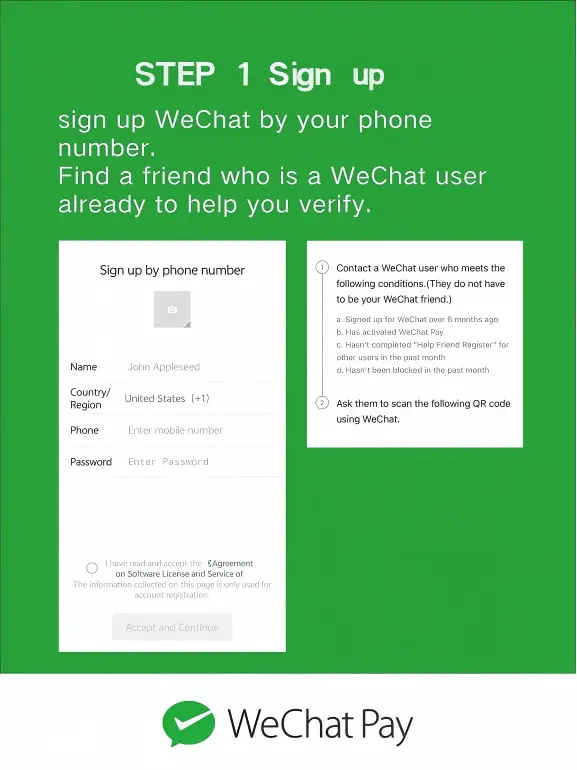
Step 1: Register a WeChat Account–You Need a Chinese Guarantor
If you register a WeChat account with an overseas phone number, you’ll hit your first unique hurdle: you need an eligible WeChat user to help you complete the verification. That person is your “guarantor”.
Your guarantor must meet four criteria:
1. Have had a WeChat account for more than 6 months.
2. Have activated WeChat Pay.
3. Have not assisted anyone else with verification in the past month.
4. Have a normal account status with no restricted functions.
Step 2: Complete Real-Name Authentication–Bind Your Identity with Your Passport
Once your account is registered, you can proceed with real-name authentication—the most crucial step to using WeChat Pay. The operation path is: Me > Services > Wallet > Identity Information (or Real-Name Authentication).
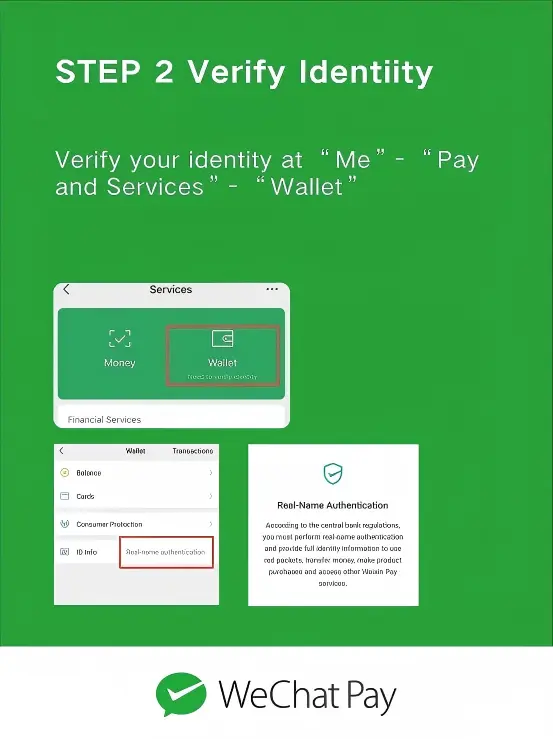
Here, you need to select your document type. The system supports six types of documents, including passports, the Mainland Travel Permit for Hong Kong and Macao Residents, the Mainland Travel Permit for Taiwan Residents, and the Foreign Permanent Resident Identity Card.
After selection, take a photo of the information page of your passport as prompted, then complete the facial recognition verification. A reminder: in accordance with regulations from the People’s Bank of China, core payment functions such as sending red envelopes, transferring money, and shopping are unavailable without completing real-name authentication. This reflects a fundamental principle of China’s financial regulation: real identity is more important than user convenience.
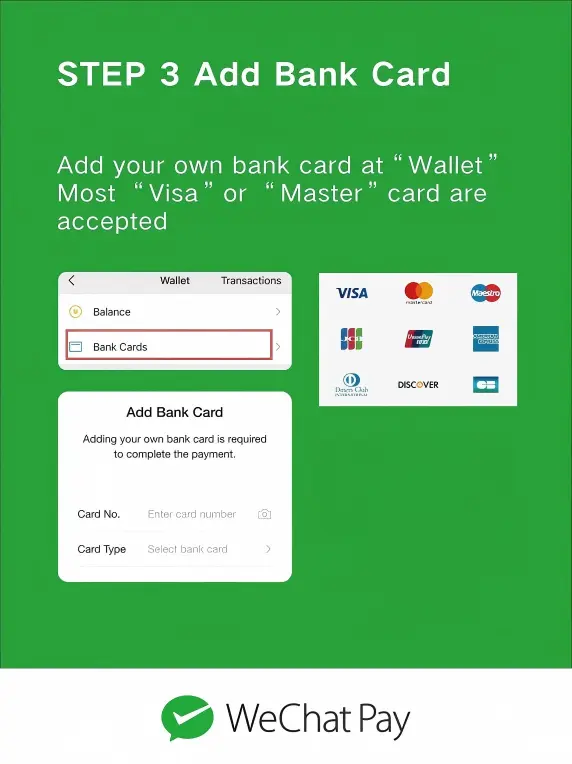
Step 3: Bind a Bank Card–International Credit Cards Are Accepted Too
After successful authentication, you can bind a bank card. The path is: Wallet > Bank Cards, then tap Add a Bank Card.
- Good news: WeChat Pay now supports binding major international bank cards, such as Visa, Mastercard, JCB, and Discover. The system will automatically identify your issuing bank after you enter your card number.
- A key point: you are binding an overseas bank card, not a card issued by a domestic Chinese bank. The entire process takes about one to two minutes, and your bank may send an SMS verification code to confirm the transaction.
Step 4: How to Make Payments?–Two Methods for All Your Spending Needs
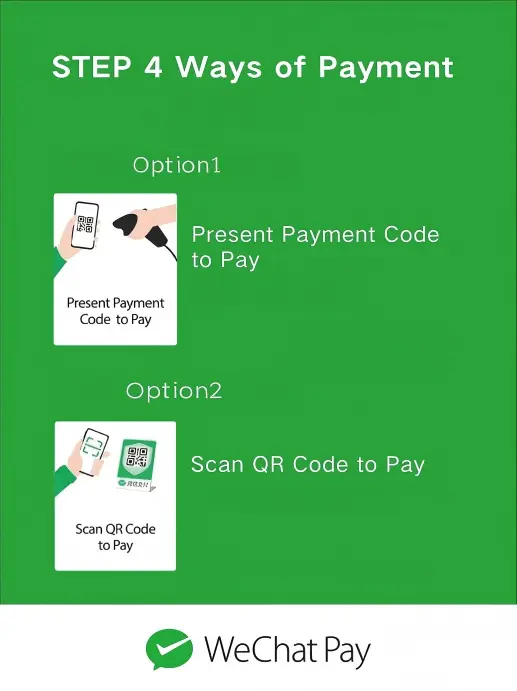
Once the payment function is activated, you’ll use two core payment methods for all your transactions:
1. Show your payment code (merchant scans you): At supermarkets, restaurants, convenience stores, and other such places, after the cashier totals your bill, open Receive & Pay on WeChat and let the cashier scan the QR code displayed on your phone.
2. Scan the merchant’s QR code (you scan the merchant): At small street shops, farmers’ markets, vending machines, and other locations, open Scan QR Code on WeChat, point it at the merchant’s QR code sign, then enter the payment amount and your password to complete the transaction.
These two methods cover almost all payment scenarios you’ll encounter in China.
WeChat Pay FAQs (Top Priority)
This is where foreigners using WeChat Pay most commonly run into issues. Understanding these in advance is key to avoiding pitfalls, and it is the core value of this guide:
1. Frequent Payment Failures
This is the most common issue, with two main causes: first, WeChat’s risk control system reviews and blocks transactions involving foreign cards; second, the issuing bank restricts online transactions abroad. Both situations will directly result in payment failure.
2. Some Small Merchants Do Not Support Foreign Cards
WeChat Pay is the mainstream choice for small merchants, but many street vendors and individual merchants have not enabled the function to accept payments from foreign bank cards in their WeChat payment accounts. Scanning the QR code will result in a payment failure.
3. Unable to Transfer Funds or Send Red Packets
Foreign users who link WeChat Pay with international cards face functional restrictions; core features such as transferring funds to friends and sending red packets are unavailable. This is a mandatory requirement under financial regulations.
4. Large-Amount Payments Are Highly Likely to Be Declined
As reflected in real feedback from overseas users: “Large-amount payments are more likely to be declined.”Whether it’s the risk control system or the issuing bank, scrutiny of large-amount transactions involving international cards is exceptionally strict, making it virtually impossible to complete such payments.
Ideal Use Cases for WeChat Pay
Despite numerous limitations, WeChat Pay is far more suitable than Alipay in certain scenarios. Its core use cases include:
- Small restaurants and home-style eateries;
- Street food stalls, farmers’markets, and fruit stands;
- Local neighborhood service shops (such as convenience stores and barbershops).
These small local businesses almost exclusively support or prefer WeChat Pay, which is the primary reason why travelers to China must be prepared to use it.
My Real-Life Experience Using WeChat Pay in Beijing for Ten Years
Having lived in Beijing for over a decade, I’ve witnessed the widespread adoption of mobile payments and gained extensive experience using them:
Small local businesses on every street and alleyway generally accept only WeChat Pay—this is its irreplaceable advantage.
However, in terms of overall user experience, I use Alipay more often because it’s more stable and payment failures are extremely rare.
The safest approach is to have both payment methods ready and switch between them flexibly depending on the situation.
My Final Recommendation
Sign up for both WeChat Pay and Alipay, using Alipay as your primary payment method and WeChat Pay as a backup.
Alipay’s stability and suitability for foreign tourists will meet the vast majority of your payment needs, helping you avoid the awkwardness of failed transactions; meanwhile, WeChat Pay compensates for Alipay’s limitations with local small businesses, ensuring smooth payments across all types of scenarios.
Key Reminders for Foreigners Using WeChat Pay
- Fee Rules: Transactions of 200 RMB or less are fee-free; a 3% fee applies to amounts exceeding 200 RMB. If a refund occurs, the fee will be refunded proportionally.
- Payment Limits: Accounts linked to overseas cards have clear limits: typically a maximum of 6,000 RMB per transaction, 50,000 RMB per month, and 60,000 RMB per year. These limits are sufficient for short-term use by tourists.
- Exchange Rate Settlement: WeChat Pay does not charge currency conversion fees. Payments are settled based on the real-time exchange rate provided by your credit card network (e.g., Visa) and issuing bank; exchange rates may vary slightly between banks.
- Functional Limitations: In addition to being unable to transfer funds or send red envelopes, accounts linked to foreign cards cannot purchase financial products within WeChat and are limited to offline payments.
Why isn’t my WeChat Pay working? Which is better to use, WeChat Pay or Alipay? These are the most common questions asked by foreigners traveling to China, and the answers actually lie in real-world usage scenarios.
Although WeChat Pay has many restrictions, it is an essential tool for integrating into daily life in China; Alipay, on the other hand, has become the top choice for foreign tourists thanks to its stable user experience. Only by using both together can you ensure a worry-free payment experience during your trip to China.