Three Hidden City Walk Routes in Beijing 2026
If you’re in Beijing and want to avoid crowded tourist traps to explore the city’s authentic, lesser-known side—then this article is for you.The following three hidden city walking routes are all tucked away in the city center. They’re easily accessible by public transportation, yet rarely visited by tour groups.
They aren’t the kind of“must-visit”spots, but rather the kind of places where, if you happen to be passing by, you’ll make a point of detouring to spend a little time there.
Table of Contents
Itinerary Overview: A Leisurely Half-Day Tour
You can visit these three places separately or combine them into a single itinerary:
Gulou Park (evening) → Debi Tiantan WE (afternoon) → Xuan Nan Cultural Museum (weekend afternoon + immersive guided tour)
Spend 1–2 hours at each location—there’s absolutely no need to rush. Below, I’ll go through them one by one in the “order of what’s most worth experiencing.”
Gulou Park: Viewing the Drum Tower from the Rooftop—Old Beijing and New Beijing in One Frame
Where Is It? How to Get There?
- Address: 206 Gulou East Street
- Subway: Take Line 8 to “Shichahai” Station, exit via Exit A2 (northwest exit), then walk about 600 meters
- Admission: Free; open 24 hours; illuminated at night
What Is It?
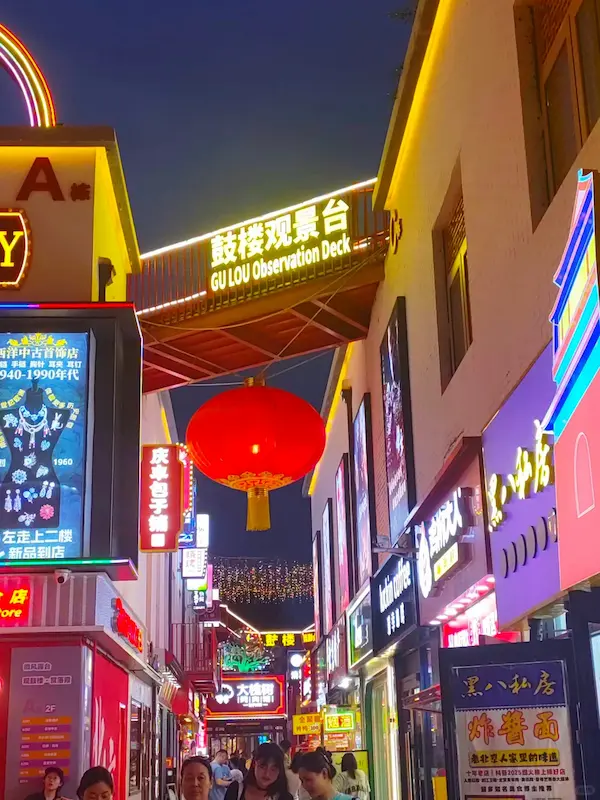
Gu Lou Park is located right next to the Drum Tower and is a trendy cultural district created by renovating historic buildings. If the Drum Tower tells stories of the past, then Gu Lou Park represents contemporary trends.
It has transformed the Drum Tower’s original solemn atmosphere by incorporating a wealth of fashionable elements.
The entire park isn’t very large, but it houses quite a few shops spread across the first and second floors (with some areas extending to a third floor).
Downstairs, you’ll find snack shops like Dehezhai and Laojinji Fried Snacks; upstairs is the observation deck—the true soul of Gulou Park.
What’s Really Worth Seeing?
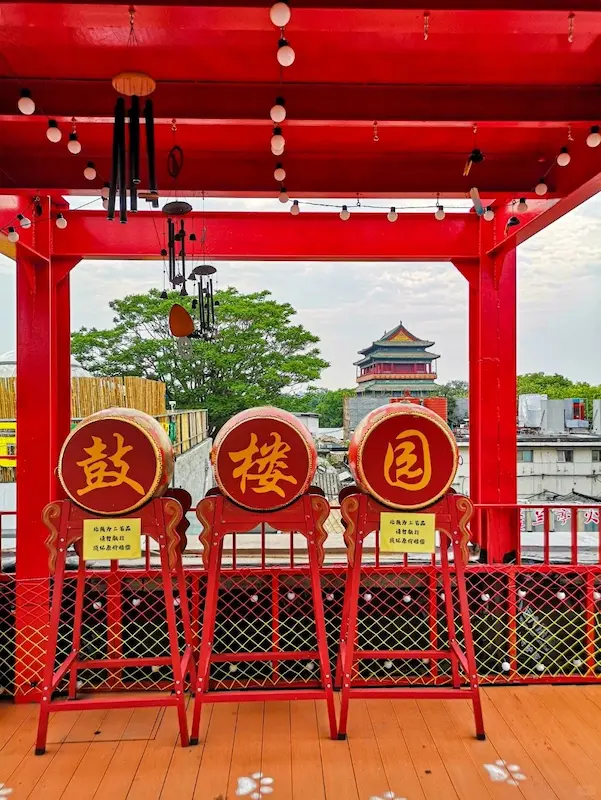
The rooftops on the second and third floors are the highlights of Gulou Park. Standing here, you can see all of the following at once:
- The Drum Tower and Bell Tower in the same frame—their gray tiled roofs bathed in golden light as the sun sets
- The China Zun and CCTV Tower in the distance—the entire Beijing skyline spread out before you
- Turn around, and you can even see the White Pagoda in Beihai Park
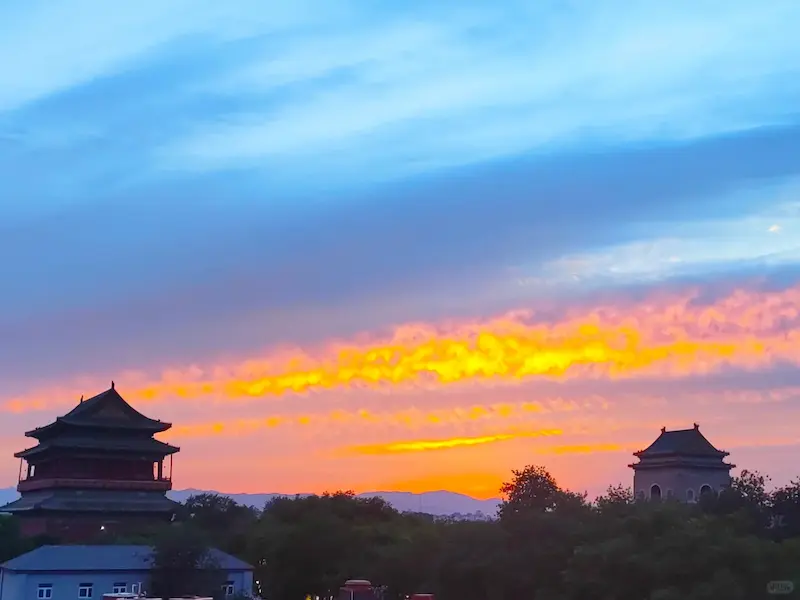
Old Beijing landmarks and new Beijing skyscrapers come together on the same rooftop, in the same direction, within a single frame. This visual effect of “old and new in the same frame” is a rare sight in Beijing.
Exclusive Tips: When to Go and How to Take Photos
The best time to visit is from 4:00 PM to 7:00 PM—you can capture both the sunset and the night view in one go.
If you only want to photograph the Drum Tower, the street directly across from it offers the best vantage point.
If you want to capture the Drum Tower and the China Zun in the same frame, head up to the second-floor rooftop of the Drum Tower Garden.
Outfit Tips: Dark colors or New Chinese-style outfits complement the red walls best. Down below, the neon signs contrast beautifully with the old buildings featuring blue-gray bricks and gray tiles—every casual snapshot turns out full of character.
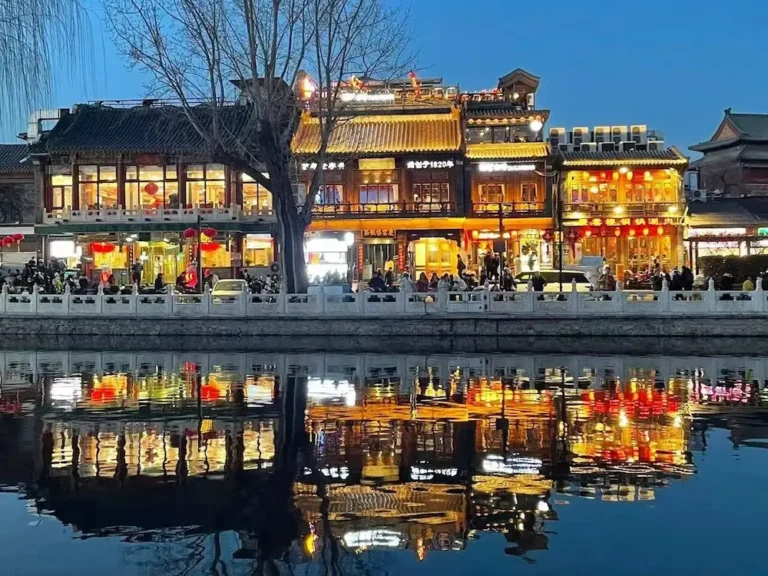
After exploring, head out of Gulou Park and walk straight to Yandai Xiejie and Shichahai—this makes for a very smooth city walk route with absolutely no detours.
A Quick Reminder
Gulou Park is an open neighborhood, not a fenced-off attraction. You can come and go as you please. If you just want to go up to the rooftop to take a few photos, 15 minutes is plenty; if you’d like to sit down, have a drink, and leisurely watch the sunset, you can stay for 1–2 hours. There are a few snack shops downstairs where you can grab a quick bite.
We don’t recommend visiting in the morning—the rooftop faces west, so the light is best from the afternoon through early evening.
Debi Tiantan WE: “Beijing Street” Hidden Inside a Century-Old Tram Factory
Where is it? How do I get there?
- Address: 91 Fahua Temple Street, Dongcheng District
- Subway: Take Exit B at “Tiantan East Gate” Station on Line 5, or Exit H at “Ciqikou” Station on Lines 5 or 7
- Admission: Free, no reservation required
What Is It?
This place has a somewhat complex history—it was once a factory, later an antique market, and is now a cultural and creative park.
Back in 1921, Beijing’s first tram was assembled and rolled off the production line here. As the tram passed through Tiananmen Square, its incessant“ding-ding”sound heralded the beginning of modernization in Beijing’s public transportation.
Designed by French engineers, this repair and manufacturing plant covers approximately 50 mu and is one of the few century-old industrial sites still standing within Beijing’s city limits.
Nearly a century later, in 2016, the site was transformed into the “Debi Tiantan WE” International Cultural and Creative Center.
The renovation was designed by Italian architect Stefano Boeri—the chief planner of the 2015 Milan Expo—who fully preserved the structure of the historic building while ensuring safety.
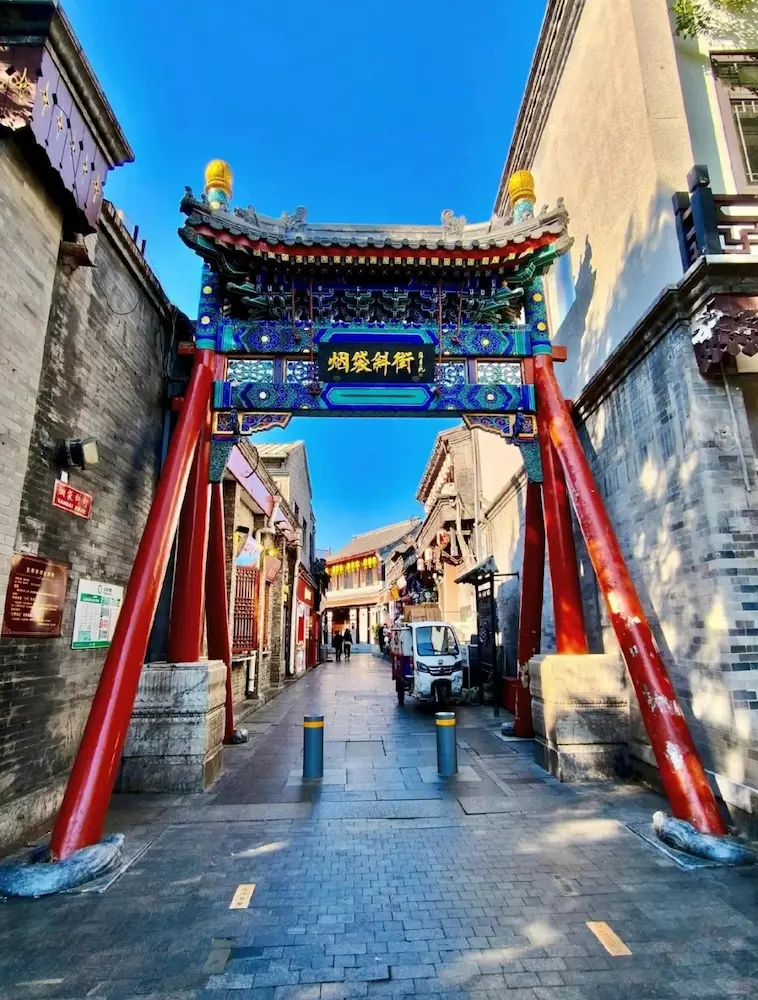
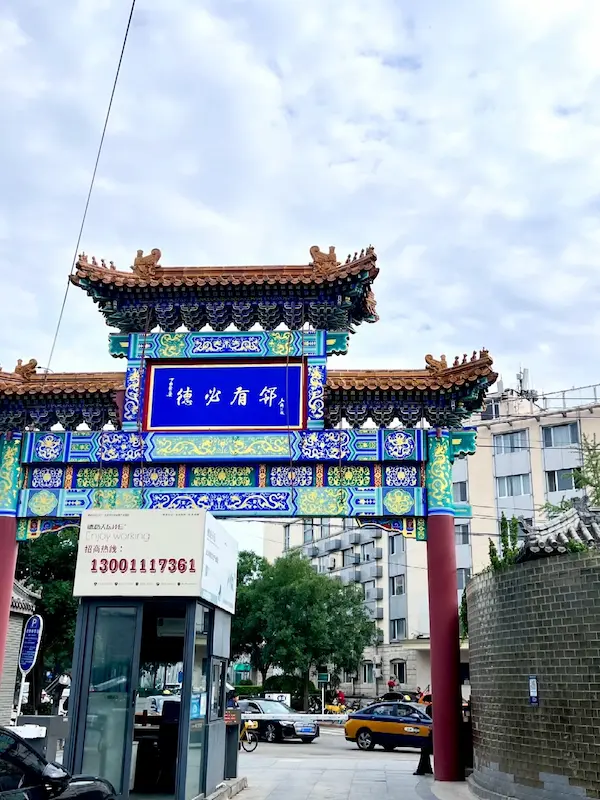
The archway at the park’s entrance bears four characters: “德必有邻” — a phrase taken from the“Li Ren”chapter of the *Analects*:“Virtue is never solitary; it must have neighbors,” meaning that a virtuous person will inevitably be accompanied by like-minded individuals.
“Beijing Street”: A Commercial Street Hidden Within the Park
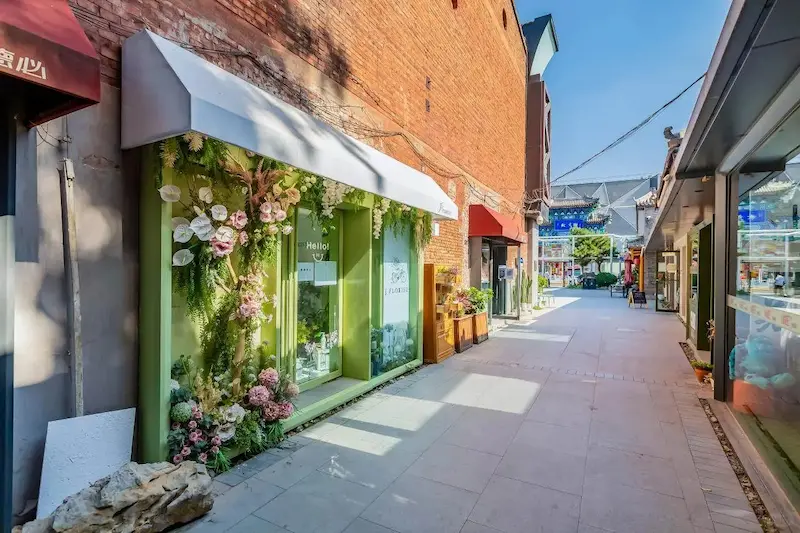
Passing through the archway leads to a commercial district called “Beijing Street.” The street winds with just the right amount of curves and varies in width, lined with shops featuring diverse decorations on both sides.
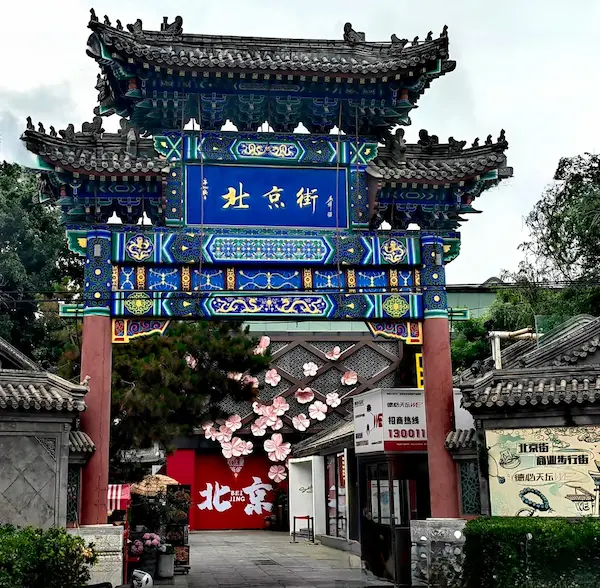
The shops offer a wide variety of goods: jewelry, cultural and creative products, trendy toys and handmade items, gourmet food and barbecue, trendy coffee shops, and handmade accessories—there’s almost everything here.
The office area and public library still retain the original French-style architecture of the old factory buildings. Some say this place resembles a “miniature version of 798,” but I find it more “intimate” than 798—it’s not as large or as empty, so strolling through it isn’t tiring.
Exclusive Highlights: What Can You Find?
- Vintage“Dangdang Trams”— you might even come across replica models of the old streetcars from back in the day
- The complex isn’t very large; it consists of a commercial area and an office area, with plenty of street-scene backdrops and graffiti walls—perfect for taking photos
- The entrance archway faces directly across from the North Gate of Tianya Jewelry City
- It’s just one street away from the East Gate of Tiantan Park—after exploring here, you can head straight to Tiantan
A Quick Tip
If you’re coming from the“Tiantan East Gate”station, note that the main entrance is on Fahua Temple Street, facing West Gymnasium Road. The entrance archway isn’t particularly conspicuous—just look for the words“Beijing Street.”
How long to spend: 30 minutes is plenty if you’re just taking photos and checking in; if you want to browse shops, grab a coffee, and wander around at a leisurely pace, set aside 1–2 hours.
Xuan Nan Cultural Museum: Experience a“Time-Travel Drama”in an Ancient Ming Dynasty Temple
Where is it? How do I get there?
- Address: No. 9 Changchun Street, Xicheng District
- Subway: Take Exit B at“Niujie”Station on Line 19; walk north for about 100 meters to arrive
- Admission: Free. No reservation required during non-performance hours; simply walk in. For performances and special events, real-name reservations must be made via the official WeChat account
What Is It?
The Xuan Nan Cultural Museum is unlike the previous two locations—it’s not a newly renovated trendy district, but a genuine ancient temple from the Ming Dynasty.
The building that houses the museum is called Changchun Temple, built in the 20th year of the Wanli reign of the Ming Dynasty (1592), with a history spanning more than 400 years.
It was commissioned by Empress Dowager Li Xiaoding—the birth mother of Emperor Wanli, Zhu Yijun—for the eminent monk Master Shuizhai.
The name“Changchun”was personally bestowed by Emperor Wanli, symbolizing his wish for his mother’s health and longevity. During the Ming Dynasty, it was known as the “Foremost Temple of the Capital.”
Changchun Temple boasted picturesque scenery during the Ming and Qing dynasties. With locust trees, wisteria, plum blossoms, and lilacs planted within its grounds, it served as a primary gathering place for literati and scholars to socialize and exchange poetry.
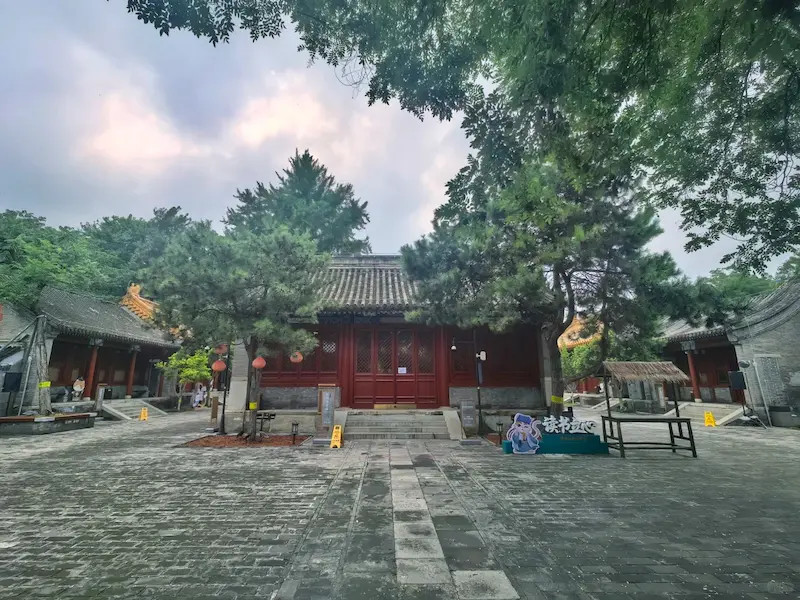
After 2001, Changchun Temple was converted into the Xuan Nan Cultural Museum. “Xuan Nan” refers to an area outside Xuanwu Gate during the Ming and Qing dynasties—a gathering place for scholars traveling to Beijing to take the imperial examinations and one of the city’s oldest districts.
The cultural traditions of Tianqiao, the commercial culture of Dashilan, and the scholarly culture of Liulichang all originated here.
What’s Really Worth Seeing?
It’s not the exhibits—it’s a play.
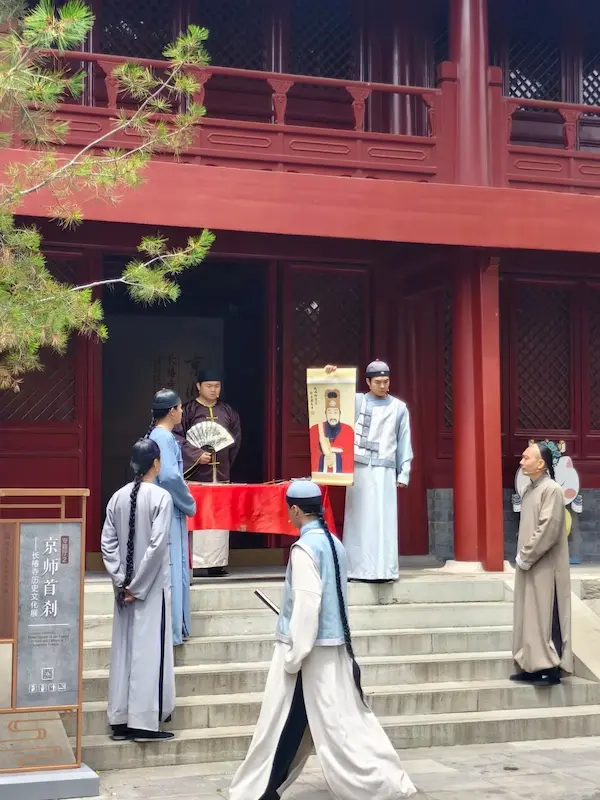
Every Saturday and Sunday from 5:00 p.m. to 6:00 p.m., the museum presents an immersive guided tour play titled *Xuan Nan Wang Shi*.
This is the nation’s first immersive guided tour play in a museum, which premiered at Changchun Temple on May 18, 2023. As of May 2026, it has been performed 261 times, reaching nearly 120,000 audience members both online and offline.
How is it different from other museum tours?
You won’t be standing in front of display cases listening to a docent read from a script. Instead, you’ll follow the actors as they lead you through the authentic historic buildings of Changchun Temple, with the scenery changing with every step.
The story is set during the late Qing Dynasty, in the Guangxu era, beginning in 1895. The fictional characters“Shi’egong”and the provincial examination candidate“Hongsheng”will guide you through historical events such as the Joint Petition to the Emperor and the Hundred Days’ Reform.
In addition to the fictional characters, the play features dozens of real historical figures, including Lin Zexu, Tan Sitong, and Kang Youwei. The performance blends various art forms, including stage drama, crosstalk, and Peking Opera.
One comment from audience feedback left a deep impression on me:“People had tears in their eyes at Tan Sitong’s noble sacrifice, and their hearts were stirred by the passionate cries of the righteous and patriotic.”History is no longer just distant text; it has become a tangible, vivid memory.
Exclusive Details: What Else Is There to See?
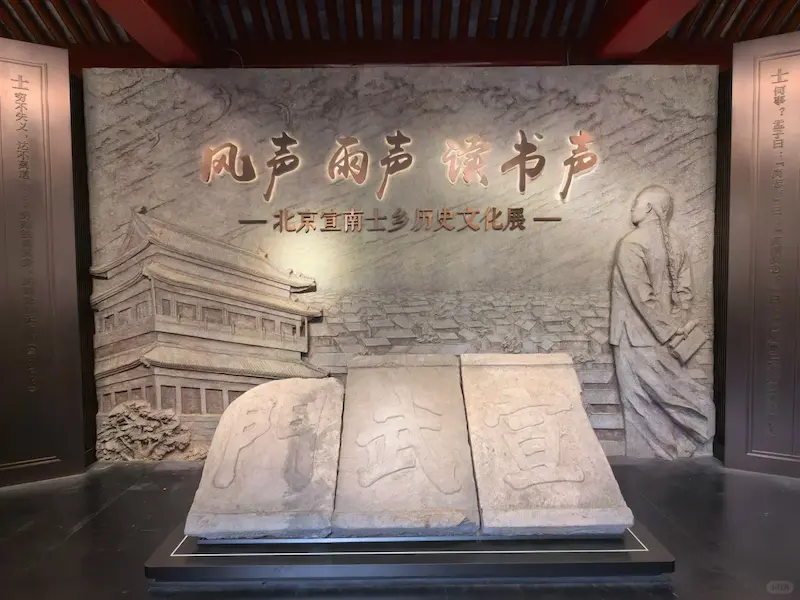
- The museum’s main exhibition, titled“The Sound of the Wind, the Sound of Rain, the Sound of Reading—The History and Culture of Beijing’s Xuan Nan Scholars’Community,”spans seven exhibition halls.
- The museum features digital interactive devices where visitors can tap the screen to watch videos and participate in interactive quizzes.
- In front of the Sutra Hall stands a 500-year-old ancient tree. Beneath it is a folk culture leisure area featuring bronze sculptures depicting people playing Chinese chess, selling watermelons, making dough figurines, and strolling through a temple fair
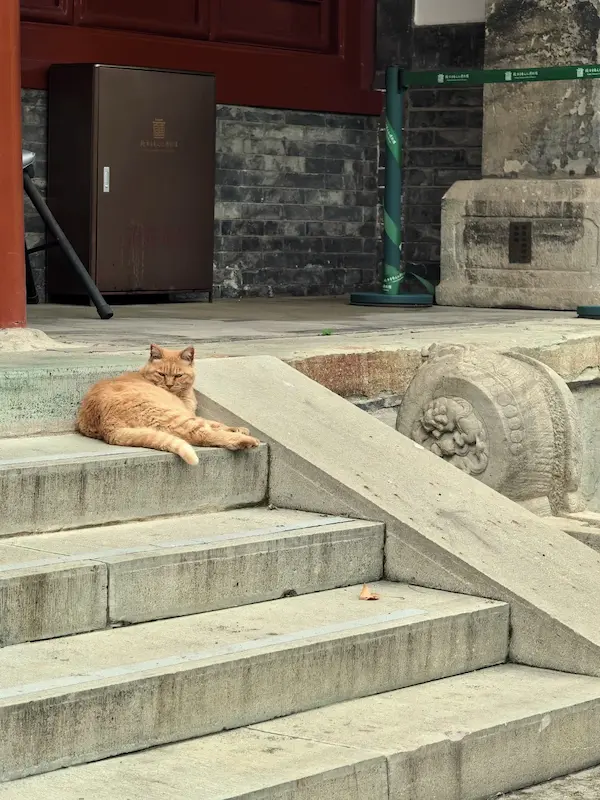
- You might encounter cats in the courtyard—a near-standard feature in old Beijing temples
- You can pick up a paper commemorative ticket by filling out a satisfaction survey at the visitor service center
Two Important Reminders
First: The immersive guided tour is performed only on Saturdays and Sundays from 5:00 PM to 6:00 PM. If you visit on a weekday, you’ll only be able to see the regular exhibition (which is still good, but you’ll miss the most exciting part).
It’s best to check the official WeChat account beforehand to confirm if there’s a performance that day.
Second: The museum stops admitting visitors at 4:00 PM, so be sure to plan your time accordingly.
Quick Reference Guide
| Item | Gulou Park | Debi Tiantan WE | Xuan Nan Cultural Museum |
| Address | 206 Gulou East Street | 91 Fahua Temple Street, Dongcheng District | 9 Changchun Street, Xicheng District |
| Subway | Exit A2, Shichahai Station (Line 8) | Exit B, Tiantan East Gate Station (Line 5) | Exit B, Niujie Station (Line 19) |
| Admission | Free | Free | Free |
| Reservation | Not required | Not required | Not required outside performance times |
| Hours | 24 hours | Daytime (during store hours) | 9:00–16:30 (Closed on Mondays? Please confirm) |
| Recommended Duration | 30 minutes–1.5 hours | 30 minutes–2 hours | 1–2 hours |
| Best Time to Visit | 4:00 PM–7:00 PM | Any time during the day | Weekend afternoons (when performances are held) |
Three Recommended Itineraries
Itinerary 1: Half-Day Tour Around Drum Tower (Easiest)
Drum Tower (take photos of the exterior) → Drum Tower Park (go up to the rooftop to watch the sunset) → Yandai Xiejie → Shichahai (stroll)
This itinerary is easygoing and perfect for setting out at 4:00 p.m.
Itinerary 2: A Side Trip to the Temple of Heaven
Temple of Heaven Park (morning) → Debi Temple of Heaven WE “Beijing Street” (lunch/coffee in the afternoon) → Hongqiao Market (optional)
Just cross the street after exiting the East Gate of the Temple of Heaven.
Route 3: In-Depth Xuan Nan Cultural Tour (Weekends Only)
Liulichang Cultural Street (afternoon stroll) → Xuan Nan Cultural Museum (enter before 4:00 PM; watch *Xuan Nan Scholars* at 5:00 PM)
This route offers the richest cultural experience, but it must be scheduled for a Saturday or Sunday.
These three places have one thing in common: none of them are “tourist attractions.”
Gulou Park is an open commercial district, Debi Tiantan WE is an office complex, and the Xuan Nan Cultural Museum is a museum housed within historic architecture—they exist not to cater to tourists, but to serve the people who live in this city.
This is the biggest difference between them and Nanluoguxiang. Nanluoguxiang was built for tourists, whereas these three places are used by the people of Beijing themselves.
When you stand on the rooftop of Gulou Park, watching the setting sun turn the gray tiles of the Drum Tower golden, with the glass curtain wall of the China Zun in the distance reflecting the last rays of light—in that moment, you’ll realize that Beijing isn’t just about the Forbidden City and the Great Wall; it’s also about these quiet, authentic slices of life hidden in the nooks and crannies of its streets and alleys.