Beijing Bell and Drum Towers Tour Guide: Explore the Ancient Imperial Timekeeping Center(2026)
The Bell and Drum Towers of Beijing, located in the Dongcheng District, collectively refer to two magnificent ancient structures—the Drum Tower and the Bell Tower.
During the Yuan, Ming, and Qing dynasties, this site served as the official timekeeping center for the entire nation, functioning like an ancient “national clock” that announced the time to the entire city through drumbeats and bell tolls.
If you’re visiting Beijing, the Bell and Drum Towers are a must-see historical attraction. Rich in history, they now feature engaging interactive exhibits that let you experience firsthand how ancient people measured time.
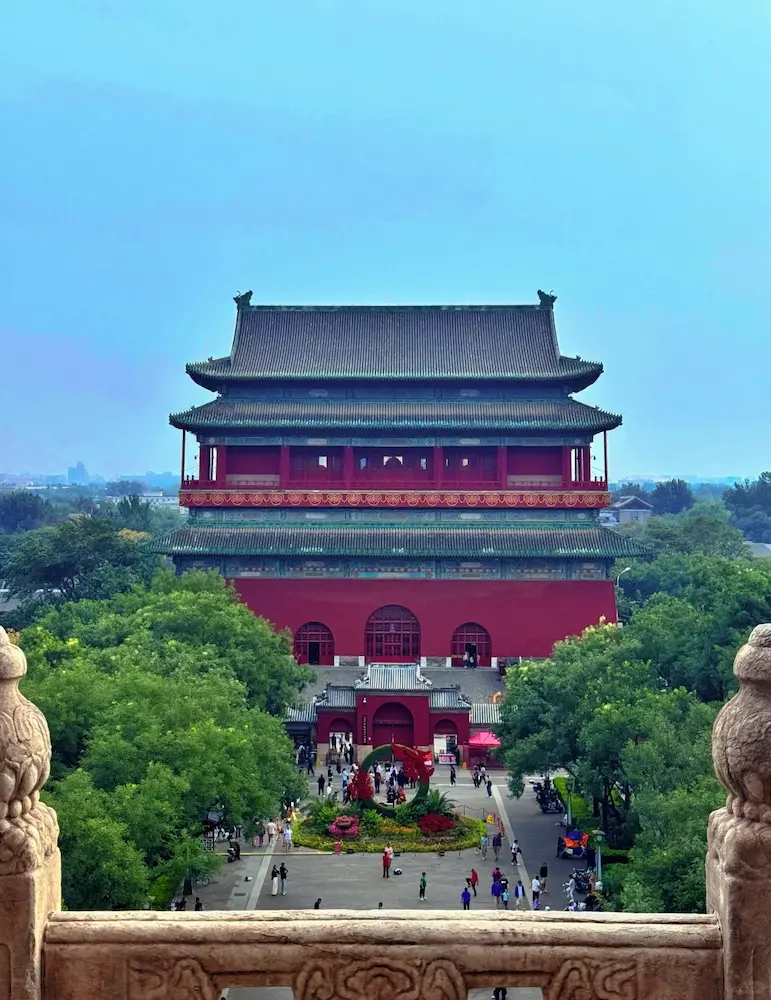
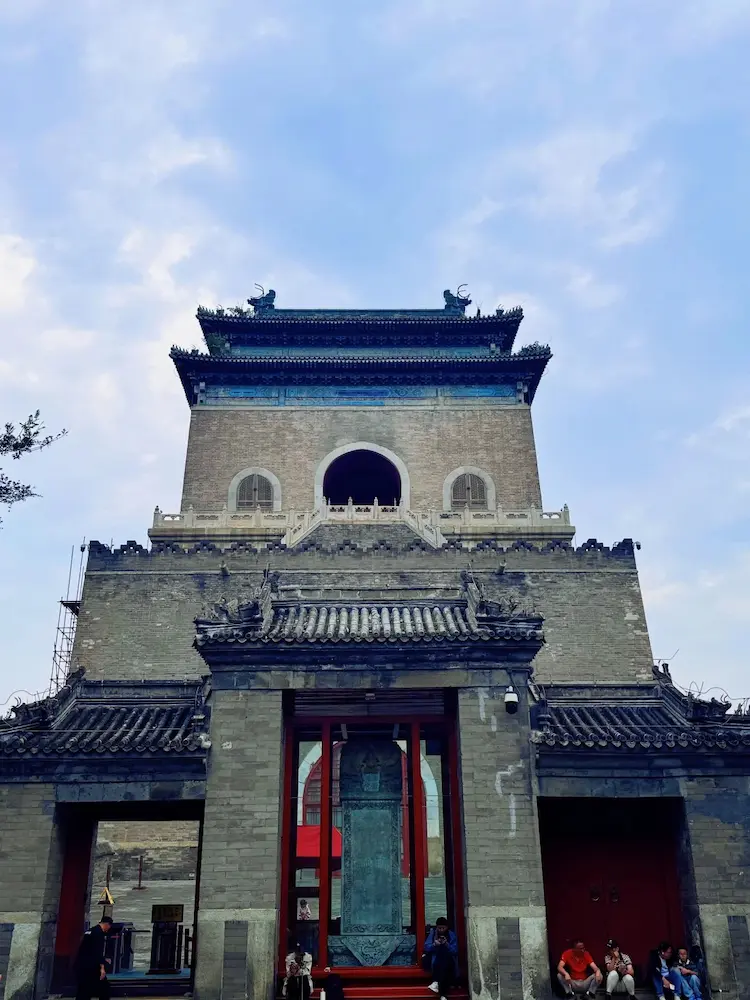
Table of Contents
Where Are the Bell and Drum Towers? How to Get There?
The exact address is No. 9, Zhonglouwan, Linzi, Dongcheng District, Beijing. Getting there is very convenient:
- The most recommended way is to take the Beijing Subway Line 8.
- Alight at Shichahai Station and exit via Exit A2 (Northwest).
- After exiting, stroll for about 10 minutes until you see these two towering ancient structures.
Admission Fees & Hours
Admission tickets are required to visit the Bell and Drum Towers, and the prices are very reasonable:
- For visiting only the Drum Tower, the ticket is 20 yuan.
- For visiting only the Bell Tower, the ticket is 15 yuan.
- The most cost-effective option is to purchase a combined ticket (30 yuan), which allows access to both towers.
We recommend setting aside 1 to 1.5 hours for your visit, so you can comfortably see all the exhibits and buildings.
Drum Tower: Ancient Timekeeping Signal Tower
Visitors typically begin with the southern Drum Tower. Standing 46.7 meters tall, it is an exquisitely crafted wooden pavilion structure.
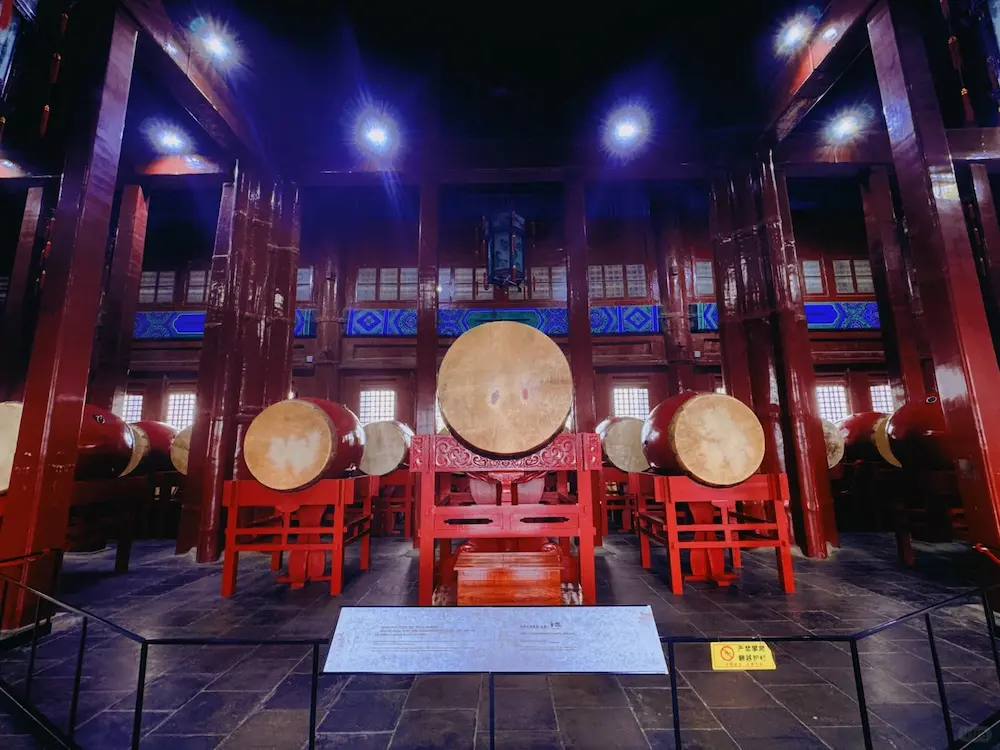
In ancient times, it housed 25 large drums, one of which is a precious historical relic from the Ming Dynasty, while the other 24 are meticulously crafted replicas based on historical records.
Originally built during the Yuan Dynasty (1272) as the “Qizheng Tower,” it endured multiple fires and reconstructions. The current structure primarily reflects its Ming Dynasty (1539) restoration.
What’s Inside the Drum Tower?
The ground floor now houses an interactive exhibition called “The Story of Time,” ideal for families with children:
- Explore Timekeeping History: Through documents, photographs, and models, you can clearly trace the historical evolution of the Drum Tower and discover traditional Chinese methods and tools for measuring time.
- Interactive Experiences: Virtual drums and bells let you
“Strike” the drumhead or push the simulated bell clapper, blending virtual and real sensations for an engaging experience. - Listen to Ancient Beijing: In the “Hearing Bells in the Forbidden City” experience, don headphones and touch the Qing Dynasty Beijing map on the screen. Select different locations to hear distant or nearby bell sounds emanating from those spots, transporting you back in time.
- Drum Performance: Don’t miss the spectacular drum performances at scheduled times (e.g., 10 AM, 11 AM).
- Prime Viewing Platform: Ascend the Drum Tower and gaze southward to take in the magnificent panorama of Beijing’s central axis. Even the Wanchun Pavilion in Jingshan Park, far in the distance, comes into clear view.
Bell Tower: A Testament to Ancient Wisdom
Walk about 100 meters north from the Drum Tower to reach the Bell Tower. Slightly taller than its counterpart at 47.9 meters, it stands as a testament to ancient engineering.
Remarkably, the Bell Tower is an entirely brick-and-stone structure, containing not a single piece of wood—a rarity among ancient large-scale buildings, likely designed for fire prevention.
The Bell Tower’s history has been equally turbulent, destroyed multiple times by fire. The structure we see today was rebuilt in 1745 by order of Emperor Qianlong of the Qing Dynasty.
The tower’s crown jewel is a massive bronze bell suspended on the second level. Cast during the Yongle era of the Ming Dynasty, this bell stands over 7 meters tall and weighs approximately 63 tons, earning it the title of “King of Ancient Bells.”
Imagine the extraordinary skill ancient craftsmen must have possessed to cast and hoist such a colossal bell!
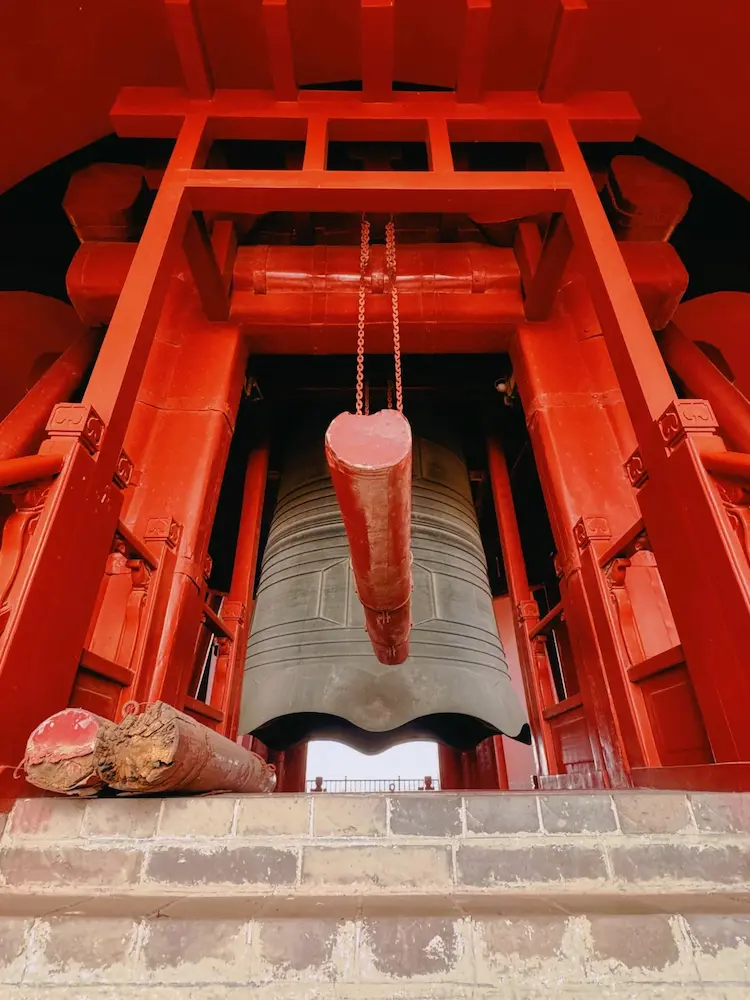
The Ancient Ritual of Bell Ringing
Ancient Chinese bell ringing to mark the hours followed a highly precise rhythm, summarized as: “Eighteen quick strikes, eighteen slow strikes, followed by eighteen neither quick nor slow.” This pattern repeated twice, totaling 108 strikes.
Why 108 strokes? This reflects ancient wisdom. The 108 strokes symbolized a full year: 12 months, 24 solar terms, and 72 候(ancient periods of five days each). The sum of 12 + 24 + 72 equals precisely 108. Thus, each completed cycle of bell strikes marked the passage of a year.
Tips for Visiting with Kids
For families with children (especially school-aged), the Bell and Drum Towers serve as an excellent educational destination. Interactive exhibits help children intuitively grasp abstract concepts of time and history. Overall, its family-friendliness earns 2.5 stars out of 5.
Additional Practical Tips
The exhibition hall on the first floor of the Drum Tower features numerous themed stamps, but note that many require payment to stamp.
The area surrounding the Bell and Drum Towers is at the heart of Beijing’s hutong culture. You can easily combine a visit here with other famous attractions like Shichahai, Nanluoguxiang, and the Prince Gong’s Mansion to plan a full day of urban exploration.
The Bell and Drum Towers also mark the northern starting point of Beijing’s Central Axis. For more information on attractions along the Central Axis, check out the [Guide to 15 Attractions Along Beijing’s Central Axis].
Beijing’s Bell and Drum Towers are far more than just two ancient structures. They once served as the beating heart and breathing pulse of the city, using sound to regulate the daily routines of countless people.
Today, though bustling tourists have replaced the citizens who once listened intently to their chimes, these towers still stand quietly along Beijing’s central axis. From a unique vantage point, they narrate tales of time and the city.
Spend half an hour ascending the towers for distant views or experience the ancient method of time-keeping. This will be a uniquely cultural highlight of your Beijing journey.