Dongming Hutong, Beijing: A Hidden Gem by Shichahai, So Narrow Only One Person Can Pass Through (2026 Off-the-Beaten-Path Hutong Guide)
Nestled beside Beijing’s famous Houhai Scenic Area lies a charming little lane—Dongming Hutong. Though short in length, it has become a fascinating spot to explore thanks to its unique history and irregular shape.
Table of Contents
Quick Overview | Decide in 10 Seconds If It’s Worth a Visit
- Key Features: A super-narrow, hidden alleyway by Shichahai, featuring an L-shaped bend; the narrowest point is only about 1 meter wide
- Location: East side of Shichahai, near Dianmenwai Street
- Duration: 10–15 minutes—perfect for a stroll
- Admission: Completely free
- Best Itinerary: Yandai Xiejie → Huode Zhenjun Temple → Dongming Hutong → Shichahai—an off-the-beaten-path route
- Ideal for: Those who enjoy tranquility, love capturing local culture, want to avoid crowds, and seek an authentic Old Beijing experience
Where is Dongming Hutong and What Does It Look Like?
Dongming Hutong is incredibly easy to find, with its northern entrance facing the beautiful Houhai Lake directly. Composed of three smaller branch alleys, it is highly irregular in shape.
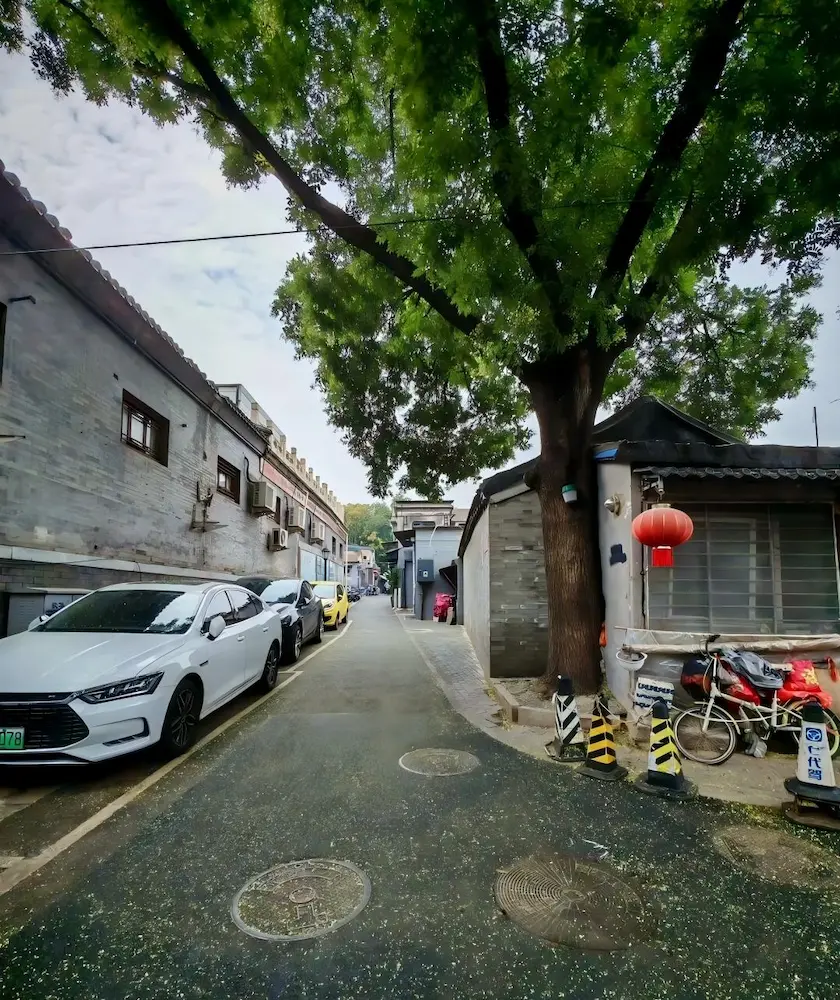
Its western starting point is Deshengmen Inner Street; it leads south to Yangfang Hutong and north straight to Houhai Lake. Stretching a mere 155 meters in total with an average width of 3 meters, it is a narrow little lane.
The Interesting Evolution of Its Name: From “Dog’s Tail” to “Dongming”
The most intriguing thing about this hutong is the evolution of its name, which is like a mirror reflecting the historical changes of Beijing.
- Qing Dynasty: Gouweiba (Dog’s Tail) Hutong. In the Qing Dynasty, the lane’s winding and twisting terrain resembled a dog’s tail, so local people gave it a vivid and affectionate colloquial name—Gouweiba Hutong. In the old Beijing dialect, it was pronounced with a pleasant retroflex ending, “Gouweiba’r”.
- Republican Period: Guanyin Temple Hutong. In the Republican period, a Guanyin Temple in the hutong grew in influence, so the lane was renamed with the more formal title of Guanyin Temple Hutong.
- 1965 to the Present: Dongming Hutong. In 1965, Beijing carried out a rectification of place names. To give the lane a more elegant name, it was officially renamed Dongming Hutong, taking the meanings of “East Sea (referring to Houhai)” and “Brightness”. This name has been in use ever since.
Why Do I Love Dongming Hutong?
Because it’s so small, so narrow, and so soothing.
It lies right next to bustling Shichahai, yet feels as though the world has quietly tucked it away.
The moment you turn into it, the outside noise vanishes instantly, leaving only:
the greenery along the walls, the old door sills at the entrances, the flower pots on the windowsills, and the occasional coo of a pigeon flying by.
It is a typical old Beijing alley—historically shaped by small plots of land and dense residential areas, resulting in this narrow, winding layout.
Unpretentious and unadorned, it preserves the most authentic character of the alley.
A Stroll Through Dongming Hutong: Old Beijing’s Gentle Charm Awaits Around Every Corner
The most charming feature of Dongming Hutong is its natural L-shaped bend.
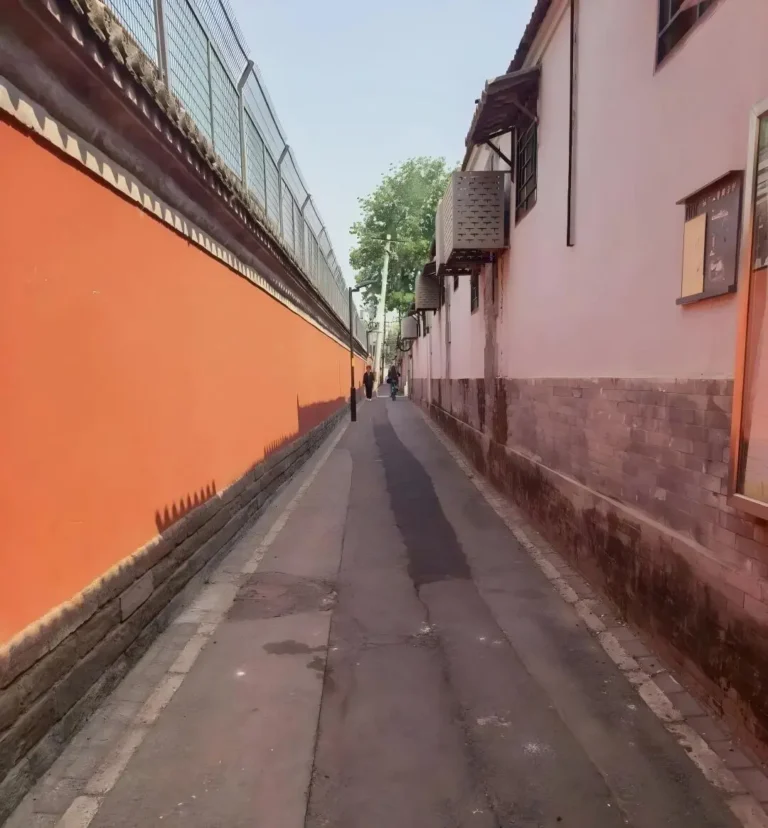
The tall gray walls on either side converge toward the center, narrowing as you walk deeper into the alley; at its narrowest point, only one person can squeeze through sideways.
Sunlight streams in at an angle from above, casting long shadows on the walls.
When the breeze blows, the vines on the wall gently sway.
The quiet, soothing atmosphere truly makes you slow your breathing in an instant.
Here, you won’t see bars or hear street vendors hawking their wares.
There are only residents coming and going quietly, elderly people sitting in the sun, and kittens dozing by the door.
This is exactly how I imagine a Beijing hutong should be.
A “Treasure” in the Hutong: The Former Site of Guanyin Temple
The origin of the hutong’s former names lies with that Guanyin Temple, whose former site is at what was once No.21 Dongming Hutong (now Courtyard No.16).
First built in the Wanli Reign of the Ming Dynasty, more than 400 years ago, the temple was quite a large complex with a mountain gate, a front hall, a rear hall and other structures.
After 1949, the former temple site was repurposed: it served as a neighborhood committee and even a workshop for a street factory, gradually blending in with the ordinary residential courtyards around it.
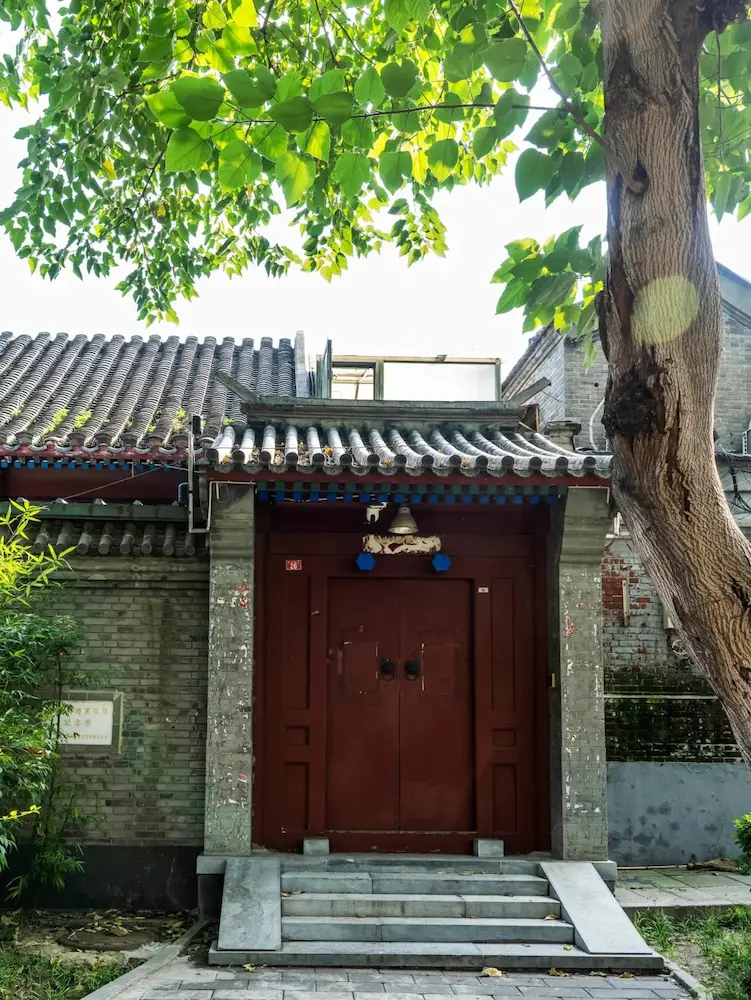
Today, if you visit the spot, you will find Courtyard No.16 with a handwritten house number after turning a right-angle bend. The courtyard walls are low, with overlapping eaves.
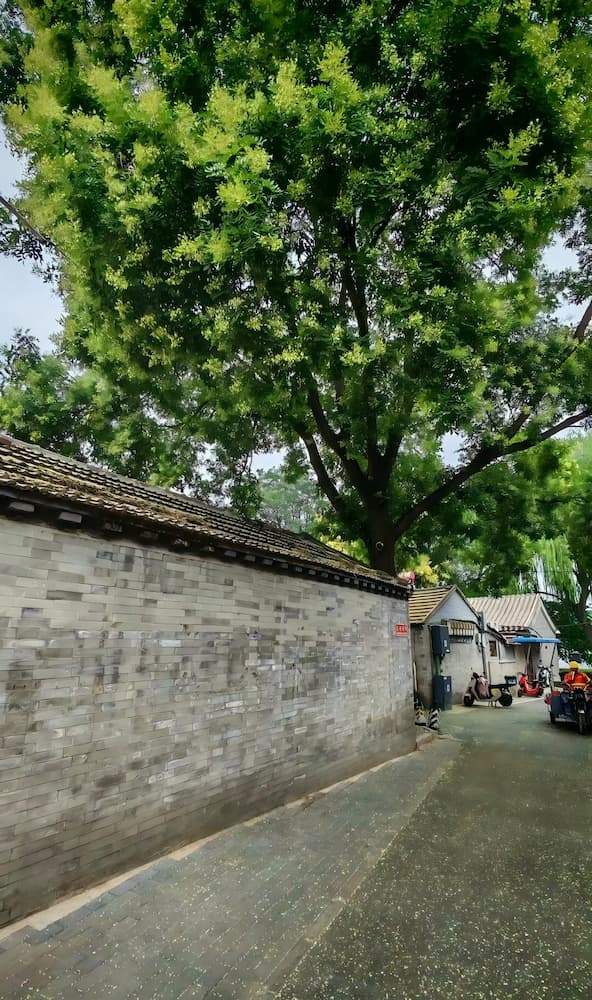
An ancient pagoda tree stands at the hutong entrance; when the wind blows, its leaves flutter gently, and pale yellow pagoda tree flowers fall like raindrops, resting on the old gray roof tiles—painting an exquisitely quiet and beautiful scene.
Life in Modern Dongming Hutong
Today, several mansions enclosed by tall walls stand quietly in Dongming Hutong, seemingly used for commercial office purposes. On the side facing Houhai Lake, however, several distinctive cultural and creative shops have opened, adding a touch of casual modern vibrancy to this ancient hutong.
Standing at the northern entrance of the hutong, you can cross a bridge to reach Shuiquan Nunnery on the opposite side, and on the other side of Deshengmen Inner Street lies Xihai Lake.
It can be said that Dongming Hutong is a delightful connecting node between this beautiful water area and the daily life of the old urban district.
The Inspiration from a Tiny Lane
From the down-to-earth local name of “Dog’s Tail”, to the renaming after a temple, and then to the elegant name it bears today, the evolution of Dongming Hutong’s name is like a brief history of Beijing itself.
It tells us that even a tiny 155-meter-long hutong in Beijing bears the marks of ordinary people’s life joys, religious beliefs, and the changes of the times.
As the ancient Guanyin Temple has turned into a quiet residential courtyard today, and as creative shops open under the old pagoda tree, this hutong continues to tell Beijing’s stories in its own unique way.
Secret Photography Tips | How to Get the Best Shots?
Dongming Hutong may be small, but it’s a photographer’s dream. Here’s what I’ve summarized for you:
1. Corner Perspective Composition (The Best!)
Stand at an L-shaped turn and shoot toward the end of the alley.
The gray walls on either side create a natural sense of depth, instantly giving your photos a cinematic feel.
2. Capture Light and Shadow on Walls
In the early morning or late afternoon, when the sun casts slanting light on the walls, the textures look particularly beautiful—minimalist and sophisticated.
3. Capture Small Details of Daily Life
Door sills, old doors, flower pots, laundry hanging out to dry, and vines climbing the walls—these are all the most authentic “Old Beijing scenes.”
4. Shoot the Hutong Sky from a Low Angle
The narrow walls frame a slender strip of blue sky, creating a composition with a unique charm.
A Practical Guide for International Visitors | Find Your Way Without Getting Lost
Where Exactly Is It? (Ultra-Precise Description)
- Location: East of Shichahai, near Di’anmenwai Street
- The entrance is quite hidden: in a small alley near Yandai Xiejie and the Temple of Huode Zhenjun
- Search for “Dongming Hutong” in your navigation app
- Recommended apps: Apple Maps / Amap (Google Maps tends to get off track in the alleys)
Best Walking Route (No Detours, No Pitfalls)
Yandai Xiejie → Huode Zhenjun Temple → Dongming Hutong → Shichahai Lakeside
The entire route takes about 1 hour, taking you from bustling streets to quiet alleys and finally to the lakefront—a truly relaxing experience.
What to Eat Nearby?
After exploring, head to Di’anmenwai Street or the area around Shichahai.
You’ll find Old Beijing snacks, cafes, and casual dining—plenty of options.