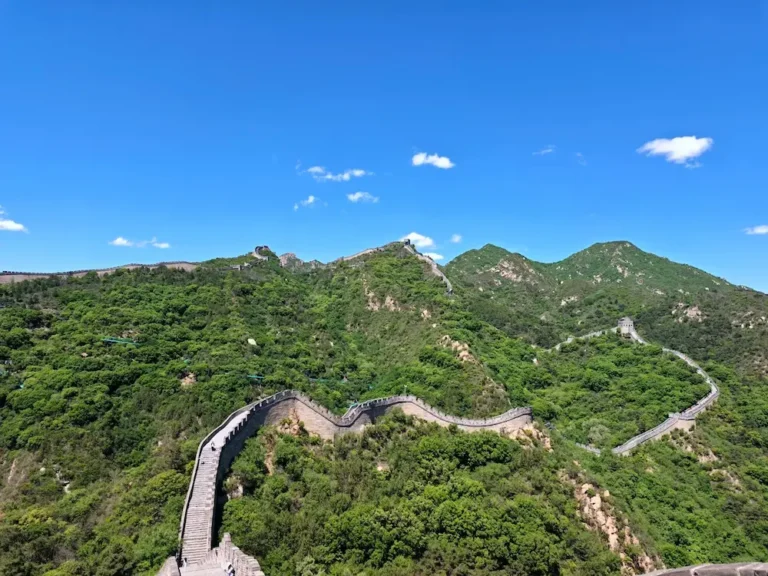
The First Watchtower of the Great Wall—A Guide to Visiting Jiuyanlou and the Intersection of the Inner and Outer Great Walls(2026)
Jiuyanlou is the largest watchtower on the Great Wall and boasts the most arrow slits—nine on each of its four sides, totaling 36. It is hailed as the “First Watchtower of the Great Wall.”
This article provides a detailed overview of its location at the junction of the Inner and Outer Great Walls, its stone-inscribed relics, two hiking routes (the Yanqing Scenic Area Route and the Huairou Wilderness Route), and high-altitude photography spots.
Table of Contents
Why Is It Called the “Uncrowned King” of Great Wall Watchtowers?
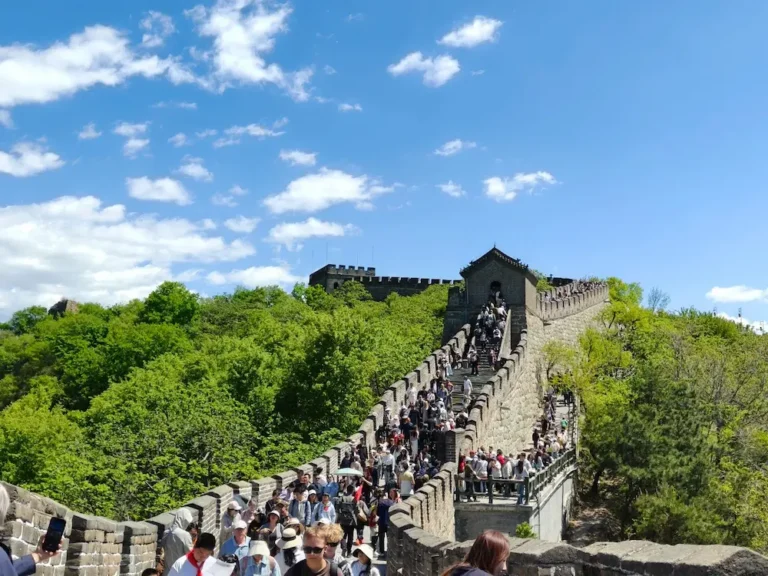
If you explore the Great Wall around Beijing, you’ll notice that most watchtowers have two, three, or at most four arrow slits. For example, most watchtowers at Mutianyu have three or four arrow slits, while those at Simatai generally have three to five.
But have you ever seen a watchtower with nine arrow slits on a single side?
Perched atop the main peak of Huoyan Mountain at an elevation of 1,141 meters, where Huairou and Yanqing districts meet, stands a structure that commands the admiration of all Great Wall enthusiasts and photographers—the Nine-Eyed Watchtower.
With nine arrow slits on a single first-floor side, it boasts a total of thirty-six arrow slits across all four sides. It is not only the watchtower with the most arrow slits along the Beijing section of the Great Wall, but also the largest and most imposing in scale, earning it the title of “The First Watchtower of the Great Wall.”
The first time I stood at the foot of the Nine-Eyed Tower, my initial reaction wasn’t to pull out my camera, but to crane my neck and stare in awe for a few seconds. The nine arrow slits are lined up in a row, like a row of cold, indifferent eyes, overlooking the Yanqing Basin below and the distant mountains.
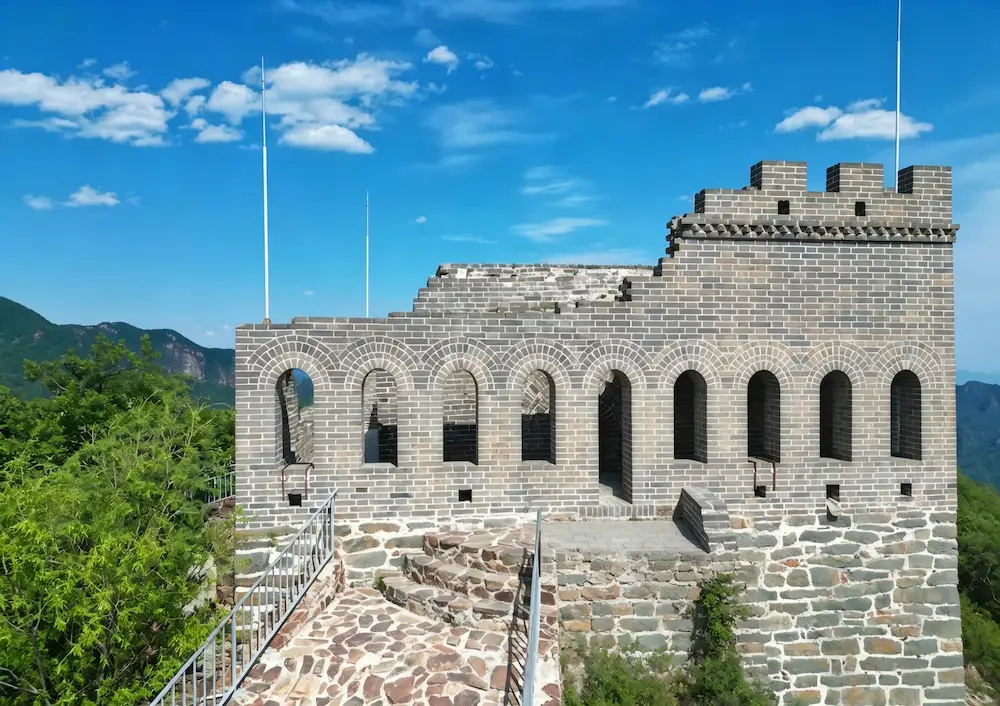
The walls are built of massive ashlars. Although the upper structure has collapsed after centuries of wind and rain, the remaining ruins of the single-story building still exude an overwhelming sense of grandeur.
This is no ordinary defensive structure. It is the highest observation post along the entire Ming Great Wall and the physical junction where the Inner and Outer Great Walls meet. Standing here, you are not merely standing on a mountain; you are standing at the “crossroads” of the Ming Dynasty’s northern defense line.
If you’ve developed a keen interest in the Nine-Eyed Tower—a massive single-structure defensive hub along the Great Wall of the Ming Dynasty—and want to see the pinnacle of Great Wall architectural artistry along with the other“Three Great Architectural Wonders, ”don’t miss my other masterpiece, Jinshanling Great Wall Guide: Barrier Walls, Inscribed Bricks, and the Great Wall Sunset—A Photographer’s Paradise (2026).
History and Military Insights: Understanding the Supreme Military Significance of the “Nine-Eyed Tower”
Why Was It Built So Large?—The Mission of a Central Observation Post
The Nine-Eyed Tower’s official name is the “Flame Mountain Position Observation Post,” built during the Jiajing era of the Ming Dynasty (1522–1566). It is situated on the main peak of Flame Mountain at an elevation of 1,141 meters, making it the highest vantage point within a radius of dozens of kilometers.
Why build a watchtower at such a high elevation? Because its mission was not to “guard the city gates,” but to “observe.” On clear days, guards stationed atop the Nine-Eyed Tower could look north to overlook the Yanqing Basin and the roads leading toward Mongolia; to the south, they could monitor the valleys leading to Changping and Huairou; to the east, they could see the Jiankou Great Wall and Beijingjie; and to the west, they could see the direction of Juyong Pass. Its field of vision was exceptionally vast.
To support such a strategic vantage point, the Nine-Eyed Tower’s scale far exceeded that of ordinary watchtowers. It was divided into two levels: the lower level consisted of a brick-and-stone vaulted chamber capable of housing dozens of soldiers and storing weapons and provisions; the upper level originally featured quarters and an observation deck, from which high-ranking officers could raise flags to direct combat operations.
The ground floor features nine arrow slits on each of its four sides, totaling thirty-six. Each slit was once manned by a musketman or archer. Such firepower density is unparalleled among the watchtowers of the Ming Great Wall.
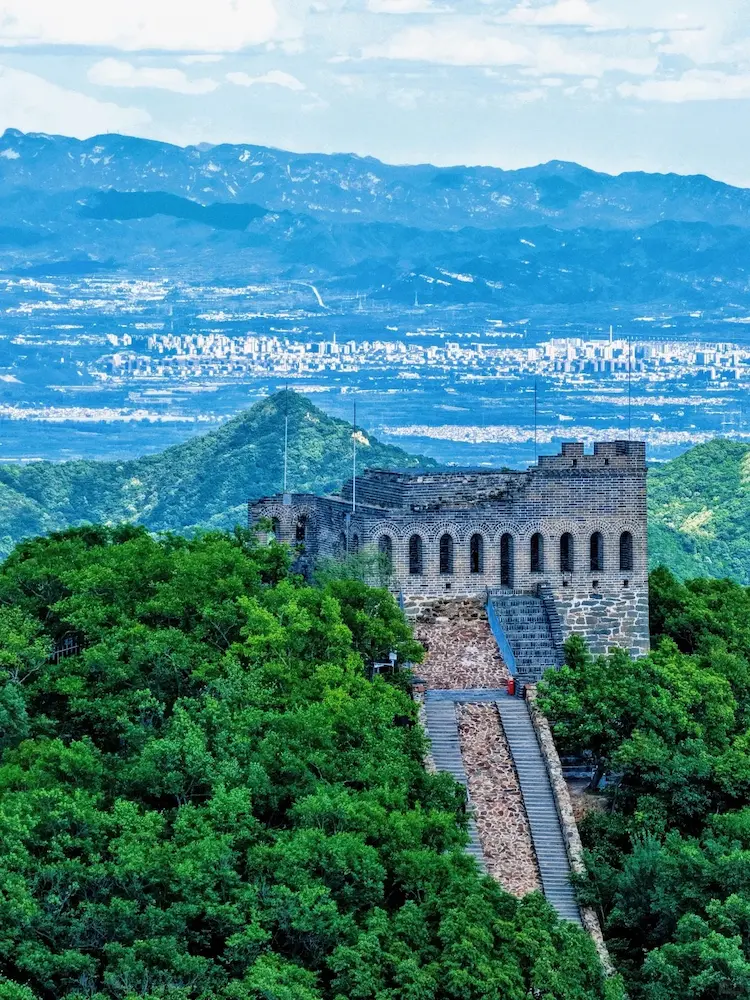
A Stunning Geographical Crossroads: The Intersection of the Inner and Outer Great Walls
To understand Jiuyanlou, one must first grasp a key concept: the Inner Great Wall and the Outer Great Wall.
The Ming Great Wall was not a single line, but rather two—or even more—lines of defense. Simply put:
- Inner Great Wall: Located near the capital, with a defensive focus. Sites such as Juyongguan, Mutianyu, and Huanghuacheng were primarily responsible for safeguarding the capital and the imperial tombs. The wall sections are relatively well-preserved, and the passes are densely concentrated.
- Outer Great Wall: Located further north and geared toward proactive defense. It extends westward from Yanqing and Zhangjiakou, facing the Mongolian grasslands directly. This line of defense encountered enemy forces earlier, featuring denser watchtowers but relatively simpler walls.
Where do these two Great Walls converge? At Jiuyanlou.
Standing atop Jiuyan Tower, the Great Wall splits into two branches before you: one heads south (toward the Inner Great Wall), passing through Jiankou, Mutianyu, and Juyongguan, eventually encircling the capital; the other heads north (toward the Outer Great Wall), passing through Yanqing and Chicheng, all the way to Zhangjiakou and Datong.
This is the “crossroads” of the two great dragons, guarding the vital point of the Ming Dynasty’s northern defense line.
Imagine this: four hundred years ago, a Ming general stood atop the Nine-Eyed Tower. To the south lay the emperor and the capital; to the north, the path from which Mongol cavalry approached.
The two Great Walls behind him were like two massive gates—one shielding the capital, the other blocking the desert. And the Nine-Eyed Tower served as the pivot for these two gates.
The Stele Corridor: A “Check-in Wall ” for Ming Generals and Scholars
The reason the Nine-Eyed Tower is considered the “most impressive” lies not only in the thickness of its bricks but also in the numerous Ming Dynasty steles that surround it.
Many ancient generals who defended the frontiers and high-ranking officials on border patrols—such as the famous Ming general and poet—were so awed by the magnificent landscape before them upon reaching this 1,141-meter peak that they inscribed poems on stone here.
These inscriptions are not official engineering records, but rather personal, literary “I was here” messages. The only difference is that they used brushes and chisels to write classical verse, while today we merely snap a photo to post on social media.
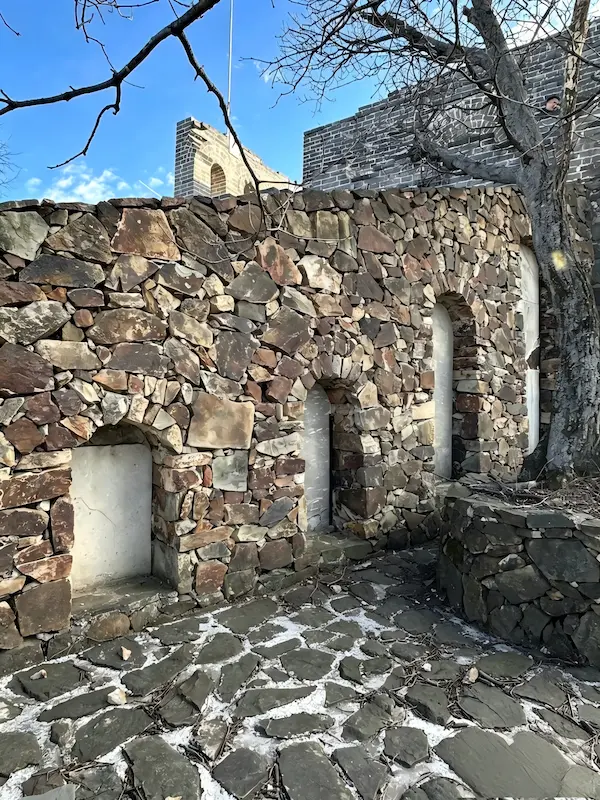
Today, the scenic area has restored a dedicated stele corridor. As you walk among these weathered stone inscriptions, take a moment to pause and read the raised Wei-style and regular script characters.
Some inscriptions have weathered away to just a few characters, yet you can still sense the inner excitement of those who stood here long ago, gazing upon the vast northern wilderness.
For instance, on one weathered stele, phrases like “Autumn deepens on the frontier” and “A lone city at sunset” are faintly discernible. Standing in the same spot, gazing at the same mountains and windswept sands, those lines from four hundred years ago suddenly come alive.
While other sections of the Great Wall leave behind the cold remnants of muskets and arrowheads, and dried bloodstains, Jiuyan Tower preserves a spirit of poetry and the scent of ink. This unique blend of martial history and literary elegance offers a profound cultural experience that you simply cannot find at Badaling or Mutianyu.
Photography and Visuals: Capturing the “Three Dragons Dancing” from the 1,141-Meter Summit
Jiuyanlou is a photographer’s paradise, but its beauty differs from the“danger ”of Jiankou and the“lines ”of Jinshanling. Its beauty lies in the grand imagery created by its sheer height.
Skyline Shot: Where Three Great Dragons Converge
Standing on the roof of the Nine-Eyed Tower and looking southeast, you can see a winding section of the Great Wall undulating along the ridgeline, stretching all the way to the horizon—that is the Jiankou Great Wall. On a clear day, you can even catch a glimpse of the three-pronged watchtower at Beijing Knot.
Looking north, the farmlands, villages, and reservoirs of the Yanqing Basin are all within view. The watchtowers of the Outer Great Wall resemble a string of gray chess pieces, sparsely scattered across the low hills and ridges to the north.
Looking southwest toward the Inner Great Wall, the vista stretches endlessly. The three branches of the Great Wall resemble three giant dragons parting ways at the foot of Jiuyan Tower.
The best vantage point is a rocky outcrop on the west side of the Nine-Eyed Tower. Standing there, you can frame the tower in the foreground, with the rolling Yanshan Mountains and the winding Great Wall stretching into the distance.
Using a telephoto lens compresses the sense of space, allowing the watchtowers of Jiankou and the ruins of the Nine-Eyed Tower to appear in the same frame—a truly breathtaking sight.
If you stand on the Nine-Eyed Tower and look toward the southeast, you’ll see several ridgelines that appear as if carved by a knife or hewn by an axe—wild and untamed. This is none other than the ultimate pilgrimage site of the Wild Great Wall, a legendary destination in the world of the Great Wall.
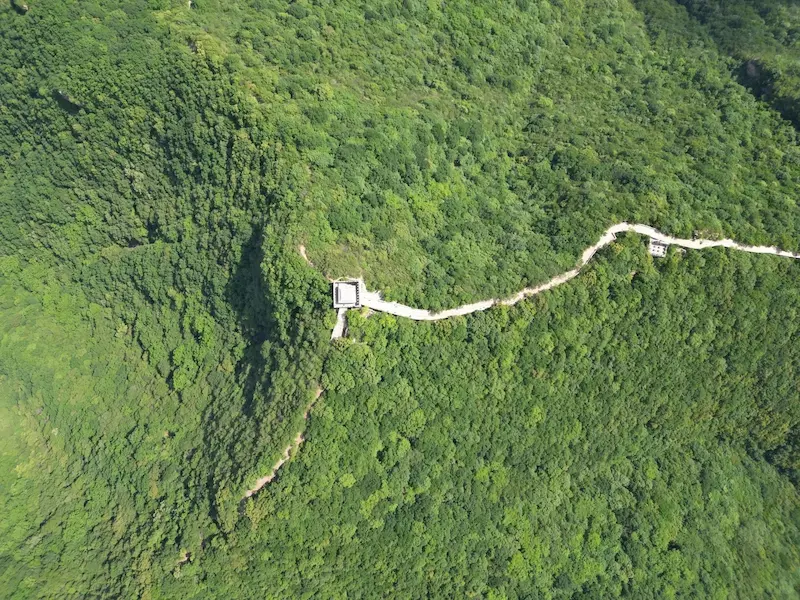
If you want to learn more about this heart-pounding, bone-shaking stretch of the Great Wall, head straight to my guide, Jiankou Great Wall Guide: Eagle’s Flight, Inverted Climb, and Sky Ladder—The Ultimate Pilgrimage to the Wild Great Wall and Safety Guide (2026).
Spectacular Moment 1: Frost-Covered Jiuyan Tower (Late October–Mid-November)
With an elevation of over 1,000 meters, the Jiuyan Tower section is one of the first along the Great Wall near Beijing to welcome rime ice, frost-covered trees, and the first snowfall.
Visit here during the transition from autumn to winter, and you’ll capture the striking contrast: while the mountainside below is still ablaze with crimson foliage and autumn colors at their peak, Jiuyan Tower atop the peak is already draped in a pristine white mantle of snow against its blue-gray bricks.
Sunlight filters through the icicles hanging from the branches, casting light on the ruined walls of the watchtower, making the entire structure appear as if it were edged with a layer of white fur.
Best time to visit: Late October to mid-November, in the early morning (within half an hour after sunrise). Be sure to check the weather forecast in advance; the best conditions occur when temperatures drop, or snow falls the day before, followed by clear skies the next day.
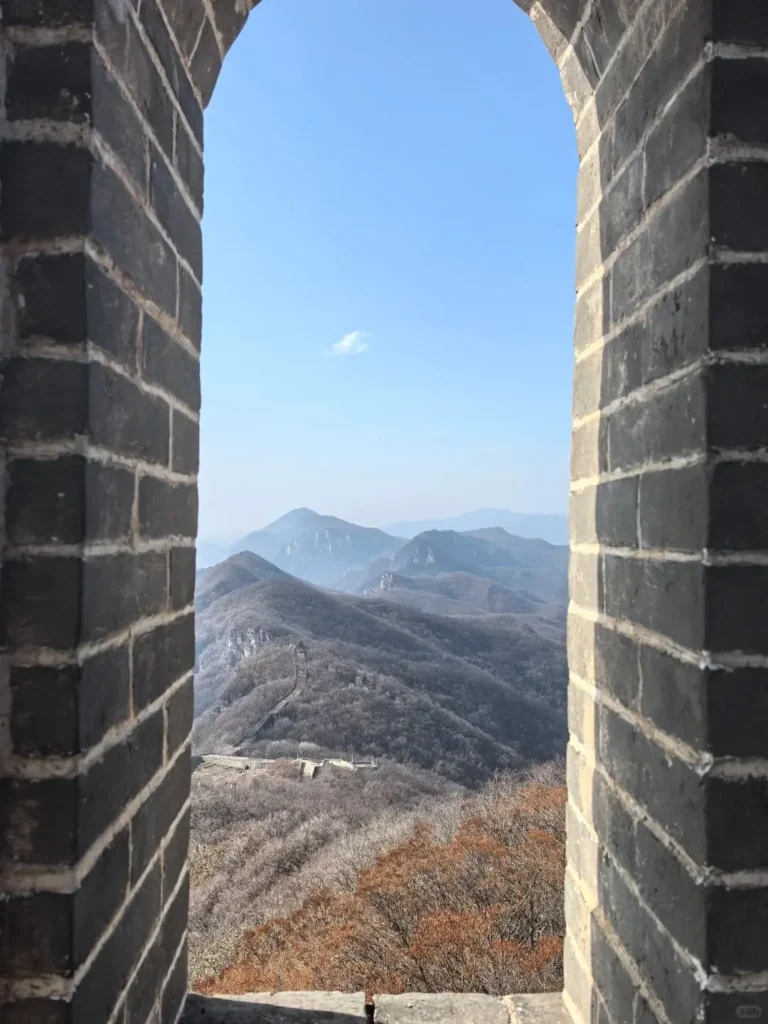
Stunning Moment 2: Snow-Covered Ruins (Winter)
In the depths of winter (December–February), heavy snow completely blankets the Flame Mountain. Snow piled up on the ruins of the Nine-Eyed Tower reaches ankle-deep, and icicles hang from the arrowslits.
Standing inside the tower and looking out, the entire world is nothing but white and gray. The wind is so strong that it forms ridges of snow.
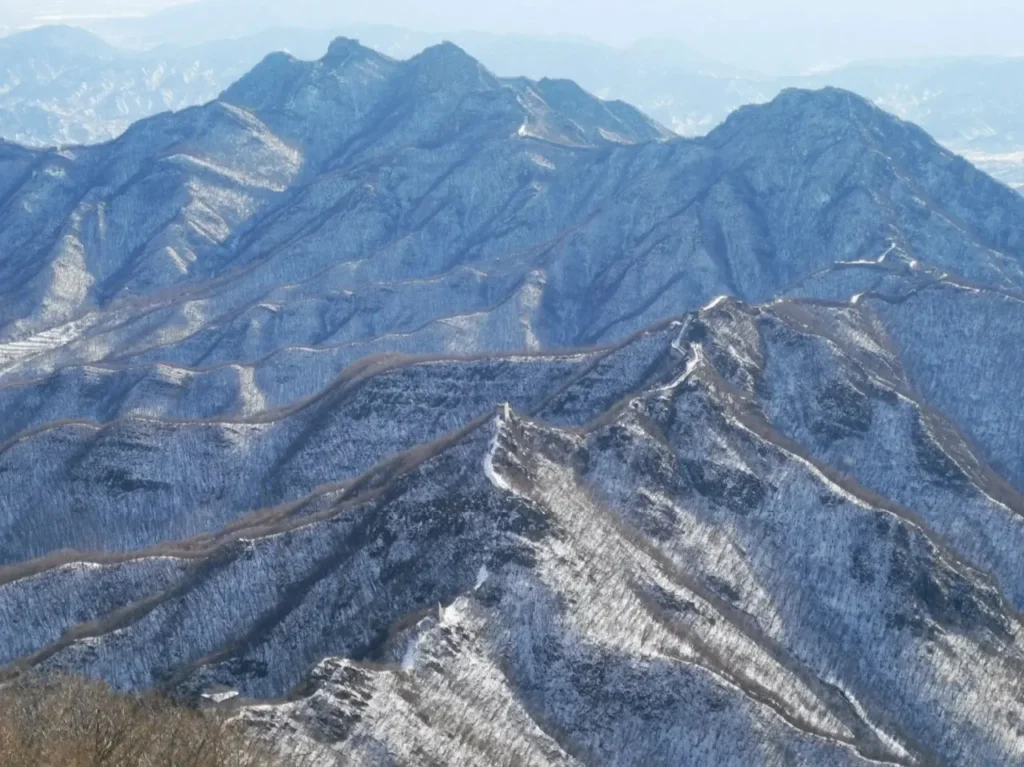
⚠️ Winter Hiking Hazards: The trails are covered in snow and ice, and the steps are extremely slippery. Do not attempt the climb without crampons and professional hiking boots. Most photographers choose to visit two or three days after a snowfall, once the main path has been packed down.
Stunning Moment 3: City Lights and the Vast Starry Sky (Clear Summer and Autumn Nights)
On a clear night with exceptional visibility, standing on the roof of Jiuyan Tower, you can use a telephoto lens to capture the dazzling city lights of the Yanqing Basin to the north, while looking up reveals the deep Milky Way stretching across the ancient watchtower.
Jiuyan Tower is one of the few Great Wall photography spots near Beijing where you can capture both the Milky Way and city lights simultaneously. This is due to its high elevation and the absence of significant light pollution from nearby cities.
On exceptionally clear summer nights (August–September), you can stay from dusk until late into the night: capture the silhouettes of the ruined walls during the “blue hour” half an hour after sunset, photograph the arch of the Milky Way in the dead of night, and take long-exposure shots of the lights of Yanqing’s urban area at dawn.
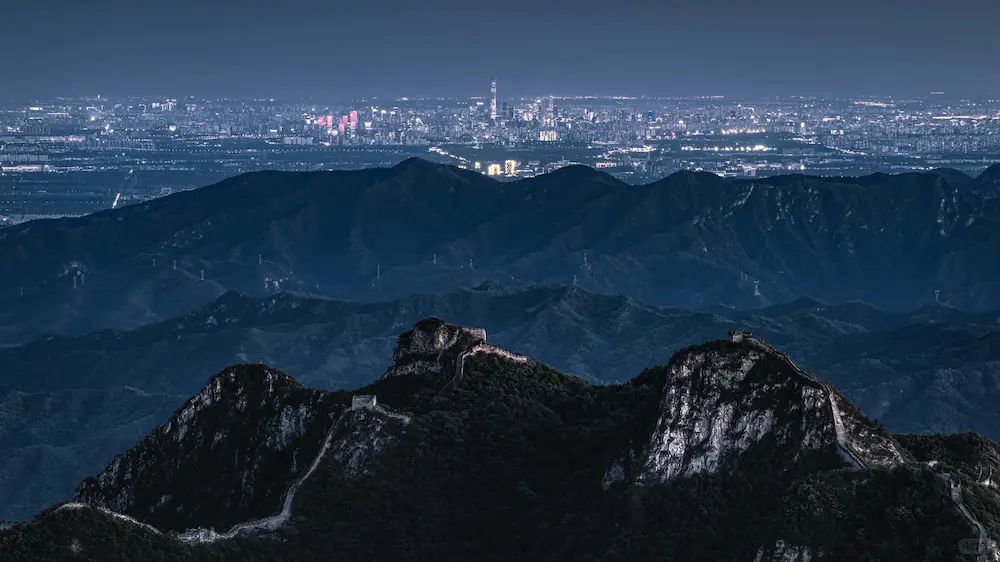
⚠️ However, hiking at night is extremely dangerous: the trail from the scenic area entrance to the summit has no streetlights, and the summit is windy with low temperatures. Only experienced, well-equipped photographers should attempt this; ordinary people should not attempt a night hike lightly.
You must also ascend before sunset and descend in the dark after photographing the night sky—a headlamp, warm clothing, and traveling in a group are all essential.
Practical Guide for Visitors
Choosing Your Route: Enter via Huairou or Yanqing?
Jiuyanlou has two main trailheads: one in Yanqing and one in Huairou. We strongly recommend the Yanqing route.
Route 1 (Recommended): Toward Yanqing—Established Scenic Area Route
- Navigation: “Yanqing Jiuyanlou Great Wall Ecological Tourism Area” (or search for “Jiuyanlou Great Wall Scenic Area”).
- Features: This is a formal scenic area with a main gate, ticket office, parking lot, restrooms, and hiking trails. A wooden boardwalk and stone steps have been built from the main gate to the summit. The entire journey takes approximately 1.5–2 hours (one way), with an elevation gain of about 400 meters. Although it can be tiring, the path is well-maintained and poses no risks associated with off-trail hiking.
- Suitable for: The vast majority of visitors, including families with moderate fitness levels (children must be 10 years or older), outdoor beginners, and photography enthusiasts.
- Important Notes: The scenic area is typically open from 8:30 AM to 5:00 PM (hours may be shorter in winter). Night hikes require prior coordination with the scenic area; night climbing is generally not permitted. It is recommended to arrive before 9:00 AM, reach the summit by noon, and descend before 2:00 PM.
Route 2 (Extremely Dangerous, Not Recommended): Huairou Direction—Wilderness Crossing Route
- Starting Point: Team 5, Xigazi Village, Huairou (entrance to the north slope of the Jiankou Great Wall).
- Route: Head north from Xizazi Village, following the ridgeline to cross several mountain ridges, passing through thickets and rocky slopes, and eventually reaching Jiuyanlou. There are no man-made trails along the entire route; navigation relies entirely on GPS tracks and trail markers.
- Hazards: Thickets that can scratch your face, loose rock slides, and a high risk of getting lost. The one-way trip takes at least 4–5 hours and is extremely physically demanding.
- Suitable for: Only professional outdoor guides and experienced hikers with multiple crossings of Jiankou should attempt this route. Ordinary hikers should absolutely not take this route. Every year, outdoor groups get lost or injured here.
Jiankou should attempt this route. Ordinary hikers should absolutely not take this route. Every year, outdoor groups get lost or injured here.
My recommendation: Stick to the Yanqing Scenic Area route. Although the entrance fee is a few dozen yuan, it’s safe, hassle-free, and the scenery is just as good.
Pre-Trip Weather Check (It’s really cold at the summit!)
The main peak of Jiuyanlou Huoyanshan stands at an elevation of 1,141 meters. According to basic geography, the temperature drops by 0.6°C for every 100-meter increase in elevation.
Additionally, since the summit offers no shelter, wind speeds there are typically 2–3 levels stronger than at the base, making the wind chill at least 6–8°C lower than in the city.
Whether you visit in summer or fall, be sure to pack a windbreaker or a lightweight down jacket in your backpack. You don’t want to be wiping sweat off your brow at the base only to find yourself shivering in the howling winds at the summit—that would ruin any chance of enjoying your photos.
Visiting in winter? Bundle up like a dumpling: three layers—fleece, down jacket, and a windbreaker—plus a hat, scarf, and gloves.
Reservations and Payment
- Search for “Jiuyanlou Great Wall” or “Yanqing Jiuyanlou” in the WeChat Mini Program to make a reservation and purchase tickets using your real name. Foreign visitors can make reservations using their passport number.
- Admission price: Approximately 40 RMB per adult (subject to official announcements).
- The scenic area accepts WeChat Pay and Alipay; ticket windows may also accept cash. We recommend linking your payment method to your phone in advance.
- There are no vendors on the mountain; you must bring your own water and food (at least 1.5 liters per person).
> If you’re still debating whether to spend this weekend relaxing with family or conquering this“First Tower of the Great Wall, ”feel free to return to my master guide,“Beijing’s 9 Great Wall Sections: Badaling, Mutianyu, and More (2026)”, and use the comprehensive comparison chart to help you make your final decision.
Gear and Pre-Trip Checklist
- Warmth: Temperatures on the mountain are 5–8°C lower than at the base, and winds at the summit are consistently at force 4–5 or higher year-round. Even in summer, be sure to bring a windbreaker. In spring and fall, wear a fleece or a lightweight down jacket.
- Knee Protection: Although the trail is well-maintained, the continuous climb of over 400 meters puts significant strain on your knees. We recommend bringing trekking poles (two poles are better), as they can significantly reduce the impact on your knees during the descent.
- Footwear: Regular sneakers are acceptable, but non-slip hiking boots are preferable. Some sections of the stone steps have been worn smooth and become even more slippery after rain.
- Sun protection: The high altitude means strong UV rays. If visiting in summer, be sure to apply sunscreen and wear a hat.
- Water and food: There are no food or water supplies at the summit. We recommend that each person bring 2 bottles of water plus bread or energy bars.
Transportation
- By Car (Highly Recommended): Set your GPS to “Yanqing Jiuyanlou Great Wall Scenic Area.” From downtown, take the Beijing-Lhasa Expressway (G6), exit at Yanqing Urban Area, and continue along Ansi Road or the county road for about 30 minutes. The total journey takes approximately 1.5–2 hours. Parking is available at the scenic area.
- By Bus (Not Recommended): Take a bus from downtown to Yanqing (e.g., the 919 Express Line), then take a taxi to the scenic area (about 20 km). This takes a long time and is not recommended.
The Nine-Eyed Tower was not built as a shield for a single battle. It served as the watchful eye of the entire Ming defense line.
Only when standing at this height can one truly grasp the immense national resources that were poured into safeguarding these mountains and rivers back then—the artisans summoned from the south, the soldiers conscripted from every province, and the silver allocated from the imperial treasury. The weathered steles left behind by literati, the soot marks in the arrow slits, and the walls cracked by the wind—all bear witness to the blood and tears of centuries past.
If Jiankou represents the ultimate in the Great Wall’s rugged terrain and Jinshanling the pinnacle of its architectural achievement, then the Nine-Eyed Tower stands as a symbol of the Great Wall’s height and vantage.
- If you stand on the Nine-Eyed Tower and find yourself drawn to those wild, steep ridgelines in the distance, that is none other than the famed Jiankou. Please see “Jiankou Great Wall Guide: Eagle-Flying Inversion and the Sky Ladder—The Ultimate Pilgrimage to the Wild Great Wall and Safety Guide (2026)”.
- If you’ve developed a keen interest in massive single-structure Great Wall sites like Jiuyan Tower and want to witness the pinnacle of architectural artistry, don’t miss “Jinshanling Great Wall Guide: Barrier Walls, Inscribed Bricks, and Great Wall Sunsets—A Photographer’s Paradise (2026)”.
- Or return to the main guide page, “Beijing’s 9 Great Wall Sections: Badaling, Mutianyu, and More (2026)“, and use the comprehensive comparison chart to plan your next weekend getaway.
Jiuyanlou wasn’t built as a shield for a single battle; it was the eye of the entire defensive line. Standing here, you’re not looking at just a section of wall—you’re witnessing the full ambition of an empire.