Beijing Beihai Park: Spring Visitor Guide | Flower Viewing, Routes, Tickets, and Travel Planning
If this is your first visit to Beijing in the spring and you’re looking for a spot in the city center where you can enjoy an imperial garden, spring blossoms, and views of White Pagoda Lake all at once, Beihai Park is a great choice to add to your itinerary.
Having lived in Beijing for over a decade and visited Beihai Park numerous times, I can personally attest that spring is the best season to experience this millennium-old imperial garden.
This guide will provide detailed information on the park’s must-see spring attractions, the best time to visit, transportation options, ticket details, and super-useful travel tips to help you easily plan a perfect spring trip to Beihai Park.
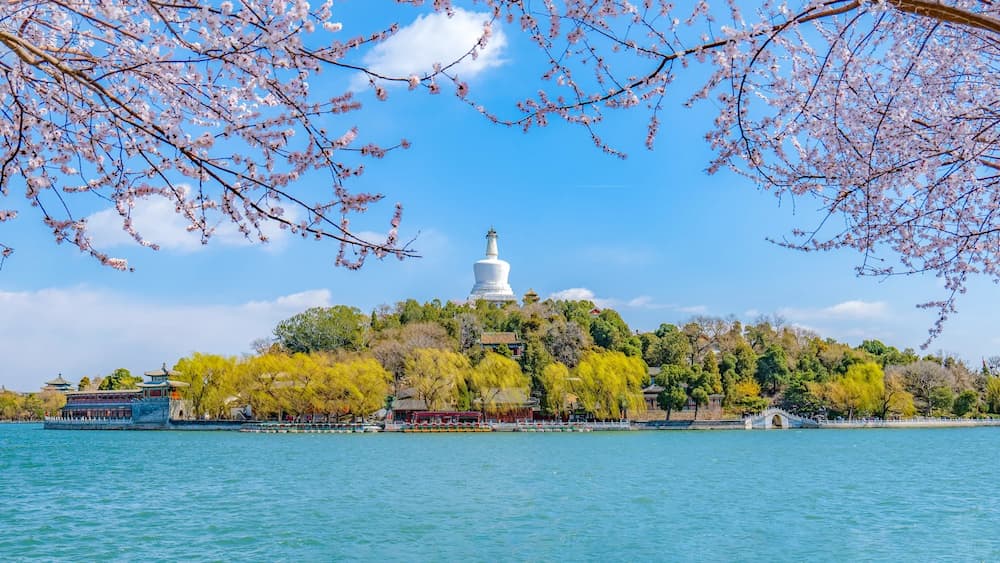
Table of Contents
What Kind of Visitors Is Beihai Park Best Suited For?
✅Ideal for
- Visitors to Beijing who want to experience a classical imperial garden and enjoy lake views, historic architecture, and spring flowers
- Those who prefer strolls and don’t enjoy strenuous hikes or brisk walks
- Photography enthusiasts looking to capture the White Pagoda, red walls, spring blossoms, and the lake all in one frame
- Those planning a one-day itinerary that combines Beihai Park with Jingshan Park and Shichahai
⚠May not meet your expectations
- If your schedule is very tight and you only have a brief half-hour stop
- If your main goal is to visit exhibition halls featuring major historical artifacts and ancient architecture
- If you prefer long-distance hiking and mountain climbing activities
5 Things to Know Before Your First Visit to Beihai Park
1. The main attraction of Beihai Park in spring isn’t any single type of flower, but rather **the overall landscape created by the combination of spring blossoms, the White Pagoda, the lake, historic architecture, and the willow-lined embankment**.
2. You don’t need to walk through the entire park; if time is limited, prioritize visiting Qionghua Island, the White Pagoda, the Five-Dragon Pavilion, and the spring flower-viewing areas.
3. The North Gate isn’t necessarily the best or only entrance; your choice of entrance depends on your previous itinerary—different starting points call for different gates.
4. The spring blooming season is affected by temperature fluctuations each year, so the exact timing of the flowers’ bloom isn’t set in stone.
5. This place is better suited for a stroll rather than a high-intensity, nonstop sightseeing marathon.
General Spring Flowering Season Guide (For reference only; subject to annual temperature variations)
| Time | Key Spring Scenery Highlights |
| Early to mid-March | Willows along the lake turn green again; early spring scenery |
| Late March | Spring flowers such as magnolias and Chinese cornel begin to bloom in succession |
| Early April | The scenery of flowers and willow-lined embankments is at its most vibrant |
| Mid- to Late April | Most early spring flowers have finished blooming, but the park’s lakeside scenery remains beautiful |
Tip: Before visiting, check the park’s official flower bloom updates.
4 Must-See Spots in Beihai Park This Spring
Willow-Lined Lakeside
The willow trees along the park’s lakeshore and around Qionghua Island are among the first to come alive in spring. Tender yellow buds adorn the slender branches; as a gentle breeze blows, countless willow branches sway lightly over the water.
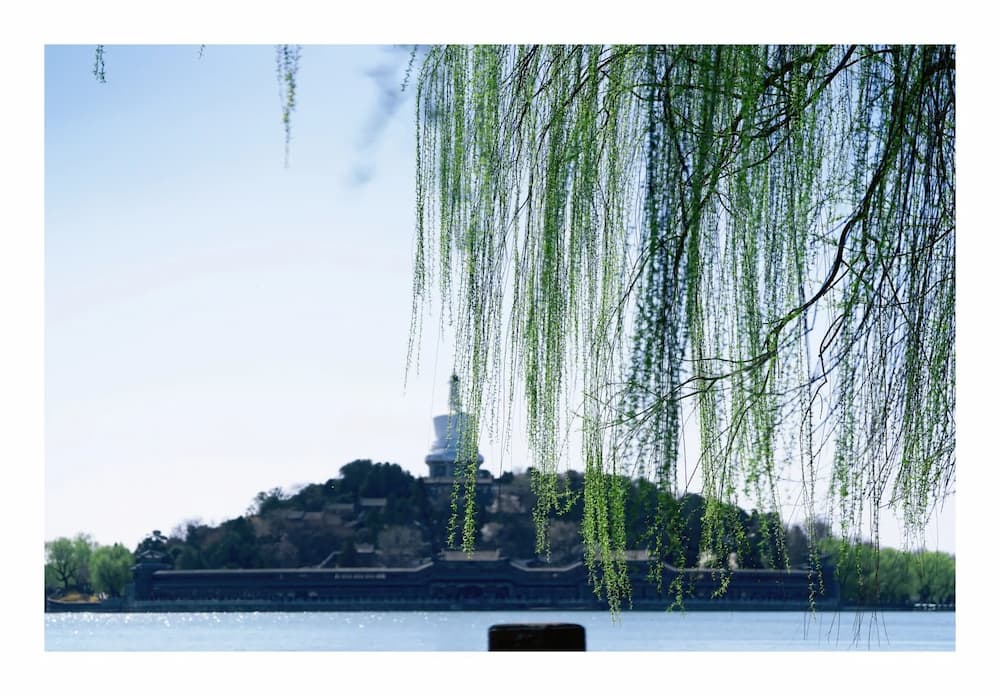
From a distance, they appear as a hazy patch of pale green, banishing the gloom of winter and fully revealing the gentle beauty of spring. This is Beihai Park’s most iconic spring scene.
We recommend walking along the lake from the east shore to the north shore to experience the poetic beauty of the willow branches skimming the water up close.
On-site Tip: We recommend walking along the east shore to the north shore—the entire route is flat, and you can enjoy the willow-lined embankment and the lake as you walk. We suggest spending 10–15 minutes here.
Magnolias and Cornelian Cherries at Chanfu Temple
Chanfu Temple is a classic ancient architectural complex within the park. In spring, the white magnolias bloom as expected here. Their pure white petals contrast beautifully with the red walls and gray tiles, creating an elegant and photogenic scene—one of the best spots for spring photography in Beihai Park.
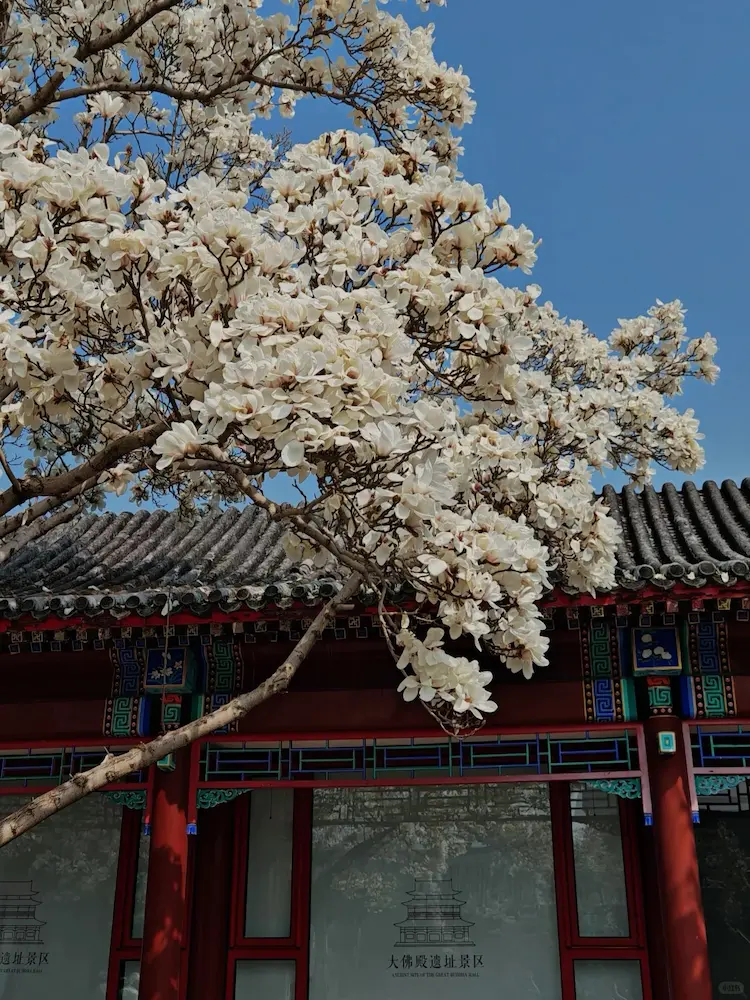
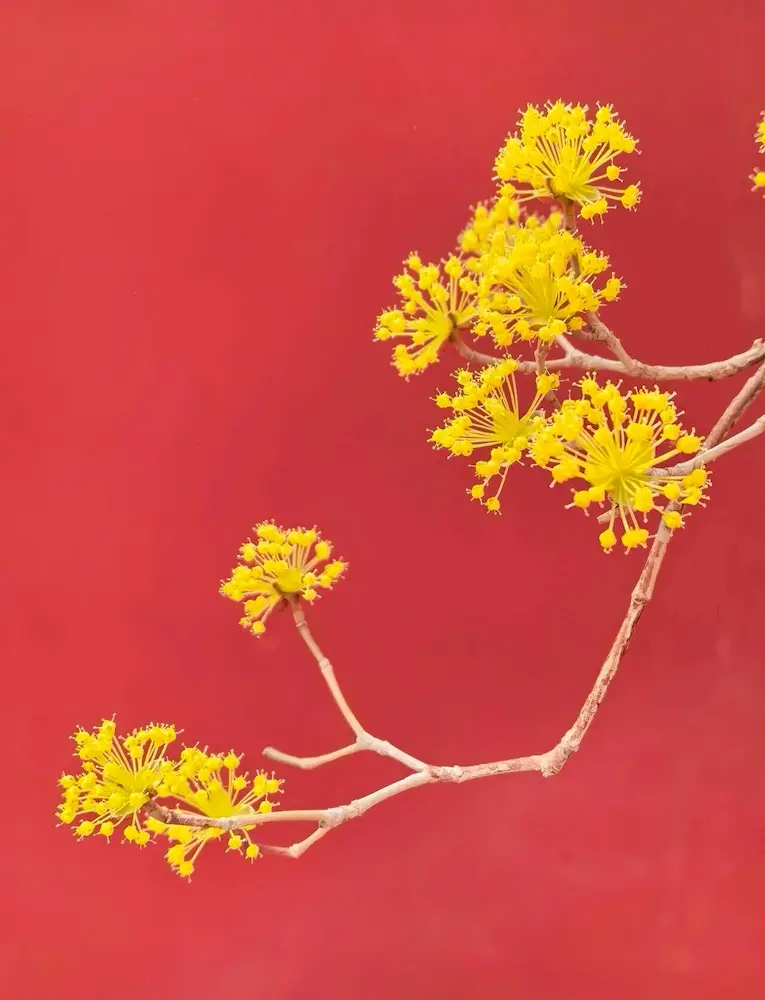
Beneath the red walls, the Chinese cornelian cherry trees bloom with delicate, golden flowers, their branches heavy with blossoms.
According to legend, this is the very plant mentioned by the Tang Dynasty poet Wang Wei in his verse: “I know from afar that my brothers have climbed high, all wearing cornelian cherry wreaths—but one is missing.”
On-site Tip: The North Gate is the closest entrance to Xuanfu Temple; if you want to take photos of the red walls and spring flowers with fewer people in the frame, try to arrive early; we recommend spending 15–20 minutes here, and after exploring, you can walk south toward the Five-Dragon Pavilion.
View of the Five-Dragon Pavilions and the White Pagoda
Not far south of Chuanfu Temple lie the Five-Dragon Pavilions. These five pavilions are built right by the water. Standing inside one of them and looking across to the opposite shore, you can take in the entire Beihai White Pagoda on Qionghua Island—this is the classic vantage point for photographing the pagoda.
If you wish to capture the pagoda’s reflection on the lake, we recommend choosing a windless early morning, when the lake’s surface is as calm as a mirror, and the pagoda’s reflection is as clear as a painting.
On-site Tip: A windless morning is the best time to photograph reflections; on windy days, it’s difficult to capture a complete reflection on the water’s surface. You can take a short break here before continuing on to Qionghua Island. We recommend staying for 10–15 minutes.
Spring Magnolias at Wenjin Academy
Continuing south toward Wenjin Academy, several spring magnolias bloom quietly in the spring. Their delicate pink petals complement the academy’s antique architecture perfectly.
The combination of ancient buildings and blooming flowers creates a truly atmospheric scene, making this a hidden gem for spring photography.
On-site Tip: This site is located relatively far to the south; if you’re short on time, you may want to prioritize visiting Chanfu Temple and Wulong Pavilion first. We recommend spending about 10 minutes here.
Multiple Spring Sightseeing Itineraries—Just Follow These Step-by-Step Guides
①⏱1-Hour Quick Tour (A stop along the way, such as after visiting Jingshan Park or the Forbidden City)
Enter through the nearest gate→Wulong Pavilion→Chanfu Temple flower-viewing area→Willow-lined embankment by the lake→Exit through the nearest gate
Tip: Skip Qionghua Island and focus only on the core spring sights—perfect for those on a very tight schedule.
②⏱2-Hour Top-Recommended Itinerary (Most Visitors’First Choice)
Enter through the North Gate→Chanfu Temple (magnolias, cornelian cherries)→Walk south to the Five-Dragon Pavilion→Stroll along the lakeside willow-lined embankment→Climb Qionghua Island to explore the area around the White Pagoda→Exit via the same route or another gate
Tip: There are a few steps on Qionghua Island; proceed at your own pace.
③⏱Half-Day Leisurely Tour (Specifically Designed for Spring Garden Visits)
Enter through the North Gate→Chanfu Temple→Wulong Pavilion→Willow-Lined Embankment by the Lake→White Pagoda on Qionghua Island and Yong’an Temple→Optional boat ride on the lake→Stroll through the garden; exit via the South Gate or East Gate.
Beihai Park Spring Photo Checklist (Feel free to screenshot and save)
□ The White Pagoda reflected in the lake
□ The White Pagoda and spring willows along the shore
□ The red walls of Chanfu Temple and magnolias
□ A panoramic view of the White Pagoda framed by the Five-Dragon Pavilion
□ Ancient architectural walls and spring blossoms
□ The reflection of the White Pagoda on the calm lake (on a windless morning)
How to Get to Beihai Park
Visiting for the first time? Which gate should you choose?
| Your previous stop | Recommended entrance | Notes |
| Coming from Shichahai / Taking Metro Line 6 | North Gate (Beihai North Station) | Closest to the spring flower-viewing spots at Chanfu Temple and the Five-Dragon Pavilion |
| Just finished touring Jingshan Park and the Forbidden City | East Gate or South Gate | Allows you to visit attractions along the Imperial City route |
| 2-Hour Main Flower-Viewing Route | Prioritize the North Gate | To minimize detours |
Subway
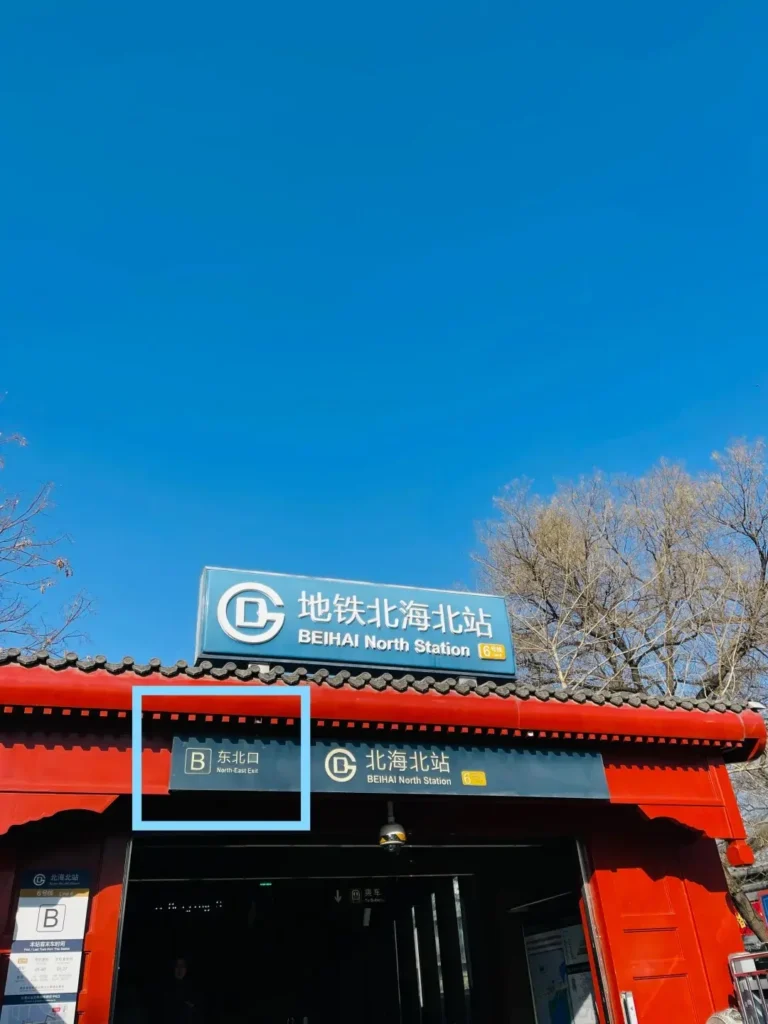
Take Subway Line 6 to Beihai North Station. Exit at Exit B (Northeast Exit) and walk about 400 meters (5 minutes) to reach the park’s North Gate.
Bus
Take bus routes 5, 101, 103, 109, 124, or 128 and get off at Beihai Station or Beihai North Gate Station. From there, it’s a short walk to the corresponding park entrance.
The North Gate is convenient for visitors arriving by subway who are planning to see the spring blossoms, but it is not necessarily the best option; your choice of entrance should depend on your itinerary at the previous stop.
Ticket Information and Opening Hours
Should You Buy a Combo Ticket?
- If you plan to visit Qionghua Island and explore key attractions such as Yong’an Temple, we recommend purchasing a combo ticket;
- If you only plan to take a stroll along the lake and admire the spring flowers, the basic admission ticket is sufficient.
ℹAll ticket prices and operating hours are subject to the park’s latest official announcements.
- Ticket Prices: Peak Season (April 1–October 31) – Standard ticket: 10 RMB/person; Combined ticket (includes core attractions such as Qionghua Island and Yong’an Temple): 20 RMB/person; Off-season (November 1–March 31 of the following year) – Standard ticket: 5 RMB/person; Combined ticket: 15 RMB/person.
- Booking Method: Reservations can be made via the official platform “Changyou Park.” The website’s interface can be switched to English in the top-right corner. The WeChat mini-program “Changyou Park” also supports ticket purchases, with English assistance available for some processes. The booking link can be viewed and used via browser translation.
- Opening Hours: Peak Season 6:30 AM–9:00 PM (last entry at 8:00 PM); Off-Season 7:00 AM–8:00 PM (last entry at 7:00 PM).
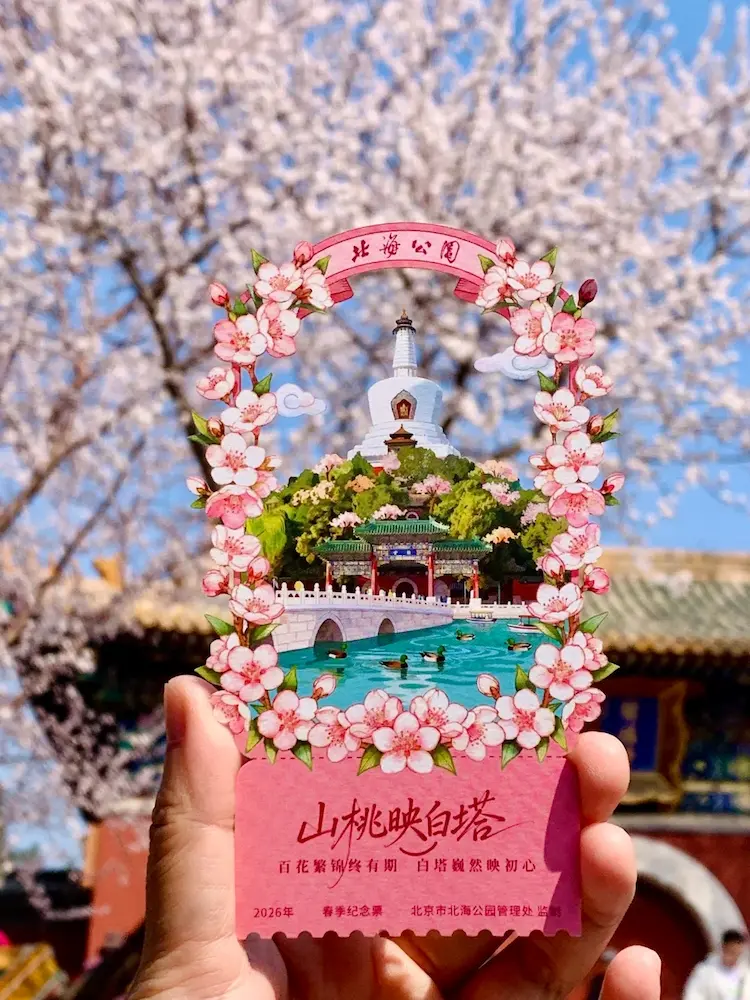
When is the best time to visit Beihai Park in the spring?
- ✨ To avoid large crowds: Try to arrive early on weekdays; on weekends, we recommend entering the park before 8:00 a.m.
- To photograph the White Pagoda’s reflection on the water: Choose a windless early morning.
- If your main goal is to view the flowers: Check the official flower bloom updates for that year.
- For a stroll and sightseeing: After 3:00 p.m., the warm light is ideal for photographing the lake scenery, but some spots may be backlit.
Early Morning (Best Time for Photography)
From 8:00 to 9:30 a.m. is the best time to visit and take photos in Beihai Park during spring. The light is soft and balanced at this hour, creating a perfect atmosphere for capturing the combination of blooming flowers and ancient architecture.
You may also chance upon locals doing morning exercises at the Five-Dragon Pavilion or walking their birds by the lake, allowing you to experience the most authentic Beijing morning scenery.
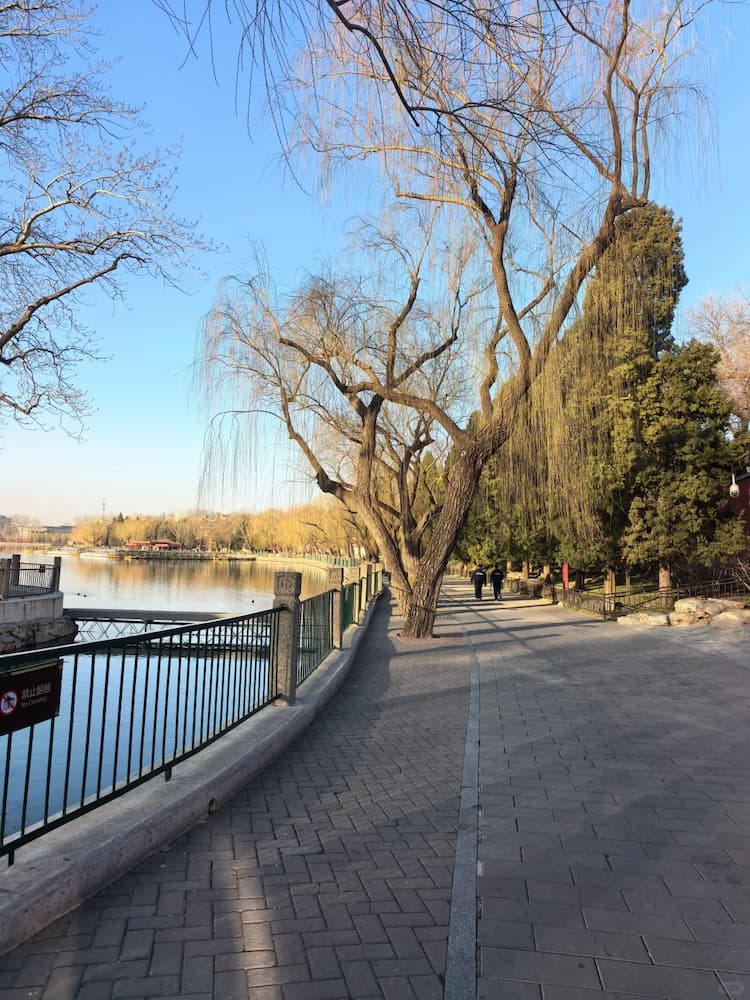
Afternoon (Warm Light for Sightseeing)
If you enter the park after 3:00 PM, the sunlight takes on a warm hue as it cascades over the lake and the White Pagoda, creating stunning light and shadow effects.
This is the perfect time to capture the White Pagoda and the lake in the same frame. Note that some areas near the lake may be backlit, so it’s best to choose your shooting spot in advance.
Visiting early in the morning is the best way to avoid crowds. Before 9:00 AM on weekdays and before 8:00 AM on weekends, the park is relatively empty, allowing you to enjoy the flowers and take photos in peace for a more immersive experience.
Estimated Budget (Per Person)
Beihai Park is a highly cost-effective Beijing attraction. There are no mandatory purchases during the tour, and optional expenses such as boat rides and nearby dining are entirely up to you. The following is a per-person budget guide, with exchange rates estimated in real time:
Note: The prices below are in RMB for reference; for foreign currencies, please convert using the exchange rate on the day of your trip.
| Item | RMB |
| Peak Season Combo Ticket | 20 RMB |
| Park Boat Ride (Optional, charged by the hour) | 80–120 RMB/hour |
| Simple lunch near the park | 30–60 CNY |
Overall, Beihai Park is an excellent budget-friendly destination in Beijing; the admission fee alone allows you to experience the spring beauty of this imperial garden.
Nearby Itineraries That Can Be Combined with Beihai Park
Combination 1|Jingshan Park + Beihai Park
Ideal for first-time visitors to Beijing who want to experience both an imperial garden and panoramic views from the city’s highest vantage point.
Combination 2|Beihai Park + Shichahai
After visiting the imperial garden, explore the hutongs and lakeside area for a leisurely stroll.
Combination 3 | Beihai Park + Nanluoguxiang
After exploring the garden, experience a city walk through the hutongs.
Combination 4 | Beihai Park + White Pagoda Temple, Zhuan Ta Hutong
Ideal for visitors interested in the history of old Beijing’s streets and alleys.
Jingshan Park Guide | Shichahai Travel Guide | Zhuan Ta Hutong Guide
Practical Travel Tips (Important)
✅ Try to arrive at the park early to avoid the crowds after 9:30 a.m., especially on weekends, when visitor numbers increase significantly after 10:00 a.m.
✅ The park is primarily designed for walking, and the entire tour takes about 2–3 hours. Be sure to bring your own drinking water, as there are few places to buy it inside the park.
✅ If you want to photograph the red walls of Chuanfu Temple with the cornelian cherry trees without crowds, arrive before 9:00 AM, when visitor numbers in this area are at their lowest.
✅ There are no large dining areas within the park; you can head to nearby restaurants after your visit. There are various snack stands and restaurants near the North Gate.
4 Travel Tips for Foreign Visitors to Beihai Park
1. Book Tickets in Advance: The “Changyou Park” platform supports real-name reservations using a passport; you can use a web translator to assist with the process;
2. Payment: For purchases inside the park, prioritize WeChat Pay and Alipay; carry a small amount of cash as a backup; Guide to Using Alipay for Foreigners;
3. Navigation: Search for “Beihai Park” in Chinese on your phone’s map app; avoid searching only in English;
4. Itinerary Planning: Plan your next stop to easily connect to nearby attractions such as Jingshan Park and Shichahai.
FAQ
A Few Practical Tips from the Author: If I had to give just one tip for visiting Beihai Park in the spring, it would be this: enter through the North Gate early in the morning. This allows you to avoid the crowds and catch the best light for photos. Once inside, head straight to Chuanfu Temple to experience the stunning scenery of red walls and blooming flowers.
Additionally, after exploring Beihai Park, take a stroll through the Shichahai area just outside the North Gate. This neighborhood offers authentic Beijing hutong charm, along with plenty of Western restaurants, cafes, and local snacks.
By combining a visit to the imperial garden with the laid-back hutong lifestyle, you can experience two distinct sides of Beijing in a single trip.
Author’s Note: This article is based on multiple on-site visits and a compilation of publicly available information from the park. Flowering seasons, admission prices, and opening hours are subject to change; please check Beihai Park’s official announcements before visiting.