Guide to the White Pagoda at Miaoying Temple: Beijing’s Oldest Tibetan-Style Stupa + Best Photo Spots + Transportation & Tickets (Updated for 2026)
Last Updated: Jul. 2026
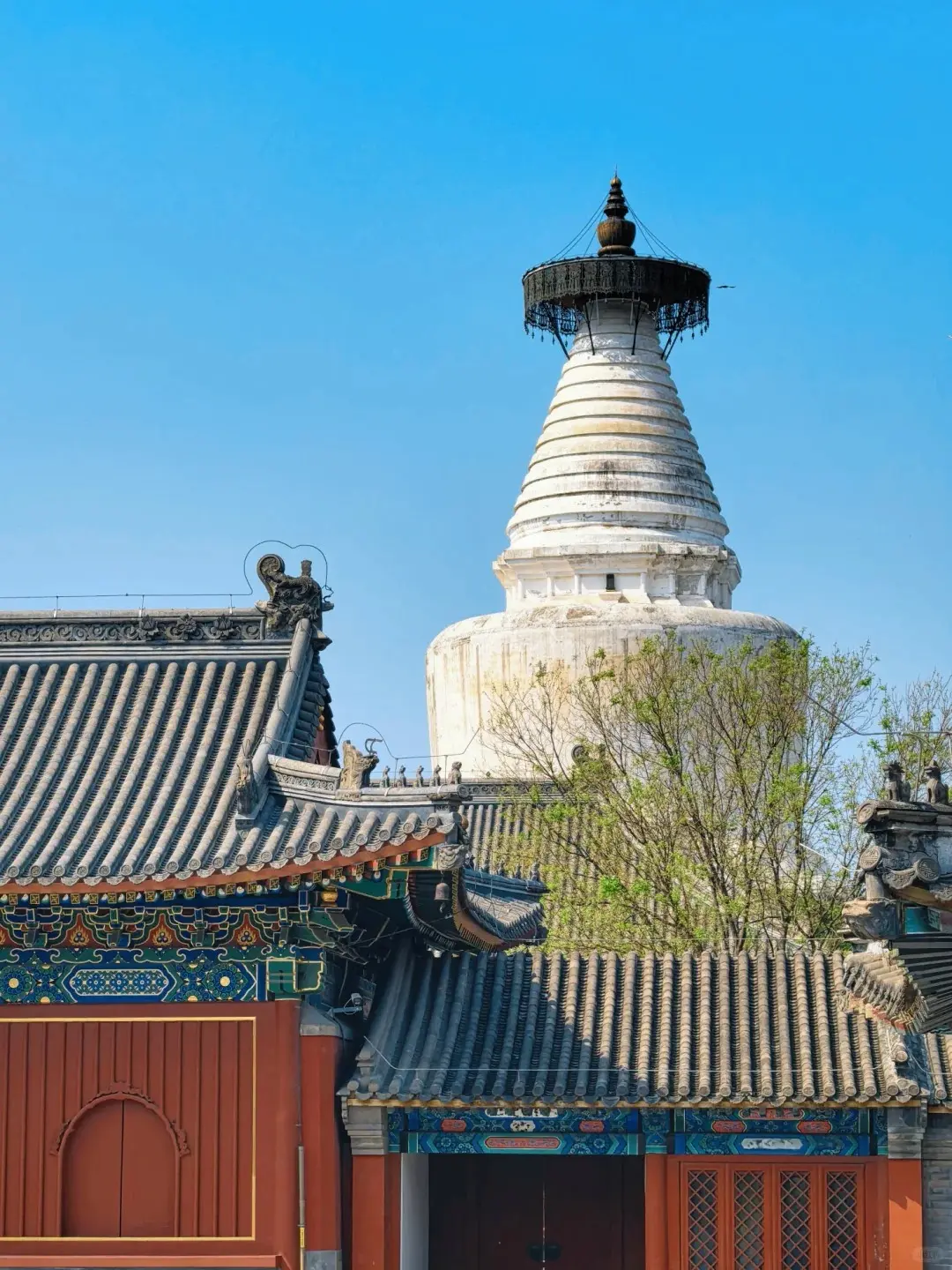
The oldest and largest surviving Tibetan-style stupa in Beijing predates the White Pagoda at Beihai Park by nearly 400 years. Commissioned by Kublai Khan and designed by the Nepalese architect Anige.
Admission is 20 yuan (approx. $2.80). Take Exit B at Fuchengmen Station on Subway Line 2, then walk 800 meters. With red walls, a white stupa, and hutong cafes, every snapshot turns into a masterpiece.
Table of Contents
Practical Information (Must-Read Before You Go)
| Item | Details |
| Name | Miaoying Temple (Baitasi) (commonly known as Baitasi Temple) |
| Address | No. 171, Fuchengmennei Street, Xicheng District, Beijing |
| Subway | Line 2, Fuchengmen Station (`Fuchengmen Station`), Exit B (Northeast Exit), then walk east for about 800 meters (approximately 10 minutes). Alternatively, take Line 4 to Xisi Station, then walk west for about 900 meters. |
| Bus | Routes 3, 13, 42, 101, 102, 103, 409, and 612 to the “Baitasi” stop |
| Driving | Not recommended. The surrounding alleys are narrow, and there is no parking lot at the site. When taking a taxi, use the destination “Miaoying Temple White Pagoda” or “Baitasi Dongjiadao”. |
| Admission | 20 RMB (approx. $2.80). Half-price tickets are 10 RMB (for students, seniors, etc.). Free for members of the Beijing Trade Union. Special Note for Foreign Visitors: No WeChat reservation is required. Please bring your original passport and proceed directly to the on-site ticket window to present your passport and purchase a paper ticket. On-site ticket purchases accept cash or mobile payments. |
| Hours | Tuesday–Sunday 9:00 AM–5:00 PM (last admission at 4:30 PM); closed on Mondays. |
| Best Times | Before 10:00 AM or after 3:00 PM on weekdays. In the morning, light streams in from the east onto the White Pagoda, making it ideal for photographing the red walls and white pagoda; In the afternoon, light comes from the west, making it ideal for sipping coffee on a hutong terrace and capturing backlit shots. |
| Recommended Duration | 1.5–2 hours (about 1 hour inside the temple, plus 1 hour for photography and coffee in the surrounding hutongs). |
| Dress Code | There is a lot of walking, so wear comfortable shoes. Hats must be removed when entering the main hall. There are many steps inside the temple, but the grounds are generally flat. |
| Budget Guide | Admission: 20 RMB (approx. $2.80). No mandatory purchases inside the temple. Nearby coffee: 30–50 RMB (approx. $4–7). Lunch: 30–80 RMB (approx. $4–11). |
| Photography | Photography is permitted throughout the temple grounds (including the White Pagoda, red walls, and exterior of the halls). Please do not photograph the Buddha statues inside the halls (out of respect for the religious site). |
| Language Support | No English-speaking guides. A few bilingual (Chinese-English) information boards are available inside the temple. We recommend using a mobile translation app. |
Friendly Reminder: The area surrounding the White Pagoda Temple is a living, traditional Beijing hutong community, not a closed-off tourist site. Many people live nearby, so please keep quiet and do not enter private courtyards.
What Is the White Pagoda Temple? Why Is It So Important?
In a nutshell: This White Pagoda is the oldest Tibetan-style stupa in Beijing, predating the White Pagoda in Beihai Park by nearly 400 years. It was commissioned by Kublai Khan, the founder of the Yuan Dynasty, in 1271, and designed and overseen by a Nepalese craftsman named Anige. The White Pagoda was completed in 1279 and has stood for over 740 years.
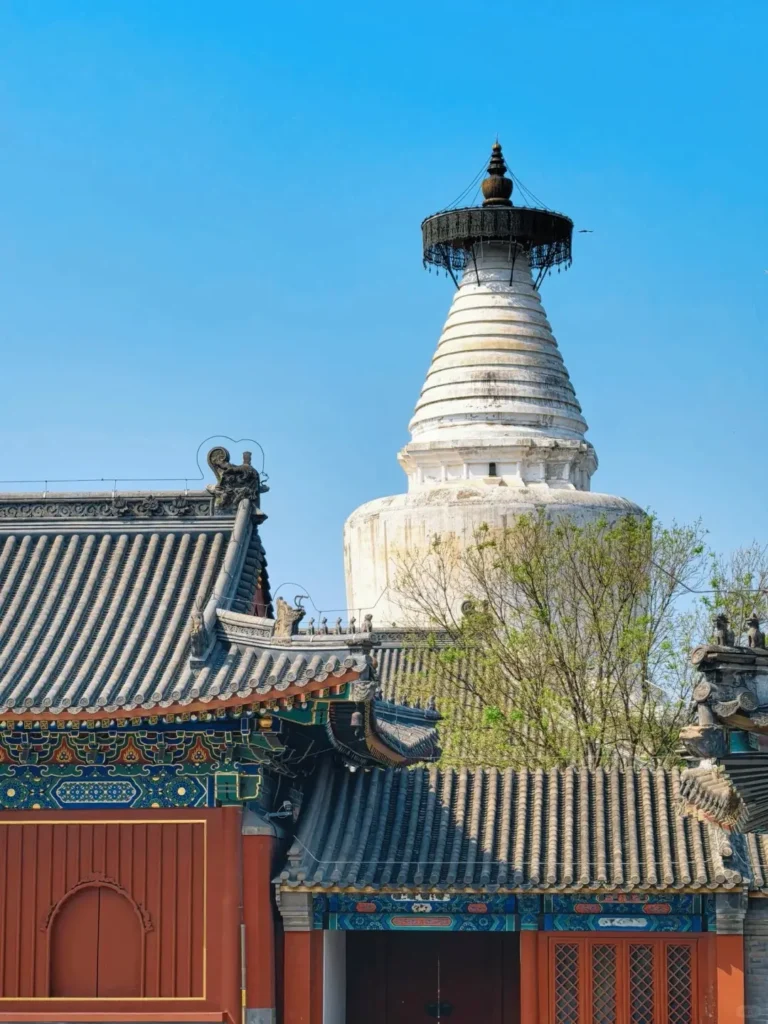
>Cultural Insight: Tibetan-style pagodas (also known as inverted-bowl pagodas or lama pagodas) resemble an upside-down bowl, featuring thirteen concentric rings (called the “Thirteen Heavens,” symbolizing the stages of spiritual cultivation), topped by a canopy (dharani) and a jeweled finial.
> Deeper Meaning: Each part of this stupa represents the five great elements of the universe—
- The base (square Sumeru pedestal) represents Earth (the ground, stability)
- The bowl-shaped body (large white rounded section) represents Water (the source of life, inclusiveness)
- The thirteen-tiered wheel of the heavens (the rings on the tower’s neck) represents Fire (energy, ascent)
- The gilded canopy (umbrella) represents Wind (air, flow)
- The jewel (the pearl at the very top) represents Space / Spirit (transcending all)
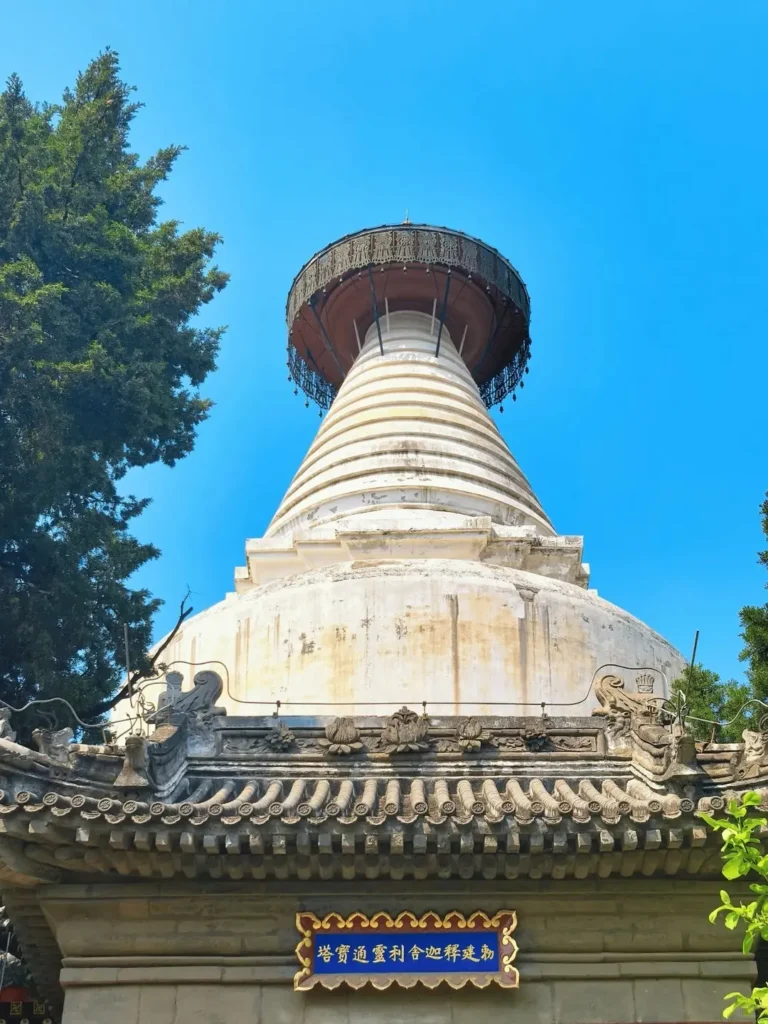
When you look up at the white stupa, you are actually viewing the entire structure of the Eastern cosmos. This is not a simple stupa, but a three-dimensional map of the universe.
Three Key Facts:
1. It is the only intact above-ground structure remaining from the Yuan Dynasty’s capital, Dadu (Beijing). The imperial palace, city walls, and streets of the Yuan Dynasty have long since disappeared, leaving only this White Pagoda standing in its original location.
2. It stands as a living testament to the friendship between China and Nepal. Its designer, Anige, was from Nepal. He traveled to Tibet to build pagodas at the age of 17 and was later highly regarded by Kublai Khan. He also constructed many other Buddhist structures in Beijing.
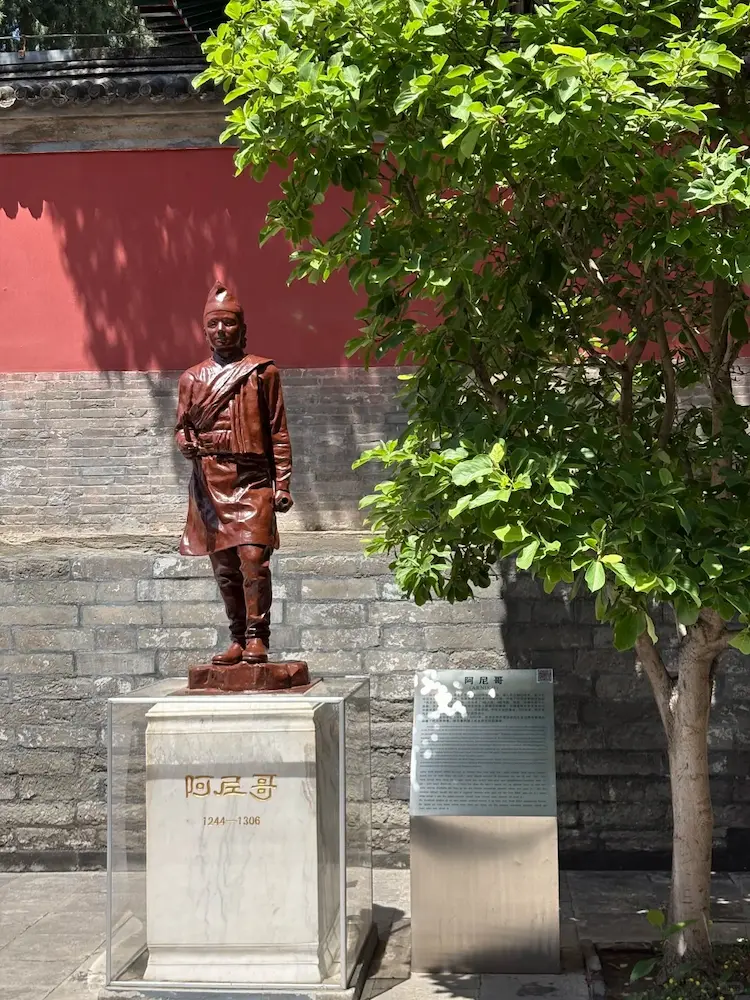
3. Its relationship with the White Pagoda in Beihai Park: The White Pagoda at Miaoying Temple is the “original elder brother,” while the White Pagoda in Beihai Park is the “Qing-dynasty replica younger brother.” The Beihai White Pagoda was built in 1651, nearly 400 years later. One stands in a hutong, while the other is located within an imperial garden.
Historical Accounts of the White Pagoda Temple
| Date | Event |
| 1271 | Kublai Khan orders the construction of the White Pagoda |
| 1279 | The White Pagoda was completed. In the same year, the “Dashengshou Wan’an Temple” was built around it to serve as Kublai Khan’s family temple. The temple complex was massive; it is said that its boundaries were determined by the range of an arrow shot from the top of the pagoda. |
| 1368 | A massive fire caused by lightning reduced all the temple halls to ashes; only the White Pagoda miraculously survived. |
| 1457 (Ming Dynasty) | The temple was rebuilt and renamed “Miaoying Temple.” At this time, the temple adopted the style of Han Buddhism (similar to Han Chinese temples). |
| Qing Dynasty | Under the reigns of the Kangxi and Qianlong emperors, the temple was successively renovated and reverted to Tibetan Buddhism (Gelug School, also known as the Yellow Sect). |
| 1937 | During the fall of Beiping, a resident named Luo Dejun hid a letter at the top of the White Pagoda documenting the atrocities committed by Japanese troops. The letter was not discovered until 1976, during the restoration of the White Pagoda following the Tangshan Earthquake. |
| 1961 | Designated as one of the first batch of National Key Cultural Relics Protection Units. |
The most poignant detail: In 1937, an ordinary citizen named Luo Dejun took part in the restoration of the White Pagoda. He wrote down his anguish over the Japanese bombing and the fall of Beiping on a piece of paper, wrapped it in oil paper, and tucked it into a crack in the wooden structure at the top of the pagoda.
In his letter, he wrote: “Airplanes and cannons are bombing everywhere, causing untold suffering… I write these few words to inform future generations, as a lasting memorial.”
The letter lay hidden for nearly 40 years until it was discovered during restoration work following the 1976 Tangshan earthquake. It is not an official historical record, yet it is the most authentic cry of an ordinary Chinese person.
Architectural Structure: Understanding the White Pagoda
The White Pagoda stands 50.9 meters tall (approximately 17 stories high) and has a base area of 1,422 square meters. From bottom to top, it is divided into four sections:
1. Base: A three-tiered square stepped platform (called a “Summit Base”), which is extremely sturdy.
2. Tower Body: A massive white bowl-shaped structure (resembling a large treasure vase). Note the seven iron bands encircling the exterior of the tower body. Folklore attributes these to the legendary craftsman Lu Ban, though they actually serve to reinforce the structure.
3. Tower Neck: Thirteen circular rings (known as the “Thirteen Heavens” or “Sangharu”), representing the thirteen stages of spiritual cultivation.
4. Spire: A gilded copper canopy (9.7 meters in diameter) with wind chimes hanging below that ring when the wind blows. At the very top sits a 4-ton gilded copper finial.
>The Legend of the “Shadowless White Pagoda”: Old Beijingers say the White Pagoda casts no shadow. In reality, it’s not that it has no shadow, but rather that the pagoda is so tall and thick, and the surrounding alleys are so narrow, that its shadow is projected onto the walls or rooftops on either side, making it invisible from the ground. This isn’t a supernatural phenomenon—it’s geometry.
How to Explore the Temple
The temple faces south. The recommended route is as follows:
Main Gate → Bell and Drum Towers (left and right) → Hall of the Four Heavenly Kings → Great Enlightenment Hall → Hall of the Seven Buddhas → Stupa Courtyard
The Stupa Courtyard is elevated 2 meters above ground level and surrounded by a red wall. Once inside the courtyard, you can walk around the stupa (according to Tibetan Buddhist custom, walking clockwise around the stupa brings great merit).
Points to note when circumambulating the stupa:
- Start on the left (east) side of the stupa and walk clockwise.
- You may silently make a wish, or simply enjoy a stroll.
- There are two ancient Chinese hackberry trees in the Stupa Courtyard; their gnarled trunks are as old as the stupa itself.
The bronze plaque in front of the stupa recounts the story of the Tibetan believer Luo Dejun from 1937. You may stop to read it.
Photo Spots: White Pagoda Temple—Beijing’s “Photographer’s Paradise”
White Pagoda Temple isn’t very large, but the surrounding hutongs offer countless great angles. The following four spots are must-visits:
1. Red Walls + White Pagoda Inside the Temple
Once you’ve climbed up to the pagoda courtyard, stand on the platform of the “Hall of the Seven Buddhas” and shoot the White Pagoda from below, using the red walls and golden tiles as your foreground. Have the subject stand in front of the red wall, with the pagoda positioned high above and behind them.
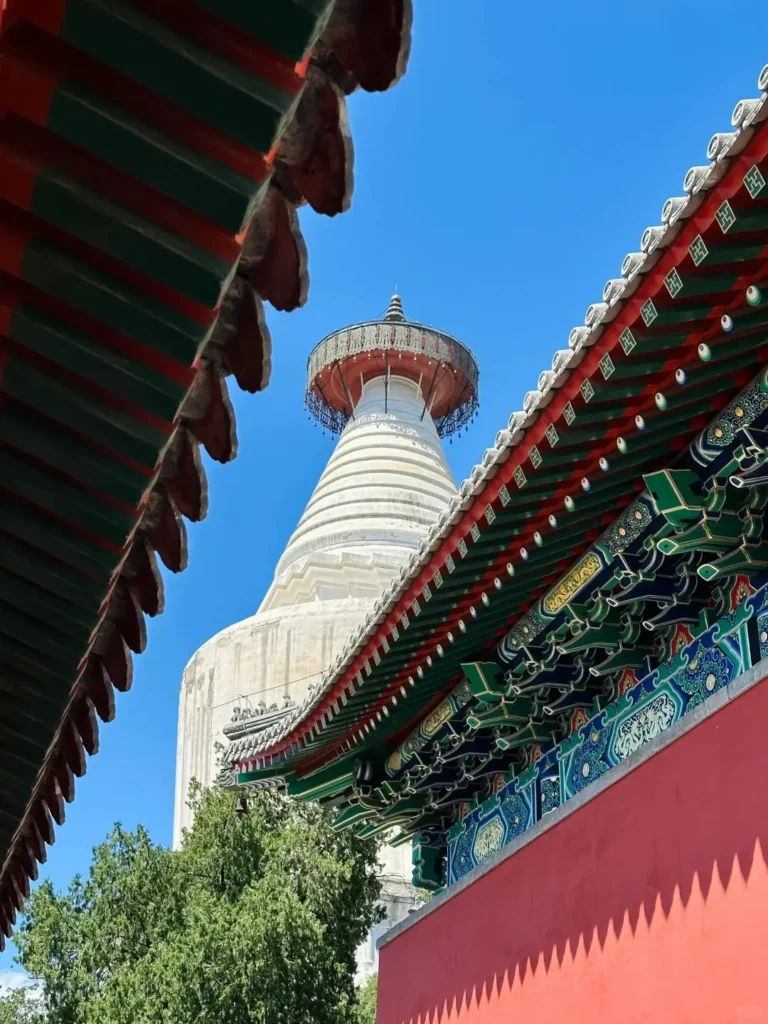
2. Baitasi East Alley (The Classic of Classics)
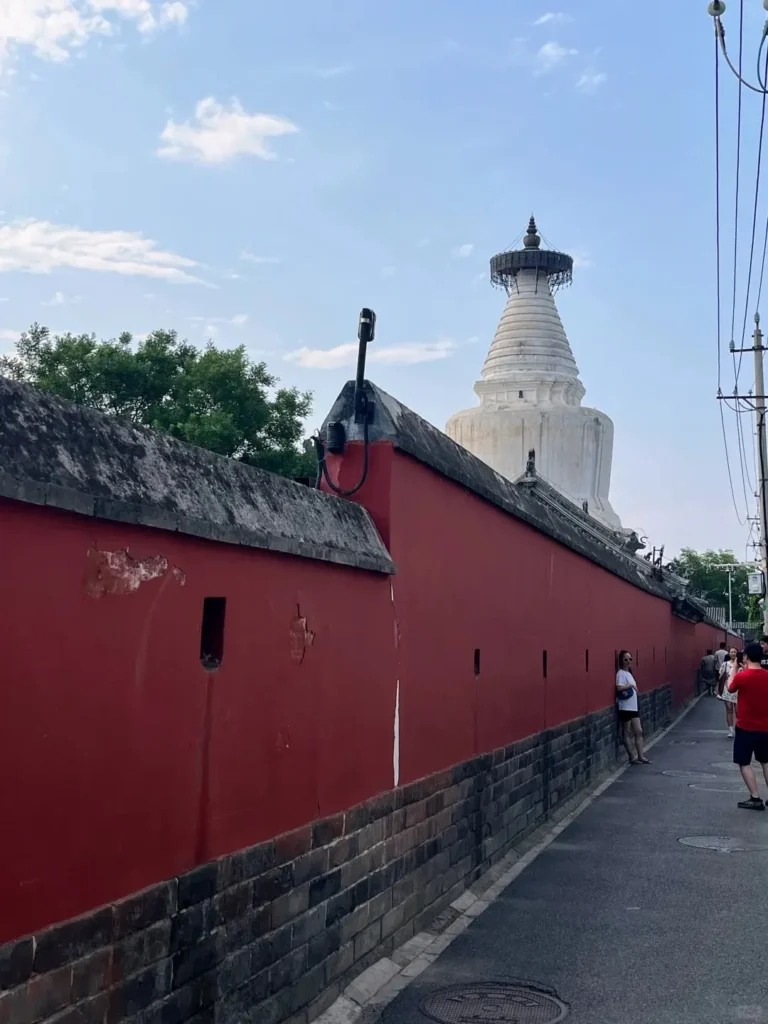
Walk through the alley along the temple’s eastern outer wall, known as “Baitasi Dongjiadao” (Pinyin: `Baitasi Dongjiadao`). Red walls, the White Pagoda, old alleys, the occasional passing bicycle, or the cooing of pigeons—this is the quintessential scene of old Beijing.
Walk to the end of the East Alley (near the public restroom), look up, and the White Pagoda will be almost directly overhead—a truly awe-inspiring sight.
3. Pharmacy Third-Floor Terrace (Instagram-Famous Spot, 2026 Updated Rules)
There is a Bai Ta Si Pharmacy on the east side of the temple. Go up to the second floor of the pharmacy, where you’ll find “Yao Coffee.”
⚠️ Latest 2026 Regulations: Due to the immense popularity of this spot and to ensure safety and prevent overcrowding, you must now first enter “Yao Coffee” on the second floor to place an order (during peak hours, you may be required to order specific meal sets or even make a reservation in advance). You will need your receipt to access the third-floor terrace.
We recommend asking a staff member about the day’s terrace access rules before deciding whether to make a purchase. However, even if you don’t go up, you can still capture a great shot of the White Pagoda from the second-floor windows.
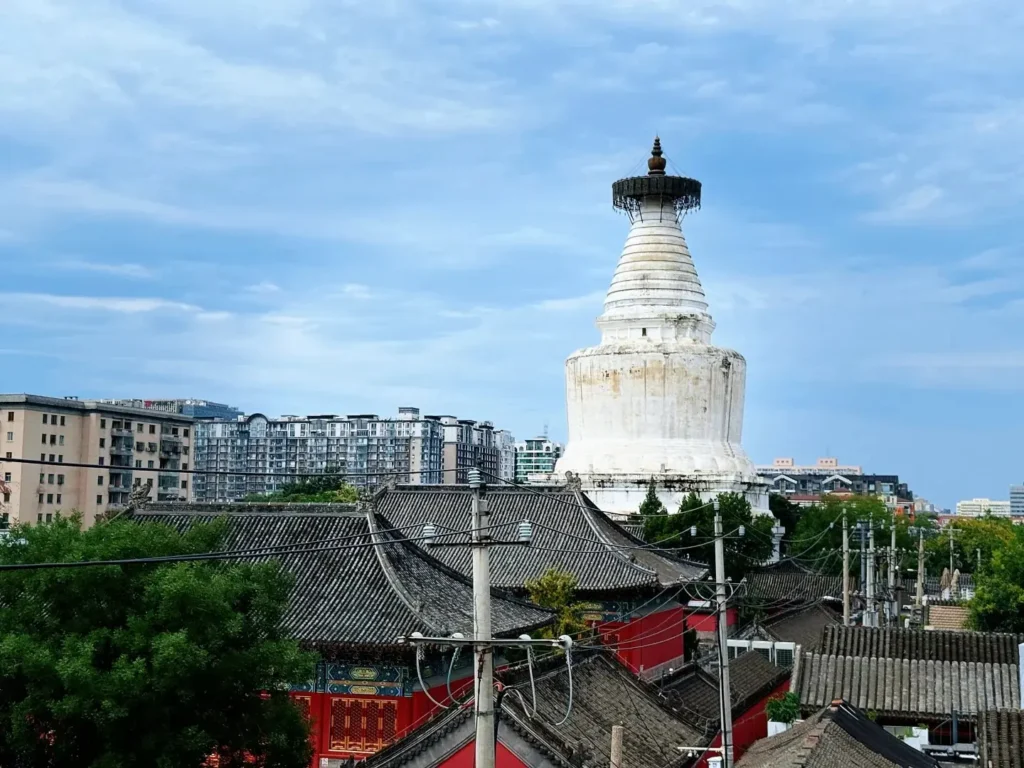
> If you successfully make it to the third-floor terrace, the White Pagoda will be right in front of you at just the right height, allowing you to take a photo of the pagoda against the rooftops. The first floor of the pharmacy also houses a Traditional Chinese Medicine Museum, which is free to visit and features a plaque inscribed by Zhao Lirong.
4. Gongmenkou Dongcha (Cafés in the Hutong)
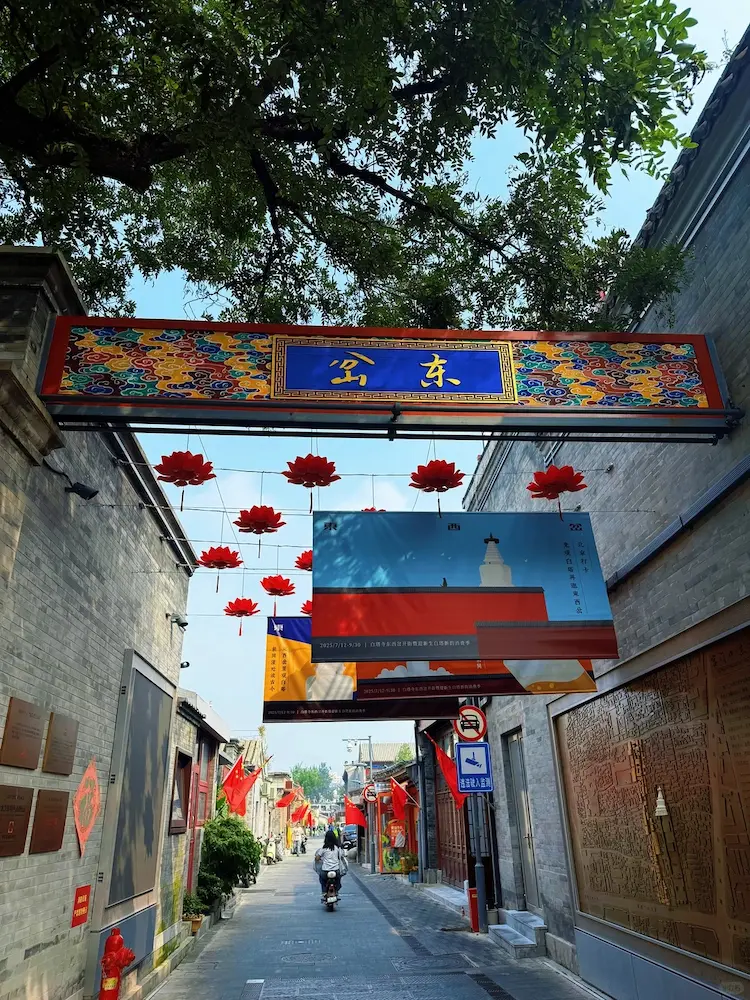
Turn off Dongjiadao into “Gongmenkou Dongcha” (Pinyin: `Gongmenkou Dongcha`), a trendy hutong renovated in 2022. The old gray-brick, gray-tiled buildings are now filled with cafés and bakeries.
Pick any place with a terrace, order a cup of coffee (30–50 yuan), and sit out there to photograph the White Pagoda. The scene here is: coffee cup in the foreground + gray tiles in the middle ground + White Pagoda in the background = a mix of modern and ancient.
> Insider Tip: There’s a café in Dongcha with a glass window where you can capture the White Pagoda’s reflection. Look up in the alley, and the White Pagoda’s…
> A little secret: There’s a coffee shop in Dongcha where you can capture the White Pagoda’s reflection in the window. If you look up in the alley, the pagoda’s spire peeks out from behind the old row houses, like a hidden Easter egg.
What to See in the Area? A Single Route Connecting Three Attractions
Fuchengmennei Street, where the White Pagoda Temple is located, is Beijing’s famous “Street of Blessings.” After leaving the White Pagoda Temple, head east:
| Attraction | English Name | Distance | Highlights | Admission |
| Temple of Emperors of Vast Dynasties | `The Temple of Emperors of Vast Dynasties` | 3-minute walk | A temple where Ming and Qing emperors paid homage to emperors of past dynasties, enshrining 188 emperors from the Three Sovereigns and Five Emperors to the Ming Dynasty. | 20 yuan |
| Guangji Temple | `Guangji Temple` (Headquarters of the Buddhist Association of China) | 5-minute walk | A famous Han Buddhist temple in Beijing; free admission. | Free |
| Lu Xun Museum | `Lu Xun Museum` | Near Fuchengmen Subway Station | Lu Xun’s former residence in Beijing; free admission. | Free |
Suggested Itinerary: Start the morning with a visit to White Pagoda Temple (1.5 hours), then stop at Dongjiadao or the eastern fork of Gongmenkou for photos and coffee (1 hour). Next, head to the Temple of the Emperors of All Dynasties (1 hour), and finish with Guangji Temple (30 minutes). The entire route is easy and can be covered on foot.
> Related Recommendation: If you enjoy this unique blend of Tibetan Buddhism and artsy hutongs, after visiting Baita Temple, you can take the subway directly to another “golden route” I previously recommended—the [Yonghegong + Wudaoying Hutong City Walk In-Depth Guide]. There you’ll find another Tibetan Buddhist temple and trendy hutong cafes, offering a completely different vibe from Baita Temple.
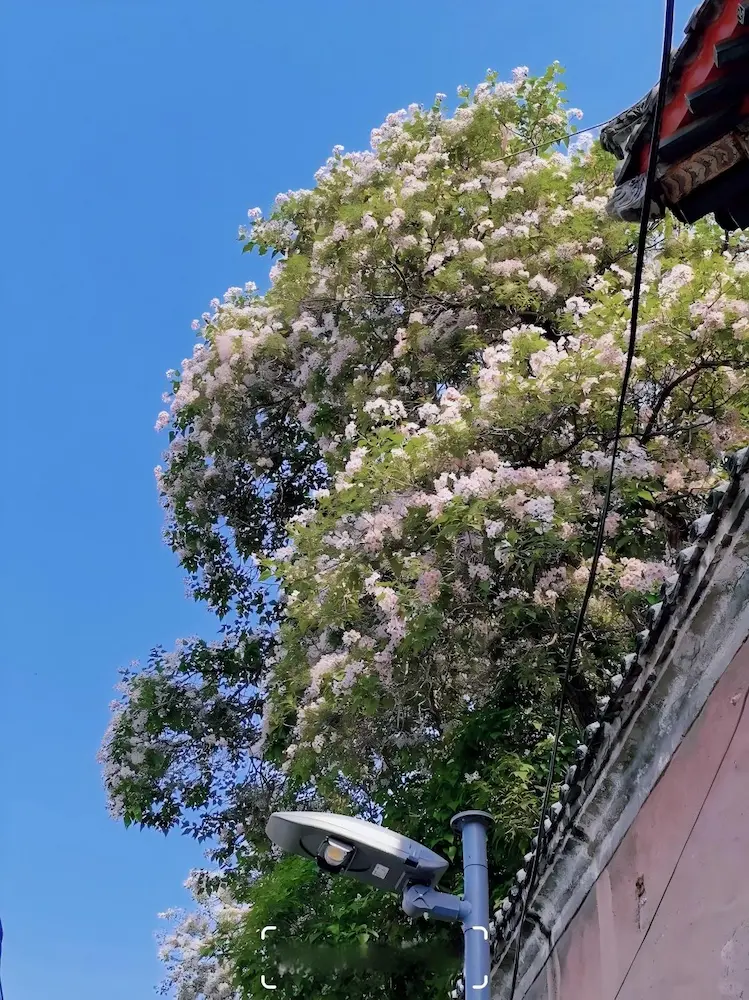
Hidden Gems in the Hutongs: The Ancient Chinese Schinus Tree
Leaving Baita Temple and venturing deep into the adjacent hutong, you’ll find an unassuming little courtyard. Hidden within is a massive ancient Chinese schinus tree. Its trunk is so thick that it takes two people to encircle it; its bark resembles the wrinkled palms of an old man, and its canopy blocks out the sky.
When the wind blows, the leaves rustle, blending with the sound of wind chimes hanging from the eaves of the White Pagoda in the distance.
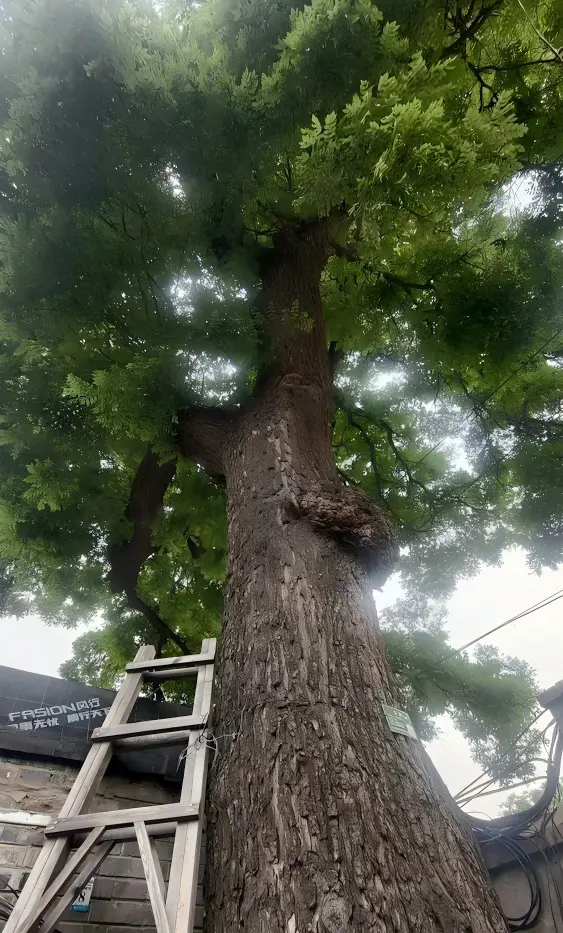
This tree has no plaque and no guide, yet it is as ancient as the pagoda itself. One stands in the temple, the other hidden in the alley, silently gazing at each other across the centuries. It is the most beautiful chance encounter along the way.
Dining Recommendations (5–10-minute walk)
| Name | Location | Features | Price per person |
| Yao Coffee | 2nd floor of Baita Temple Pharmacy | Terrace with direct view of the White Pagoda (in 2026, access to the 3rd floor requires a receipt after purchase), coffee + cake | 40–60 RMB |
| Postpost | East Fork of Gongmenkou | Specialty coffee, tucked away in a small alley, artsy | 40–50 RMB |
| Hutong Noodle House | Near Dongjiadao | Old-style Beijing-style fried sauce noodles, noodles with thick sauce | 25–30 RMB |
| Yufunan | Inside Fuchengmen Street | Hunan cuisine (spicy), perfect for a change of pace | 80–100 RMB |
Frequently Asked Questions
Why Is It Worth a Visit?
Baitasi Temple lacks the crowds of the Forbidden City and the overwhelming incense smoke of Yonghe Temple(Gong). It lies quietly tucked away in a hutong on Fuchengmennei Street, like a silent old man.
- The White Pagoda you see when you look up was witnessed by Kublai Khan, and every brick was laid by his own hands.
- The stone path you walk around the pagoda was once trodden by emperors and empresses of the Yuan Dynasty, monks of the Ming Dynasty, and lamas of the Qing Dynasty.
- The letter from 1937 you discover is a testament to the grief and anger of an ordinary person at the moment of national collapse.
- The shutter you press while standing beneath the red walls of the East Side Passage captures the 700-year-old White Pagoda and you, in the year 2026, within the same frame.
Here, there are no hawkers; only the chime of wind chimes, the cooing of pigeons, and centuries of silence.
When you come to Beijing, you must visit the Forbidden City and the Great Wall. But set aside a quiet afternoon for this White Pagoda. It will reveal another side of Beijing to you.