The Imperial Ancestral Temple (Palace of Working People’s Culture): The Imperial Hall for Ancestral Worship on Beijing’s Central Axis (2026)
Just east of the Forbidden City, separated by a red wall, lies an imperial hall even wider than the Hall of Supreme Harmony in the Forbidden City—the Imperial Ancestral Temple.
During the Ming and Qing dynasties, this was where emperors paid homage to their ancestors. “Being enshrined in the Imperial Ancestral Temple” was the highest honor a subject could attain in ancient China.
In 2024, the Imperial Ancestral Temple, as one of the 15 constituent elements of Beijing’s Central Axis, was inscribed as part of the World Heritage Site alongside the Bell and Drum Towers, the Forbidden City, and the Temple of Heaven.
For just 2 yuan, you can step inside a World Heritage-level imperial architectural complex and behold the “First Hall Under Heaven,” which spans eleven bays in width. It’s directly accessible via Subway Line 1, and after your visit, you can walk from the West Gate to the Meridian Gate area of the Forbidden City.
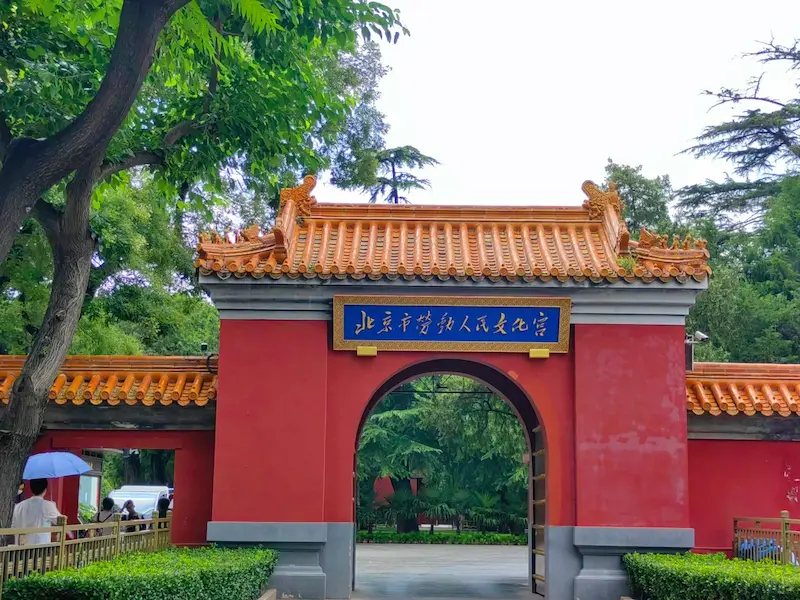
Table of Contents
Practical Information (Must-Read Before You Go)
| Item | Details |
| Name | Temple of Heaven / Beijing Working People’s Cultural Palace (English: `Tai Miao` / `Beijing Working People’s Cultural Palace`) |
| Location | East of Tiananmen Square, Dongcheng District, Beijing; southeast of the Forbidden City |
| How to Visit | Purchase a ticket for entry; self-guided tour |
| Subway (Recommended) | Line 1, Tian’anmen East Station (`Tian’anmen East Station`), Exit B; about a 500-meter walk from the station. For information on how to use transit cards, ride public transportation, and make electronic payments in Beijing, please refer to my [2026 Step-by-Step Guide to Beijing Subway and Transit Payments] |
| Bus | Take Buses 1, 2, 10, 52, etc., and get off at the “Tian’anmen East” stop |
| Driving and Taxis | Not recommended. Traffic restrictions around Tiananmen Square are strict, and parking is difficult. When taking a taxi, set your destination to “Taimiao” or “Beijing Workers’ Cultural Palace” |
| Admission | 2 yuan for park entry; a separate ticket is required to enter the Main Hall (the central hall): 15 yuan during peak season, 10 yuan during off-peak season. No reservation is needed; tickets can be purchased on-site |
| Opening Hours | Park: High Season (April–October) 6:30 a.m.–7:30 p.m., Low Season (November–March) 7:00 a.m.–5:30 p.m.; Hall of Joy (Historic Architecture Area): 9:00 a.m.–4:30 p.m., closed on Mondays |
| Best Times to Visit | Early morning from 6:30–8:00, when crowds are at their lightest, and the play of light and shadow among the ancient cypress trees is particularly beautiful; or after 3:00 p.m., when the slanting sunlight casts a golden glow on the red walls, yellow tiles, and the grand hall made of golden thread nanmu wood, offering excellent photo opportunities |
| Recommended Duration | 1.5–2 hours |
| Dress Code | Wear comfortable flat shoes. The park is large, and the ground consists mostly of stone pavers |
| Budget Guide | Park admission: 2 yuan (approx. $0.30) + Xiang Hall: 10–15 yuan (approx. $1.40–$2.10) |
| Photography | Absolutely allowed. The red walls, ancient cypress trees, white marble railings, and golden nanmu hall—every corner is a picturesque scene. Flash photography is prohibited indoors; do not enter restricted areas, touch cultural relics, or climb ancient structures |
| Language Support | Exhibition panels within the park are primarily in Chinese; we recommend using a mobile translation app for assistance |
| ID Reminder | Carry your ID card or passport with you at all times; ID checks are frequently conducted at Tiananmen Square Metro Station and the surrounding areas |
⚠Important Reminder: The Imperial Ancestral Temple has two main entrances—the East Gate and the South Gate. The East Gate is located outside the security checkpoint area of Tiananmen Square, so you do not need to go through the square’s security checkpoint; we recommend using the East Gate. The South Gate is close to Tiananmen Square and requires passing through the square’s security checkpoint; wait times may be long during peak season.
Is This Attraction Right for You? (3-Second Quick Check)
It’s worth a visit if you:
- Are interested in the imperial sacrificial rituals and ancestral temple protocols of the Ming and Qing dynasties
- Want to see for yourself the “First Hall Under Heaven,” which is wider than the Hall of Supreme Harmony at the Forbidden City
- Want to find a quiet spot near the Forbidden City where you won’t have to wait in long lines
- Enjoy photographing the texture of red walls, ancient cypress trees, historic architecture, and the grand hall made of golden nanmu wood
- Are you visiting Beijing with children and want to find a spacious, safe place rich in historical stories
You can skip it if:
- You’re not particularly interested in historic architecture or traditional culture
- You’re on a very tight schedule and can only choose between the Imperial Ancestral Temple and the Forbidden City (In that case, you’re better off visiting the Forbidden City)
If you’re on a tight schedule:
You can visit the Imperial Ancestral Temple and the Forbidden City on the same day—it’s right next to the Forbidden City. It takes 1–1.5 hours to explore the core area, and then you can exit through the West Gate and walk to the Meridian Gate area of the Forbidden City. Just buy separate tickets for each site.
In short: The Forbidden City is about “seeing how the emperor lived,” while the Imperial Ancestral Temple is about “seeing how the emperor honored his ancestors.” For just 2 yuan, with no lines, fewer crowds, and an imperial hall even wider than the Hall of Supreme Harmony—if you’re interested in the “emperor’s family temple,” it’s well worth spending 1.5 hours popping in for a look.
What Is the Imperial Ancestral Temple?
The Imperial Ancestral Temple was first built in the 18th year of the Yongle reign of the Ming Dynasty (1420), the same year the Forbidden City was completed. It served as the place where emperors of the Ming and Qing dynasties paid homage to their ancestors—you can think of it as the emperor’s “family temple.”
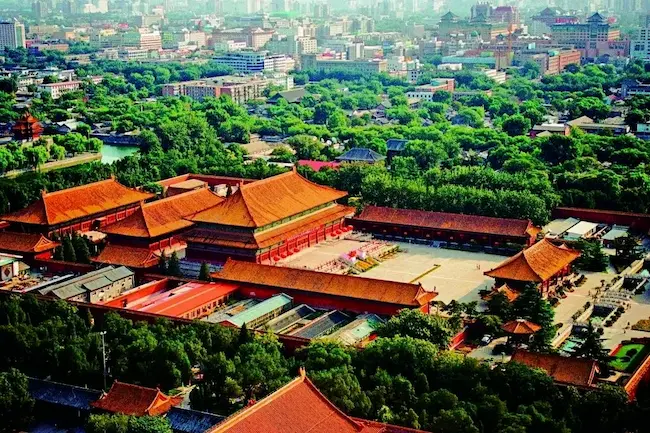
Ancient Chinese tradition emphasized the principle of “ancestors on the left, the Earth and Grain Altars on the right”—to the left (east) of Tiananmen Square stood the Imperial Ancestral Temple (for ancestral worship), while to the right (west) stood the Altar of Land and Grain (for worshiping the gods of the earth and the five grains).
The Imperial Ancestral Temple occupied the honored “left side for ancestors” position. Together with the Altar of Land and Grain—one on the left and one on the right—they jointly guarded the Imperial City, embodying the ideal capital planning paradigm described in the *Record of the Master Craftsman* (*Kaogongji*).
What does “enshrined in the Imperial Ancestral Temple” mean?
You may have heard the term “enshrined in the Imperial Ancestral Temple” in movies or TV dramas. In the traditional patrilineal and ritual system of ancient China, when a minister of outstanding merit passed away, his spirit tablet was placed in a side hall of the Imperial Ancestral Temple to be honored alongside the imperial ancestors—this was the highest honor a subject could attain.
Zhang Tingyu, a veteran statesman who served three Qing dynasties, was the only Han Chinese minister in the entire Qing dynasty to be enshrined in the Imperial Ancestral Temple.
From Imperial Enclave to Public Park
In 1950, a meeting of the State Council decided to convert the Imperial Ancestral Temple into the “Beijing Cultural Palace of the Working People.” Chairman Mao inscribed the name of the palace, and it officially opened to the public on May 1 of that year. The former imperial enclave was transformed into a park where ordinary people could come and go freely.
In 1988, the Imperial Ancestral Temple was designated a National Key Cultural Relic Protection Unit.
On July 27, 2024, Beijing’s Central Axis was inscribed on the UNESCO World Heritage List.
As one of the 15 constituent elements of Beijing’s Central Axis, the Imperial Ancestral Temple, together with the Bell and Drum Towers, the Forbidden City, and the Temple of Heaven, forms part of this World Heritage Site.
How Big Is the Imperial Ancestral Temple? Three Numbers Tell the Story
- Covers an area of 197,000 square meters—about the size of 27 standard soccer fields
- Encircled by three layers of red walls
- 714 designated ancient trees over 100 years old, primarily Chinese arborvitae and Chinese juniper, most of which were planted during the Ming Dynasty; the oldest is over 600 years old
Cultural Insight: Why were so many cypress trees planted at the Imperial Ancestral Temple? According to *Research on Old News from Rixia*, the planting of cypress trees at the Imperial Ancestral Temple began in the early Ming Dynasty, drawing on the meaning of “pines and cypresses remain evergreen” to symbolize the perpetual continuity of the imperial lineage.
The ancient cypresses within the grounds take on a myriad of forms, among which the “Cypress Planted by Emperor Chengzu of the Ming Dynasty” (legend has it that Emperor Chengzu, Zhu Di, planted it himself), the “Deer-Shaped Cypress,” the “Tree-on-Tree Cypress,” and the “Nine-Dragon Cypress” are the most famous.
Of the 714 ancient trees in the garden, Grade 1 ancient trees—those over 300 years old—account for 70 percent. Together with the ancient architecture, these ancient cypresses embody and bear witness to the ideal order of a Chinese capital as manifested along Beijing’s Central Axis.
The “Heart” of the Imperial Ancestral Temple: The Hall of Sacrifice—A Grand Imperial Hall Spanning Eleven Bays
The most central structure of the Imperial Ancestral Temple is the Hall of Sacrifice—the place where the emperor conducted grand ancestral rites. Often referred to as “the foremost hall under heaven,” one of its most distinctive features is its width of eleven bays (68.2 meters), surpassing the nine bays of the Hall of Supreme Harmony in the Forbidden City.
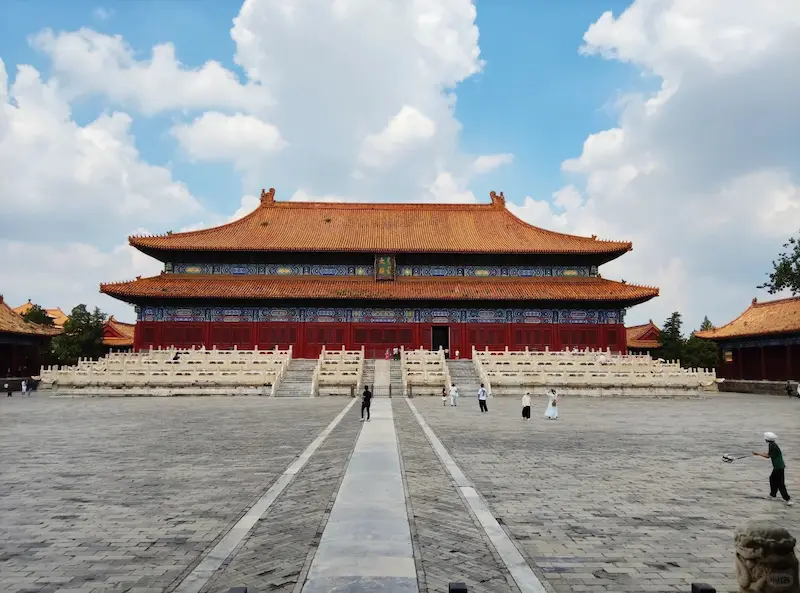
Just how impressive is it?
- 11 bays wide—wider than the Hall of Supreme Harmony in the Forbidden City (9 bays)
- 68 massive columns made of solid golden-threaded nanmu wood, with the tallest reaching 13.32 meters (about four stories high) and the thickest measuring 1.2 meters in diameter
- A three-tiered white marble Sumi base, 3.46 meters high
- Double-eaved hall-style roof with yellow glazed tiles
- Ten mythical beasts at the eaves
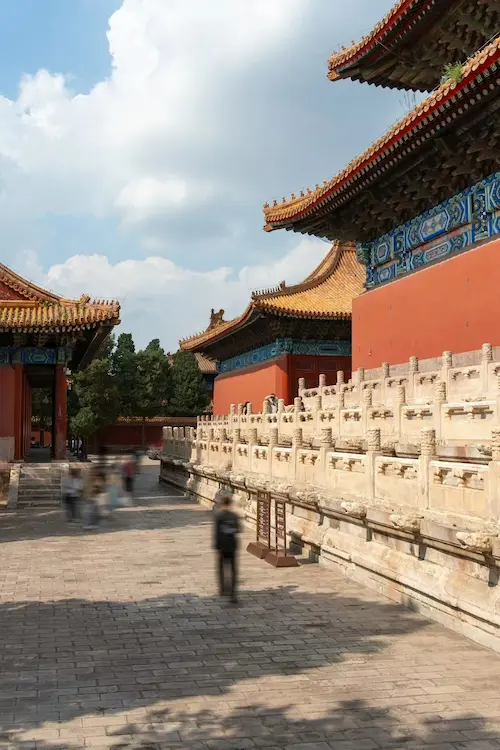
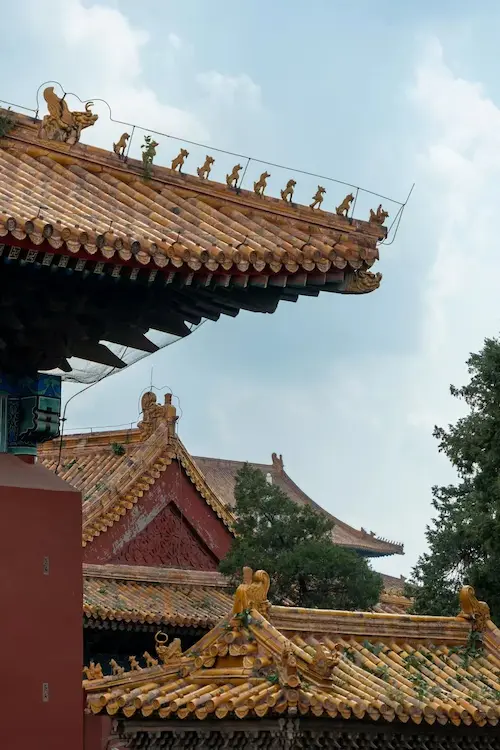
An interesting contrast: The Hall of Supreme Harmony in the Forbidden City was where the emperor held court; its pedestal is higher, symbolizing the “supremacy of imperial power.”
However, the Hall of Ancestral Worship at the Imperial Ancestral Temple is 11 bays wide, wider than the Hall of Supreme Harmony’s 9 bays, embodying the principle that “the ancestors are supreme” — in traditional ritual systems, the status of ancestors was held in the highest regard. This is the architectural manifestation of “filial piety” in ancient China.
The “Three Treasures” of the Hall of Sacrifice: Golden-veined Nanmu Wood, Solid-Gold Polychrome Paintings, and Gold Bricks
First Treasure: 68 Giant Golden-Thread Nanmu Pillars
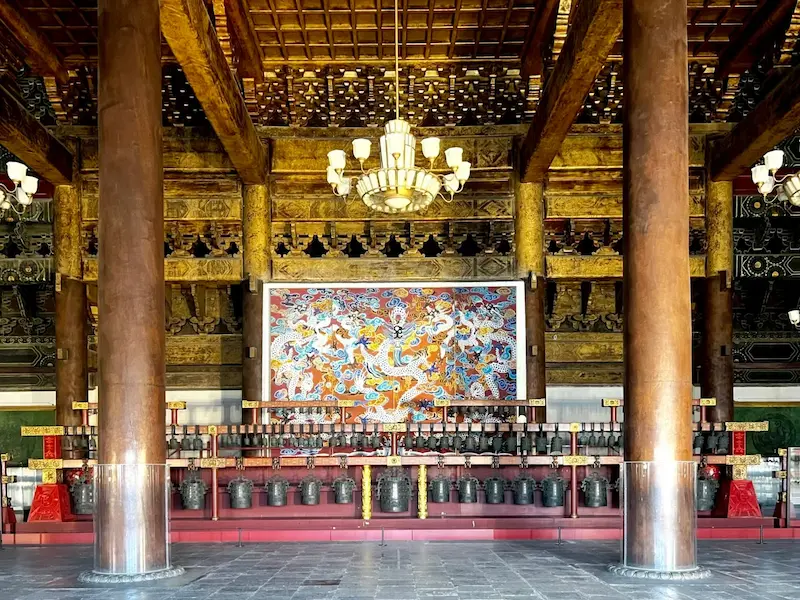
Inside the Hall of Sacrifice stand 68 massive pillars carved from solid golden-thread nanmu. Each pillar is so thick that it takes two people to encircle it, and they stand over 13 meters tall.
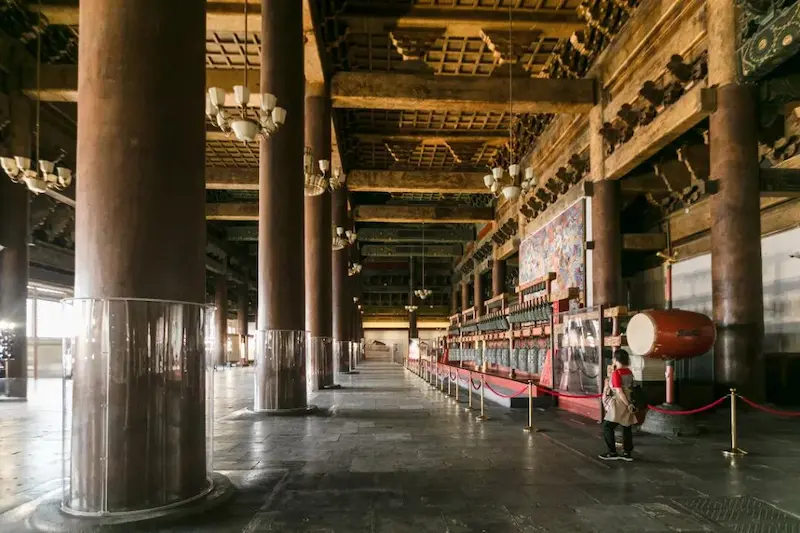
Golden-thread nanmu is one of China’s most precious woods, known for its hardness, beautiful grain, natural fragrance, and resistance to decay for over a thousand years.
In ancient times, golden-veined nanmu was a premium timber reserved exclusively for imperial architecture. These trees were harvested from deep in the mountains and transported to the capital only after enduring great hardships.
Upon entering the Hall of Sacrifice, a faint woody fragrance lingers in the air. Six hundred years have passed, yet these nanmu pillars still retain their distinct grain patterns and enduring aroma.
The Hall of Sacrifice is the only location along Beijing’s Central Axis where visitors can view Golden Thread Nanmu up close.
Cross-cultural interpretation: You can think of Golden Thread Nanmu as “the rarest and most prized timber in the world of architecture.” Today, wild Golden Thread Nanmu of such large diameter is extremely rare, and each log is a priceless cultural relic.
The Second Treasure: Solid-Gold Polychrome Paintings
The beams, crossbeams, and ceiling of the three central bays of the Hall of Sacrifice feature the highest-grade solid-gold polychrome paintings. Artisans first raised the intricate patterns using a relief technique, then applied gold leaf over the entire surface—giving the entire ceiling a subdued, golden luster.
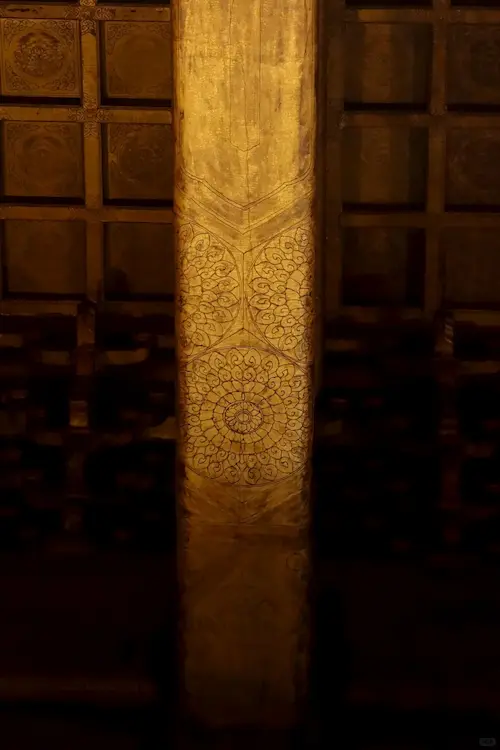
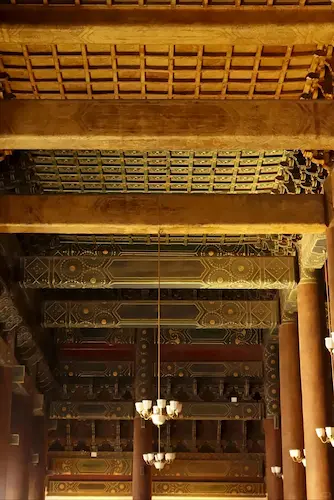
The ceiling of the Hall of Sacrifice is adorned with a five-color, nine-dragon painting in solid gold, which differs from the yellow dragons commonly found in the Forbidden City—the Ancestral Temple, with its focus on honoring ancestors, follows its own distinct system.
Treasure No. 3: Gold-Brick Flooring
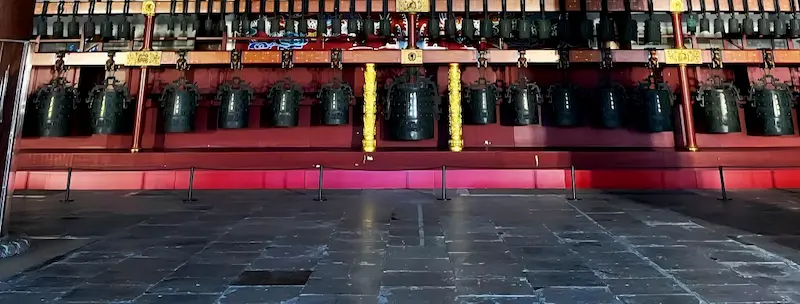
The floor of the Hall of Sacrifice is paved with gold bricks from the Imperial Kiln in Suzhou. Each gold brick undergoes 29 production steps—including clay selection, clay preparation, molding, and firing—with the firing process alone taking over a year.
The gold bricks are dense; a light tap produces a clear, metallic ring. A folk saying describes them as “one tael of gold per brick.”
What Else Is Hidden Inside the Hall?
On the central wall of the Hall of Sacrifice hangs a mural depicting nine dragons amidst auspicious clouds, with the central dragon appearing majestic and imposing.
Below the mural hang bronze chime bells, which were part of the ritual instruments for the Zhonghe Shao Music—in ancient times, elegant music was played during ancestral ceremonies, with ritual and music complementing one another. A complete set of chime bells is also on display within the Hall of Sacrifice.
The eastern and western side halls flanking the Hall of Sacrifice enshrine the spirit tablets of imperial clan members and ministers who rendered meritorious service throughout history—the Western Side Hall specifically enshrines meritorious officials such as Zhang Tingyu.
“Hidden Highlights” of the Imperial Ancestral Temple
After entering the grounds through the East Gate, you’ll see the following attractions in order:
1. The Crown Prince’s Grove (inside the East Gate)
Upon entering the East Gate, the Crown Prince’s Grove stretches along both sides of the avenue—legend has it that these ancient cypress trees were planted by hand by imperial princes of the Ming and Qing dynasties.
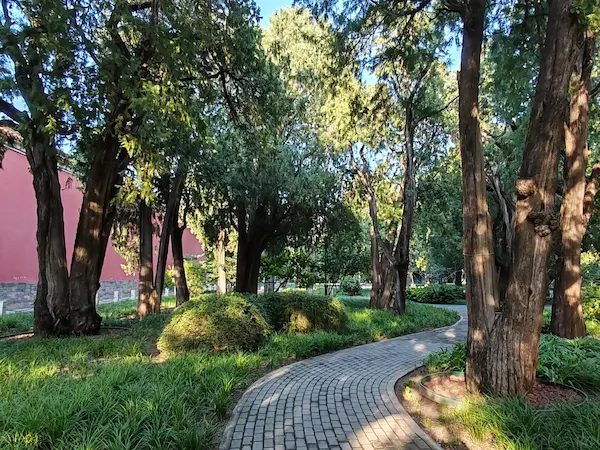
Each tree is over several hundred years old, making this the first sight to catch your eye among the Ancient Cypress Grove of the Imperial Ancestral Temple.
2. The Five-Colored Glazed Tile Gates and the Seven Jinshui Bridges
Three five-colored glazed tile gates stand side by side on the south side of the Imperial Ancestral Temple, serving as the first set of gates leading into the ritual area.
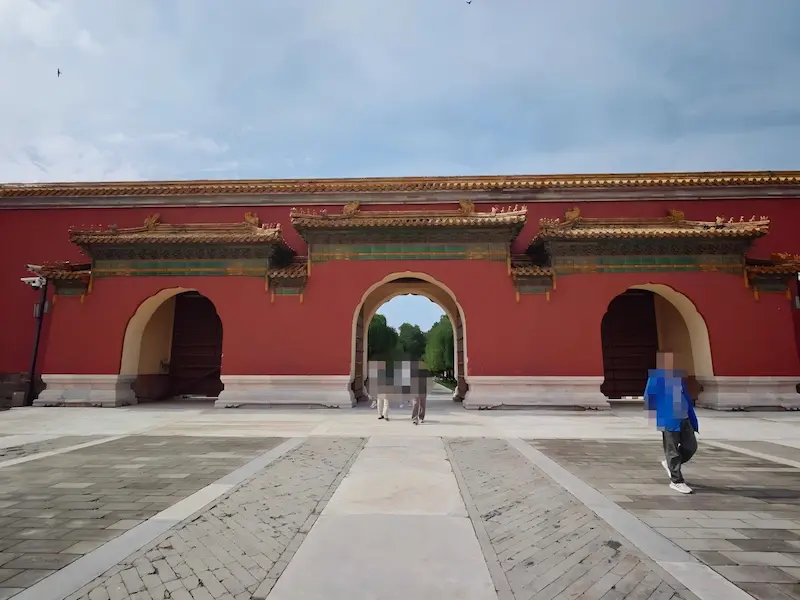
The Jinshui River flows through the space inside the gates, spanned by seven single-arch white marble bridges. These seven stone bridges create a highly orderly waterscape and are a noteworthy detail for architectural photography of the Imperial Ancestral Temple.
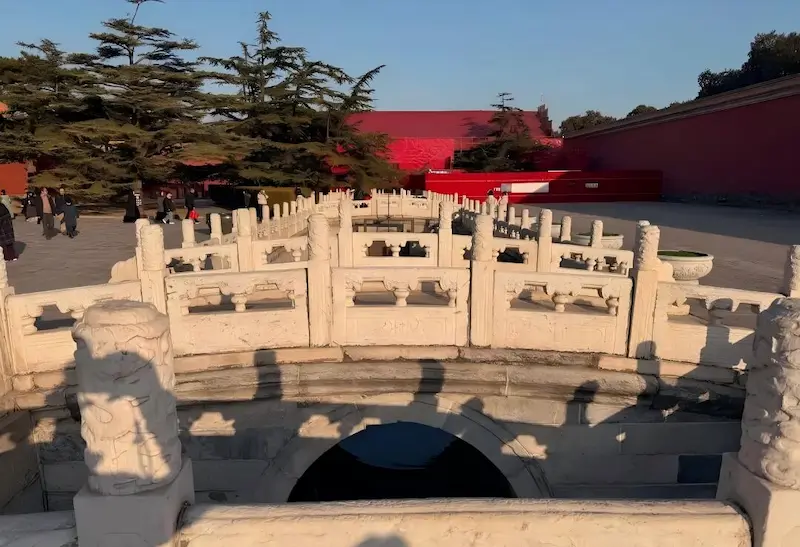
3. The Halberd Gate and the “Ventilation” Holes in the Red Wall
Passing through the Golden Water Bridge leads to the Halberd Gate. It derives its name from the eight vermilion-lacquered halberd racks that originally stood outside the gate, holding a total of 120 ceremonial halberds—featuring silver pommels, red shafts, and gilded dragons—used as part of the ceremonial procession.
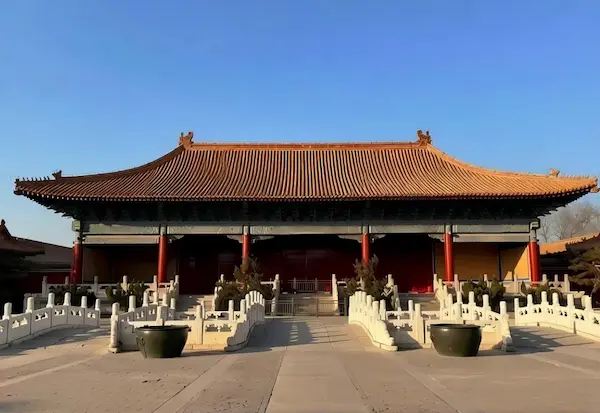
In 1900, all 120 of these gilded dragon halberds were looted by the Eight-Nation Alliance that invaded Beijing. Through the gap in the center of the Halberd Gate, you can photograph the “Taimiao” plaque in the background—an excellent vantage point for a framed composition.
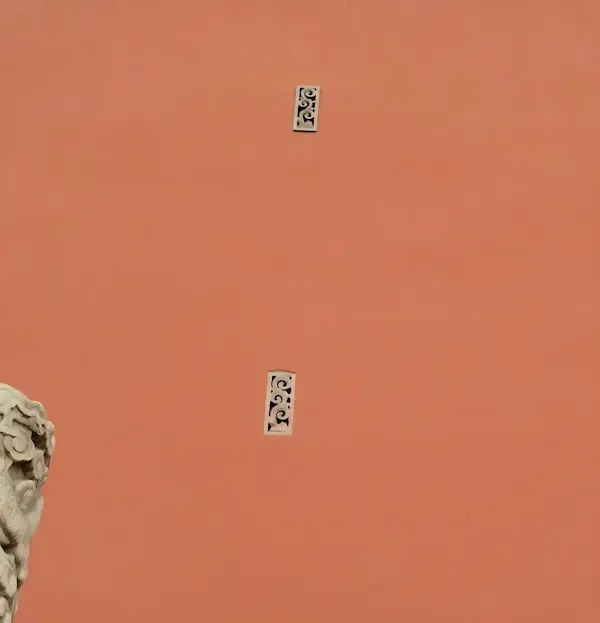
On the red wall to the east of the Halberd Gate, there are scattered small, rectangular openwork holes. This architectural feature is called “ventilation holes”—details that are easily overlooked by visitors.
4. The Hall of Sacrifice (The Heart of the Complex!)
The heart of the entire complex. With 68 massive pillars of golden nanmu wood, a solid gold-painted ceiling, a floor paved with gold bricks, and murals depicting nine dragons—step inside, stand in the center of the hall, look up, look down, and take a full 360-degree look around.
5. The Sleeping Hall and the Ancestral Temple
Behind the Hall of Sacrifice lie, in order, the Sleeping Hall (where the ancestral tablets are normally enshrined) and the Ancestral Temple (where the tablets of the emperor’s distant ancestors are enshrined).
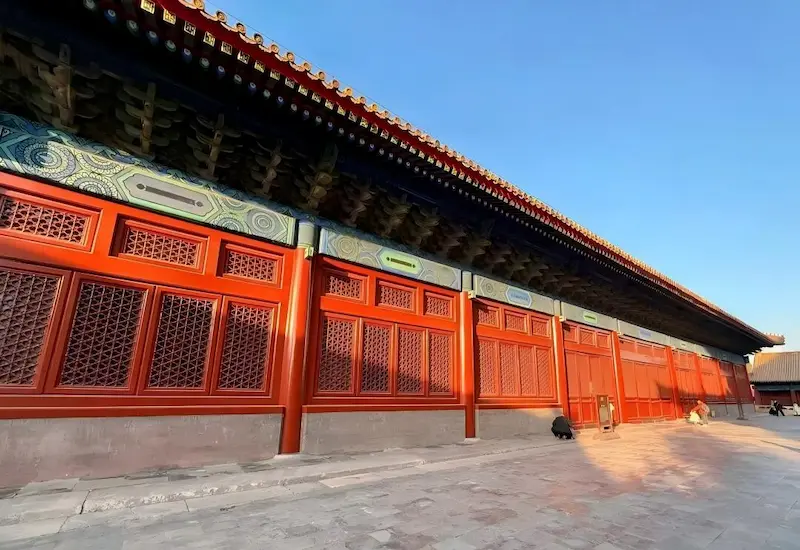
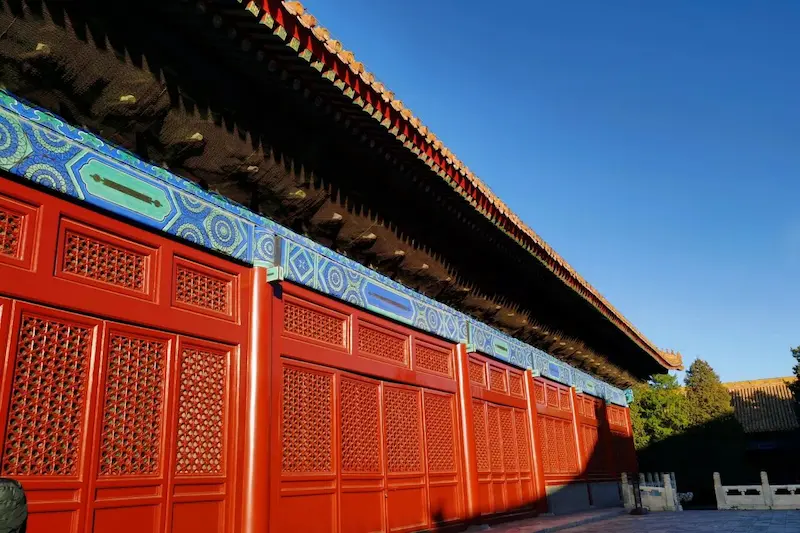
According to the current public access schedule, these two halls frequently host various exhibitions of calligraphy and painting by staff members.
Recommended Tour Routes
1-Hour Express Route (Suitable for Visitors with Limited Time)
Enter through the East Gate → Hall of Sacrifice (Highlight! Golden-threaded nanmu columns + gold bricks + Nine-Dragon murals) → Exit through the West Gate
One hour is sufficient to see the highlights.
1.5–2-Hour Complete Route (Recommended)
Enter through the East Gate → Prince’s Grove (ancient cypress trees) → Five-Color Glazed Tile Gate → Jinshui Bridge (take photos of the reflection) → Halberd Gate (take photos of the “Taimiao” plaque through the gate’s gap) → Hall of Sacrifice (68 golden nanmu pillars + solid gold painted decorations + gold bricks + Nine-Dragon murals + chime bells) → Sleeping Hall → Ancestral Temple → Exit via West Gate
This route covers all the highlights of the Imperial Ancestral Temple.
Combined Itinerary with the Forbidden City
Exit at Exit B of Tiananmen East Subway Station → Enter the Imperial Ancestral Temple via the East Gate (2 yuan) → Explore the Imperial Ancestral Temple following the full route (1.5 hours) → Exit through the West Gate → Walk to the Meridian Gate area of the Forbidden City
⚠️ Important Reminder: The Imperial Ancestral Temple and the Forbidden City are two separate attractions; you must check ticket availability, reservations, and opening hours for each individually.
After exiting the Imperial Ancestral Temple through the West Gate, you can walk to the Meridian Gate area of the Forbidden City; the exact walking time depends on the exit conditions and crowd levels on the day of your visit.
Photography Guide
| Shooting Spot | Location | Best Time to Shoot | Tips |
| Light and Shadow Among Ancient Cypresses | Along both sides of the pathway after entering the park | 6:30–8:00 a.m. | Sunlight filters through the branches and leaves of the ancient cypresses, casting dappled shadows—perfect for portraits |
| Colorful Glazed Tiles Gate + Golden Water Bridge | Between the Glazed Tiles Gate and the Halberd Gate | Morning | The seven white marble bridges are reflected in the water, creating a classic, ancient-style scene |
| Composition Through the Halberd Gate | Center of the Halberd Gate | Morning | Shoot the “Taimiao” plaque behind the gate through the gap; the framed composition creates a strong sense of ceremony |
| Golden Nanmu Columns in the Hall of Sacrifice | Inside the Hall of Sacrifice | All Day (Indoors) | No Flash! A low-angle, wide-angle shot looking up at the array of 68 massive columns |
| Gilded and Polychrome Painted Ceiling | Inside the Hall of Sacrifice | All Day (Indoors) | No Flash! A shot looking up at the gilded and polychrome painted ceiling |
| “Imperial Ancestral Temple” Plaque | Under the eaves of the Hall of Sacrifice | Morning | The gilded “Imperial Ancestral Temple” plaque with nine dragons, inscribed in both Manchu and Han characters |
| Ventilation Holes in the Red Wall | Red wall east of the Halberd Gate | Afternoon | Photographing the small, regularly spaced holes in the red wall |
Nearby Attractions: Half-Day Tour Along the Central Axis
The Imperial Ancestral Temple is located at the heart of Beijing’s Central Axis, and several attractions are within walking distance:
| Attraction | Direction | Walking Time | Highlights | Admission |
| The Forbidden City | Exit through the West Gate of the Imperial Ancestral Temple and walk | About 10 minutes on foot | Imperial palace of the Ming and Qing dynasties, UNESCO World Heritage Site | Reservation required |
| Tiananmen Square | South | About a 10-minute walk | The world’s largest urban square | Free (reservation required) |
| Altar of Land and Grain (Zhongshan Park) | West of Tiananmen Square | About a 15-minute walk | The “Right Altar” symmetrical to the Imperial Ancestral Temple; the site where the gods of the earth were worshipped during the Ming and Qing dynasties | 3 yuan |
| Tiananmen Gate Tower | North side | About a 10-minute walk | Site of the founding ceremony of the People’s Republic of China | Reservation required |
⚠Forbidden City Ticket Reminder: reservations are required for the Forbidden City. Please refer to the official Forbidden City information for specific opening dates, ticket prices, and reservation rules.
FAQ
600 years ago, only the emperor was allowed to enter this place. Today, you can step inside for just 2 yuan. Standing in the center of the Hall of Sacrifice, look up at the ceiling adorned with gilded and colorful paintings, look down at the floor paved with gold-colored bricks, and take in the 68 massive pillars of golden nanmu wood surrounding you—you’re not just strolling through a park; you’re stepping into a living, breathing imperial hall from the Ming Dynasty.
If you’ve already planned a visit to the Forbidden City, consider adding the Imperial Ancestral Temple to your itinerary for the same day. There, you’ll find the “Foremost Hall Under Heaven,” a 600-year-old cypress tree, and an imperial hall that’s even wider than the Hall of Supreme Harmony.