Beijing Temple of Heaven Park Visitor’s Guide: A Complete Guide Foreigners Can Easily Understand
The Temple of Heaven is one of Beijing’s most awe-inspiring attractions. If you think it’s merely a beautiful ancient building, you might miss its most essential aspect.
In reality, the Temple of Heaven is a three-dimensional representation of the ancient Chinese worldview and was the sacred site where emperors of the Ming and Qing dynasties performed the highest-level ceremonies to worship Heaven. Understanding this will completely change your visiting experience.
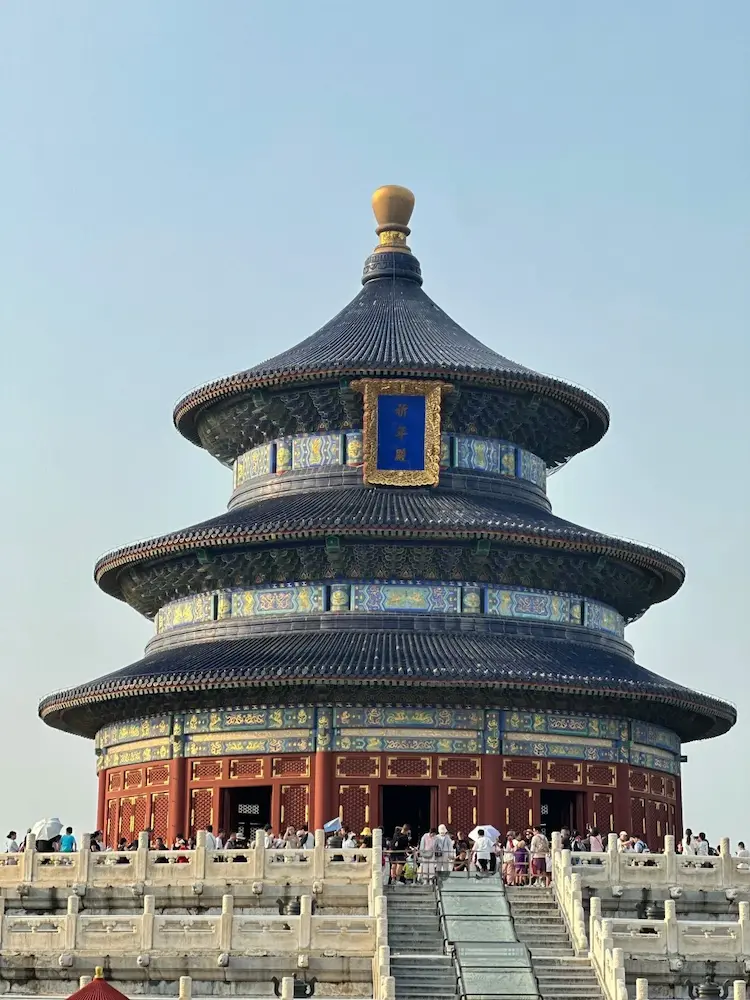
Table of Contents
What is the Temple of Heaven? Understanding the Core Concept First
Before diving into the details, we need to establish an overall framework of understanding:
1. A Sacred Layout: The buildings within the entire Temple of Heaven Park are not randomly arranged. They strictly follow the ancient Chinese cosmological concept of “the round heaven and the square earth.” The northern part, centered on the Hall of Prayer for Good Harvests, symbolizes “Heaven,” with buildings mostly circular. The southern part, centered on the Circular Mound Altar, symbolizes “Earth,” with structures mostly square. Connecting north and south is a 360-meter-long “Sacred Way” —the Danbi Bridge.
2. Core Function: This was where the emperor communicated with “Heaven.” Every winter solstice, the emperor would hold a grand ceremony at the Circular Mound Altar to pray for favorable weather and peace for the nation. In early spring, he would pray for a bountiful harvest at the Hall of Prayer for Good Harvests.
3. Architectural “Codes”: Nearly every design element in the Temple of Heaven contains hidden numerical symbolism, often related to “Heaven” (like multiples of nine), the four seasons, months, or hours. Deciphering these “codes” is the key to unlocking the temple’s mysteries.
Practical Information: Tickets and Preparation
- Ticket Options: Tickets are divided into Park Entry Tickets (15 RMB) and Through Tickets (34 RMB).
- Through Ticket: Includes access to core structures like the Hall of Prayer for Good Harvests, the Echo Wall, and the Circular Mound Altar. This is the choice for most visitors. You can enter by scanning your ID card, but each attraction can only be entered once.
- Park Entry Ticket: Grants access only to the park grounds, not the core buildings mentioned above. Consider this if you only wish to stroll among the ancient cypress trees.
- Opening Hours: The park is generally open from 6:00 to 22:00, but core attractions (like the Hall of Prayer and the Circular Mound Altar) close earlier, usually around 17:00-18:00. Be sure to check when planning your visit.
- Recommended Visit Duration: The Temple of Heaven Park is vast. To see all the main sights carefully and understand their significance, it’s recommended to allocate at least 4-5 hours. A quick visit also requires 2-3 hours.
- Best Entrance: Choose your entrance based on your focus.
- East Gate: Closest to Tiantan East Gate Station on Subway Line 5, it’s the most convenient for transportation. Entering here allows you to visit in the order: North Slaughter Pavilion→Seven Star Rocks→Hall of Prayer for Good Harvests.
- West Gate: Use this if arriving from Tianqiao Station on Subway Line 8 or if you wish to see the Hall of Abstinence first.
- South Gate: Leads directly to the Circular Mound Altar, suitable for a reverse itinerary.
Detailed Guide to Core Attractions & Suggested Route
It is recommended to follow the historical ritual sequence. Here is a classic in-depth route:
First Stop: The Sacrificial Preparation Area (Behind the Scenes of the Ritual)
After entering from the East Gate and turning right, don’t head straight to the Hall of Prayer. You can first visit the North Slaughter Pavilion and the North Divine Kitchen. This is where livestock were processed and offerings prepared before ceremonies. Looking at the ancient pools and tools, you can imagine the solemn preparatory scenes before the rituals.
Interesting Find: On the way to the Hall of Prayer, look for an ancient tree named “Cypress Embracing Locust Tree.” An old cypress tree grows embracing a locust tree, over 590 years old—a miracle of nature.
Second Stop: The Hall of Prayer for Good Harvests Complex (The Sacred Land for Praying for Bountiful Harvests)
This is the most magnificent and photogenic part of the Temple of Heaven, but don’t just take pictures.
Hall of Prayer for Good Harvests: This is the symbol of the Temple of Heaven. Observe:
- Structural Symbolism: The main hall is circular, symbolizing the vault of heaven. The four central pillars symbolize the four seasons, the twinner twelve golden pillars symbolize the twelve months, and the outer twelve eave pillars symbolize the twelve two-hour periods of the day. The entire space is a perfect embodiment of the ancient concept of time.
- Look for Details: On the western wall surrounding the Hall of Prayer, find the Huajia Gate (for those over 60) and the Guxi Gate (for those over 70). Legend has it that only ceremonial personnel over the age of 60 or 70 were allowed to pass through these small gates, showing respect for the elderly.
- The Long Corridor: This was a closed corridor (now semi-open) connecting the Slaughter Pavilion, the Divine Kitchen, and the Hall of Prayer. Its purpose was to ensure that the sacrificial offerings remained pure and undefiled, uncontaminated by rain or snow during transport. Walking through it, you can imagine the solemn procession carrying the offerings in ancient times.
- Seven Star Rocks: Southeast of the Hall of Prayer, you’ll find eight large stones. Why are there eight rocks when it’s called “Seven Stars”? Seven represent the Big Dipper, and the smaller eighth one represents Mount Tai, “the Chinese nation as one family, the country forever stable.”
Third Stop: The Danbi Bridge (The Sacred Way to the “Heavenly Realm”)
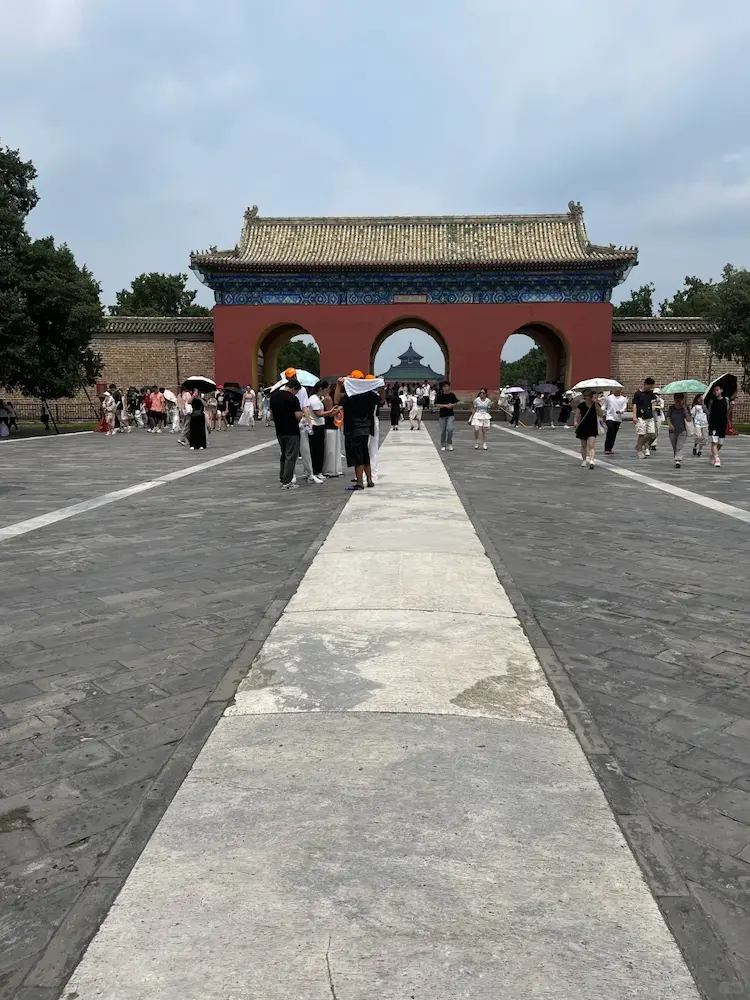
Exiting the south gate of the Hall of Prayer, you will step onto a broad, straight, and gradually rising walkway—the Danbi Bridge. It is 360 meters long, lower in the south and higher in the north. Walking on it feels like ascending step by step towards the heavenly court—the psychological suggestion of the architectural design is very powerful. It also offers an excellent vantage point to overlook the vast ancient cypress forest on both sides.
Fourth Stop: The Imperial Vault of Heaven and the Circular Mound Altar (The Core of the Heaven Worship Ceremony)
The Imperial Vault of Heaven and the Echo Wall: The Imperial Vault of Heaven was where the memorial tablets used in worship were stored. Its outer circular wall is the famous Echo Wall. If two people stand at the east and west annex halls respectively and speak softly towards the wall, the sound travels along the surface and can be heard clearly, demonstrating ingenious architectural acoustics.
- The Circular Mound Altar: This is the most sacred and conceptually dense place in the entire Temple of Heaven. Here, the emperor worshiped Heaven.
- All About “Nine”: Everything about the Circular Mound revolves around the number nine, which represented the ultimate “yang” and “Heaven” in ancient China. The altar has three tiers, each with nine steps. The top tier’s surface centers on a round “Heaven’s Heart Stone,” surrounded by fan-shaped stone slabs. The first ring has 9 stones, the second 18 (9×2), increasing successively until the ninth ring has 81 stones (9×9). Speaking from the center of Heaven’s Heart Stone, one’s voice sounds particularly loud due to echo reflection, as if in “communion between Heaven and Man.”
Visiting Tips & Suggestions for a Deeper Experience
1. Do a Bit of Homework: Spend 10 minutes before your visit understanding basic concepts like “the round heaven and square earth” and “numerical symbolism.” Your on-site experience will be ten times deeper.
2. Use Tools: You can access an audio guide by scanning QR codes on-site or checking the “Temple of Heaven” official account.
3. Observe the Trees: The Temple of Heaven has thousands of ancient cypress trees, many hundreds of years old. Notice the color-coded plaques on the trees (e.g., red plaques indicate trees over 300 years old). They are living, silent history.
4. Avoid Crowds: Try to visit on weekday mornings. Afternoons, especially around the Hall of Prayer and Circular Mound, see more tour groups. If visiting in the afternoon, crowds thin out about an hour before closing, and the buildings look beautiful in the sunset light.
5. Wear Comfortable Shoes: The Temple of Heaven covers an area four times larger than the Forbidden City, requiring a lot of walking.
6. Try a Deeper Experience: Like the visitor mentioned in the article, bring a sketchbook to draw, or simply sit quietly for a while observing architectural details and the play of light and shadow. This can be far more rewarding than rushing to take photos.
Conclusion: How to Truly “Understand” the Temple of Heaven
When visiting the Temple of Heaven, the most beautiful sight is not just the blue-tiled, golden-roofed Hall of Prayer for Good Harvests. It’s when you know why the Danbi Bridge is lower in the south and higher in the north, when you’ve counted that the stones on the Circular Mound Altar are all multiples of nine, and when you experience the ancient acoustic wisdom at the Echo Wall—then you have completed a dialogue with ancient Chinese philosophy and cosmology.
Remember, the Temple of Heaven is not an ordinary park; it is a grand philosophical text written in stone, wood, and glazed tiles. Slow down, “read” it with a curious mind, and it is sure to become the most awe-inspiring and memorable part of your trip to Beijing.