Bird’s Nest and Water Cube | Ticket Reservations and Practical Visitor Guide (2026)
The National Stadium, known as the “Bird’s Nest,” and the National Aquatics Center, known as the “Water Cube,” are the core Olympic landmarks of Beijing, the city that has hosted two Olympic Games.
Many visitors come here, take a few photos, and leave, but if you understand the background of their designs before standing in front of the buildings, your experience will be completely different.
One resembles a giant woven nest, while the other looks like a blue bubble; one is round and the other square, with distinctly different auras—one strong, the other gentle—as the two venues face each other across the street.
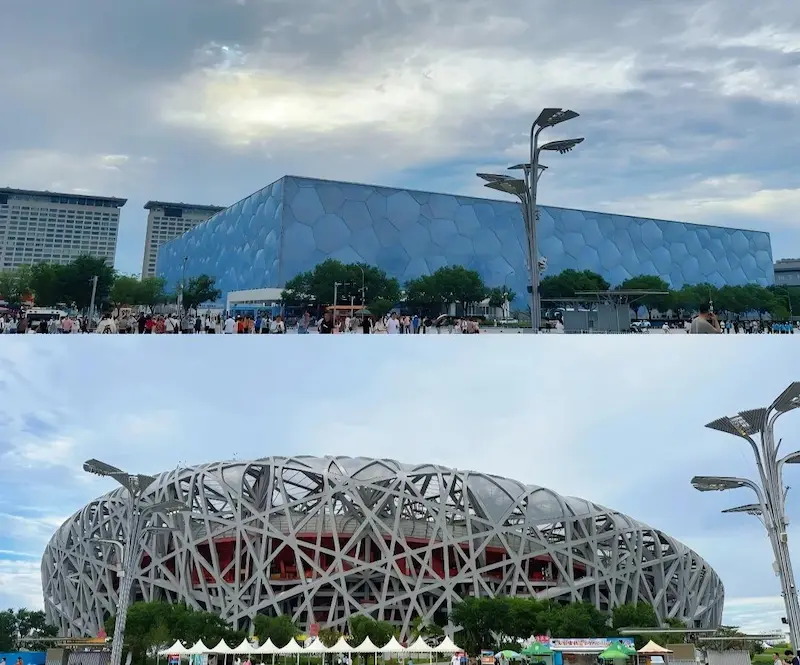
Table of Contents
Practical Information Before Your Visit
Note: Ticket prices, opening hours, combined ticket policies, and lighting schedules are subject to change based on the season and event updates. Please refer to the latest announcements on the official mini-program and WeChat official account before your visit. This information is provided for reference only when planning your 2026-2027 trip.
Bird’s Nest (National Stadium)
| Item | Details |
| Regular Visiting Hours | 10:00–22:00 (last admission at 21:00) ⚠Special Note: Admission to the Top View Skywalk closes at 16:30; even if the venue remains open late, high-altitude activities must be completed during daylight hours |
| General Admission Ticket | 50 yuan/person |
| Discounted Ticket | 25 yuan/person (students, seniors aged 60–69, etc.) |
| Free Admission | Children under 6 years old or under 1.2 meters tall, seniors aged 70 and older, people with disabilities |
| Reservation Method | WeChat Mini Program “Chaopiao”; reservations can be made 1–7 days in advance |
| Closed on Mondays | The Bird’s Nest is open as usual on Mondays and does not close |
Water Cube (National Aquatics Center)
| Activity | Details |
| Peak Season Hours | 9:00–22:00 (last admission at 21:00) |
| Off-Peak Season Hours | 9:00–19:00 (last admission at 18:00) |
| General Admission | 30 yuan/person |
| Booking Method | Purchase tickets and make reservations via the WeChat official account “Water Cube” |
| ⚠Important Reminder | The Water Cube is closed every Monday (except on national holidays) |
Combo Tickets and Free Outdoor Areas
| Item | Details |
| Bird’s Nest + Water Cube Combo Ticket | 80 yuan per person, valid for both venues; subject to change—official announcements prevail |
| Olympic Park Outdoor Areas | Completely free; no reservation required; visit and take photos directly |
| Best Time to Visit | 5:30–8:00 PM; capture both the daytime architecture and nighttime lighting |
| Summer Lighting Schedule | Approx. 7:30–10:00 PM; subject to temporary adjustments based on season and major events |
Transportation Guide
– Subway (Highly Recommended)
1. If your first stop is the Bird’s Nest: Take Line 8 to Olympic Sports Center Station, Exit B. It’s a 5-minute walk to the Bird’s Nest South Gate, where there are relatively fewer people taking photos.
2. If your first stop is the Water Cube or the larger Olympic Park area: Take Line 8 or Line 15 to Olympic Park Station, Exits D or E. It’s a 5–8-minute walk from there.
– Driving Tips: Use your navigation app to find Bird’s Nest Parking Lot P7. Parking spaces are extremely limited during major sporting events and activities, and availability cannot be guaranteed; parking fees are approximately 9–12 yuan per hour.
⚠️ Important Reminder: All venues require real-name ticket verification, so please carry your ID card; foreign visitors must bring their original passport. The Water Cube is closed on Mondays, so please do not make a special trip there on that day.
Decision-Making Guide: Is it worth paying to visit these venues?
Here’s a quick guide to help you decide before you arrive:
✅ Recommended to visit the Bird’s Nest:
– First-time visitors to Beijing; those interested in Olympic history or large-scale architecture; those who want to experience the stunning skywalk with panoramic city views.
✅ We recommend visiting both the Bird’s Nest and the Water Cube:
– Architecture enthusiasts who want to fully compare the designs and internal structures of both venues.
✅ Prioritize the Water Cube:
– Families with children planning to experience the swimming pool and water play area.
⭕ No need to buy tickets—just explore the outdoors:
– If you’re on a tight schedule and just want to check out the exterior and take nighttime photos, the Olympic Park’s outdoor plaza and the dragon-shaped water features are all you need for your exterior photos.
A quick tip from the blogger: If it’s your first visit, I recommend arriving in the afternoon. Check out the architectural structure during the day, then wait until dusk to see the lights—you’ll get two visual experiences in one trip.
Behind the Architecture: Was the Bird’s Nest Really Designed After a Bird’s Nest?
In 2002, the National Stadium launched a global call for architectural proposals, and architects from around the world submitted a large number of creative designs.
Ultimately, the proposal submitted by a consortium led by Pritzker Prize laureates Herzog & de Meuron in collaboration with the China Academy of Architectural Design was selected.
“Bird’s Nest” is merely a nickname that caught on among the public later on. It wasn’t as though the designers first sketched the shape of a bird’s nest and then filled it with seats.
According to Li Xinggang, the Chinese chief architect, the entire design process proceeded from the inside out: first, the functions of the stands were determined, with their layout drawing on the logic of ancient Roman amphitheaters; only then was the structure of the outer shell studied.
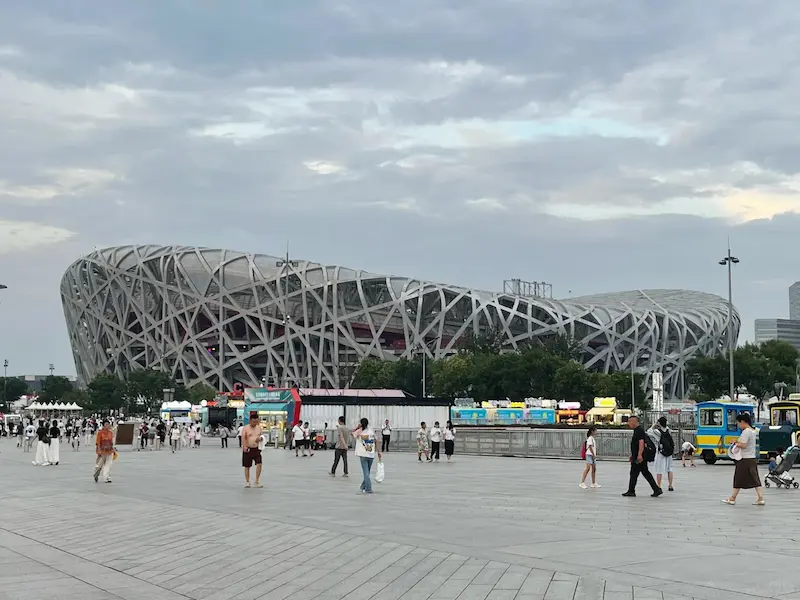
According to Li Xinggang, the design team conducted extensive simulations to create the outer layer’s interwoven steel structure, which resembles interlaced spokes. Forty-eight main beams interlock along the openings, weaving layer by layer to form the shell we see today.
The texture of the exterior draws inspiration from the “crackle glaze” pattern found on traditional Chinese porcelain and the “icicle lattice” design of ancient window frames. Foreign architects magnified these traditional motifs, transforming them into the stadium’s massive exterior structure.
Water Cube: A “Square Box” Shaped by the Bird’s Nest
While the Bird’s Nest is bold and exuberant, the design philosophy behind the Water Cube leans toward restraint and subtlety.
The Water Cube was jointly designed by China Construction International, Australia’s PTW, and other firms. Its name underwent several iterations: from “WATER COOP” to “H₂O cubed,” before finally settling on “Water Cube.”
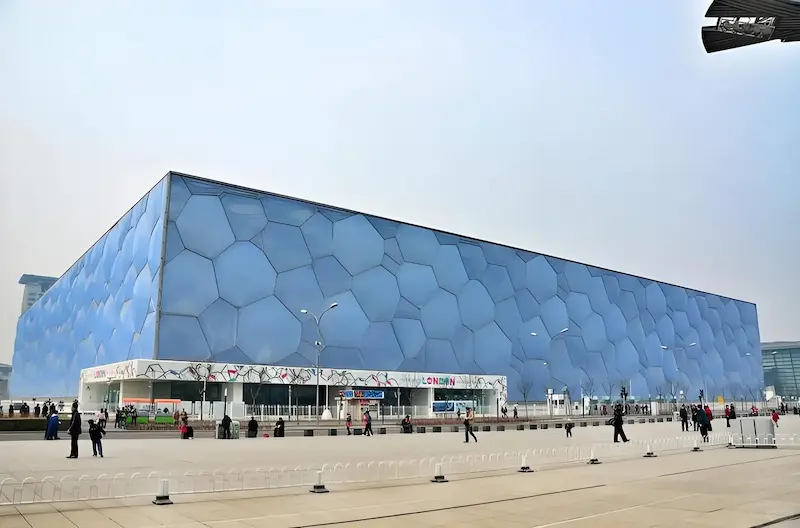
The Water Cube’s design was “forced” by the Bird’s Nest.
Once the Bird’s Nest proposal was selected, the designers had to consider how to create a dialogue and achieve visual balance between the square swimming center and the circular stadium.
Consequently, the team opted for a low-key, symmetrical “cube” shape, creating a sense of design courtesy; the two structures were already designed to complement each other from the conceptual stage.
The Water Cube is not merely a box that looks like water; the design aims to fuse the building itself, the sport of swimming, the water, and light into a single entity. The pairing of the square and the circle—the two main Olympic venues—was already fully planned out during the blueprint phase.
Heartwarming Stories from the Construction Site
Did you know? Interesting facts from the site
❶Real Magpies Nesting on the Construction Site
During the construction phase, workers discovered a pair of magpies that had built their own nest using welding rods and steel wire found in the gaps of the Bird’s Nest’s steel structure. The massive stadium, built from thousands of metric tons of steel, and the tiny birds’nest coexisted miraculously in the same space.
❷Welders’Markings on the Steel Structure
Most of the welding on the Bird’s Nest’s steel structure took place during the summer, in sweltering heat. Some welds bear the welders’marks and names, a testament to the builders’hard work; while not every weld is inscribed with a name, these are the human traces left behind at the construction site.
❸The “Moment of Self-Support” for the Bird’s Nest’s Steel Structure
The Bird’s Nest’s outer shell consists of a massive woven steel structure. Public records cite two sets of figures—48,000 metric tons and 42,000 metric tons—with the statistical scope differing based on whether ancillary components or the main load-bearing structure are included.
On September 17, 2006, 78 temporary steel support columns were gradually removed. The main load-bearing steel structure no longer relied on external scaffolding and achieved independent load-bearing capacity. It was at this moment that the Bird’s Nest truly “stood” on its own, with a design service life of 100 years.
❹The Water Cube’s Blue Bubble Exterior
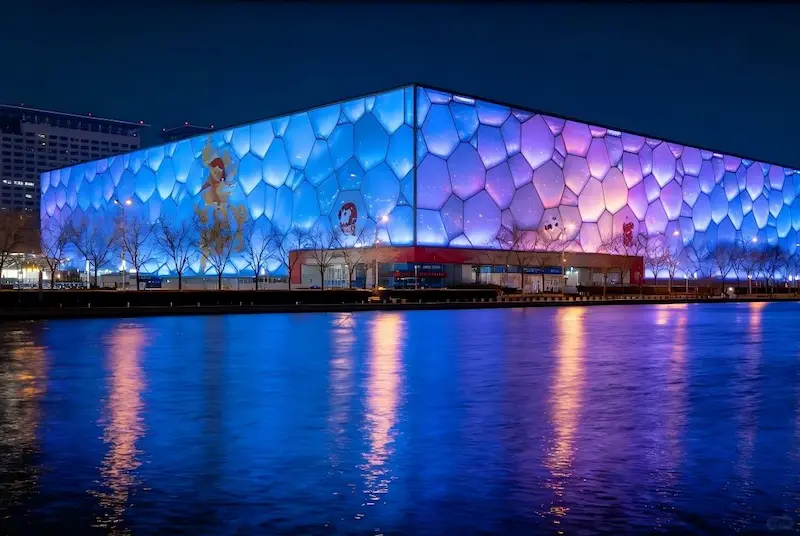
The Water Cube’s exterior facade consists of 3,065 ETFE membrane air cushions, resembling floating blue water molecules. The walls and roof are assembled using fine steel tube joints, totaling 12,000 connection points.
This membrane material is thin yet possesses strong load-bearing capacity and features self-cleaning properties that repel rainwater; the venue is equipped with a rainwater harvesting system.
Note: While traditional reinforced concrete was not used in the wall and roof envelope systems, concrete was still used for the building’s foundation and base; therefore, it should not be assumed that the entire structure is completely free of concrete.
❺Donations from Overseas Chinese Around the World
The Water Cube was the only venue at the 2008 Beijing Olympics funded by compatriots from Hong Kong, Macao, and Taiwan, as well as overseas Chinese. More than 350,000 compatriots from 107 countries and regions around the world contributed a total of 940 million yuan.
At the time, people affectionately referred to it as the “beloved daughter” of compatriots from Hong Kong, Macao, and Taiwan—a colloquial term that was not an official designation.
Two Buildings: A Dialogue Between Circle and Square
The Bird’s Nest is elliptical in shape, with an interwoven steel structure that exudes a powerful visual presence; the Water Cube is a regular square, featuring a light and gentle blue membrane.
The visual contrast between the circle and the square naturally leads many visitors to associate the structures with the traditional Chinese concepts of “the sky is round, and the earth is square” and the balance of yin and yang.
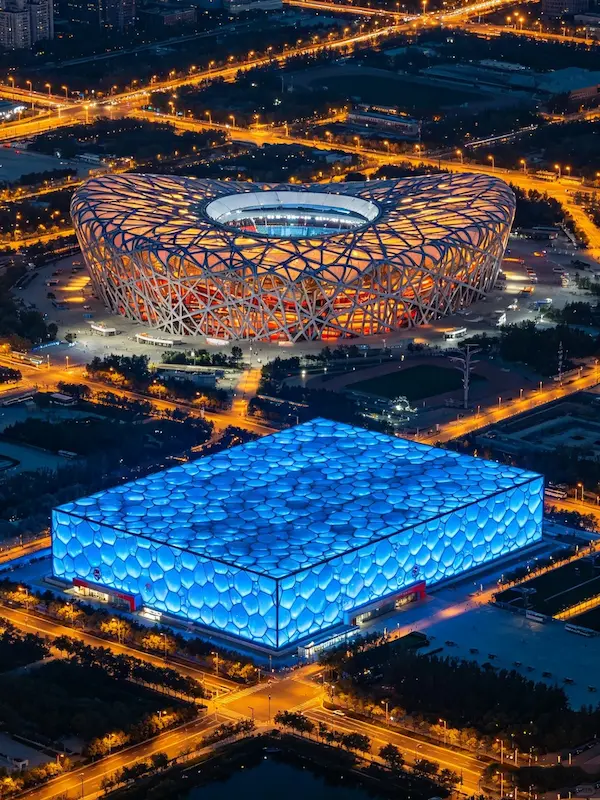
However, this was not a design theme explicitly set by the original architects; rather, it is an interpretation derived from the associations made by later visitors as they viewed the structures.
Are the Bird’s Nest and Water Cube Really a Pair?
Yes. They were not placed there randomly. Since the Bird’s Nest was completed first, the Water Cube’s form and scale were designed to create a dialogue with it—one rigid, one supple, complementing each other to form the most iconic architectural pair in the Olympic Park.
Tour Itineraries (Multiple Options to Choose From)
Relaxed Outdoor Itinerary (2–3 hours, no entry into the venues; photo-taking only)
Exit at Olympic Park Station, Exits D/E→Take photos of the Bird’s Nest exterior→Walk to the Water Cube exterior→Wait by the Dragon-shaped Water Feature for the evening lights and take nighttime photos.
⏱Half-Day Highlights Tour (Approx. 3–4 hours, includes museum visits)
Exit at Exit B of Olympic Sports Center Station on Metro Line 8 → Take photos of the Bird’s Nest exterior (15 minutes) → Tour the Bird’s Nest interior (1.5 hours, including the stands and the Dual Olympics Exhibition Area; aim to complete the Top View Skywalk by 4:30 PM) → Walk 5 minutes to the Water Cube → View the Water Cube exterior and tour the interior (1 hour) → Capture nightscapes of the dragon-shaped water feature at dusk.
Route Logic: Olympic Sports Center Station is closer to the Bird’s Nest, so visit the Bird’s Nest first; save the water feature for the evening to capture the lighting effects as day turns to night.
⏱Full-Day In-Depth Tour (approx. 6–7 hours)
- Morning: Visit the Bird’s Nest (1.5–2 hours; prioritize the Top View Skywalk during daylight hours)
- Noon: Lunch at the New Olympic Shopping Center or nearby restaurants
- Afternoon: Beijing Olympic Museum (1 hour, free) → Visit the Water Cube (1 hour)
- Evening: Return to the Dragon-Shaped Water Feature to photograph the architectural lighting at dusk and at night.
Photography Spot Guide
| Spot | Location | Best Time | Tips |
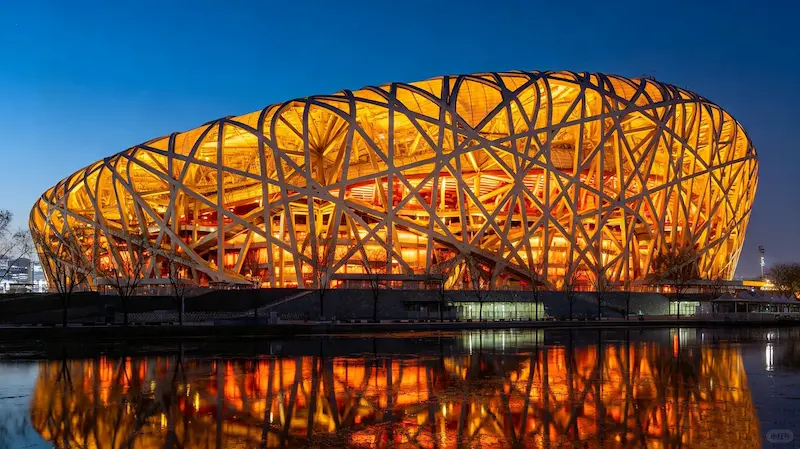
| Panoramic View of the Bird’s Nest | Plaza directly in front of the Bird’s Nest | Daytime or in the evening after the lights come on | During the day, focus on capturing the sense of power in the interlacing steel framework; at night, when the warm yellow lights illuminate the venue, the entire stadium resembles a giant, glowing nest |
| Water Cube Night View | Plaza directly in front of the Water Cube | After dark, when the lights come on | The venue’s lights cycle through blue, purple, and pink hues |
| Reflections in the Dragon-Shaped Water Feature | Along the banks of the Dragon-Shaped Water Feature | Windless evenings | When the water’s surface is calm, you can capture the architectural reflections of both the Bird’s Nest and the Water Cube |
| Close-up of the Bird’s Nest Steel Frame | Low-angle shot looking up from the Sunken Garden | Daytime | A low-angle shot looking up creates a strong visual impact with the crisscrossing steel lines |
| Top View Skywalk | Top of the Bird’s Nest | Be sure to enter before 4:30 PM | Looking north and south, you can see the cityscape extending northward along Beijing’s urban axis |
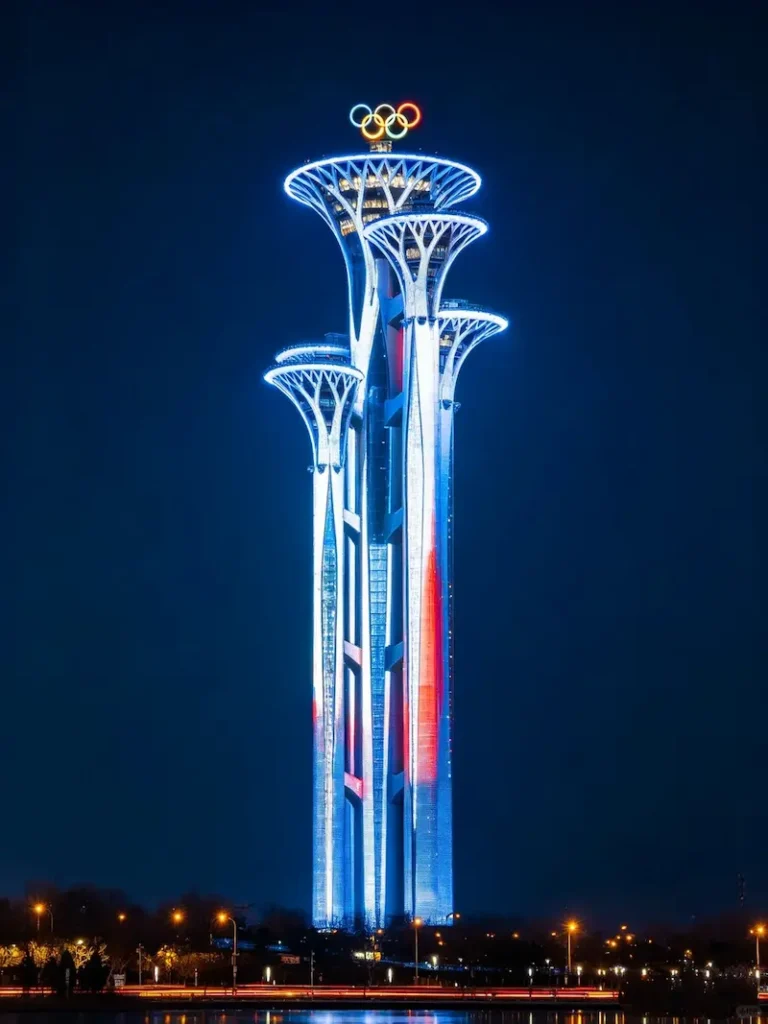
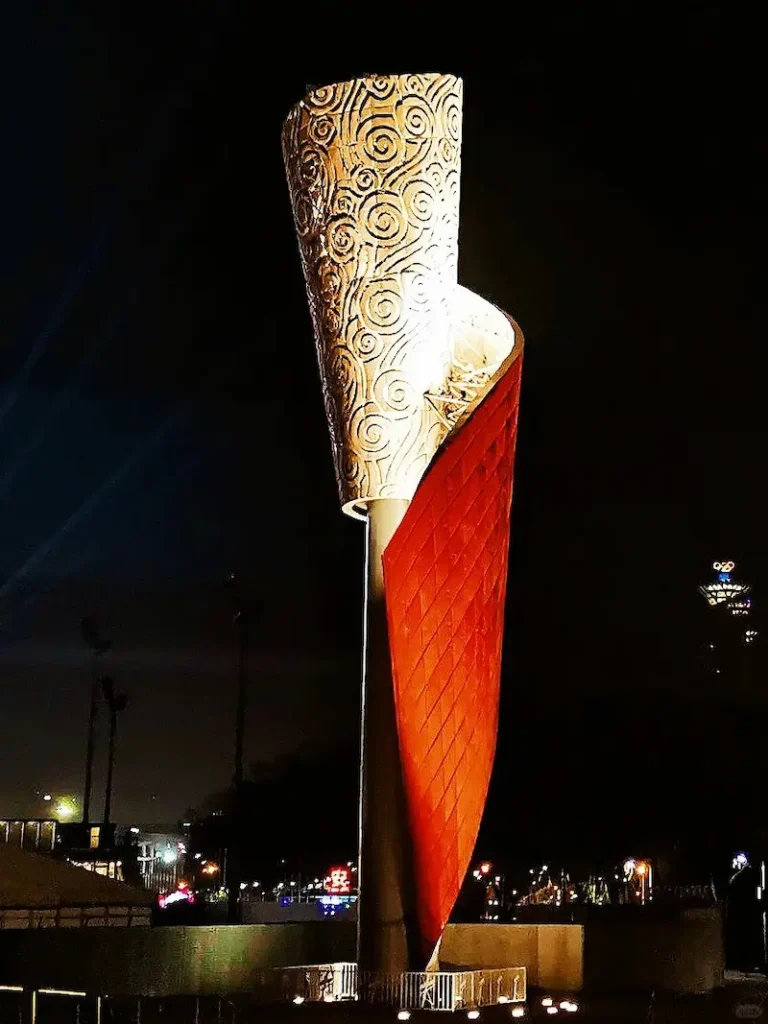
In addition to the Bird’s Nest and the Water Cube, the other iconic buildings at Olympic Square are also very beautiful at night.
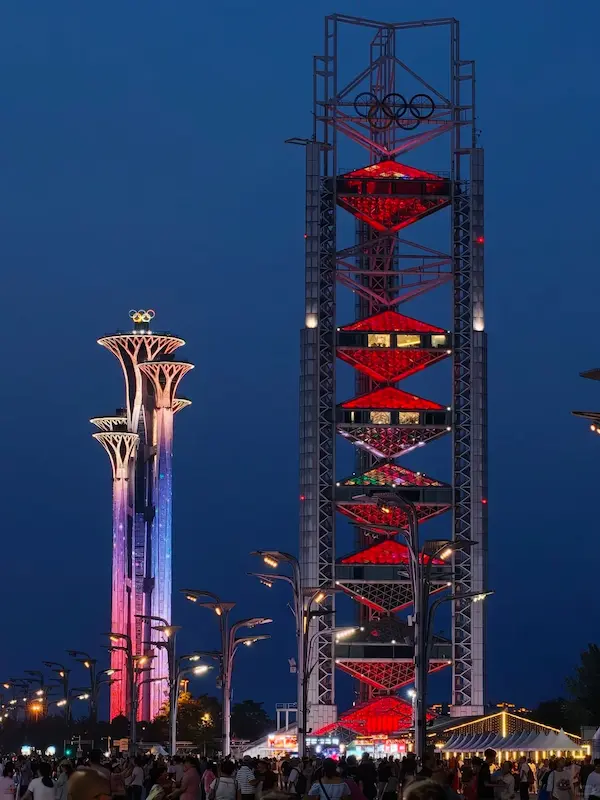
When You Visit, Look for These 7 Highlights
1. The giant interwoven steel structure on the exterior of the Bird’s Nest
2. The massive bowl-shaped stands inside the Bird’s Nest—imagine the scene of tens of thousands of spectators watching the games back then
3. The Water Cube’s exterior facade, featuring panels of blue ETFE bubble-like air cushions
4. Experience the visual contrast between the Bird’s Nest’s circular shape and the Water Cube’s square shape up close
5. The “Dual Olympics” logos preserved throughout the venues: Both the 2008 Summer Olympics and the 2022 Winter Olympics were held here, making Beijing the world’s first city to host both Summer and Winter Olympic Games
6. The dragon-shaped water feature—observe the interplay of light and shadow between the buildings and the water’s surface
7. Experience the spatial layout of the two venues along the northern extension of Beijing’s Central Axis
Supplementary Note: The Bird’s Nest and the Water Cube are not constituent elements of the Beijing Central Axis World Heritage Site, but they are situated within the modern urban space extending northward from the Central Axis.
The giant footprint created by fireworks during the 2008 Olympic Opening Ceremony traveled northward along the city’s Central Axis, eventually reaching the Olympic Park.
FAQ
A nest, a body of water; a circle and a square, the hard and the soft. They bore witness to the 2008 Beijing Summer Olympics and went on to host the 2022 Winter Olympics, cementing Beijing’s status as the world’s first city to host both Summer and Winter Olympic Games.
The history of Beijing’s urban central axis dates back to the era of the Yuan Dynasty’s capital, Dadu. Centuries later, the Bird’s Nest and the Water Cube stand on the land where this axis extends northward. Here, the echoes of the ancient capital’s history and the cheers of the modern Olympics meet across time.