Beijing Confucius Temple and Imperial Academy: Exploring 700 Years of Imperial Education | Admission, Reservations, and a 3-Hour Tour Itinerary
For foreign visitors who love history and culture, Beijing has a very special place: Guozijian Street.
Here, you’ll find not only the highest imperial academy from over 700 years ago but also a temple dedicated to Confucius.
Note: This article was updated in September 2026 to reflect the latest information on admission fees, opening hours, and reservation policies.
Table of Contents
Why Are the Confucius Temple and the Imperial Academy Worth Visiting?
If this is your first time in Beijing and you want to learn about ancient Chinese education, the imperial examination system, and Confucian culture, the Confucius Temple and the Imperial Academy are well worth setting aside 2–3 hours to explore.
- Confucius Temple: Learn about Confucius and Confucian culture, and browse the stone steles inscribed with the names of jinshi from throughout history
- Imperial Academy: Explore the highest institution of learning during the Yuan, Ming, and Qing dynasties
- Biyong Grand Hall: See firsthand the hall where ancient emperors delivered lectures
- Steles Inscribed with the Names of Jinshi: Look for the names of historical figures you’ve encountered in textbooks
- Glazed Tile Archway: Understand the cultural symbolism of “leaping through the Dragon Gate” in the ancient imperial examination system
- Imperial Academy Street: Experience the well-preserved atmosphere of Old Beijing’s archway-lined streets and alleys
Objective Note: If you’re primarily interested in seeing grand imperial palace architecture, this might not be your top choice. However, if you wish to gain a deeper understanding of ancient China’s comprehensive system of “education–imperial examinations–entering government service,” I highly recommend taking your time to explore the site at a leisurely pace.
In this article, you’ll learn the stories behind each building and receive detailed travel tips.
Quick Reference Guide Before Your Trip
| Item | Key Information |
| Admission | Full price: 30 yuan; Half price: 15 yuan; Free for visitors under 18 or over 60 (reservation required) |
| Free Admission on Wednesdays | Limited to 200 people; call 010-64075259 one day in advance to reserve |
| Opening Hours | High Season (May 1–Oct. 31): 9:00 AM–6:00 PM (last entry at 4:30 PM); Low Season (Nov. 1–Apr. 30): 9:00 AM–5:00 PM (last entry at 4:30 PM); Closed on Mondays (except public holidays) |
| Transportation | Exit F at Yonghegong Station (Subway Lines 2/5), 5–8 minutes’walk; driving is not recommended |
| Recommended Visit Duration | 3 hours |
| Online Booking | KKday Online Booking Portal or the WeChat official account “ Confucius Temple and Imperial Academy Museum ” |
| Inquiries | 010-64042407 |
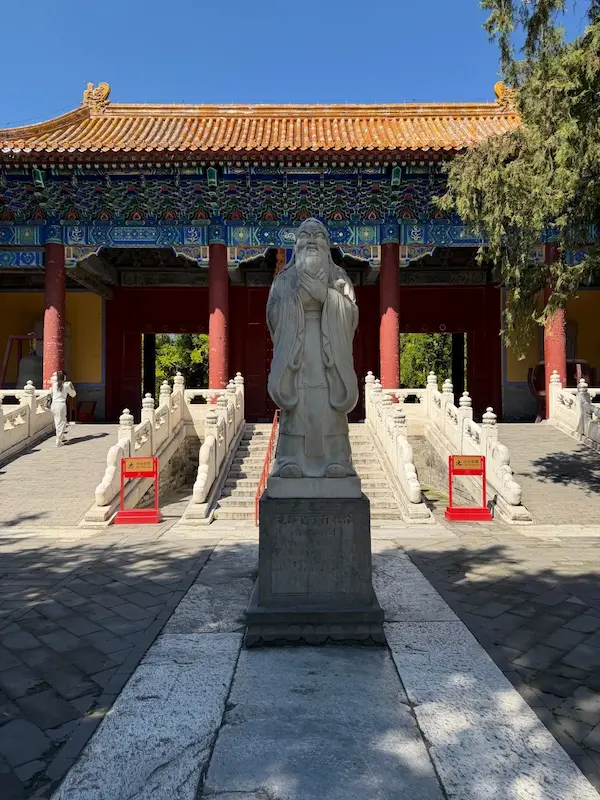
6 Must-See Highlights for First-Time Visitors
Top spots to visit first—perfect for taking screenshots to save
1. Stele of Successful Jinshi Candidates — The “Golden Roll” of ancient Jinshi scholars; look for famous historical figures
2. The “Expose the Traitor” Cypress — A 700-year-old tree shrouded in folk legends about a treacherous minister from the Ming Dynasty
3. Dacheng Hall — The main hall of the Confucian Temple and the central venue for ancient national Confucian rituals
4. Glazed Archway — An iconic structure of the Imperial Academy, where you can experience the cultural significance of “leaping through the Dragon Gate” in the imperial examination system
5. Bi’yong Grand Hall — The hall where the emperor delivered lectures, featuring a unique ancient architectural design with a water-enclosed courtyard and no supporting columns
6. Giant Turtle Sculpture — The physical origin of the idiom “to take the top spot” (独占鳌头), symbolizing good luck in academic pursuits
Guozijian Street: Beijing’s Only Historic Street with Archways
As you walk down Guozijian Street, the archways on either side will immediately catch your eye. Archways are a type of traditional Chinese gateway structure, typically built of wood or stone and adorned with exquisite painted designs.
Guozijian Street features a total of four painted archways—one at each of the street’s eastern and western entrances, inscribed with the characters “Chengxian Street”; and one on either side of the Imperial Academy, inscribed with the characters “Guozijian.”
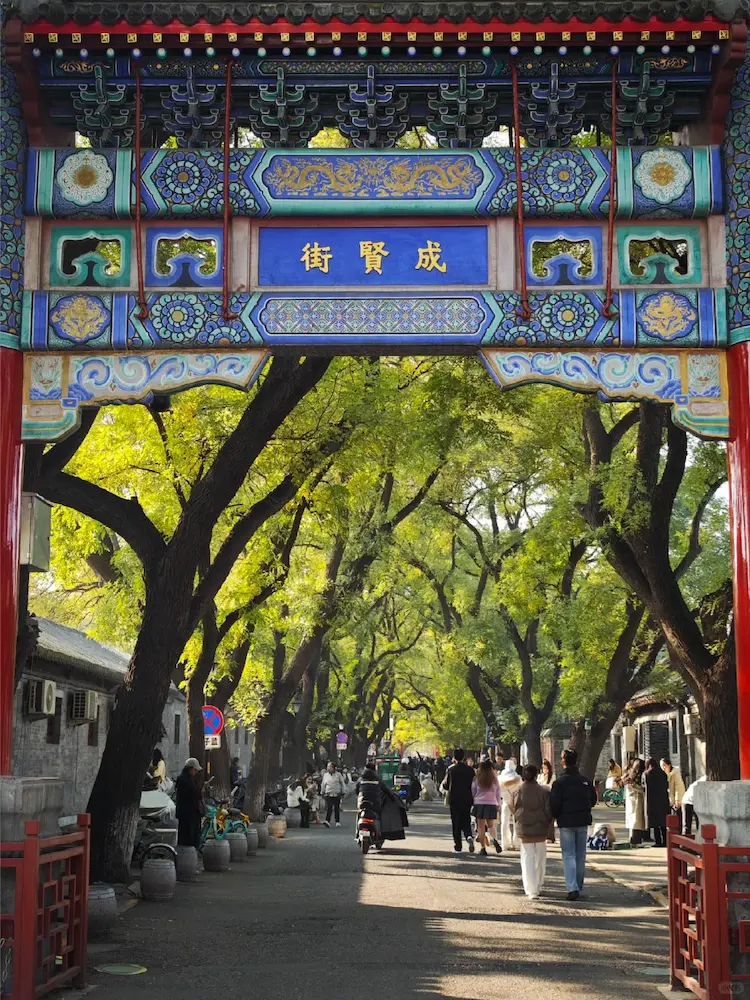
In the past, many streets in Beijing had arched gateways, but as the city has changed, most of them have been demolished.
Guozijian Street is the only street in Beijing where these arched gateways have been preserved. Walking beneath them, you’ll feel as if you’ve stepped back in time.
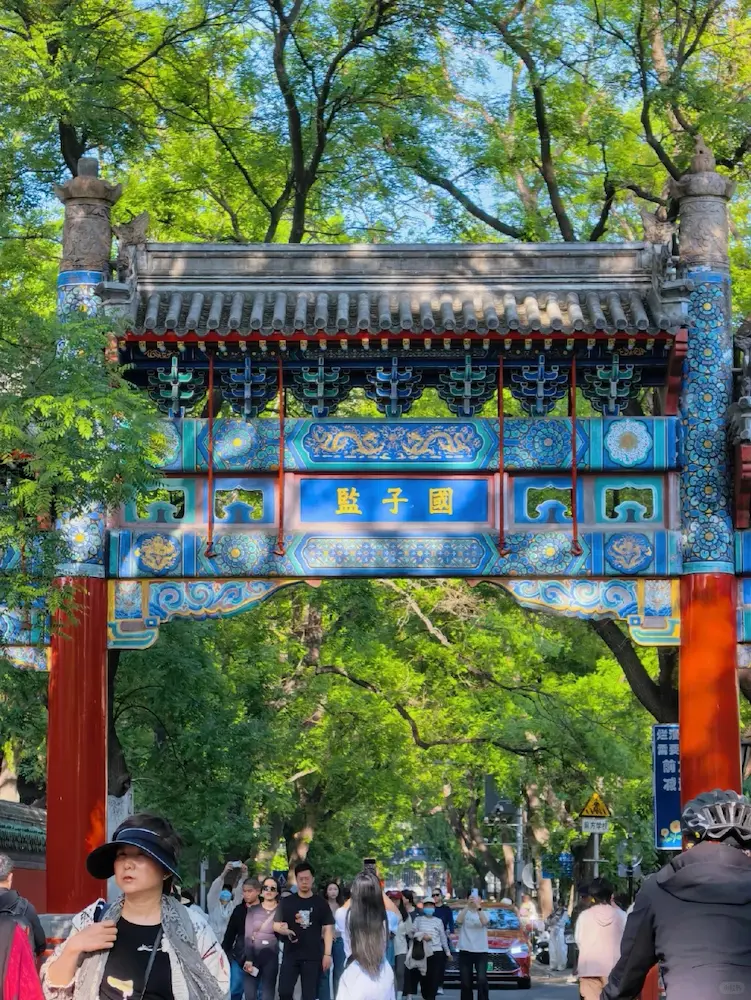
The Dismounting Stele—a place where everyone in the past had to stop and pay their respects. Next to the “Imperial Academy” archway, you will see two white marble steles known as the Dismounting Stele.
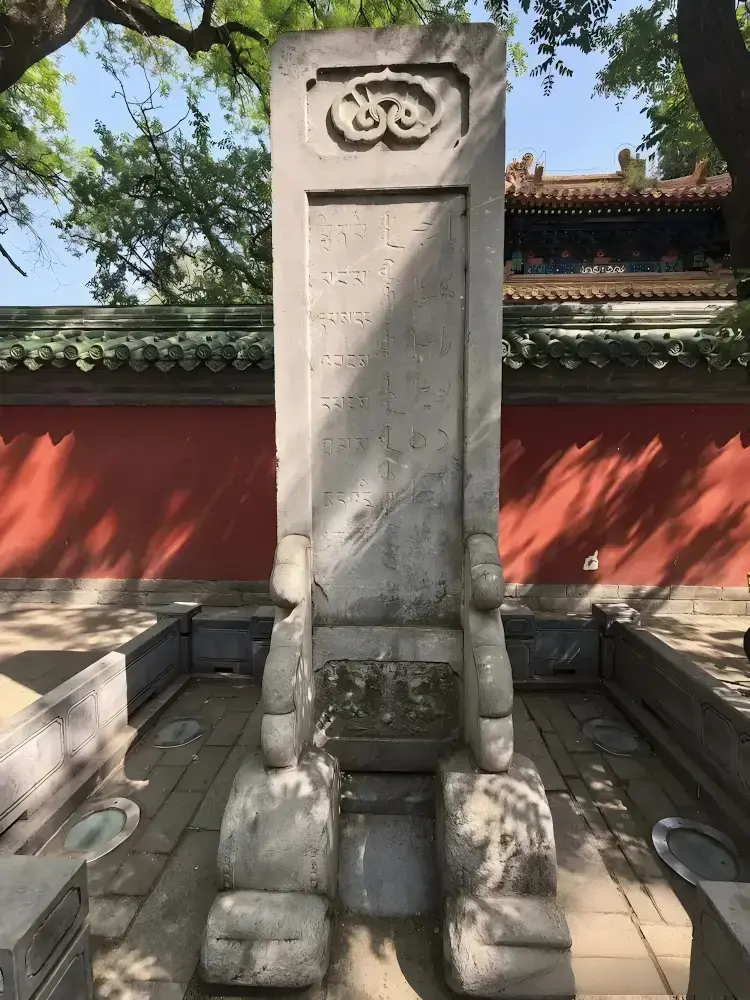
The inscription on the stele, written in six scripts—Manchu, Chinese, Mongolian, Hui, Töte, and Tibetan—reads: “All officials and others must dismount upon reaching this point.”
This means that no matter how high one’s rank, upon arriving here, one must dismount and walk on foot to the statue of Confucius. This reflects the Chinese people’s deep-seated respect for knowledge and education.
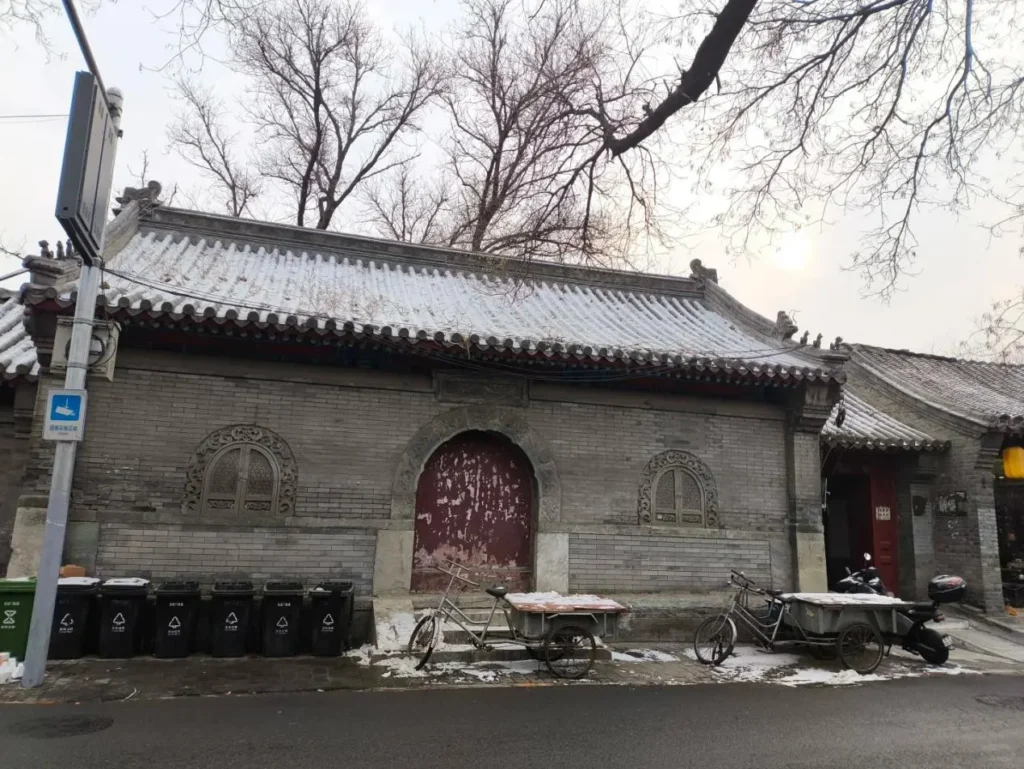
The Temple of the Fire God—a place where students go to pray for good luck before exams. Located in the middle section of Guozijian Street, this temple was built during the Ming Dynasty and houses a statue of the Fire God, Zhu Rong.
Legend has it that students from the Imperial Academy would visit the Temple of the Fire God before exams to pray for a safe exam and inspiration while writing.
The Confucius Temple: A Tribute to the Greatest Teacher of Ancient Times
Confucius is the most revered philosopher and educator in Chinese history. The Confucius Temple was built after his death to honor his memory.
1. Steles Inscribed with the Names of Imperial Examination Graduates—The“Wall of Honor” for Top Students (51,624 Steles)
As soon as you enter the courtyard of the Confucius Temple, you will see the steles inscribed with the names of imperial examination graduates neatly arranged. There are a total of 198 stone steles here, engraved with the names, hometowns, and rankings of 51,624 graduates from the Yuan, Ming, and Qing dynasties.
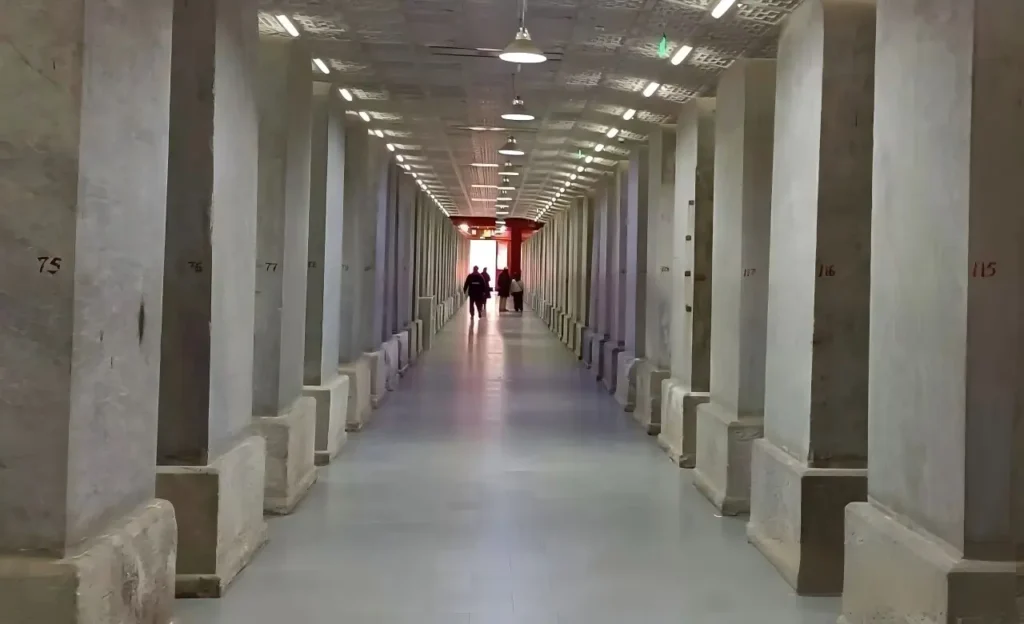
Jinshi were the intellectual elite who passed the highest-level imperial examinations in ancient China. To draw a rough modern analogy, the title is not equivalent to a modern doctoral degree; rather, it represents the highest achievement within the imperial examination system for scholars in ancient times.
As you browse these inscriptions, you’ll find many figures renowned throughout Chinese history: Yu Qian of the Ming Dynasty (the great hero who defended Beijing), Yuan Chonghuan (a patriotic general of the late Ming Dynasty), Lin Zexu of the Qing Dynasty (the patriotic official who oversaw the destruction of opium at Humen)…
On a quiet afternoon, you can try “treasure hunting” among these stone steles, searching for the names of figures you’ve encountered in your studies.
2. The “Expose-the-Traitor” Cypress—A 700-Year-Old Ancient Tree That Can “Distinguish Between Loyalists and Traitors.”
As you approach the Dacheng Hall, you will see a very sturdy ancient cypress tree known as the “Expose-the-Traitor” Cypress.
Its crown is vast, with seven sturdy branches reaching vigorously toward the sky; the knots left by time resemble the weathered face of an elderly man.
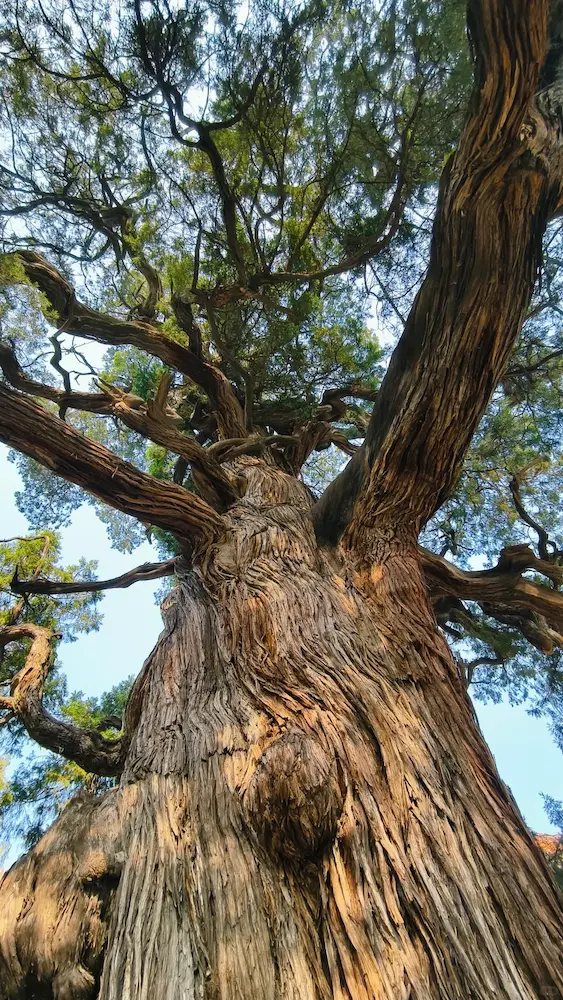
There is an interesting legend behind this tree: During the Ming Dynasty, a minister named Yan Song wielded great power but committed many evil deeds. On one occasion, he went to the Confucius Temple to offer sacrifices on behalf of the emperor.
According to protocol, he was only allowed to pay his respects outside the Great Hall of Achievement, but he insisted on forcing his way inside. Just as he was walking beneath this cypress tree, a strange gust of wind suddenly blew up, and a branch of the ancient cypress shot out, knocking his official cap right off his head with a loud “smack.”
Yan Song was terrified out of his wits and slunk away in disgrace. Later, when the truth came to light, he was indeed convicted of his many misdeeds.
The common people believed that this ancient cypress possessed a spirit and “could distinguish between good and evil,” so they named it the “Cypress That Strikes the Traitor.” From then on, a large growth appeared on the trunk, which, from a certain angle, bore a striking resemblance to the traitorous minister’s hideous face.
Note: This is a folk tale passed down through the ages and is not recorded in official historical accounts.
3. The Great Hall of Achievements—The Main Hall of the Confucius Temple
The Great Hall of Achievements is the most important building in the Confucius Temple and is used for worshiping Confucius.
The architecture here is truly magnificent; the golden glazed tile roofs glisten in the sunlight, creating a spectacular sight. Inside the hall, statues or spirit tablets of Confucius are enshrined.
In ancient times, this was a major venue for national Confucian memorial rites. When the emperor personally presided over the grand Confucian memorial ceremony, the central rites were held here, observing the highest standards of ceremonial protocol.
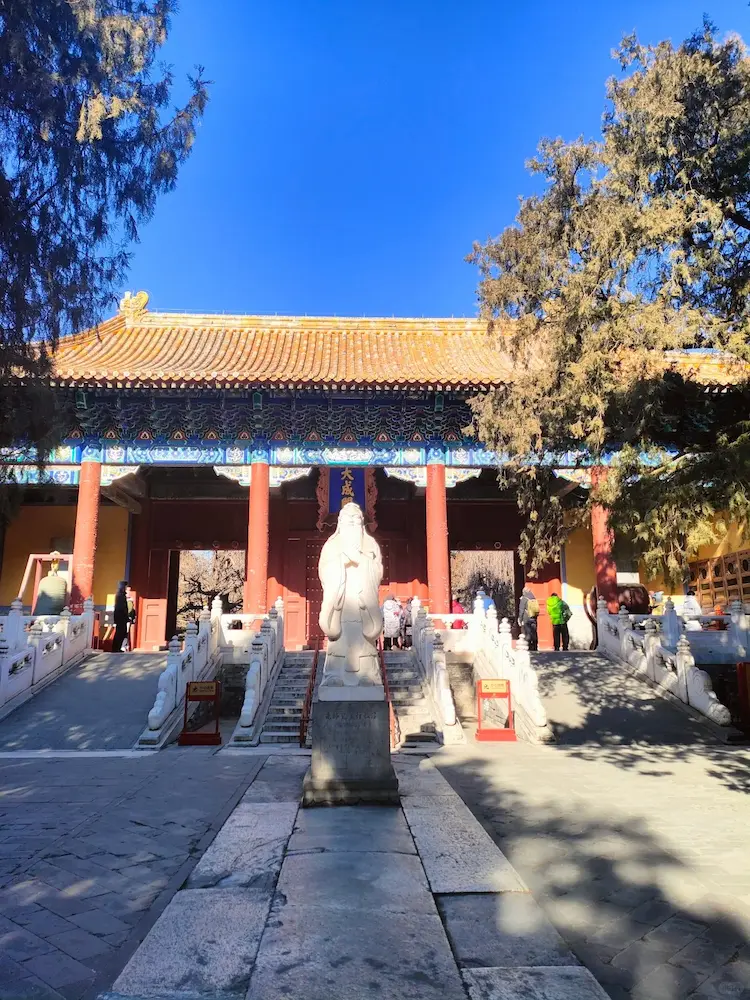
The Imperial Academy: The Highest Imperial Institution of Learning During the Yuan, Ming, and Qing Dynasties
After visiting the Confucius Temple, you can head to the Imperial Academy next door. The layout here is known as “temple on the left, academy on the right”: on the left is the Confucius Temple, where Confucius is worshipped, and on the right is the Imperial Academy, where talent is cultivated.
Fun Fact: Many tourists tend to confuse the Confucius Temple and the Imperial Academy—they are two adjacent complexes with completely different functions. The Confucius Temple is used for worshiping Confucius, while the Imperial Academy was the highest educational institution established by the imperial court.
In ancient Chinese cosmology, this “literature on the left, martial arts on the right” structure was highly significant.
Imagine every student at the Imperial Academy passing by the Confucius Temple each morning, paying their respects to the Sage before entering the classrooms to study the Four Books and Five Classics.
What exactly was the Imperial Academy? To draw a simple modern analogy, the Imperial Academy served both as the highest institution of learning in ancient times and as the national educational administrative body; it is not entirely equivalent to a modern university.
Students studied Confucian classics here to prepare for the imperial examinations. Those admitted to study here were the nation’s most outstanding young people.
1. The Glazed Tile Archway—The Only Path to “Leaping Through the Dragon Gate.”
To enter the heart of the Imperial Academy, one must first pass through a magnificent glazed tile archway.
The archway is topped with yellow and green glazed tiles adorned with golden dragon patterns that glisten in the sunlight.
This archway holds special significance: it features three arched passages. In ancient times, only the emperor and the top scholar (the national champion), selected every three years, were permitted to pass through the central arch.
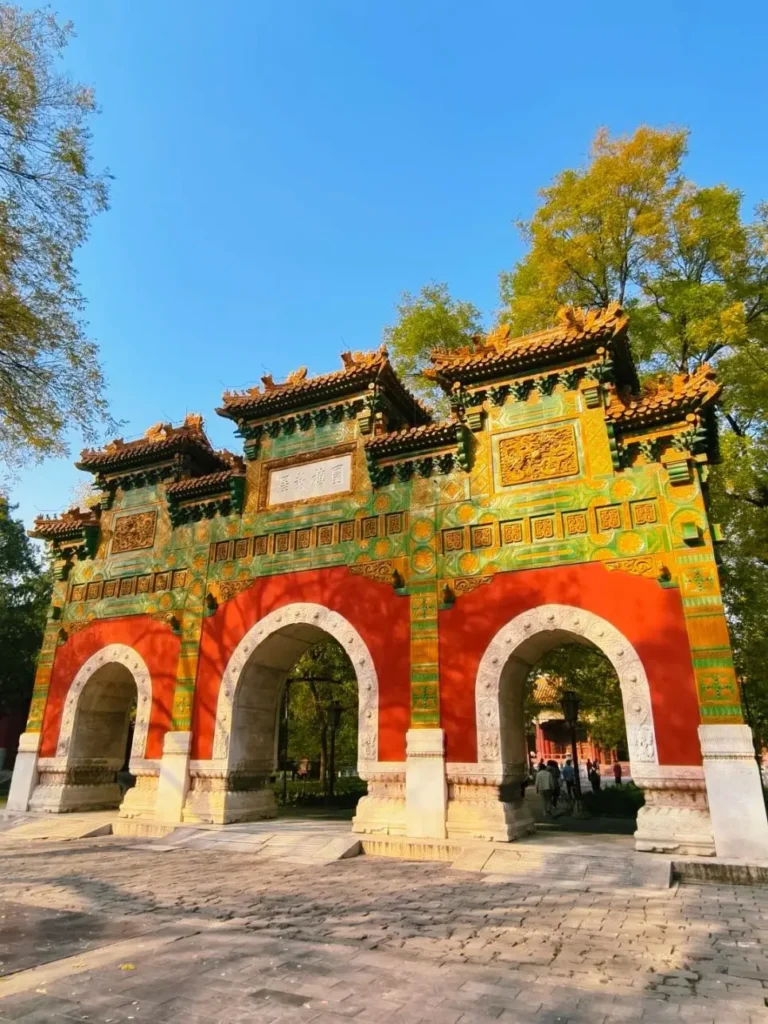
In traditional Chinese culture, which places great emphasis on education and reveres learning, the fact that the top scholar of the imperial examinations walked the same path as the emperor was considered the highest honour.
Today, when you visit, you can walk through the central archway and experience the feeling of “leaping through the Dragon Gate.”
2. The Grand Hall of the Biyong—Where the Emperor Personally Delivered Lectures (A Miracle of Column-Free Architecture)
The Grand Hall of the Biyong is the heart of the Imperial Academy. It was constructed in 1783 by order of Emperor Qianlong of the Qing Dynasty and was specifically designed for the emperor to deliver lectures.
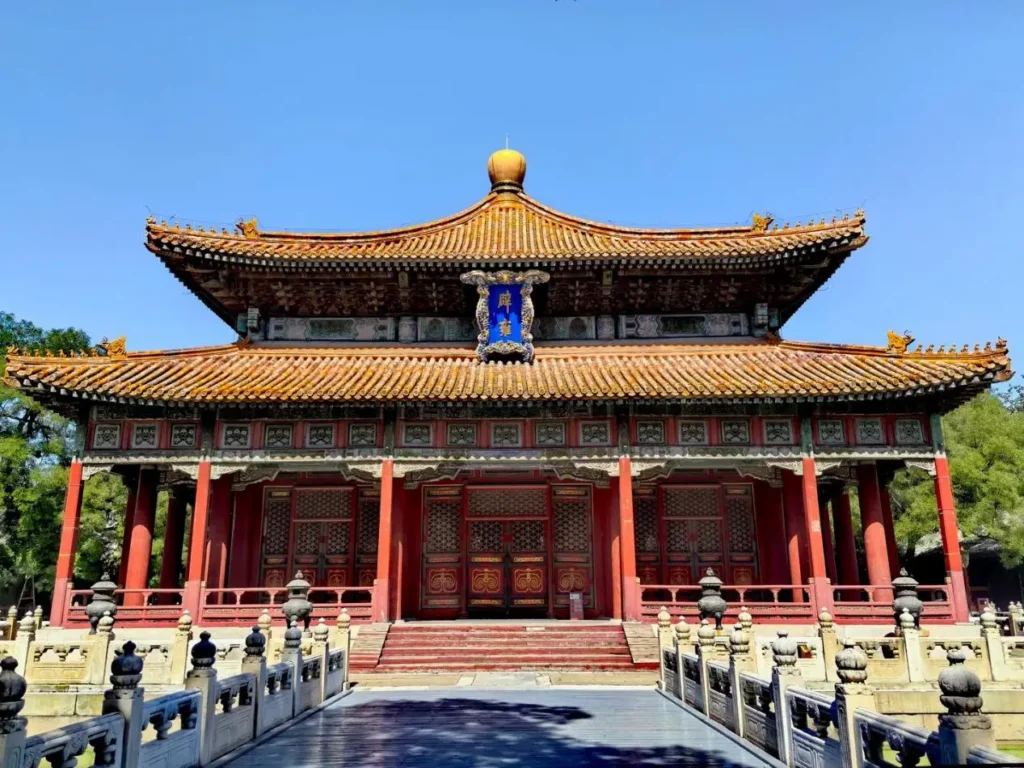
What makes this grand hall so special? First, it is built on a square platform in the center of a circular pond, with a small bridge leading to it from each of the four cardinal directions—this is the famous “Biyong surrounded by water” layout.
This design bears the imprint of ancient Chinese cosmology: the outer circle and inner square represent the cosmic principle of softness on the outside and strength on the inside; the water encircling it on all sides is not merely a scenic highlight, but also symbolizes the living spring of knowledge flowing ceaselessly in all directions.
Second, and most surprising of all: there isn’t a single pillar in the very center of the hall! According to the structural principles of ancient architecture, how could such a large building possibly lack supporting columns?
📌Folklore: Regarding the design of the Biyong Grand Hall—which features a spacious, column-free interior—a story circulating among the people links this to He Shen. At the time, He Shen, a minister deeply trusted by Emperor Qianlong, was in charge of the construction.
After personally reviewing the blueprints, he realized that the four columns originally planned would obstruct the emperor’s view when he spoke. On the spot, he had the four large columns removed and replaced them with a truss system. This not only saved 4,200 taels of silver but, more importantly, made the entire hall appear exceptionally spacious and bright.
Beginning with the Qianlong Emperor, every subsequent emperor, upon ascending the throne, would come here to deliver his first lecture to the faculty and students of the nation’s highest institution of learning.
Imagine this: while the emperor sat on the Dragon Throne in the Hall of Supreme Harmony as the sovereign of the realm, when he stood at the lectern in the Bi Yung, he appeared as the “Teacher of the World,” imparting the power of culture and enlightenment.
3. Yilun Hall and the“Supreme Leader.”
Yilun Hall was where the teachers of the Imperial Academy conducted their business. In front of Yilun Hall stands a fascinating artifact—a bronze ao fish, which has the head of a dragon and the body of a turtle.
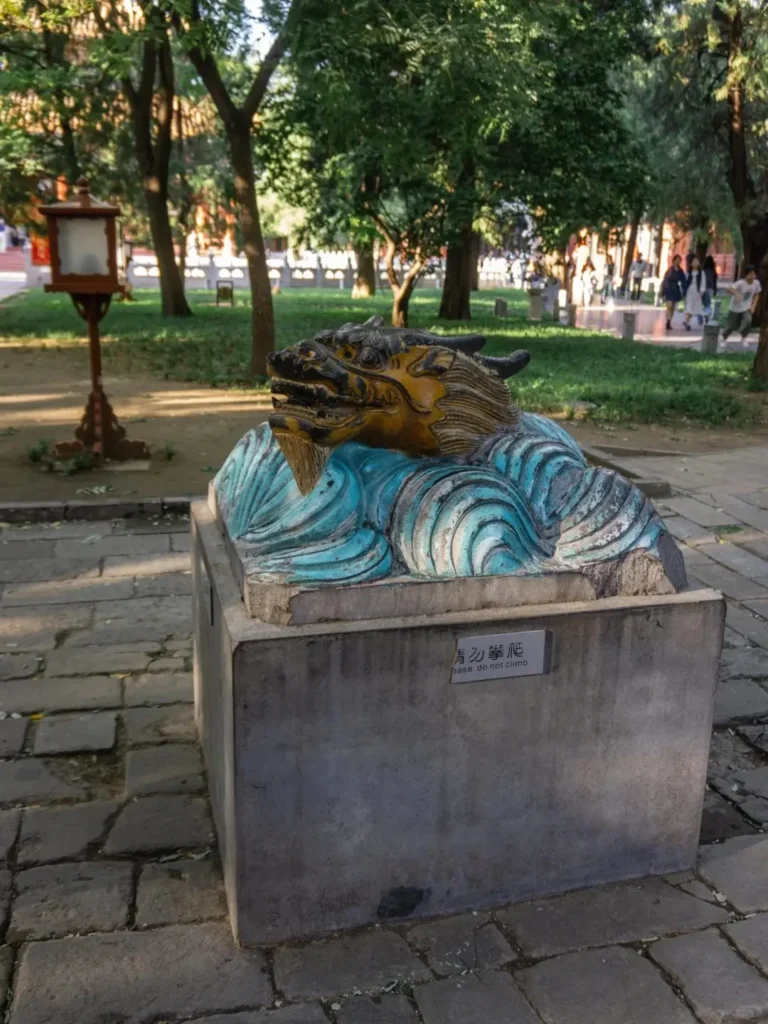
In ancient times, after the imperial examinations concluded, the emperor would announce the names of the Zhuangyuan, Bangyan, and Tanhua (the top three candidates nationwide) at the Imperial Academy.
The Zhuangyuan was the top-ranked candidate, who would stand before a statue of a giant fish to receive the emperor’s decree. This is the origin of the idiom “to come out on top” (独占鳌头).
Today, many parents bring their children here to touch the statue of the giant fish, hoping their children will “come out on top” and achieve excellent results in their exams!
Cultural Trivia
1. Why is it called the“Imperial Academy”?
“Guozi” literally means “children of the state,” referring to the offspring of the nobility and outstanding students from across the country; “Jian” was the name of an official institution in those days and carried no negative connotations.
Therefore, taken together, “Imperial Academy” means “the highest institution of learning for nurturing the nation’s future leaders.”
2. What was the Imperial Examination System?
The Imperial Examination System was an ancient Chinese system for selecting officials that lasted for over 1,300 years.
Students had to pass through a series of exams: county-level, prefectural-level, academy-level, provincial-level, national-level, and palace-level. Those who passed the Jinshi (Doctoral) exam were the cream of the crop, selected from among tens of thousands. The “Zhuangyuan” was the top-ranked candidate nationwide.
3. Why did Emperor Qianlong place such a high value on education?
Emperor Qianlong was a very famous emperor of the Qing Dynasty (reigned 1735–1796). He personally ordered the construction of the Biyong Hall, and whenever a new emperor ascended the throne, he was required to come here to deliver lectures.
In ancient Chinese tradition, emperors were not merely rulers; they also bore the moral responsibility of preserving and passing down culture and classical texts.
Practical Guide (Information You Can Follow Step-by-Step)
Ticket Information
- Ticket Prices: Full-price tickets are 30 yuan per person (approximately $4.20); half-price tickets are 15 yuan per person.
- Free Admission Policy: Visitors under 18 and over 60 are admitted free of charge, but reservations are required.
- Wednesday Special: Every Wednesday, 200 visitors are admitted free of charge on a first-come, first-served basis. Reservations must be made by phone one day in advance (on Tuesday). Phone: 010-64075259.
Booking Methods (Foreign-Friendly):
1. WeChat Official Account: Search for “孔庙和国子监博物馆” (Confucius Temple and Imperial Academy Museum), then select “Ticket Services” from the menu to purchase tickets. Tickets can be purchased for the current day and the next two days; available dates are updated daily at 7:00 PM.
2. On-site Purchase: Tickets can also be purchased on the day of your visit by scanning the QR code at the museum entrance or at the ticket counter.
3. International Booking Channels: Tickets can also be seamlessly reserved via the KKday Official Booking Page. It offers an intuitive English interface, supports international credit card payments, and provides instant e-ticket confirmation—making it a hassle-free option for foreign visitors.
Booking Tips: Reservations can be made up to 7 days in advance. Each day is divided into two time slots: 8:30 AM–12:00 PM and 12:00 PM–4:30 PM, with a capacity of 4,000 visitors per slot. If you plan to visit during peak season, it is best to book your tickets a week in advance.
Best Time to Visit (Avoiding Peak Crowds)
Best Times of Day:
- Right after opening at 9:00 AM: The lighting is excellent, there are the fewest visitors, and it’s perfect for taking photos. Wisteria flowers look their best in the morning light.
- 4:00–5:00 PM: Warm sunlight bathes the red walls, creating a particularly beautiful scene, and the crowds begin to thin out.
Best Days of the Week:
- Try to avoid weekends. The site is closed on Mondays, and weekends are the busiest.
- Visit Tuesday through Friday for significantly fewer crowds.
Best Seasons of the Year:
- Late April to early May: This is the best time to see the wisteria at the Confucius Temple! The entire courtyard is adorned with clusters of purple blossoms, creating a stunning sight.
- September to October: The weather is cool, and the red walls and yellow tiles against the blue sky make for excellent photo opportunities.
Spring Flower-Viewing Tips: Late April through early May is the best time to view wisteria. Since the blooming conditions vary each year depending on the temperature, we recommend checking the museum’s latest flower updates before your visit and not setting your expectations too rigidly.
Special Notes:
- The May Day holiday (May 1) and National Day holiday (October 1–7) are extremely crowded; try to avoid these dates.
- Don’t rush through the site. We recommend setting aside at least 3 hours to explore at a leisurely pace so you can truly appreciate the charm of this ancient academy.
Transportation
Address: No. 15, Guozijian Street, inside Andingmen, Dongcheng District, Beijing
Most Convenient: Subway
- Take Subway Line 2 or Line 5 and get off at Yonghegong Station.
- Exit options: Take Exit F and walk for about 5–8 minutes to arrive. Alternatively, take Exits C or D, walk 200 meters south, turn right onto Guozijian Street, and walk another 200 meters until you see Jixian Gate.
Bus Routes:
- Take Bus Routes 13, 116, 117, or 684 and get off at “Yonghegong Station.” After getting off, walk 100 meters south onto Guozijian Street, then continue for another 200 meters to reach your destination.
Taxi/Driving Tips:
- Driving is not recommended, as parking around Guozijian Street is extremely difficult! This area is located within the old city, where the streets are very narrow, and there are almost no parking spaces.
- If taking a taxi, we recommend having the driver drop you off near Jinxian Street; the area beyond that is mostly a pedestrian zone, so you’ll need to walk the rest of the way.
Travel Tips for Foreign Visitors (Feel free to take a screenshot and save this; copy the Chinese text directly for taxis and navigation)
- Chinese addresses and keywords to show to drivers or copy into map apps
- Confucius Temple and Imperial Academy Museum
- No. 15, Guozijian Street, Inside Andingmen, Dongcheng District, Beijing
- Jixian Gate | Piyong Grand Hall | Guozijian Street | Yonghe Temple
3-Hour First-Time Tour Itinerary (With Highlights and Step-by-Step Directions)
The entire route is on flat ground with no steep slopes; if you get tired, you can take a short break under the ancient trees.
1. First Stop: Guozijian Street–Jixian Gate (Entrance)
Learn briefly about the history of this ancient imperial academy, and take note of the archways on both sides and the “Dismount” stele.
2. Second Stop: Glazed Tile Archway
Focus on the three arched gateways and learn about the historical symbolism of the top imperial examination scholar “leaping through the Dragon Gate.”
3. Third Stop: Biyong Grand Hall
The central building of the entire complex—take a look at its layout surrounding the water feature and learn about the context in which the emperor delivered lectures.
4. Fourth Stop: Yilun Hall + Ao Fish Sculpture
Learn the origin of the idiom “to come out on top” (独占鳌头), and feel the aoi fish for good luck.
5. Fifth Stop: Move to the Confucius Temple Area
Experience the transition from the “state-run education” setting to the “worship of the Sage Confucius” setting.
6. Sixth Stop: Dacheng Hall and the “Exposing Corruption” Cypress
Visit the main hall for Confucian rituals and listen to the folk legend of the “Exposing Corruption” Cypress.
7. Seventh Stop: Stele Forest of Jinshi Inscriptions
Spend a few minutes looking for the names of historical figures you’ve seen in your textbooks.
8. Eighth Stop: Jingyi Pavilion, End of the Tour
Tip: You can also take the tour in reverse—start at the Confucius Temple, view the Stele Forest and ancient trees, and then head back to explore the Imperial Academy and the Big Hall of the Bi Yong.
Budget Guide (Per Person)
| Item | RMB | USD (approx.) |
| Admission | 30 RMB | $4.20 |
| Round-trip Metro | 10 RMB | $1.40 |
| Snacks / Water | 20–50 RMB | $2.80–$7.00 |
| Total (approx.) | 60–90 RMB | $8.50–$12.50 |
Note: This covers only admission and basic transportation costs. If you plan to visit the nearby Yonghe Temple or dine in Wudaoying Hutong, the cost will be higher.
Pre-Departure Checklist | We recommend taking a screenshot to save this
☑ Confirm opening dates: The site is typically closed on Mondays; avoid peak times during national holidays
☑ Book your tickets in advance—even those eligible for free admission must make a reservation
☑ Take a screenshot of the Chinese address and keywords for the attraction; this can be used for taxi rides and navigation
☑ Download a translation app on your phone
☑ Fully charge your power bank—taking photos and using navigation drain the battery quickly
☑ Allow at least 2–3 hours for your visit
☑ Wear comfortable flat shoes—there’s a lot of walking on cobblestone paths
☑ Bring your own drinking water in the summer—there are few places to buy it inside the museum
☑ Check the official website for the latest exhibition and flower display updates before you go
Suggested Nearby Attractions (One-Day Itinerary)
Option A | Half-Day Historical and Cultural Tour (Recommended)
Confucius Temple and Imperial Academy → Yonghe Temple → Wudaoying Hutong
Ideal for first-time visitors to Beijing who are interested in historical sites.
Option B | Visit Temples First, Then Academic Sites
Yonghe Temple → Confucius Temple and Imperial Academy → Wudaoying Hutong
Ideal for visitors who arrive in the Yonghe Temple area in the morning.
Itinerary C | In-Depth Exploration of the Imperial Academy and Historic Hutongs
Confucius Temple and Imperial Academy→Imperial Academy Street→Jianchang Hutong→Wudaoying Hutong
Things to Know Before You Go
What to Bring
- Comfortable walking shoes (the entire route is paved with stone slabs, and your feet will get tired after walking for a while)
- Water and snacks (there are no shops selling food inside; you’ll have to go outside the main gate to find any)
- A portable charger (Navigating on your phone and taking photos drains the battery quickly)
- A small notebook (you might just find a name on the Stele of Successful Candidates that resonates with you)
Language Communication (For International Visitors)
- Staff primarily speak Chinese; we recommend installing a translation app in advance (Google Translate or Youdao Translator).
- Common Chinese phrases (save as screenshots):
| Scenario | Chinese Sentence |
| Asking for Directions | Excuse me, how do I get to Jixian Gate? |
| Finding a Location | I want to go to the Bi Yong Hall. |
| Asking About Tickets | How much are the tickets? |
| Asking About Guided Tours | Are there English-language guided tours available? |
- There are English versions of the signs within the scenic area, so you’re unlikely to get lost.
- You can save the Chinese names—Confucius Temple, Imperial Academy, and Bi Yong—on your phone in advance.
Photography Tips
- For the best photos, wear light-colored clothing (white, light blue, or light pink) and stand in front of the red wall.
- When the wisteria is in bloom, standing beneath the flowers creates a scene of timeless beauty.
- Between 4:00 and 5:00 p.m., the setting sun casts its light on the glazed tiles, creating a stunning golden glow.
FAQ
Update Information
This is the latest guide for 2026, updated in May 2026. Ticket prices, opening hours, and reservation policies have all been verified.
Official Contact Information:
- Confucius Temple and Imperial Academy Museum Phone: 010-64042407 (Chinese service)
- Beijing Municipal Government Service Hotline (English support available): +86 10 12345
Great content! Keep up the good work!
Thank you.