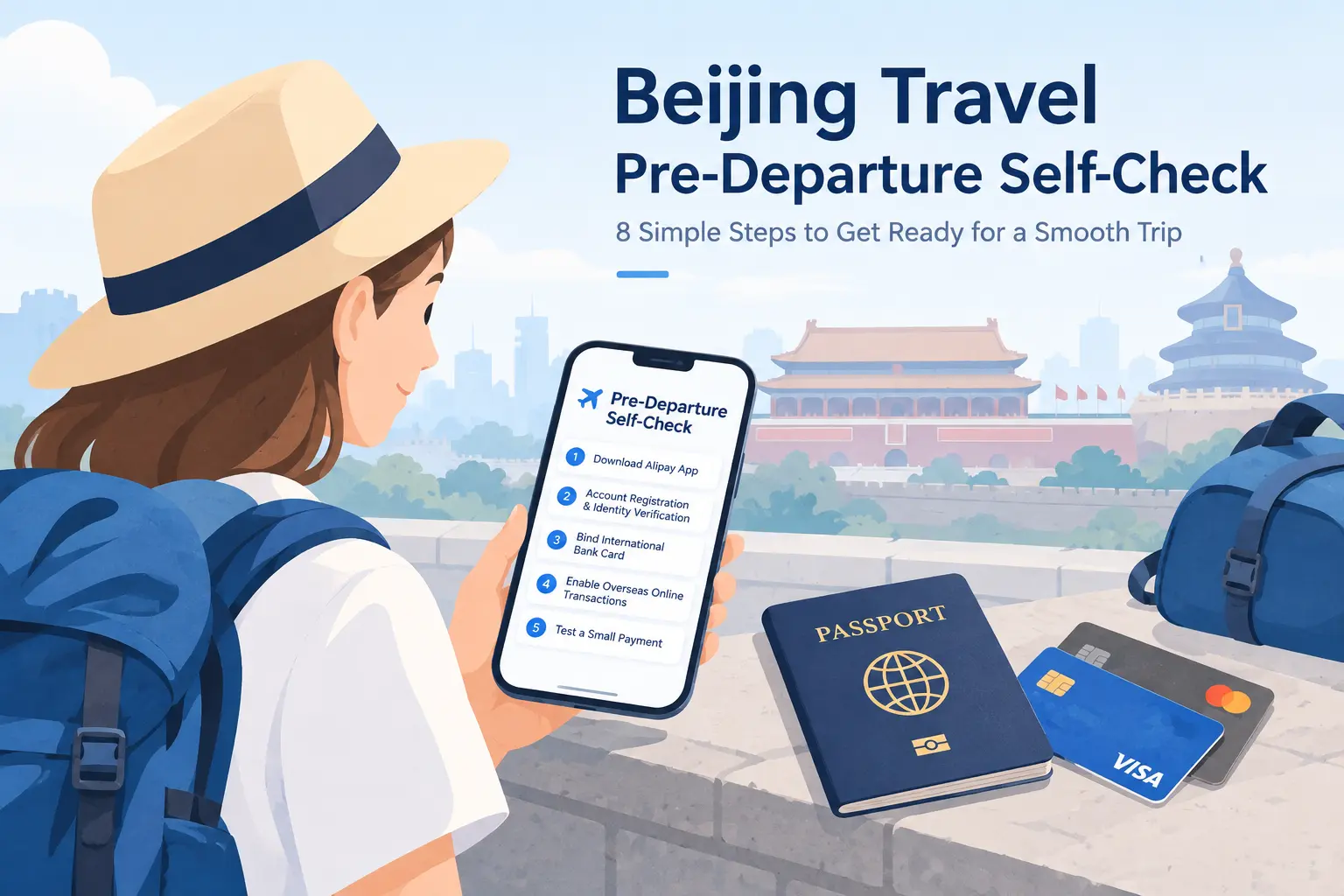
First-Time Trip to Beijing | Pre-Trip Self-Assessment Guide
When visiting Beijing for the first time, many problems don’t arise after you arrive—they stem from failing to anticipate real-life situations in China before you leave.
This article isn’t just a generic travel packing list; it’s more like a pre-trip stress self-assessment: Imagine you’ve just landed in Beijing—would you be able to navigate your first day smoothly? Drawing on over a decade of firsthand observations in Beijing, I’ll help you identify potential pitfalls in advance.
Table of Contents
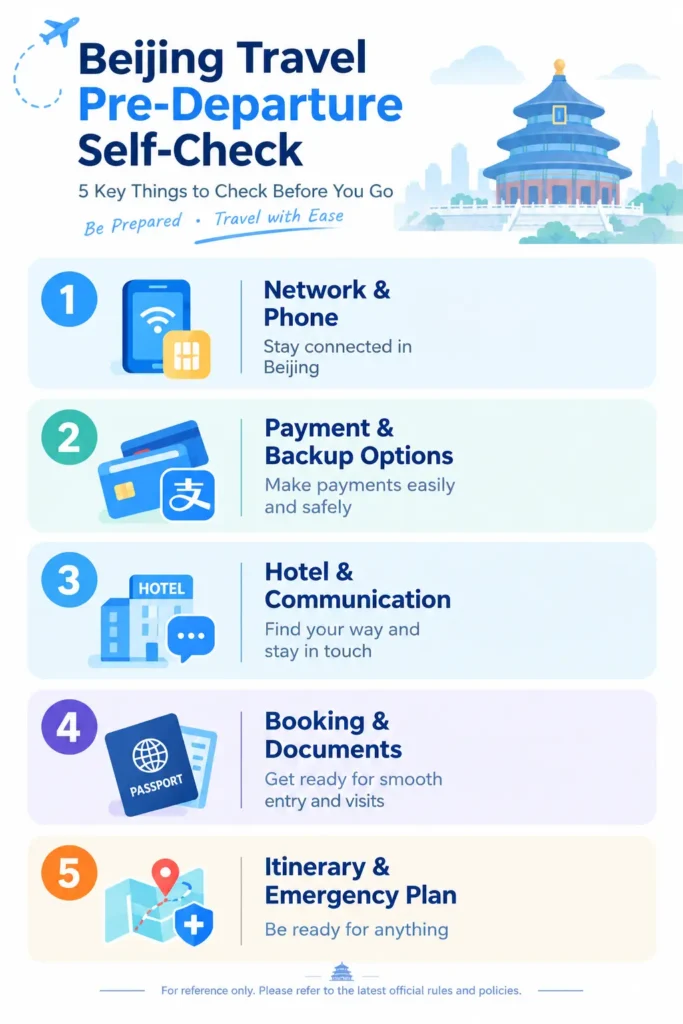
Five-Point Pre-Departure Checklist (Feel free to take a screenshot and save it)
| Category | Key Points to Check |
| Internet & Cell Phone | Confirm your internet plan for China; ensure maps and translation apps work properly |
| Payments & Backup Plans | Understand how to link your foreign credit card to mobile payment apps; prepare emergency payment methods |
| Hotels & Communication | Save screenshots of your hotel’s Chinese name and address to help when asking for directions or hailing a taxi |
| Reservations & Documents | Verify the validity of your documents and reservation details for each attraction; save your admission tickets |
| Itinerary & Contingency Plans | Plan daily activities and allow extra time for transportation and lines; have backup plans ready in case of rain or failed reservations |
Note: This checklist is for travel reference only. Please refer to the latest official regulations in China for all requirements.
Internet and Mobile Devices (Will My Phone Work Normally Once I Arrive?)
Many travelers assume everything is fine once they’ve downloaded the app, but upon arriving in China, they may encounter issues such as being unable to open maps or complete payments. We recommend conducting a simple test before departure.
1. Internet Access Options: Confirm your internet access options—such as roaming or eSIM—in advance to ensure network availability after entry.
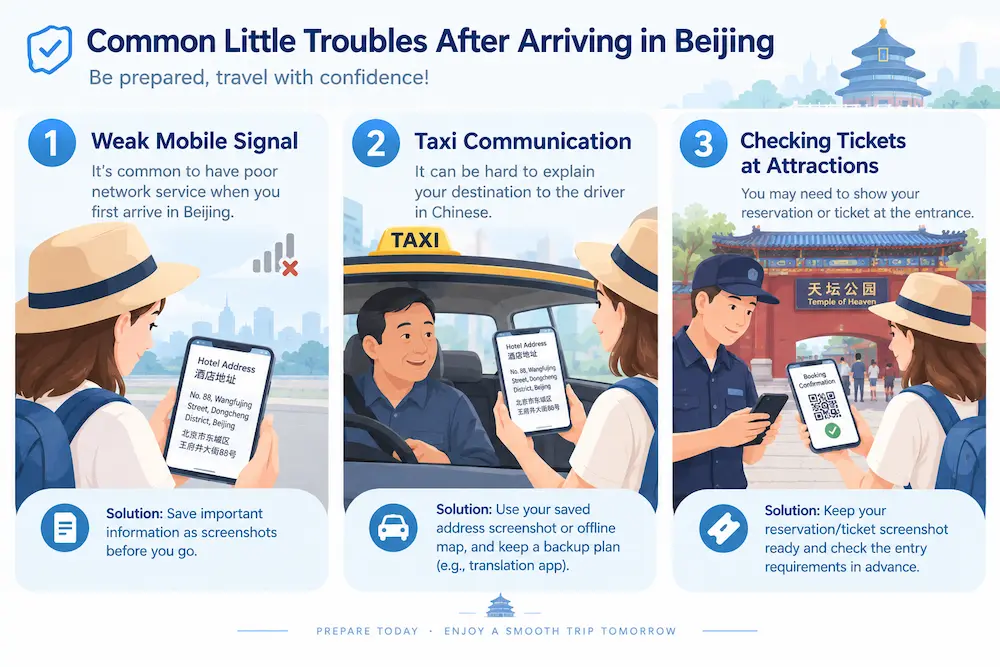
Important: Take screenshots of your hotel address and key navigation points in advance to prepare for unstable network signals.
2. Mobile Payments
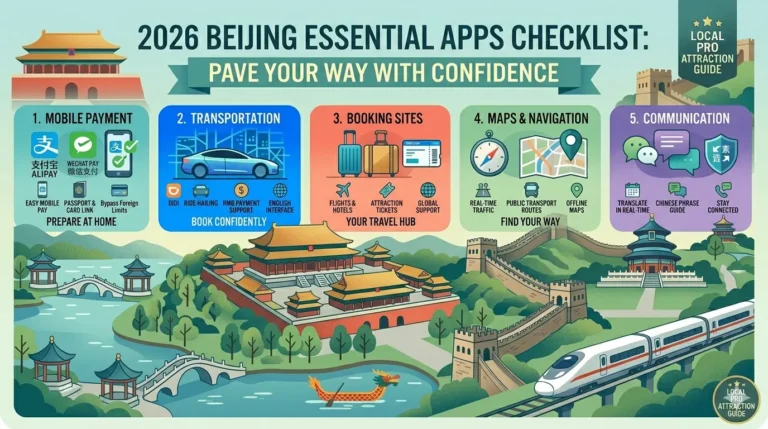
International visitors should familiarize themselves with the rules for linking foreign credit cards to Alipay and WeChat Pay. See the [Alipay User Guide for Foreigners]
Practical Tip: If possible, test with a small transaction before departure; don’t assume you can make purchases just because you’ve completed registration.
3. Power Adapters and Power Banks
China uses Type A/I plugs with a voltage of 220V; be aware of capacity limits for power banks.
⚠Note: Regulations regarding power banks vary across airlines, high-speed rail, and tourist attractions. Check the carrier’s rules before traveling; do not rely solely on the stated capacity figures.
4. Translation Tools: Prepare a translation app and save a Chinese-English glossary of key information—such as allergies and dietary restrictions—on your phone in advance.
Communication and Emergency Backups (How to Handle Language Barriers)
In Beijing, many taxi drivers and shop clerks do not speak English. Relying solely on translation apps for real-time translation won’t work if your phone loses internet connection, so it’s recommended to prepare backup communication materials in advance.
✅We recommend preparing the following information in advance (save screenshots of everything to your phone)
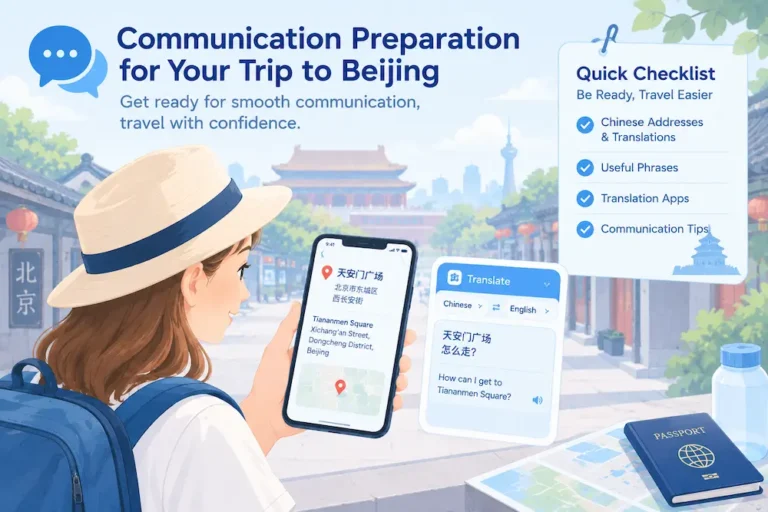
1. The hotel’s full Chinese name and detailed Chinese address (don’t just save the English name—local drivers can recognize Chinese more easily)
2. A description in both Chinese and English of any dietary restrictions or food allergies
3. Short messages asking for help—you can show these directly to passersby if you get lost or need assistance
Pro Tip: When asking for directions or hailing a taxi, show a screenshot of the address first—it’s more reliable than a verbal description.
Documents, Reservations, and Entry Verification (Will I Be Able to Enter the Attraction Without Issues?)
1. Passport and Visa: It is recommended that your passport be valid for at least 6 months; confirm that your tourist visa is valid.
2. Flight Tickets and Hotel Reservations: Keep electronic copies of your booking confirmations; it is recommended to also save screenshots of important documents.
3. Attraction Reservation Verification
Don’t stop at simply completing your booking—ask yourself these 3 questions:
① Do the identification details on your reservation exactly match those on your actual passport?
② Have you saved the documents you’ll need to present for entry?
③ If the attraction is fully booked and you can’t enter that day, do you have an alternative plan?
Popular attractions such as the Forbidden City and Tiananmen Square require real-name reservations. See [Reservation guides for the Forbidden City and Tiananmen Square.]
Itinerary Planning: Avoid Overbooking Your Schedule
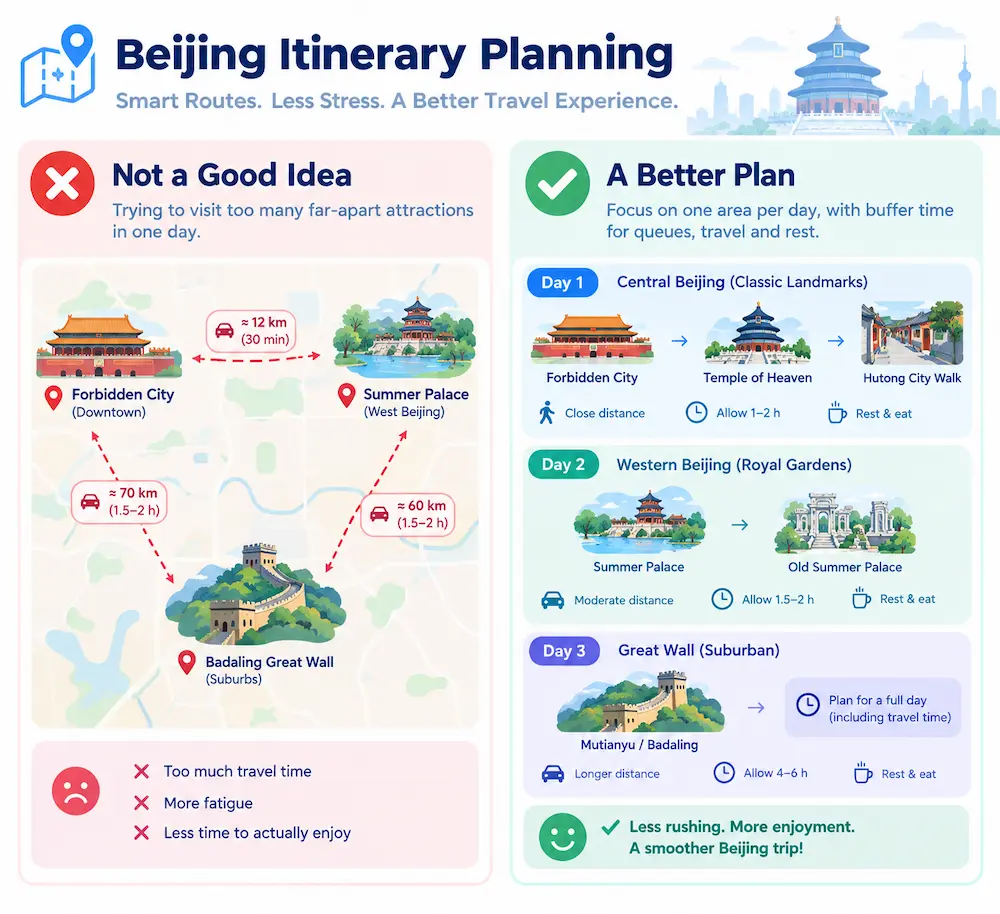
Beijing covers a vast area, and travel time between attractions often far exceeds the straight-line distance shown on a map. A common mistake many tourists make is cramming multiple attractions that are far apart into a single day.
Simple Itinerary Planning Tips
1. Identify the one most important core attraction for the day;
2. Then select nearby locations to visit along the way;
3. Allow extra time for lines, security checks, and walking between attractions;
4. If you’re visiting time-consuming attractions like the Great Wall or the Forbidden City that day, avoid adding multiple distant destinations.
❌ Example to Avoid: The Forbidden City in the morning, the Summer Palace in the afternoon, and the Great Wall in the evening (long distances, immense physical strain, and travel stress)
✅ A more reasonable approach: Schedule attractions in the same area on the same day, and spread out distant attractions across different days.
See also: Beijing Subway Navigation, Hutong / Central Axis City Walking Guides.
Essentials to Bring and Contingency Plans (Dealing with Unforeseen Problems)
In addition to packing your luggage, it’s even more important to plan how you’ll handle unexpected situations.
Emergency Essentials to Bring
- Cash: Bring 500–1,000 RMB in cash as a small emergency fund; don’t rely entirely on mobile payments.
- Tissues: Many public restrooms in China do not provide toilet paper, so it’s recommended to carry your own.
- Electronics: Power banks and rain gear; pack clothing appropriate for the season of your visit.
- Medications: Bring any personal medications you regularly use, but be sure to verify that they comply with China’s customs regulations for entry—do not bring large quantities of various medications into the country without proper authorization.
- Travel Insurance: Purchase travel insurance that covers mainland China, including medical and accident coverage.
Plan Ahead: 3 Alternatives for Unexpected Situations
1. In case of rain or fatigue: Which attractions can you skip?
2. If your payment method suddenly stops working: What other payment options are available?
3. If there’s a problem with your attraction reservation: What nearby alternative sightseeing options are available that day?
Safety Tips:
Keep your passport and valuables secure; memorize emergency numbers: 110 for police, 120 for medical emergencies; avoid remote or unfamiliar areas; be wary of common scams at tourist sites, such as tea touts and fortune-tellers; and keep receipts for all purchases.
⚠Three Things First-Time Visitors to Beijing Most Often Underestimate
1. Underestimating the Total Time Spent at Attractions: The total visit time isn’t just about viewing exhibits or architecture—you also need to factor in security checks, waiting in lines, and long walks.
2. Overestimating the Availability of English Communication and Mobile Payments: Just because you’ve downloaded an app doesn’t mean it will work properly; internet outages can cause major inconvenience, so be sure to have a backup plan.
3. Overpacking Your Itinerary: Distances may look short on a map, but in reality, commuting, security checks, and crowds can consume a significant amount of time and energy.
If You Can Only Prioritize Three Things Before Your Trip
If you’re short on time and can’t complete all your preparations, prioritize these three things:
1. Make sure your essential tools—such as mobile internet and mobile payment apps—are working, and have backup plans ready.
2. Double-check your passport and visa, and confirm that your reservations for major attractions match your travel documents.
3. Keep your daily itinerary flexible and allow for some wiggle room in case of unexpected situations.
FAQ
After reading this, check out these helpful resources
- Guide to Using Alipay for Foreigners
- Survival Guide for Beijing Subway, Navigation, and Travel
- Guide to Booking Tickets for the Forbidden City and the Great Wall
- Walking Routes Through Beijing’s Hutongs and Along the Central Axis
Author’s Note: This article is based on years of on-the-ground research. Policies regarding visas, entry, payments, and attraction reservations are subject to change; please check the latest official announcements before traveling.