Jiankou Great Wall Guide: Zhengbei Tower, Beijing Knot, Hiking Routes, and Safety Tips (2026)
Jiankou is Beijing’s most treacherous section of the Wild Great Wall. Its three notorious “gates of death ”—the “Heavenly Ladder,” “Eagle’s Flight,” and “Beijing Knot”—have left countless hikers trembling.
This article breaks down the Zhengbeilou Viewing Platform, its archaeological-style restoration, essential gear, and safety warnings. Recommended only for well-prepared adventurers; casual hikers should head to Mutianyu instead.
Table of Contents
Visiting Jiankou for the First Time? Check Out These 6 Things First (Take a Screenshot to Save)
| What to Know Before You Go | Information |
| Type | Off-the-beaten-path Great Wall mountain hike; not a developed tourist site |
| Main Highlights | Zhengbei Tower, the “Heavenly Ladder,” “Eagle Soaring Upside Down,” and the “Beijing Knot” |
| Hiking Difficulty | Significantly more challenging than typical commercial Great Wall trails |
| Recommended Route for First-Time Visitors | Zhengbei Tower round-trip route |
| Requirements for a Full Crossing: | Sufficient physical fitness, ability to follow trails, and thorough safety preparations |
| Major Risks: | Steep, rocky slopes; exposed cliffs; sudden weather changes; getting lost |
| Suitable for Children: | Not recommended as a family-friendly destination |
| Essential Gear: | Professional hiking boots, plenty of drinking water, offline trail maps, and real-time weather updates |
What Kind of Travelers Is the Jiankou Great Wall Suitable For?
✅Recommended for:
- Travelers with practical experience in mountain hiking
- Enthusiasts hoping to see the Ming Great Wall in its original, unaltered state
- Those interested in the restoration of Great Wall cultural relics and mountainous historical sites
- Those who can handle non-standardized mountain trails and are comfortable with long-distance hikes
❌Not recommended for:
- Those who only want to casually check in and take photos, with no mountain hiking experience
- First-time participants in mountain outdoor activities
- Those bringing young children to treat it as a regular tourist attraction
- Those who insist on entering the mountains despite adverse weather conditions such as rain, snow, or strong winds
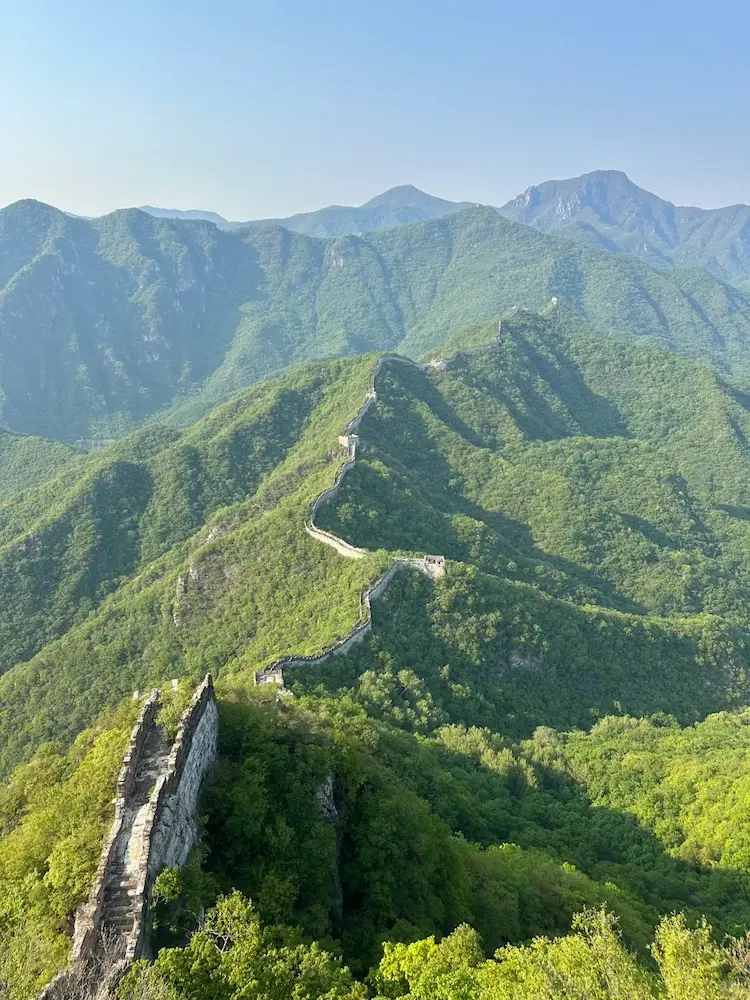
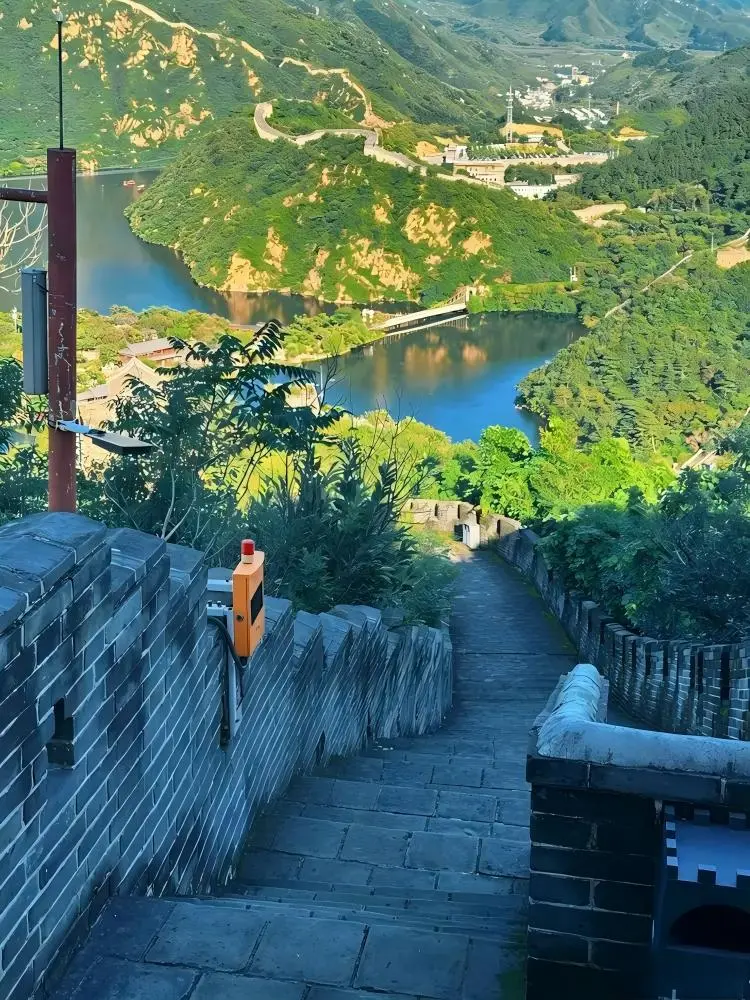
If your legs are already trembling at the North Watchtower and you find the rugged terrain too much to handle, and you’d rather head to a scenic spot where you can sip coffee and glide down the slope on a toboggan run? Check out my guide, Mutianyu Great Wall Guide: How to Choose Between the Cable Car, Aerial Tram, and Toboggan Run. Family Hiking Routes and Tips to Avoid Pitfalls (2026) (Note: Walking west from Watchtower 20 at Mutianyu actually leads to the starting point of Jiankou, but be sure not to get them mixed up).
Want to see another gentle side of the Huairou Great Wall and discover how the Great Wall playfully dips into the water? Head over to “Huanghua Water Great Wall Guide: The Great Wall Meets the Water, Ming Dynasty Chestnut Orchards, and Boat & Camping Guide (2026)”.
Or return to the main directory“Beijing’s 9 Great Wall Sections: Badaling, Mutianyu, and More (2026)” to use the comparison chart to choose your next stop.
Extreme Geography and Adrenaline: Unraveling the“Three Gates of Hell” at Jiankou
The Jiankou trail stretches over 20 kilometers, but its most spectacular—and most spine-chilling—sections are the “Heavenly Ladder,” “Eagle’s Inverted Flight,” and “Beijing Knot. Local veteran hikers collectively refer to these as the Three Gates of Hell.”
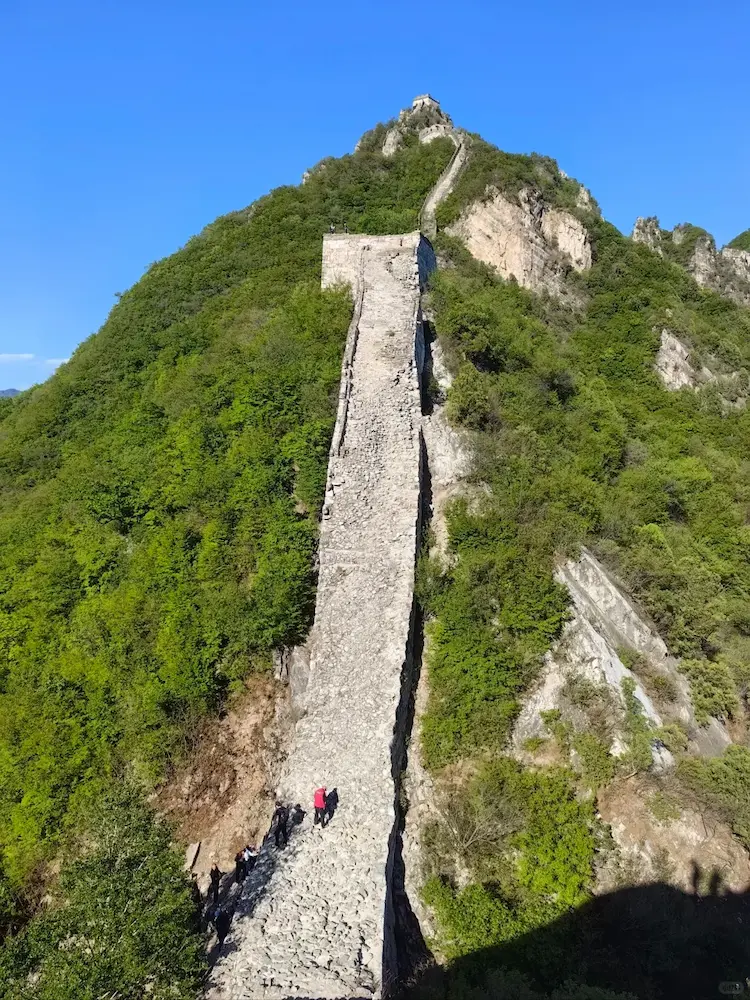
The Stairway: A 70–80-Degree Vertical Dread
Starting from the middle section of Jiankou, you’ll suddenly notice that the path beneath your feet has changed. The city wall, which you could previously barely stand upright on, suddenly transforms into an almost vertical slope.
With a gradient of 70 to 80 degrees, the narrowest sections allow only one person to squeeze through sideways. Large sections of the city’s bricks have collapsed, exposing the rubble beneath. There are almost no intact steps to stand on; often, you must dig your fingers into the cracks between the bricks and brace your feet against protruding rocks, climbing upward as if rock climbing.
Standing at the bottom of the “Heavenly Ladder” and looking up, you have to tilt your neck back as far as it will go to see the top. From up here, people look like ants on the wall.
Looking down, you see a bottomless valley; some dangerous sections are equipped with reinforced steel stakes and makeshift guardrails. These facilities are subject to change as part of ongoing maintenance work, so do not rely on old photos to judge current road conditions. When the wind blows from the side, you instinctively grab onto whatever is within reach—even a single blade of wild grass.
What Visitors Need to Know: The Stairway is not just an ordinary set of steps that you can “get through by simply walking a little slower.” If this is your first visit to Jiankou, don’t make climbing the Stairway a must-do goal; instead, assess whether to continue based on your own abilities and the on-site trail conditions.
Eagle Flies Upside Down: Even Eagles Must Fly Upside Down
The end of the Heavenly Ladder isn’t the hardest part. Further ahead lies the most famous perilous section of Jiankou—the “Eagle Flies Upside Down.”
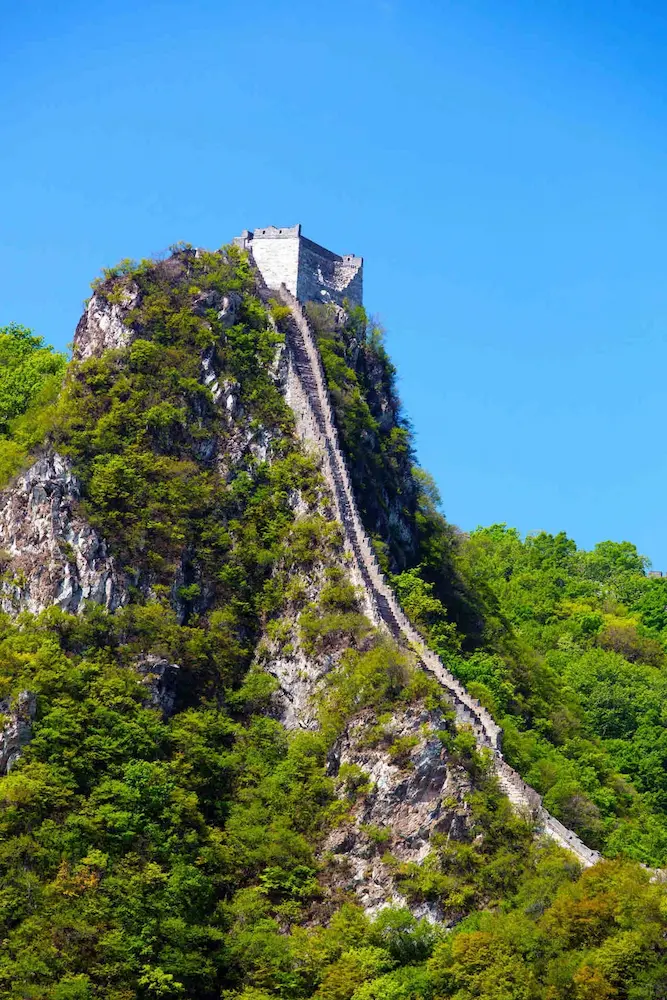
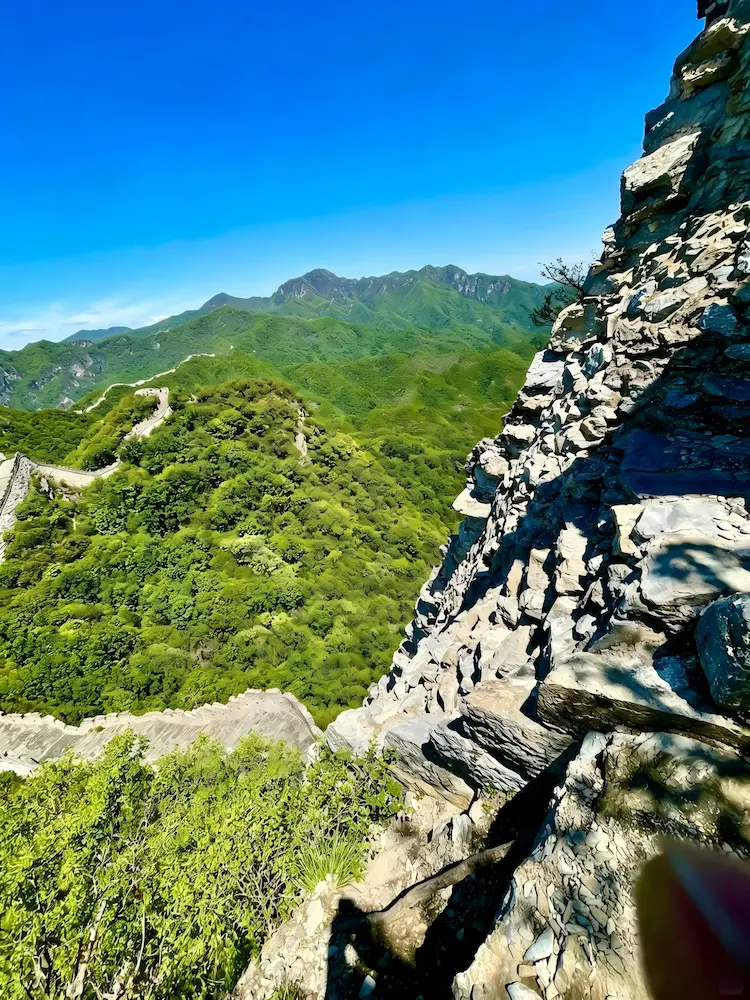
How did it get its name? Locals say this ridge forms an inverted “V,” with cliffs on both sides and the city wall built on the narrowest ridge. In some places, the city wall has completely collapsed, leaving only bare rock. Ruined watchtowers hang precariously over the sheer cliffs.
“Even a mighty eagle flying here must tilt its head back and flip its body upside down to pass,” they say. This nearly vertical visual pressure will make you truly understand, when you’re there, what it means to be “building on the edge of a knife.”
In fact, the “Eagle’s Inverted Flight” section does feature a cliff face several dozen meters long where the original city wall has completely vanished. You must detour around it via a scree slope, using both hands and feet to grip shrub roots and rocky ledges as you traverse a slope that feels utterly exposed. Below lies a chasm hundreds of meters deep, with absolutely no safety barriers. Every step must be firmly planted, and every grip must be secure.
On many outdoor forums, someone posted a photo taken at Eagle Soaring and Backward Leaning: a climber is lying flat against an almost vertical rock face, with the straps of their backpack blown askew by the wind. The most upvoted comment in the thread reads: “Just looking at this picture, my legs are already shaking.”
What Visitors Need to Know: If this is your first visit to Jiankou, there’s no need to force yourself to tackle the “Eagle Soaring, Head Tilted Back” section. If your main goal is to admire the scenery of the Wild Great Wall, the area around Zhengbei Tower offers an excellent experience.
The Beijing Knot: Where Three Sections of the Great Wall Form a “Knot”
If you manage to make it through the “Heavenly Ladder” and the “Eagle Soaring Upside Down,” you will arrive at a massive junction of mountain ridges—the Beijing Knot.
This is the geographical junction of the Yanshan and Taihang mountain ranges. Even more remarkable is that three sections of the Great Wall, coming from different directions, converge here at a single watchtower, forming a “knot”: one stretches westward toward Juyongguan, another extends eastward to Mutianyu, and the third heads north into the rugged mountains, becoming the Outer Great Wall.
It is an extremely rare “Great Wall three-way junction” in the Ming Dynasty’s northern defense line, controlling the throats of these three mighty dragons.
Standing on the watchtower at Beijing Knot, you can clearly see the three dragons rushing in from three directions, twisting together at your feet, and then heading off in separate directions. This “three-way junction” layout of the Great Wall is extremely rare throughout the entire Ming Great Wall.
Many hikers, upon reaching Beijingjie, pause to sit for a long time. It is not because they are tired (though they certainly are), but because of that vast, desolate feeling of “standing at a crossroads of history,” which makes one reluctant to leave too quickly.
What visitors need to know: The value of Beijing Knot lies not only in its rugged terrain, but also in the unique spatial layout that allows visitors to clearly see multiple sections of the Great Wall converging and extending along the mountain ridges.
History and the“Chinese Model” for Great Wall Restoration: Preserving Wrinkles Is Better Than a Facelift
Standing at Jiankou, you might wonder: Why does this place still look so “run-down” even after the government allocated massive funds for its restoration (Phases I through IV)?
The restoration of Jiankou serves as a key example of the emphasis placed in recent years on archaeological involvement, minimal intervention, and preserving the original state of cultural heritage in the conservation of the Great Wall of China.
In the past, some Great Wall restoration projects tended to focus on restoring the structure’s complete appearance; Jiankou, however, chose a different conservation approach, guided by the core principles of minimal intervention and restoring the old to its original state.
How exactly is this done?
- Preserving Wild Trees: Wild trees that have grown naturally on the tops of watchtowers for decades will be left in place as long as they do not threaten structural safety. They have become an integral part of the architecture, and cutting them down would actually compromise stability.
- Not Rebuilding Ruined Walls: Collapsed walls will only be structurally reinforced to prevent further collapse, but they will not be restored to their original state. Those gaps and broken walls are evidence of the Great Wall’s “age.”
- Reinstallation of Old Bricks: Ming Dynasty city bricks scattered across the hillside will be collected and reinstalled. Every effort will be made to reuse the original bricks and stones, and the use of new materials will be strictly controlled; new bricks will not be added in large quantities without restriction.
- Carried by Men and Mules: Due to the treacherous terrain, no machinery can be used to transport any repair materials. Cement, lime, bricks, water… everything relies on mules and the workers’ shoulders, carried step by step along the steep ridges and up the cliffs. An elderly worker once told a reporter, “Repairing this is harder than building a new skyscraper.”
The primary objectives of the restoration are to eliminate structural hazards, slow the further deterioration of the walls, and preserve the Great Wall’s historic, weathered appearance; however, absolute safety cannot be guaranteed, and the sections of the wall in the open still face the risk of weathering and collapse.
What will be the status of the Jiankou Great Wall restoration by 2026?
The conservation and restoration of the Jiankou Great Wall is not yet complete. The fifth phase of the conservation and restoration project extends from Niujiaobian in the east to Zhengbeilou in the west. According to the 2025 plan, the fifth phase was expected to be completed in 2026; however, in 2026, officials approved a new restoration plan for the eastern section of Jiankou.
Access conditions and safety measures in certain sections may change dynamically as construction progresses. Do not rely solely on hiking guides from several years ago; it is recommended that you check the latest official information before setting out.
A Photographer’s Dreamscape: How to Capture the“Sunset of the Age of Cold Weapons”
Many landscape photographers make a special trip to Jiankou to shoot; the striking colors and lines of the city walls and mountains here offer great potential for stunning photos. Every year, countless photographers make special trips to stake out the area, with some even visiting five or six times a year.
Why is Jiankou so unparalleled? Because its lines and textural contrasts are truly one-of-a-kind.
The walls of Jiankou are built from local white limestone, while the surrounding mountains are composed of dark brown granite. The stark contrast between white and black is striking.
Combined with the jagged contours left by the collapsed walls, the scene appears as sharp and rugged as if carved by a knife or hewn by an axe in the light of dawn or dusk.
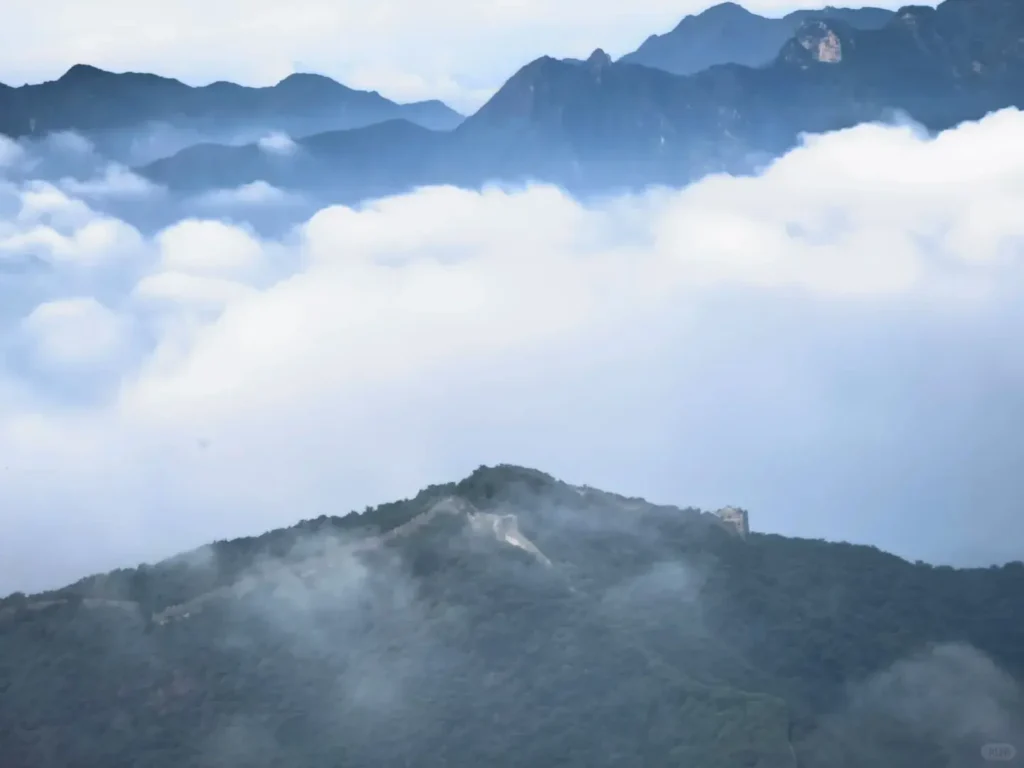
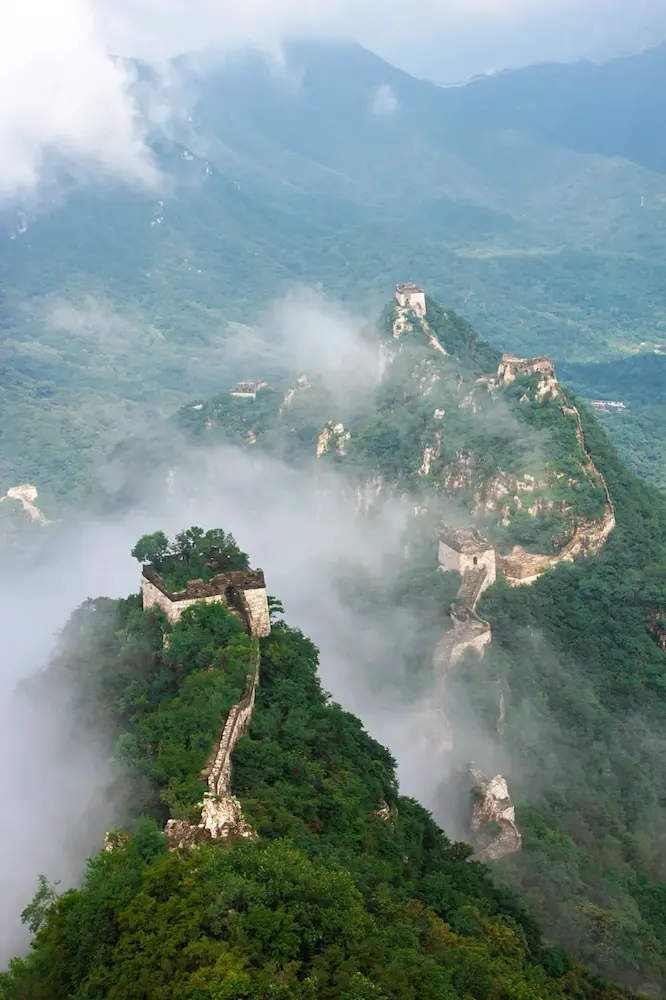
When mist rolls in, the crumbling walls appear and disappear amidst the sea of clouds, resembling a living ink-wash painting.
Photography tip: Don’t risk entering closed-off or dangerous sections of the city wall just to capture sea-of-clouds scenes or cinematic shots.
Dawn at Jiankou (Highly Recommended)
- Location: Zhengbei Tower. This is the highest watchtower in the eastern section of Jiankou and, following recent renovations, is currently the safest viewing spot.
- Best Time: Early mornings in spring and autumn (April–May, September–October). It’s best if it rains or is humid the day before, followed by clear skies the next day, as this creates ideal conditions for fog to form in the valley.
- What to shoot: Arrive at the North Tower half an hour before sunrise. The eastern horizon shifts from deep blue to orange-red as the first rays of sunlight strike the walls at Yingfei Daoyang and Beijing Jie. Clouds and mist fill the valley, with only the highest watchtowers emerging from the sea of clouds, resembling palaces floating in the sky. Golden light cascades over the crumbling crenellations, transforming the entire Great Wall into a wounded dragon still writhing amidst the clouds.
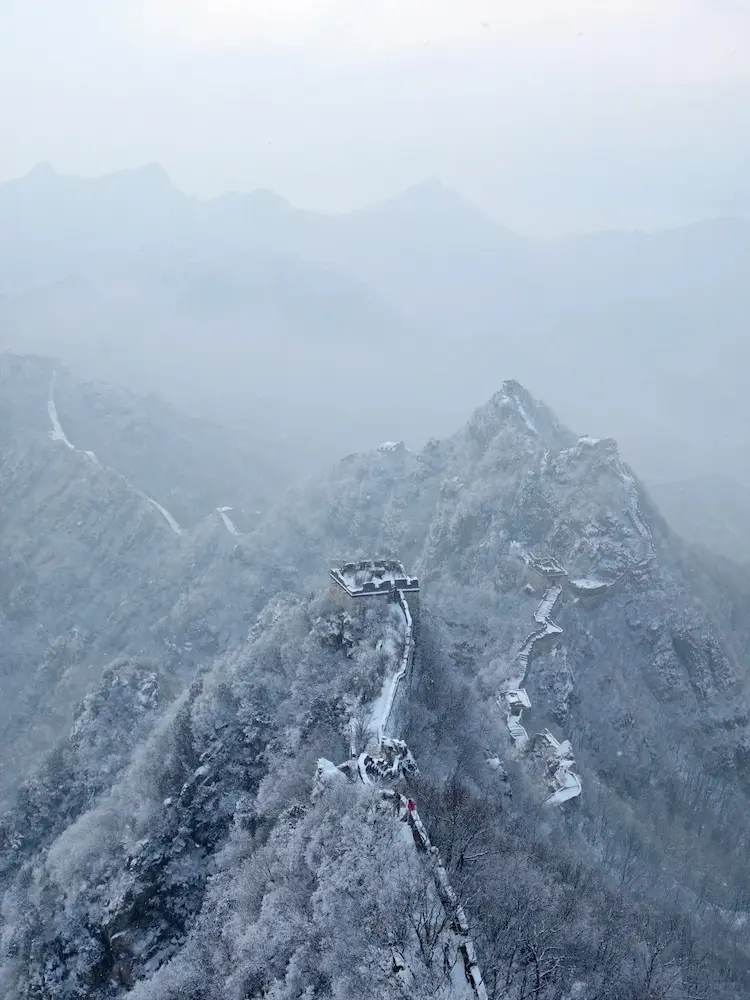
Snow-Covered Ruins (Winter Exclusive)
- Time: December to February, after heavy snowfall.
- Location: Near the North Tower and Little Potala.
- What to shoot: Heavy snow has blanketed all traces of modernity, leaving only the white and gray ruins of the Great Wall. That sense of utter solitude and desolation is something Badaling can never offer you. The wind has sculpted the snow into ridges, and the shadows of the crenellations stretch out long.
Winter hiking is twice as dangerous: The mountain trails are extremely slippery after snowfall, and the “Sky Ladder” and “Eagle’s Flight” sections are nearly impassable. Do not take risks without crampons and professional ropes. Most photographers only dare to go as far as the North Tower before turning back.
If You’re Only Visiting Jiankou Once
- Top vantage point: North Tower, offering a bird’s-eye view of the entire Great Wall ridge
- Best time: Early mornings in spring and fall after rain, when a sea of clouds is likely to form
- The snowy scenery in winter is stunning, but road conditions become significantly more hazardous
Practical Hiking Tips and Essential Guide to Avoiding Pitfalls
The Most Important Notice (Please Read This Three Times)
Most sections of the Jiankou Great Wall are not officially open to the public. Although some of the most dangerous sections have been reinforced in recent years (e.g., with makeshift guardrails and steel spikes installed on the “Heavenly Ladder” and “Eagle Flying Upside Down” sections), it is still not a conventional tourist attraction. There is no central visitor center, and some areas lack supplies, staff, first-aid stations, and streetlights.
If you do not meet the following requirements, please do not go:
- At least two years of off-trail hiking experience
- High-top professional hiking boots + non-slip gloves + headlamp
- Ability to read track maps (e.g., Liubulu, Liuziji)
- Hike in a group (at least two people, preferably with a guide who has been there before)
- Outdoor insurance
Never climb over barbed wire or barriers clearly marked “No Entry” or“Dangerous Cultural Relics.”Every year, people are injured or stranded while climbing Jiankou, requiring rescue by the fire department—it’s both dangerous and embarrassing.
Route Options: From“Experience the Wilderness” to“Hardcore Self-Torture”
Route 1: Beginner Level—Round Trip from Zhengbeilou (Suitable for first-time visitors to Jiankou who just want to soak up the atmosphere)
- Starting Point: Team 5, Xigazi Village, Huairou (accessible via GPS; parking available at local farmhouses)
- Route: Ascend from the village along a well-marked dirt trail (approx. 40 min) → Reach Zhengbeilou (the highest watchtower in the eastern section of Jiankou, offering unbeatable views)
- Take photos, rest, and enjoy panoramic views of the “Sky Ladder” and “Eagle Flying Upside Down” from Zhengbeilou
- Descend the same way (be careful not to continue westward—that leads to the “Heavenly Ladder”)
- The entire round trip takes about 3–4 hours, with an elevation gain of approximately 400 meters. This route avoids all dangerous sections and bypasses the most hazardous parts of the core area, making it ideal for first-time visitors to experience the scenery of Jiankou. Difficulty: Upper-intermediate mountain hike; this is not a typical leisurely hike.
Actually, if you head east from the Zhengbei Watchtower, you’ll reach the highest point of the Mutianyu Great Wall—Watchtower No. 20 (Heroes’Slope). These two sections of the Great Wall are physically connected.
If you look down from the North Watchtower and find yourself overcome by a fear of heights, your legs too weak to handle the rugged wildness of the Great Wall, and you’d rather switch to a more comfortable section where you can sip coffee and glide down a thrilling slide, please immediately check out my neighboring post, “Mutianyu Great Wall Guide”.
Route 2: Classic Crossing Route (Relatively manageable, but caution is still advised)
- Starting Point: Team 5, Xizazi Village or Wofo Mountain Villa (south slope)
- Route: Zhengbeilou → Follow the city wall westward → Little Potala (a cluster of watchtowers) → Descend from Xizazi Village (plan your descent point)
- Features: The route passes beneath the “Heavenly Ladder” and the lower edge of “Eagle Soaring Backwards,” but you are not required to actually climb them (you can bypass them from the side). However, you will still need to use both hands and feet, and the route offers a strong sense of exposure.
- Total duration: approximately 6–7 hours. It is recommended to set out at first light and begin the descent before 2:00 PM.
Route 3: Hardcore Restricted Area Route (Extremely dangerous; provided for informational purposes only; not recommended for anyone to attempt)
- General’s Pass ⇄ Heavenly Ladder ⇄ Eagle’s Plunge ⇄ Beijing Knot
- This route encompasses the three most challenging sections of the “Three Ghost Gates.” The “Eagle Soaring Backward” section features a detour around a cliff face dozens of meters high, requiring you to climb over slippery rocks and bushes with a deep abyss below. Every year, groups get lost or injured here.
- Unless you are a seasoned outdoor guide with extensive experience on the Jiankou route, you should absolutely not take this route. It is included here solely to illustrate just how difficult it is, not to encourage you to attempt it.
If you only have half a day, here’s how we recommend you plan your visit
- First-time visitors: Head up the mountain from Team 5 in Xigazi Village → Take photos from the viewing platform at Zhengbei Tower → Return the same way; do not venture west into the high-risk sections
- If you plan to attempt the traverse: Be sure to download the offline route in advance, confirm the sunset time, allow plenty of time for the return trip, and don’t make “completing the entire route” your only goal
- In case of severe weather such as strong winds or rain: Do not venture deep into the Great Wall structure; prioritize safety.
Gear Reference Chart (Suitable for Screenshotting and Saving)
| Gear | Why It’s Needed |
| High-top, non-slip hiking boots | Gravelly, steep slopes; slippery surfaces after rain |
| Non-slip gloves | Many sections require gripping rocks, rough brick joints, and shrub branches |
| Sufficient drinking water + high-calorie trail snacks | No convenience stores or supply points on the mountain |
| Headlamp | For sunrise/sunset hikes; there’s a risk of descending in the dark, and a cell phone flashlight is not a sufficient substitute |
| Long-sleeved shirt and long pants | Dense underbrush; to prevent scratches |
| Offline GPS track | Cell phone signal is often lost in mountainous areas |
| Windproof and sun-protective outer layers | Strong winds on ridges; significant temperature differences between day and night |
✅Before setting out, in addition to checking your gear, be sure to verify these 4 things
1. The weather forecast for the mountains for the next few hours
2. The sunset time for that day—allow enough time to head back down
3. Your phone’s battery level—we recommend bringing a power bank
4. Confirm your evacuation route down the mountain in advance
Visiting Jiankou for the first time—where should I set my GPS?
Jiankou is a section of the Great Wall in the Shanshan area that stretches for over ten kilometers. There is no single main entrance or visitor center, so don’t just search for “Jiankou Great Wall” on your GPS.
1. Round trip to the North Watchtower (for most casual travelers): Set your GPS to the “North Slope Trailhead at Team 5, Xigazi Village”—this is a relatively easy starting point. You can park at the farmhouses within the village.
2. If you plan to start from the south slope for a traverse route: Set your navigation to “Wo Fo Mountain Villa.” The ascent on the south slope is steeper and requires greater physical endurance.
The total driving time from the city center is approximately 2 hours.
Transportation and Accommodations
- Navigation: Typically, choose Team 5 of Xigazi Village (north slope, relatively easy to hike) or Wofoshan Villa (south slope, steeper). The drive from the city center takes about 2 hours.
- Parking: You can usually park at the farmhouses in the village for a fee of 10–20 yuan.
- Accommodations: We recommend staying at a farmhouse in Xizazi Village. After your hike, enjoy a meal at a local’s home, have a couple of shots of baijiu, and chat with the host about the legendary stories of the Great Wall maintenance crew. Accommodations are basic but clean.
Tips for the Descent:
By the time you reach level ground in Xizazi Village with trembling legs and sweaty palms, your “stamina reserves” will be virtually depleted. The perfect remedy at this point is to slip into a local farmhouse in the village and order a pot of Huairou-style braised chicken with chestnuts, freshly stewed in a large wood-fired cauldron. Huairou is famous for its chestnuts.
The chestnuts, steamed until soft, sticky, and sweet, soak up the rich fat of the free-range mountain chicken. Paired with a plate of freshly picked, tender wild mountain vegetables and piping-hot flatbreads, the sense of bliss—as if you’ve returned from hell to heaven—will stay with you for a lifetime.
Extra Tip: While you’re eating, try striking up a conversation with the owner of the farmhouse inn. Many locals have firsthand experience with the Great Wall restoration projects, and their stories about the Jiankou Mountain Pass and the repair of damaged sections of the wall offer vivid, firsthand insights that you won’t find in books.
FAQ
Collector’s Edition | My First Trip to the Jiankou Great Wall (Shared by a Travel Companion)
✅Top Choice for First-Timers: Round Trip from Zhengbei Tower
⚠️ “Heavenly Ladder” and “Eagle’s Inverted Flight”: Just familiarize yourself with them—no need to force yourself to tackle them
Unique Highlights: The “Beijing Knot”—experience the Great Wall’s intricate network of intersecting ridges
⏱ Time Allocation: Allow an extra 1–2 hours buffer along the route; don’t time your hike to coincide with sunset
Essentials: Non-slip hiking shoes, gloves, plenty of water, offline GPS tracks, and a headlamp
✅Must-dos before departure: Check the mountain weather, confirm the sunset time, and verify on-site access conditions
Rules: Do not climb over closed barriers, and do not enter dangerous sections just to take photos
Reminder: Jiankou is not a typical tourist attraction; do not apply your experience from well-established Great Wall sites here.
Jiankou is a mirror.
It reflects the Great Wall’s truest, most indomitable spirit—ruined, rugged, and ancient, yet still standing tall. It also reveals humanity’s insignificance in the face of nature—only after you’ve climbed the “Heavenly Ladder,” crossed the “Eagle’s Flight,” and stood on the watchtower at “Beijing Knot,” where the wind is so strong it blows you off your feet, will you realize: we are not conquerors; we are merely bystanders of history.
But if you find Jiankou too difficult, too dangerous, or too masochistic, there’s absolutely no need to feel regret. The Great Wall has countless faces: the beauty of Mutianyu, the grace of the Water Great Wall, the age-old grandeur of Simatai, the majesty of Juyongguan… there’s bound to be a section that suits you.
Jiankou is a blood-stained ruin reserved for the brave. If you find the atmosphere here too oppressive and want a change of pace—to see how the Ming Great Wall playfully dips into the water, revealing a gentle, “Jiangnan beyond the frontier” charm—your old buddy recommends driving to another nearby destination: “Huanghua Water Great Wall Guide: The Great Wall Meets the Water, Ming-Dynasty Chestnut Orchards, and Boat Camping Guide (2026)”.
– If your legs are already starting to tremble on the North Tower and you’d prefer a more scenic route where you can sip coffee and glide down the slope in comfort, check out the “Mutianyu Great Wall Guide”.
– If you’d like to see another, gentler side of the Huairou Great Wall, head over to the “Huanghua Shui Great Wall Guide”.
– If you’re still unsure whether your stamina and gear can handle this rugged stretch, feel free to return to my master guide, “9 Great Wall Sections in Beijing: Badaling, Mutianyu, and More (2026)”, check the comprehensive comparison chart, and rethink your destination.
Jiankou isn’t for everyone. If you decide to go, please prepare thoroughly, maintain a sense of awe, and come back alive. If you choose not to go, that’s fine too—some beauty is best appreciated from afar.
If you decide to go, be thoroughly prepared; if the weather or road conditions aren’t favorable, there’s no need to risk your safety just to complete the challenge. Even if you don’t hike all the treacherous sections, the historic charm of Jiankou is still well worth experiencing.