Yonghe Temple Travel Guide: Admission, Transportation, History, and Treasures (Updated for 2026)
Beijing’s largest Tibetan Buddhist monastery, it once served as the “home” of Emperors Yongzheng and Qianlong. With its yellow tiles and red walls, it’s even more majestic than the Forbidden City.
Direct access via Subway Lines 2 and 5; admission is 25 yuan (about $3.50). The site features an 18-meter-tall Buddha carved from a single piece of wood, which is listed in the Guinness World Records.
Table of Contents
Practical Information (Must-Read Before You Go)
| Item | Details |
| Address | No. 12 Yonghegong Street, Dongcheng District, Beijing (`Yonghe Temple`, `The Lama Temple`) |
| Subway | Line 2 or Line 5 to Yonghegong Station (`Yonghegong Station`). Exit at Exit C (southeast exit) or Exit F; it’s about a 2-minute walk from there. Once you exit the station, you’ll see red walls and yellow tiles—just follow the crowd. |
| Bus | Routes 13, 116, 117, 684, etc., to the “Yonghegong” stop |
| Driving | Not recommended. Parking in the area is extremely difficult, with very few available spots. If taking a taxi, set the destination to “Yonghegong South Gate” or “Yonghegong Ticket Office.” |
| Admission | 25 RMB (approx. $3.50). You can make a reservation via the WeChat official account “Yonghegong Tourist and Devotee Services” (Chinese interface only; no English version available; we recommend using a mobile translation app). If you do not have a Chinese phone number or are unable to make a reservation via WeChat, please be sure to bring your original passport and go directly to the on-site ticket window to purchase a paper ticket in person (on-site purchases accept cash or mobile payments). |
| Opening Hours | High Season (April 1–October 31): 9:00 AM–4:30 PM (last admission at 4:00 PM) Low Season (November 1–March 31): 9:00 AM–4:00 PM (last admission at 3:30 PM) Open year-round, but very crowded on the first and fifteenth days of the lunar month and during Buddhist holidays. |
| Best Time to Visit | Weekdays from 9:00 AM to 10:30 AM; avoid weekends and the first and fifteenth days of the lunar month. Afternoons are relatively less crowded, but the lighting isn’t as good for photos as in the morning. |
| Recommended Duration | 2–3 hours. If you want to explore each hall in detail, you may need 3.5 hours. |
| Dress Code | There’s a lot of walking, so wear comfortable shoes. You must remove your hat and sunglasses before entering the halls. Do not wear miniskirts or off-the-shoulder tops (though not strictly prohibited, it is recommended to show respect). |
| Budget Guide | Admission: 25 yuan (approx. $3.50). Incense sticks are free (available at the entrance). Prayer beads or amulets: Prices range from tens to thousands of yuan. Dining nearby: 30–80 yuan (approx. $4–11). |
| Photography | Photography and video recording are strictly prohibited inside the halls (as they are disrespectful to the Buddha and flash photography can damage cultural relics). Photography is permitted outdoors (in the courtyard, on the rooftops, at the archways, and in front of the Great Buddha). |
| Language Support | No English-speaking guides. Audio guides are available for rent (English version available, deposit required). We recommend downloading a translation app on your phone. |
> Friendly Reminder: Yonghe Temple is an active place of worship, and many believers come here every day to burn incense, prostrate themselves, and spin prayer wheels. Please remain quiet, refrain from loud talking or laughing, and respect others’ beliefs.
What Is Yonghe Temple? Why Is It So Important?
In a nutshell: This was originally a residence built by Emperor Kangxi for his fourth son, Yinzen (later Emperor Yongzheng). After Yongzheng ascended the throne, it was converted into an imperial retreat because no one else could live here. Later, Yongzheng’s son, Emperor Qianlong, transformed it into a Tibetan Buddhist temple.
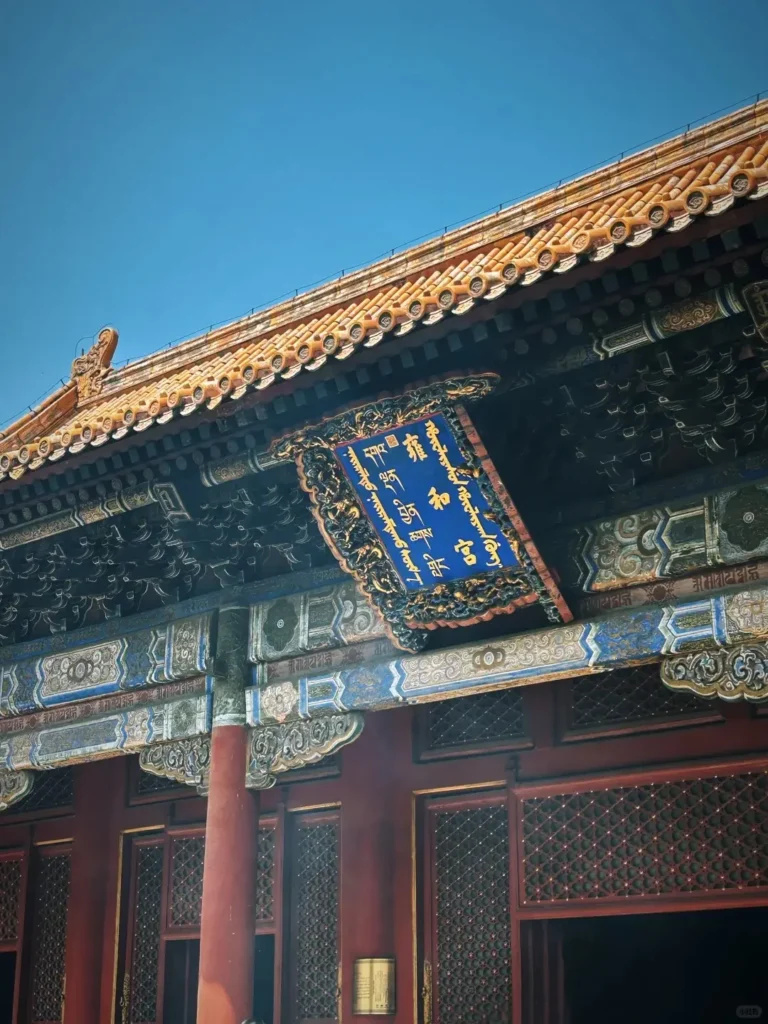
Because two emperors lived here (and Qianlong even claimed to have been born here), people call it the “Dragon’s Lair”—a place where emperors resided before ascending the throne. Its status is exceptionally high: the roof is covered with yellow glazed tiles, and the walls are red, matching the specifications of the Forbidden City. Ordinary temples are only allowed to use gray tiles, so the Yonghe Palace looks like a miniature imperial palace.
Yonghe Palace was founded in 1694 and has a history of over 330 years. After being converted into a Lamaist monastery in 1744, it became the center for the Qing government to manage Tibetan Buddhist affairs nationwide. It is also the largest existing Tibetan Buddhist monastery in the Beijing area.
The Layout of Yonghe Palace: Three Axes, Seven Courtyards, and Five Levels
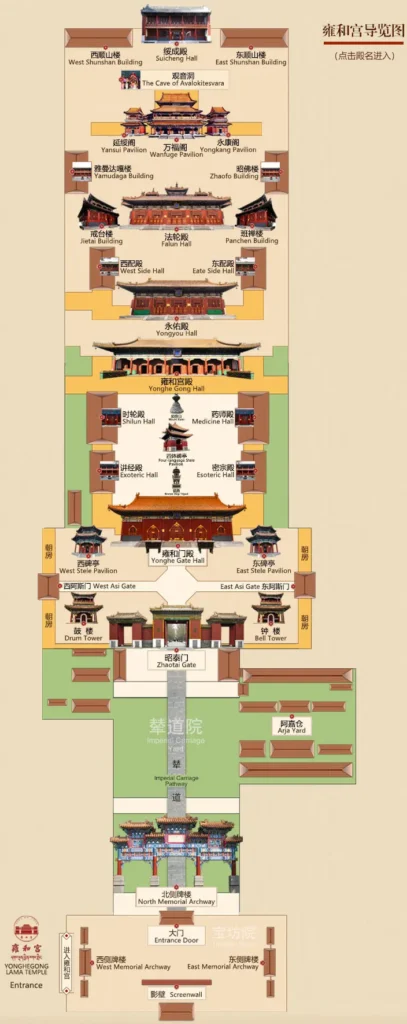
The architectural layout of Yonghe Palace is remarkably symmetrical. As you walk along the central axis from south to north, you will pass through seven courtyards (each successive courtyard) in sequence, with the ground level of the halls rising progressively. The further you go inward, the more it feels like you are “climbing a mountain.”
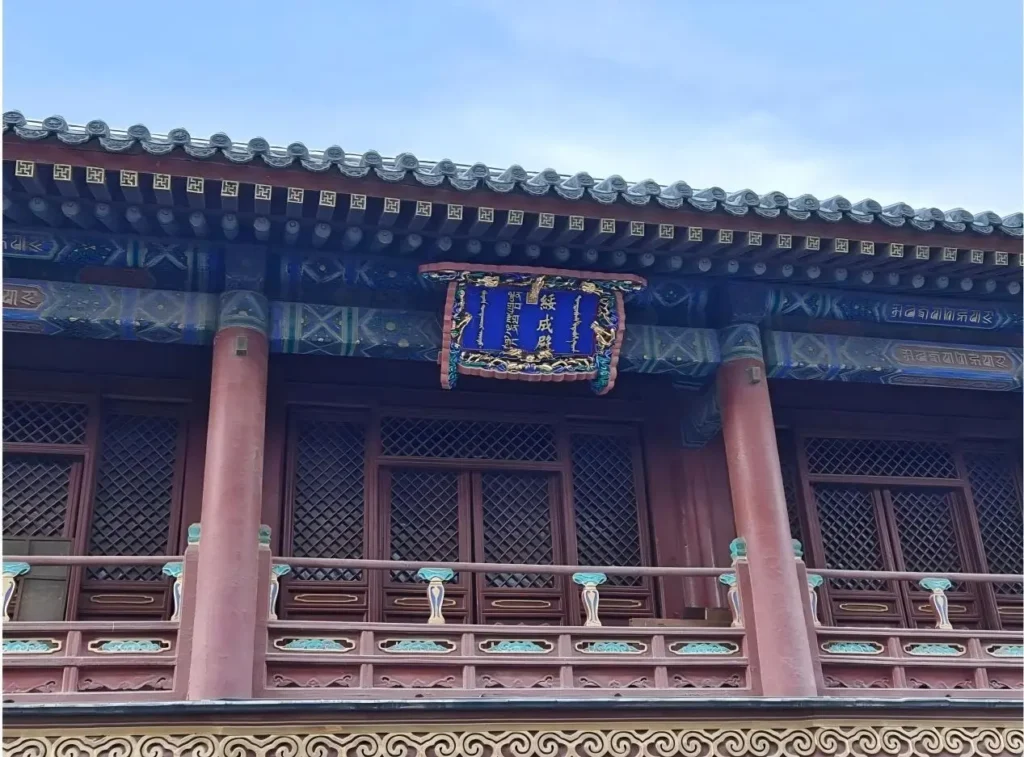
Quick Guide: Zhaotai Gate → Yonghemen Hall → Yonghe Palace → Yongyou Hall → Falun Hall → Wanfu Pavilion → Suicheng Hall.
On the east and west sides, there are also auxiliary halls such as the Sutra Lecture Hall, the Esoteric Buddhism Hall, the Medicine Buddha Hall, and the Kalachakra Hall.
Highlights of the Central Axis (South to North)
1. The Archway and the Imperial Processional Way
Upon exiting the subway station, you’ll first see a towering archway inscribed with the four characters “寰海尊亲” (Huán Hǎi Zūn Qīn, Respected by All Under Heaven), written by Emperor Qianlong. Passing through the archway leads to a 200-meter-long imperial processional path (the path once used by the emperor). Over 100 ginkgo trees line both sides. In the fall, the ground is blanketed in golden hues, making it a highly photogenic spot.
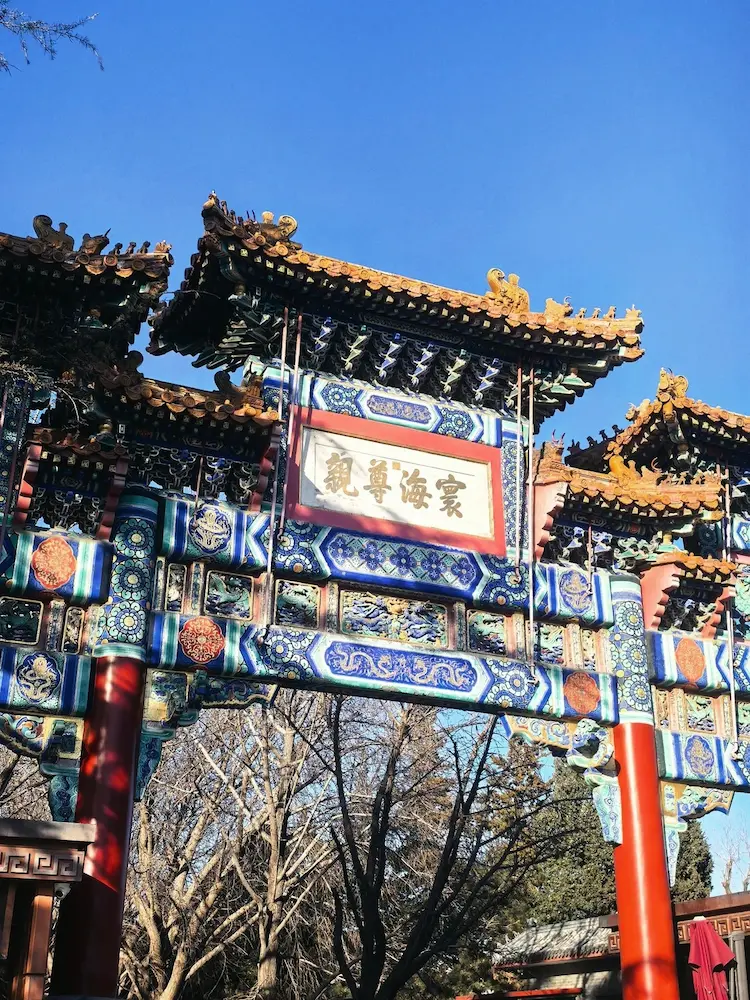
Cultural Interpretation: What does “Respecting Parents and Ancestors Throughout the World” mean? A literal breakdown: “寰海Huán Hǎi” refers to “the entire world,” while “尊亲Zūn Qīn ” refers to “respecting and serving parents and ancestors.”
Taken together, this means “Under the heavens, all should respect and serve their parents and ancestors”—this is the most central tenet of “filial piety” in Chinese Confucian thought.
However, Emperor Qianlong employed a double meaning here: in ancient China, the emperor was often likened to the “parent of the people” (as in the term “parental official”), so “尊亲” can also be interpreted as “respecting and serving the emperor/the imperial court.”
Furthermore, since Yonghe Temple is a Tibetan Buddhist monastery, and Buddhism teaches that “all sentient beings should respect the Buddha,” this plaque actually layers three meanings together: Confucian filial piety, imperial authority, and Buddhist faith. A single phrase thus accommodates the cultural concepts of the Han, Manchu, Mongol, and Tibetan peoples.
2. Zhaotai Gate (Entrance)
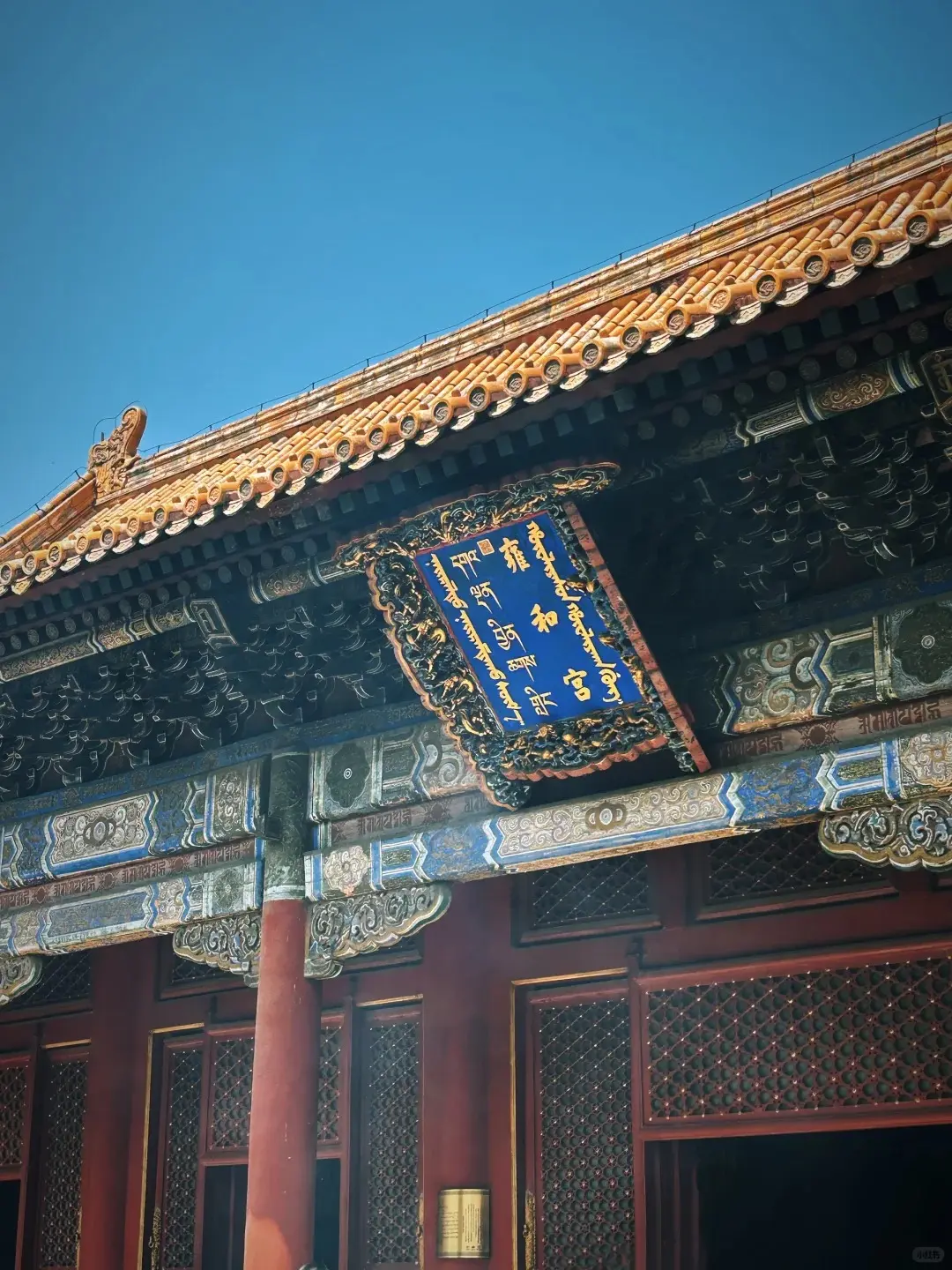
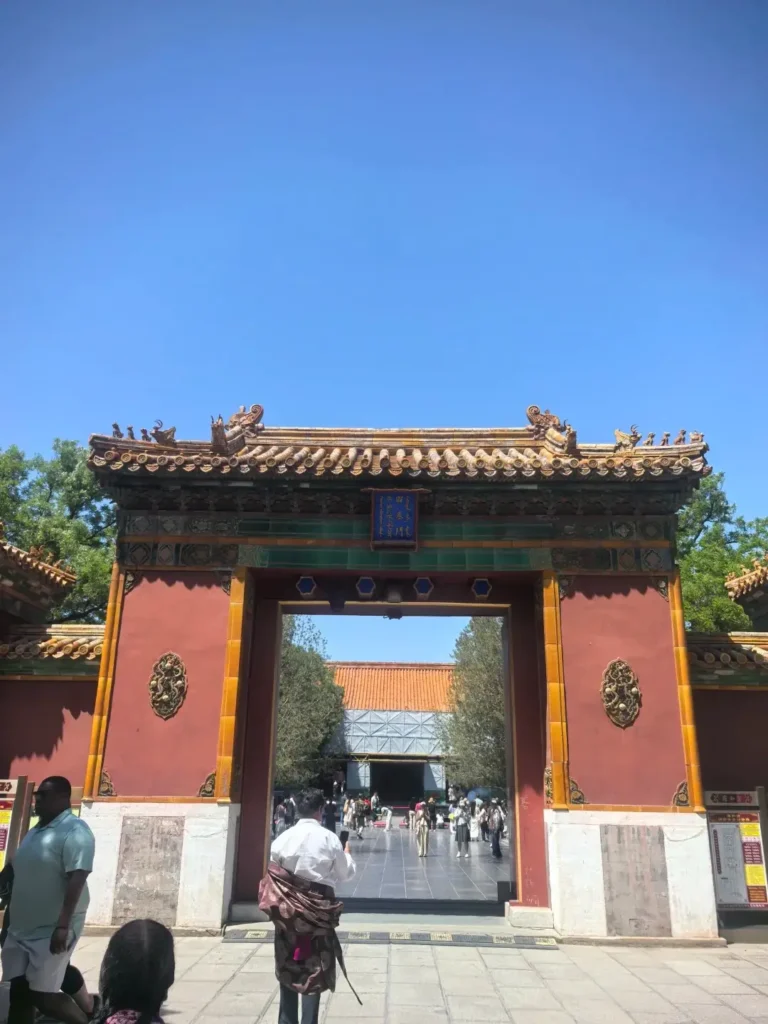
This is the main entrance. The plaque above the gate is inscribed in four scripts: Manchu, Han, Mongolian, and Tibetan. Once you pass through this gate, you enter Yonghe Temple.
Free incense is available on both sides of the entrance. Each person receives a small bundle, which is sufficient. There’s no need to buy incense outside.
3. The Bronze Cauldron (Laba Congee Cauldron)
Just inside the entrance on the right (east of the Drum Tower) stands a massive bronze cauldron. It measures 2 meters in diameter and 1.5 meters in depth, and was cast from 8 tons of bronze. In the past, Laba congee was traditionally cooked here every year on the eighth day of the twelfth lunar month (Laba Festival).
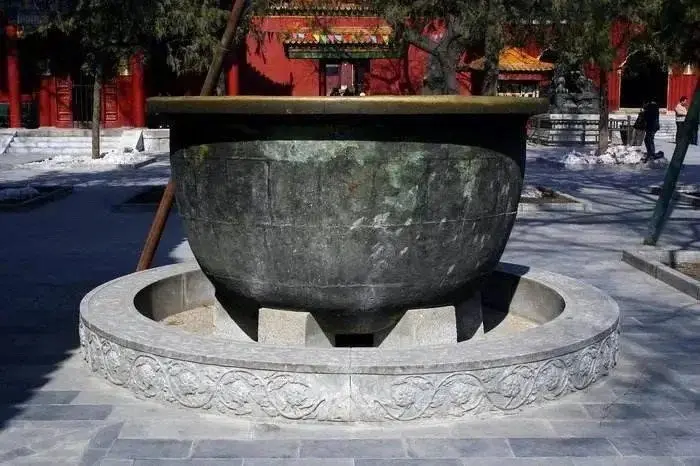
The first pot was offered to the Buddha, the second to the emperor, the third to princes and ministers, the fourth to civil and military officials, the fifth to the monks of the temple, and the remainder was distributed to the common people.
This tradition continues to this day. Every year on Laba Day, many people line up before dawn just to have a bowl of the “blessed porridge” distributed by the temple. If you happen to be in Beijing during the winter, you can look up the date (usually in early January) and experience it for yourself.
4. The Octagonal Stele Pavilions
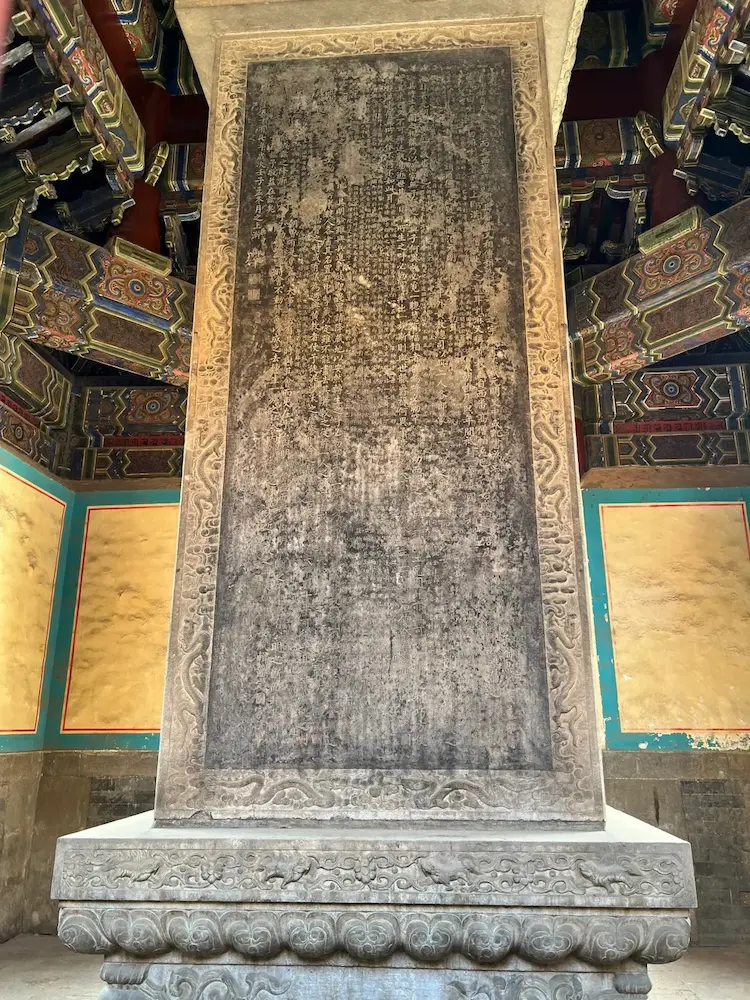
Past the Bell and Drum Towers, there is a pavilion on each side. Inside each stands a large stone stele, with inscriptions personally composed by Emperor Qianlong. The stele on the west side (inscribed in Mongolian and Tibetan) is particularly significant; it is titled *The Lama’s Discourse*.
In the inscription, Emperor Qianlong explained why Tibetan Buddhism must be protected: “To promote the Yellow Sect is to bring peace to the Mongol people”—because the Mongols practiced Tibetan Buddhism, safeguarding Buddhism would ensure stability in the border regions.
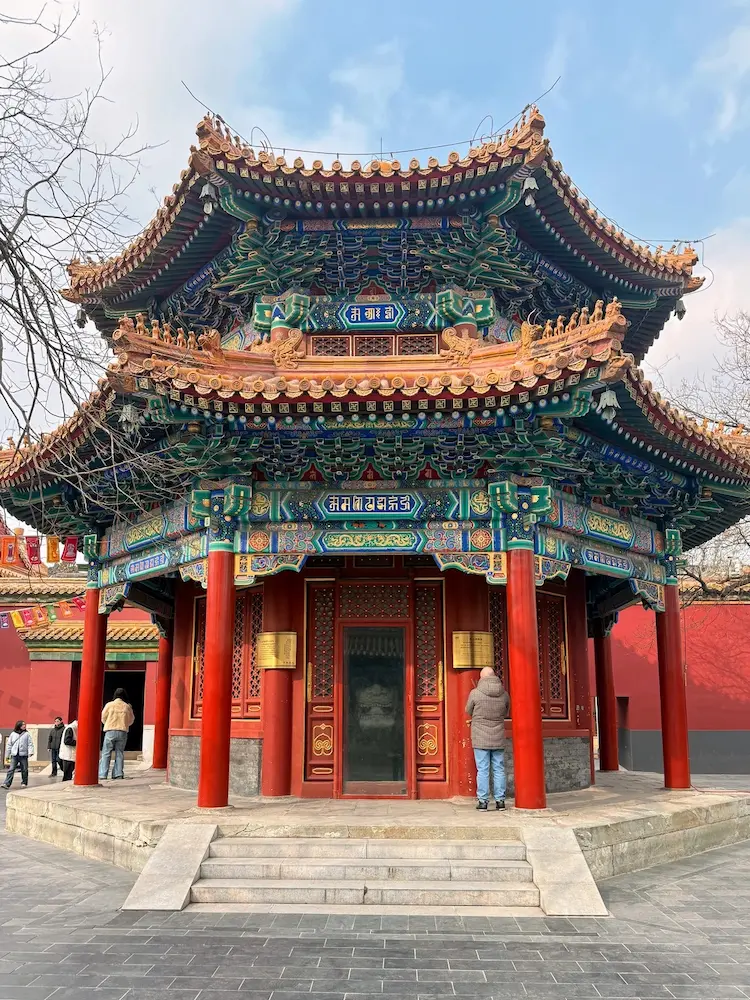
Most crucially, in this stele, Qianlong openly criticized the flaws in the system of reincarnated lamas. He stated that it was unreasonable for reincarnated lamas to frequently come from the same family.
Therefore, he established the “Golden Urn Lottery” system—the selection of a reincarnated lama would be determined by drawing lots from a golden urn, with the final decision requiring approval from the central government. This system remains in use to this day. Writer Shu Yi described it as a stele that “reveals the secrets of heaven.”
>Cultural Insight: The Golden Urn Lottery is akin to “selecting a reincarnated lama by drawing lots.” Previously, the process might have been monopolized by the nobility, but the Qianlong Emperor used the lottery method to make the system fairer. This also demonstrated the Qing emperors’ control over Tibet.
5. Yonghemen Hall (Hall of the Four Heavenly Kings)
It may currently be under renovation, but you can still view the exterior. In front of the gate stands a pair of bronze lions, almost identical to those in front of the Qianqing Gate at the Forbidden City. The male lion steps on a silk ball (symbolizing the unification of the realm), while the female lion cradles a cub (symbolizing a prosperous lineage).
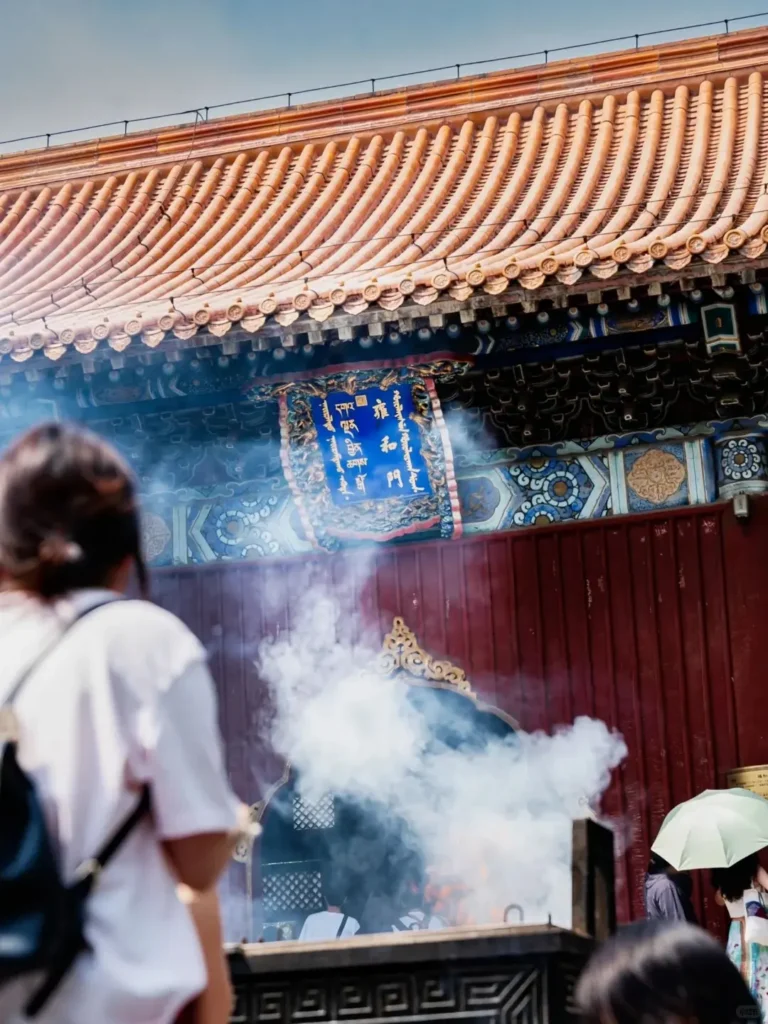
Inside the hall, the central figure is Maitreya Bodhisattva (depicted as the Monk Budai), smiling broadly with a large belly. Flanking him on either side are the Four Heavenly Kings, while behind him stands the guardian deity Vaisravana.
6. The Main Hall of Yonghe Palace (Great Hall of the Buddha)
This is the main hall of Yonghe Palace. In front of the hall stands a massive bronze incense burner, which is said to have been cast in a single pour using melted-down ancient bronze artifacts from the Yuan and Ming dynasties (including the precious Xuande incense burner).
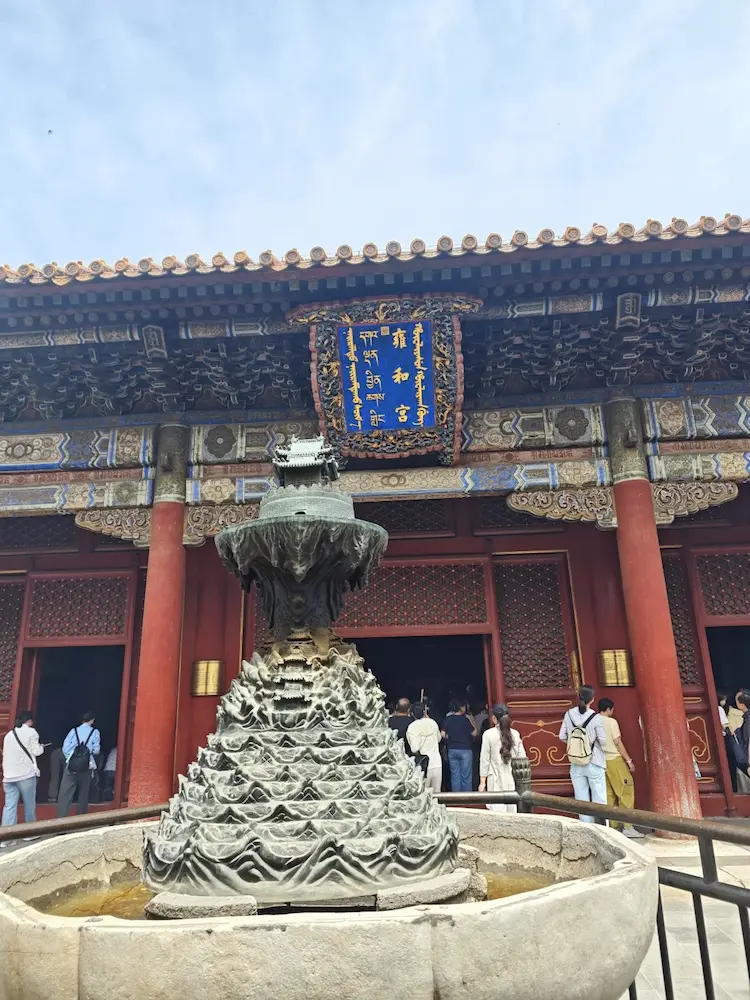
Beside the incense burner stands Mount Sumeru—a bronze model of the Buddhist cosmos. Mount Sumeru is the center of the world, surrounded by the Four Continents, the Seven Golden Mountains, the Salt Sea, and other features. You can think of it as a “cosmic map” of Buddhism.
Inside the hall, the Three Buddhas of the Three Ages are enshrined:
- Center: Shakyamuni Buddha of the Present Age (his right hand touches the ground, signifying his attainment of enlightenment)
- East: Buddha Dipankara of the past
- West: Maitreya Buddha of the future
These three Buddhas symbolize the eternal transmission of the Dharma from the past to the future.
7. Yongyou Hall
This was once Emperor Yongzheng’s study and bedroom, known as the “Tongbai Study.” After Emperor Yongzheng’s death, his coffin was laid to rest here. When the site was converted into a temple, it was named Yongyou Hall, meaning “eternal protection for the late emperor.”
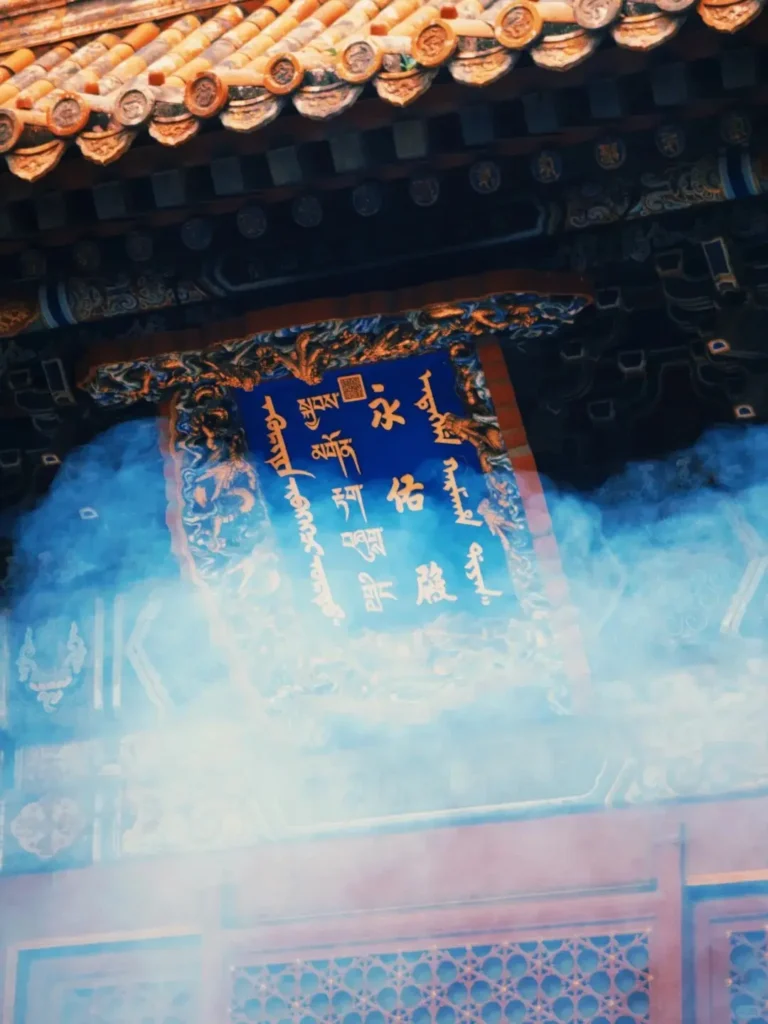
Three Buddhas are enshrined within the hall: Amitayus (Longevity), Bhaisajyaguru (Health), and Shihou Buddha (Wisdom). Together, they symbolize granting you ample time, a healthy body, and a clear mind.
On the west wall hangs a patchwork embroidered portrait of the Green Tara. It is said to have been created by the Qianlong Emperor’s mother and her palace maids using the “piled brocade embroidery” technique—a method in which small pieces of silk are cut, layered, and sewn together to form a picture. It is exceptionally exquisite.
8. The Hall of the Dharma Wheel (Great Assembly Hall) — One of the “Three Masterpieces of Wood Carving” at Yonghe Temple
This is one of the largest halls at Yonghe Temple and serves as the place where monks gather to chant sutras. The roof features five gilded pagodas—one large and four small. The central pagoda represents Mount Meru, while the four smaller pagodas at the corners represent the Four Continents. A glance at the roof offers a complete view of the Buddhist cosmos.
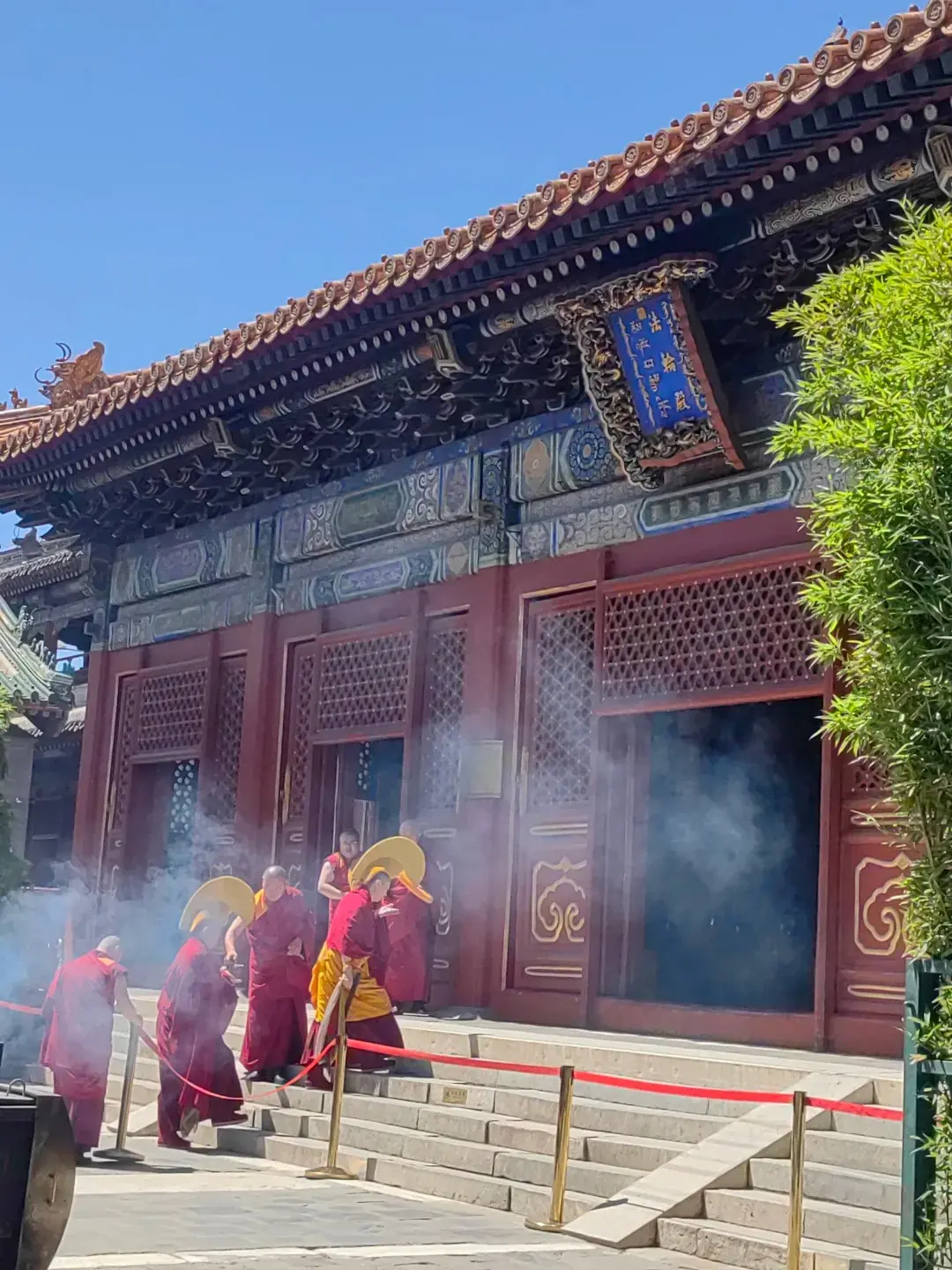
The three most important items inside the hall are:
- Statue of Master Tsongkhapa: Tsongkhapa was the founder of the Gelug School (Yellow Hat Sect) of Tibetan Buddhism. The yellow monk’s hat he wears is the origin of the name “Yellow Hat Sect.” He is depicted as an eternal lamp, with the flame always burning, symbolizing the imperishable nature of the Dharma.
- The Mountain of the Five Hundred Arhats (one of the “Three Masterpieces of Wood Carving at Yonghe Temple”): A mountain carved from rosewood, standing 3.4 meters tall, featuring five hundred arhats. These arhats are cast from five metals—gold, silver, copper, iron, and tin—each approximately 10 centimeters tall, and each in a different pose: some are preaching the sutras, some are riding cranes, some are subduing dragons, and some are drunk… all rendered with great vitality.
- The Fish-to-Dragon Transformation Basin: A basin carved from golden thread cypress. It is said that Emperor Qianlong was bathed in this basin three days after his birth (a tradition known in old Beijing as “the third-day bath”). The basin is carved with a pattern of a fish transforming into a dragon, symbolizing a meteoric rise to success.
9. Wanfu Pavilion (The Most Impressive Site) — One of the “Three Masterpieces of Wood Carving” at Yonghe Temple
This is the tallest structure at Yonghe Temple, featuring three tiers of overhanging eaves that are truly spectacular. Flanked on either side by Yongkang Pavilion and Yansui Pavilion, it is connected by a series of elevated walkways—essentially sky bridges.
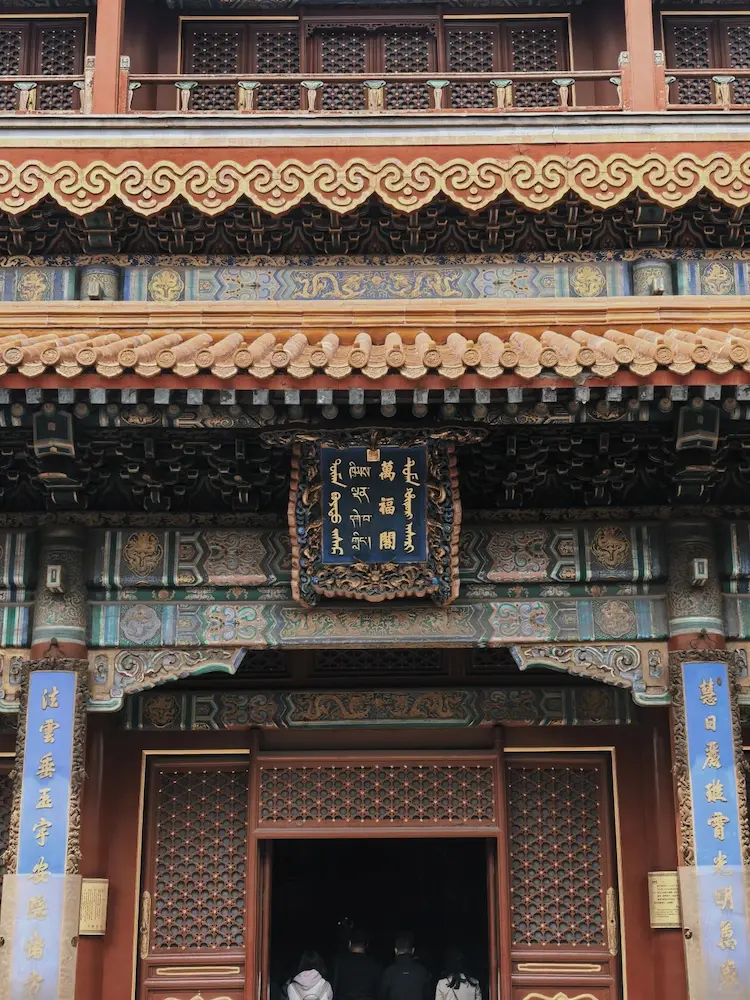
This architectural style dates back to the Tang Dynasty, and today, Yonghe Temple is the only remaining example in all of China of “pavilions connected by sky bridges.”
Step inside Wanfu Pavilion and look up—a massive standing statue of Maitreya Buddha stands there. It is 18 meters tall, with an additional 8 meters buried underground. The entire statue is carved from a single piece of white sandalwood.
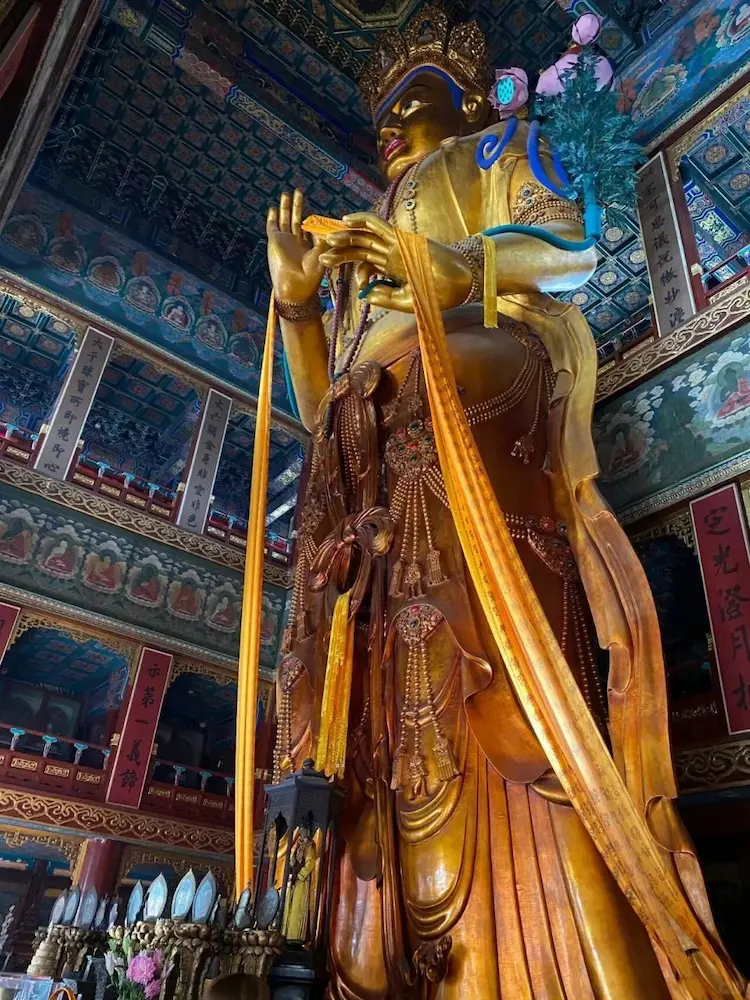
This piece of wood came from Nepal, acquired by the 7th Dalai Lama in exchange for a vast amount of precious treasures, and then transported by water from Tibet to Beijing over a three-year journey. Emperor Qianlong spent over 80,000 taels of silver and more than 800 taels of gold to carve this Buddha and construct Wanfu Pavilion.
In 1990, this giant Buddha was listed in the Guinness World Records as the world’s largest single-log carved Buddha statue. This is the second of the Three Masterpieces of Wood Carving at Yonghe Palace.
>Cultural Insight: This Buddha is Maitreya (known as “Maitreya Buddha” in Tibetan Buddhism). Note: The Maitreya depicted here is not the pot-bellied, sack-carrying monk commonly portrayed, but rather a slender, standing Bodhisattva. In Tibetan Buddhism, Maitreya represents the future savior.
10. Zhaofo Tower (Golden Thread Nanmu Shrine) — The Third of the “Three Masterpieces of Wood Carving” at Yonghe Palace
Located in the eastern side hall of Wanfu Pavilion, this was a private Buddhist chapel built by Emperor Qianlong for his mother. Inside stands a golden thread nanmu shrine, 5.5 meters tall, featuring three layers—inner, middle, and outer—and carved with 99 golden dragons.
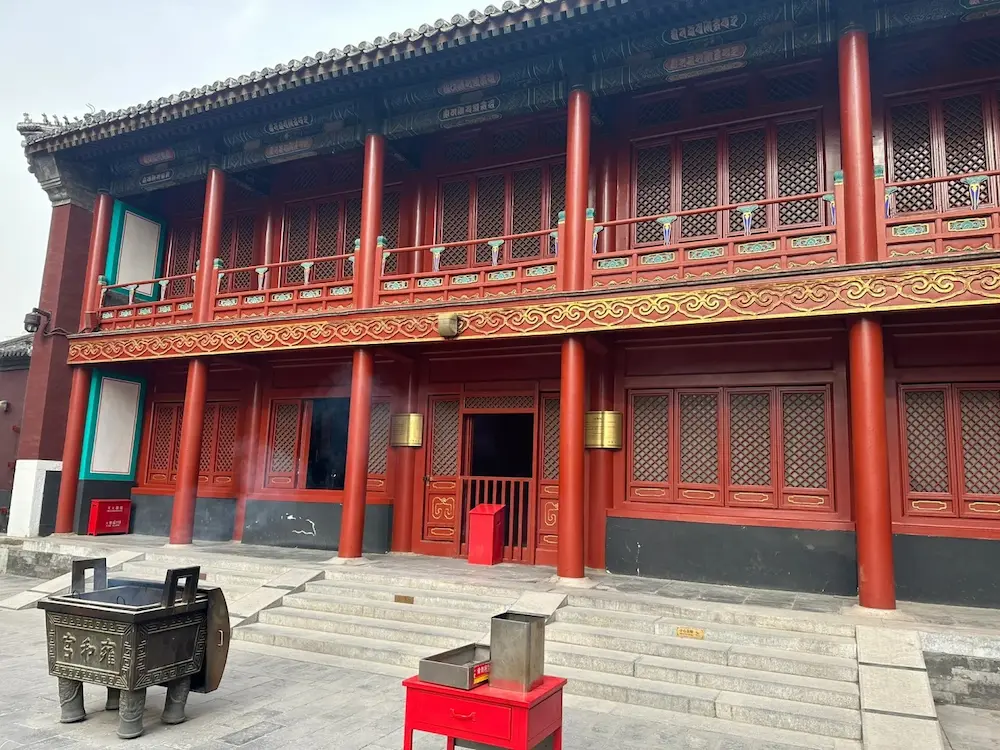
Golden thread nanmu is an extremely precious wood that shimmers with a golden sheen in the sunlight. Inside the altar stands a standing statue of the Buddha carved from sandalwood. This is the third of the Three Masterpieces of Wood Carving at Yonghe Temple.
>Summary of Yonghe Palace’s “Three Masterpieces of Wood Carving”:
> 1. The Five Hundred Arhats Mountain (Dharma Wheel Hall)
> 2. The White Sandalwood Maitreya Buddha (Ten Thousand Blessings Pavilion)
> 3. The Golden Thread Nanmu Wooden Buddha Shrine (Zhao Fo Tower)
11. Suicheng Hall (The Final Hall)
This marks the end of the central axis. The hall is dedicated to the Great White Umbrella-Bearer (protector of the nation and dispeller of disasters), as well as the White Tara (symbol of longevity and health) and the Green Tara (savior from suffering and distress). Legend has it that prayers for “good fortune and fulfillment” offered here are particularly efficacious.
The Four Great Zangchen: Ancient Buddhist Academies
Yonghegong is not merely a temple; it is also a comprehensive Buddhist academy. When Emperor Qianlong converted Yonghegong into a lama temple, he established four “zangchen” (academies):
| Zangchen | Equivalent to |
| Sutra Hall | Exoteric Buddhism (Basic Buddhist Theory) |
| Esoteric Hall | Esoteric Buddhism (Advanced Meditation Practices) |
| Medicine Buddha Hall | Medicine (Tibetan Medicine) |
| Kalachakra Hall | Astronomy (Astronomy and Calendrics) |
Therefore, monks at that time not only studied Buddhist scriptures here, but also medicine and astronomy. It was very much like a modern comprehensive university.
Secrets on the Roof: The Aerial Mandala
At Yonghe Temple, don’t forget to look up at the roof. In addition to the five gilded pagodas atop the Hall of the Dharma Wheel, the ridges of the Hall of Ten Thousand Blessings and other halls are dotted with small stupa-like structures, arranged in a harmonious pattern alongside ridge animals such as dragons, phoenixes, and lions.
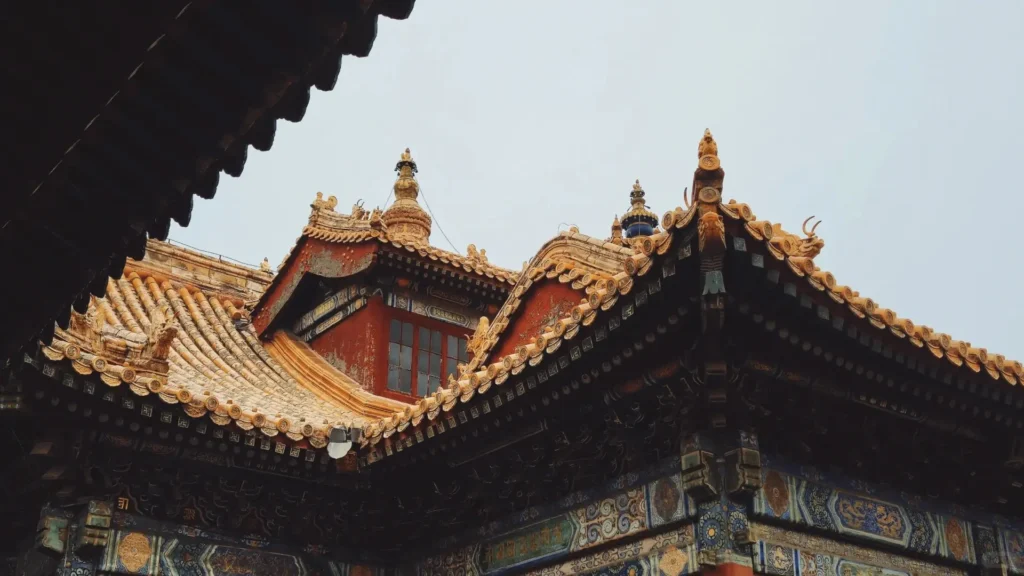
These pagodas are known as “inverted-bowl pagodas” (also called Lama pagodas) and are a symbol of Tibetan Buddhism. The rooftops make for highly photogenic shots—perfect for your travel photography.
Guide to Praying for Blessings: What Is the Proper Way to Do It?
✅ The Correct Way
- Collecting Incense: After entering the Zhaotai Gate, there are free incense stations on both sides. Each person receives a small bundle, which is sufficient. Do not buy incense outside; the incense sold there is expensive and cannot be brought inside.
- Lighting Incense: Use the oil lamps or candles outside the hall to light the incense; do not use a lighter.
- Holding Incense: Hold the incense in your left hand (Buddhism considers the left hand to be pure) and use your right hand to support it. Raise the incense above your head and bow once in each of the four directions (to offer respect to the Buddha, the Dharma, the Sangha, and all sentient beings).
- Inserting the Incense: Gently place the incense into the incense burner. Do not blow out the flame; instead, gently sway the incense until the flame extinguishes naturally.
- Prayer Wheels: Rows of prayer wheels are located under the eaves of each hall. Be sure to turn them clockwise (from your left hand toward your right). Each full rotation is equivalent to reciting the sutras inside the wheel once. You may turn them with your hand as you walk.
- Prostration: If you wish, you may perform three prostrations on the prayer mat. Place your palms together, first raising them above your head (mind), then bringing them to your mouth (speech), and finally to your chest (body), before kneeling and bowing. There is no need to force yourself; sincerity is what matters.
❌ Things You Must Never Do
- Do not step on the threshold: The threshold symbolizes the Buddha’s shoulders. When entering or exiting the main hall, step over it—do not step on it. Men should step over with their left foot first, and women with their right foot first (this rule is not strictly enforced; just make sure to step over it).
- Do not take photos of the Buddha statues: Photography is strictly prohibited inside the hall. Flash photography can damage centuries-old artifacts and is considered disrespectful to the Buddha. You may take photos freely outside.
- Do not make loud noises: Please remain quiet; do not play around, laugh loudly, or make noise inside. If you need to speak, keep your voice down.
- Do not wear hats or sunglasses: Remove your hat and sunglasses before entering the hall. This is basic courtesy.
Special Events at Yonghe Temple
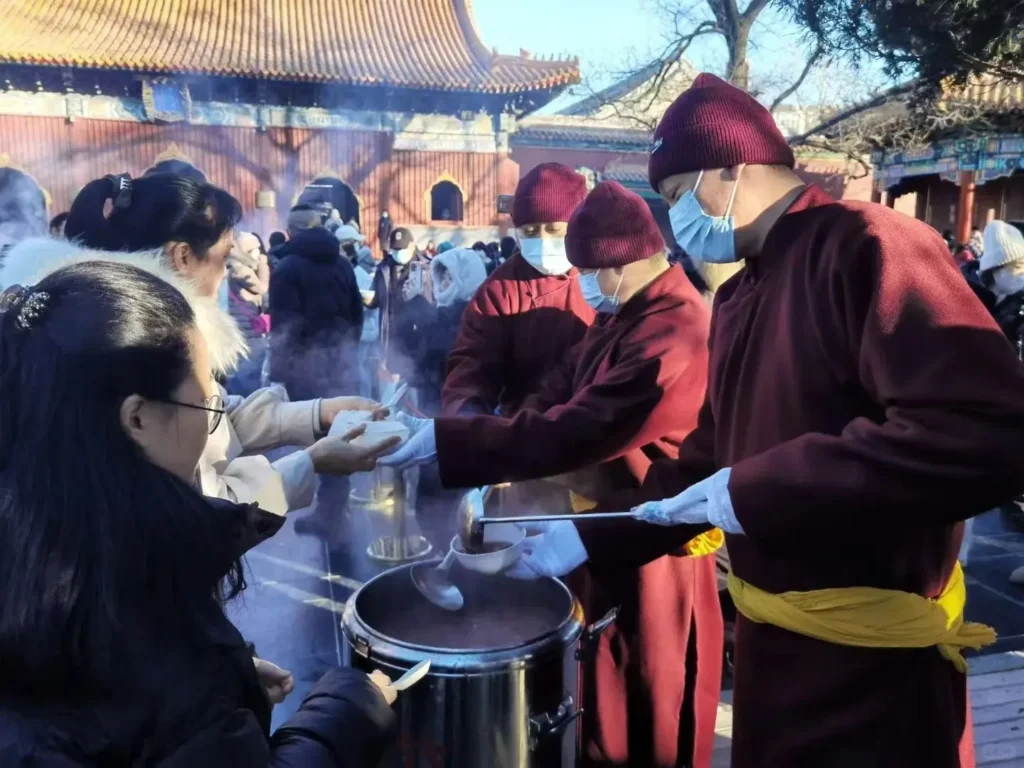
1. Laba Festival Porridge Distribution (The 8th day of the 12th lunar month, usually in January)
Every year on this day, Yonghe Temple revives the traditional porridge-making ritual. Preparation begins at dawn, and after sunrise, the porridge is distributed free of charge to worshippers and visitors. Many people start lining up as early as midnight. If you happen to be in Beijing during this time, it’s definitely worth experiencing.
2. “Exorcism” Ceremony (29th day of the 12th lunar month to 1st day of the 1st lunar month)
Old Beijingers call it “Ghost-Beating,” though its formal name is “Tiao Buza.” This is a Tibetan Buddhist exorcism ritual. Lamas wearing various masks (symbolizing guardian deities) dance to the sound of drums and music, and finally burn effigies representing “demons,” symbolizing the expulsion of evil and praying for world peace. It is a spectacular sight, and many people come specifically to watch.
3. Reminder: Queuing at the Amulet and Souvenir Shop
If you wish to purchase a famous Yonghegong incense ash bracelet or amulet (which have become very popular on foreign social media in recent years), you will typically need to wait in a long line at the amulet and souvenir shop inside the temple grounds.
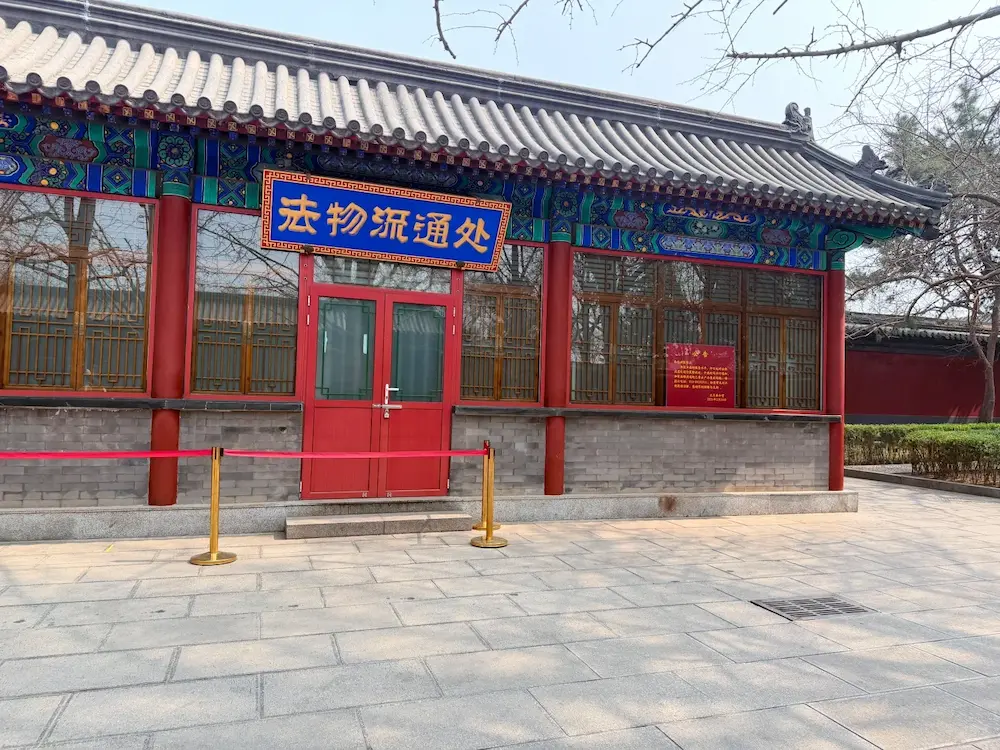
Especially on holidays and weekends, the wait can exceed one hour. Please allow ample time when planning your itinerary, or consider arriving on a weekday morning to be among the first visitors.
After visiting Yonghe Temple, where else can you go nearby?
| Location | Distance | Highlights |
| Confucius Temple and Imperial Academy Museum | 5-minute walk | The site where emperors of the Yuan, Ming, and Qing dynasties paid homage to Confucius, and also the highest seat of learning in ancient times. Admission: 30 yuan. |
| Wudaoying Hutong | 8-minute walk | Quieter than Nanluoguxiang, with many artsy boutiques, cafes, and restaurants. A great spot to rest and grab a bite. In-Depth Guide: For a detailed guide to exploring and dining in Wudaoying, specific shop names, and the latest 2026 guide on linking international credit cards to WeChat/Alipay, please refer to my “In-Depth Guide to Wudaoying Hutong” . |
| Ditan Park | 15-minute walk | The site where the Ming and Qing emperors performed earth-worship rituals. A temple fair is held here every Chinese New Year, and it’s a popular spot for locals to take walks. Admission: 2 yuan. |
| Yonghegong Street | Right at the entrance | There are many shops selling incense, Buddhist artifacts, and prayer beads. It’s worth a stroll, but be cautious about buying “blessed” items—prices can be inflated. |
Dining Recommendations (5–15-minute walk)
| Name | Location | Features | Price per person |
| Xuxiangzhai Vegetarian Restaurant | Yonghegong Street | Vegetarian buffet; serene atmosphere; popular with many devotees | 80 RMB (approx. $11) |
| Pengcheng Bakery | Wudaoying Hutong | French bread and coffee; great for breakfast | 30–50 RMB |
| Saffron Spanish Restaurant | Wudaoying Hutong | Spanish cuisine run by foreigners; the paella is excellent | 150 RMB+ |
| Lao Kongjia Zha Jiang Mian | South Section of Yonghegong Street | Authentic Beijing-style Zha Jiang Mian | 25 RMB |
Frequently Asked Questions
Why Is It Worth a Visit?
Yonghe Temple is unlike other temples in Beijing. It is not merely a tourist attraction, but a living historical site.
- The floor tiles you walk on were once trodden by Emperor Yongzheng and Emperor Qianlong.
- The bronze pot you see has been used to cook Laba congee for over 300 years.
- The giant white sandalwood Buddha you gaze upon was transported from Nepal and carved during the Qing Dynasty.
- The stone stele inscribed with The Lama’s Discourse explains why Tibet is part of China.
- The prayer wheels you see are spun daily by devotees.
There is no excessive commercial hawking here—only the scent of incense, the sound of chanting, and centuries of silence.
Whether you believe in Buddhism or not, Yonghe Temple will give you a sense of quiet strength. And it is truly beautiful—yellow tiles, red walls, gilded pagodas, ginkgo leaves blanketing the approach in autumn, and snow covering the rooftops in winter… Every snapshot is postcard-worthy.
When you come to Beijing, you must visit the Forbidden City and the Great Wall, but Yonghe Temple is also worth spending half a day exploring.