Zhaofu Street: 3 Must-Visit Spots Evoking Old Beijing Near the Bell and Drum Towers (Updated 2026)
My first visit to Zhao Fu Street was prompted by rumors of a state-run grocery store that opened in 1956. Later, it went viral online, drawing crowds of people who made special trips just to check it out.
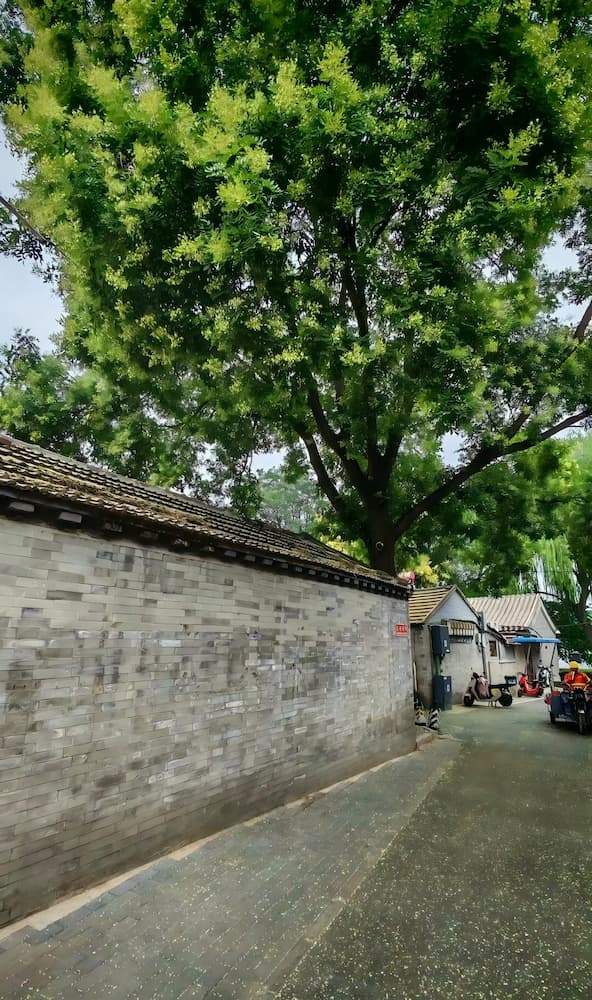
But it wasn’t until I walked the entire length of this alley that I realized there was more to it than just that store—the ancient locust trees lining the street, the courtyard gates (some neatly arranged, others haphazard), and the hidden arts and culture hubs all proved far more captivating than I had imagined.
> If you stand in Zhonggu Lou Square facing the Bell Tower, the first alley directly behind it is the southern entrance to Zhao Fu Street. Hidden behind the Bell Tower, this street is so low-key that even many Beijingers have never set foot inside.
Table of Contents
Where is this alley? How do I get there?
Zhaofu Street is located north of the Bell Tower in Beijing’s Dongcheng District—more precisely, it lies directly behind the Bell Tower. Although it is called a “street,” it is actually a bona fide north-south alley.
During the Ming Dynasty, it belonged to Jintai Fang and was known as Zhaofu Hutong; during the Xuantong era, it was renamed Zhaofu Street, a name that has been in use ever since.
It is only 390 meters long, stretching from Zhongtao Hutong in the north to Doufuchi Hutong in the south, and connects east-west with small alleys such as Guosheng Hutong, Guoxiang Hutong, Yuge Hutong, and Zhangwang Hutong.
Route 1: Coming from the Bell and Drum Towers (walking north to south, recommended)
- After visiting the Bell and Drum Towers, walk to the north side of the Bell Tower and head straight into Doufuchi Hutong. Walk for about 3 minutes, then turn north at the side of Hong’eng Temple to reach the southern entrance of Zhao Fu Street. This is the smoothest route and the least likely to lead to getting lost.
- Exit from Exit A2 of Shichahai Station on Metro Line 8, head north across Gulou West Street, and you’ll also reach the southern entrance of Zhao Fu Street. The entire walk takes about 10 minutes.
Route 2: Coming from Gulou Dajie Subway Station (Exploring from North to South)
- Exit from Exit G of Gulou Dajie Station on Subway Lines 2 or 8. Walk straight south along Jiugulou Dajie. When you see the sign for Zhongtao Hutong, turn left (east) and walk straight to the end, where you’ll reach the northern entrance of Zhao Fu Street. The entire walk takes about 12 minutes. This route is best for exploring from north to south, exiting at the south end for a seamless transition to the [Doufuchi Hutong In-Depth Guide ].
> Tip: Vehicles cannot enter Zhao Fu Street, so walking or riding a shared bike is best. If you want to explore Zhao Fu Street and the hutongs to the north, after exiting the north entrance, head east to reach Zhongtao Hutong, or west to reach Jiugulou Street—both are very convenient.
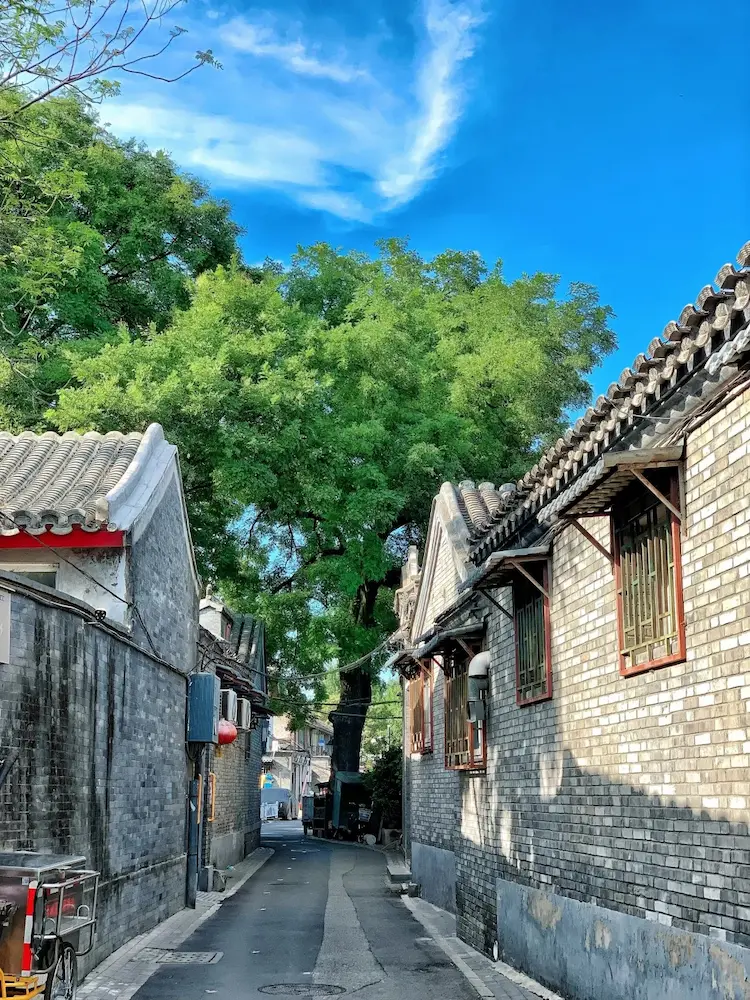
Best Time: Weekdays from 9:00 AM to 11:00 AM. At this time, the sun slants in from the east, casting the shadows of locust trees onto the gray walls. You’ll see locals strolling down the street with their groceries or carrying birdcages.
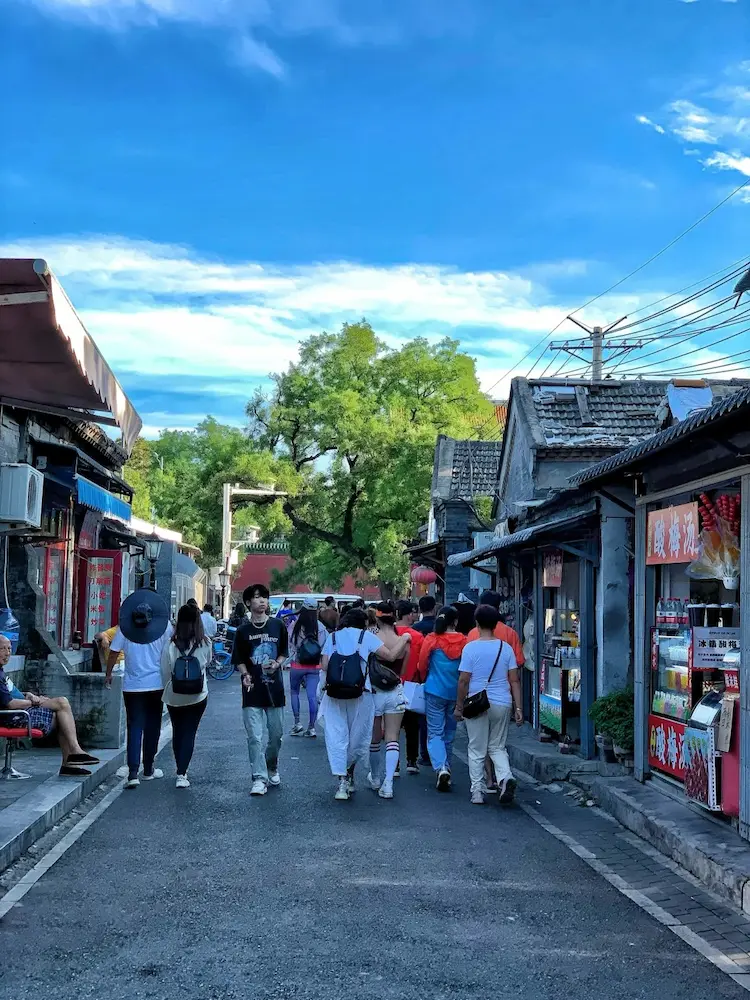
Early winter (late November–December) or autumn is best, when the leaves are golden or still lush and green. In summer, the locust trees provide cool shade, but the area gets crowded in the afternoon.
Budget: There is no admission fee for the entire alley. Shopping at the grocery store costs about 12–15 yuan (detailed below). A cup of American coffee at the on-site café costs about 25–35 yuan.
Starting from the South Entrance: First Glimpse of Zhao Fu Street
Turning off Doufu Chi Hutong onto Zhao Fu Street, the first thing you see on the west side is an L-shaped courtyard wall. One of the side rooms in that courtyard juts out, and the owner has cut a doorway into the gable wall (the load-bearing wall on either side of the building)—this practice isn’t actually very safe, but in old hutongs, people will come up with all sorts of ways to squeeze in an extra room.
Right next to it is the original main entrance, with a sign reading “No. 1 Courtyard, Zhao Fu Street.” This is a typical “wall-mounted door” structure—a door cut directly into the wall, without a separate gatehouse.
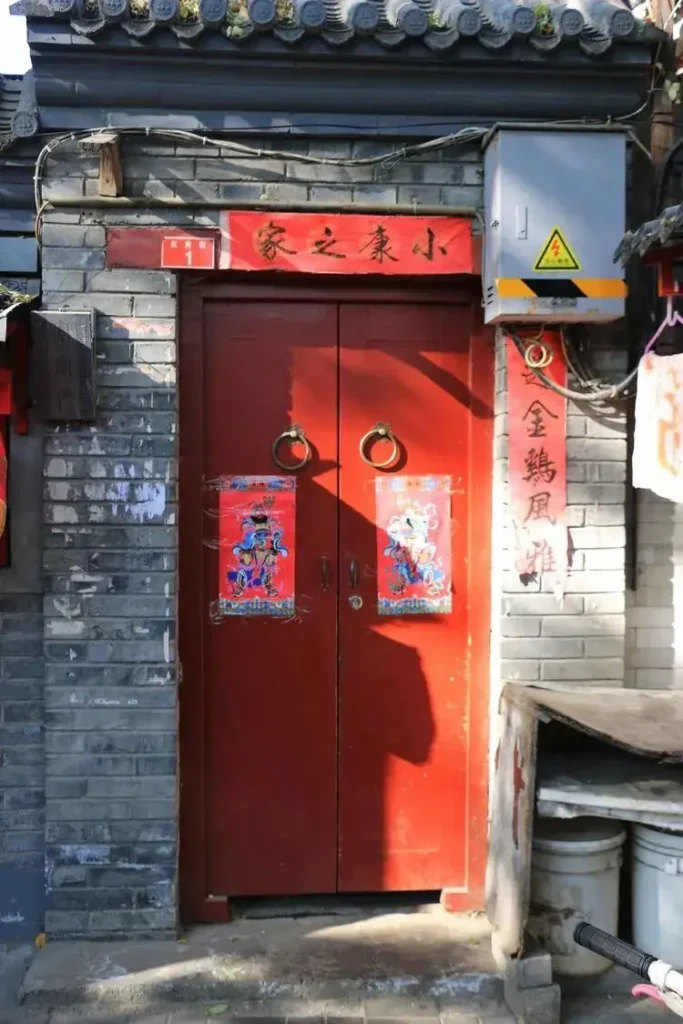
The main gate has been renovated as part of the street’s unified renovation project; it is clad in gray ceramic tiles on the outside. A pair of red wooden doors stands tightly shut, adorned with paper door gods (images of guardian deities posted during the Spring Festival), and the door knockers are newly installed copper fittings.
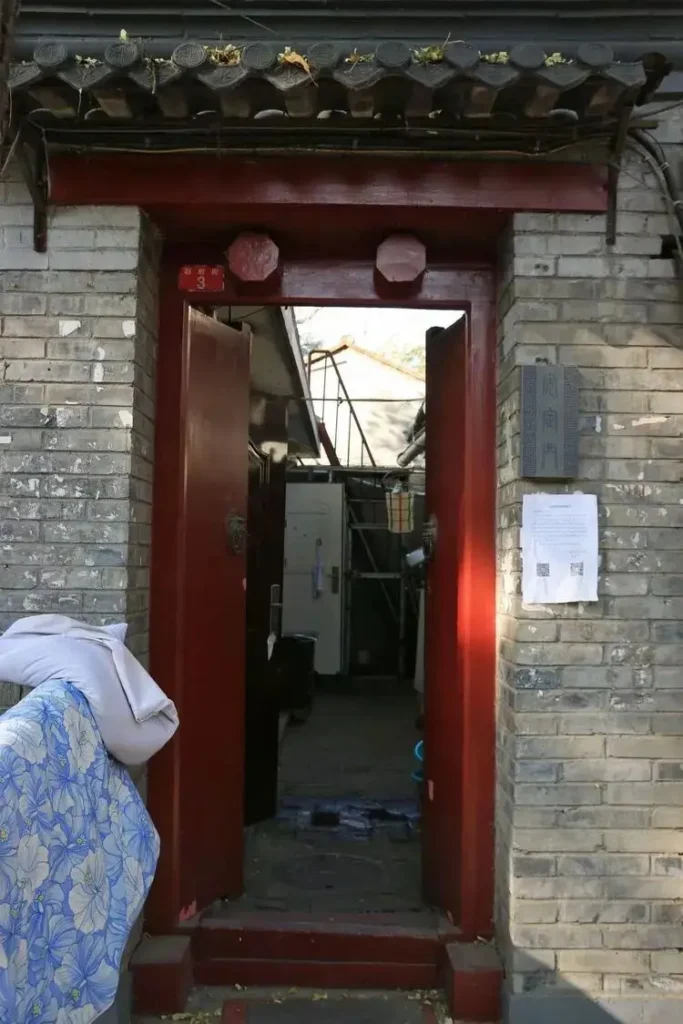
Further north, Courtyard No. 3 on the west side of the street also features a wall-mounted entrance, but its roof is a half-hip-and-gable style (a type of Chinese roof design), with a pair of plum-blossom-shaped door pins below. These door pins are round wooden carvings above the doorframe used to secure the door panels, and they also carry auspicious symbolism.
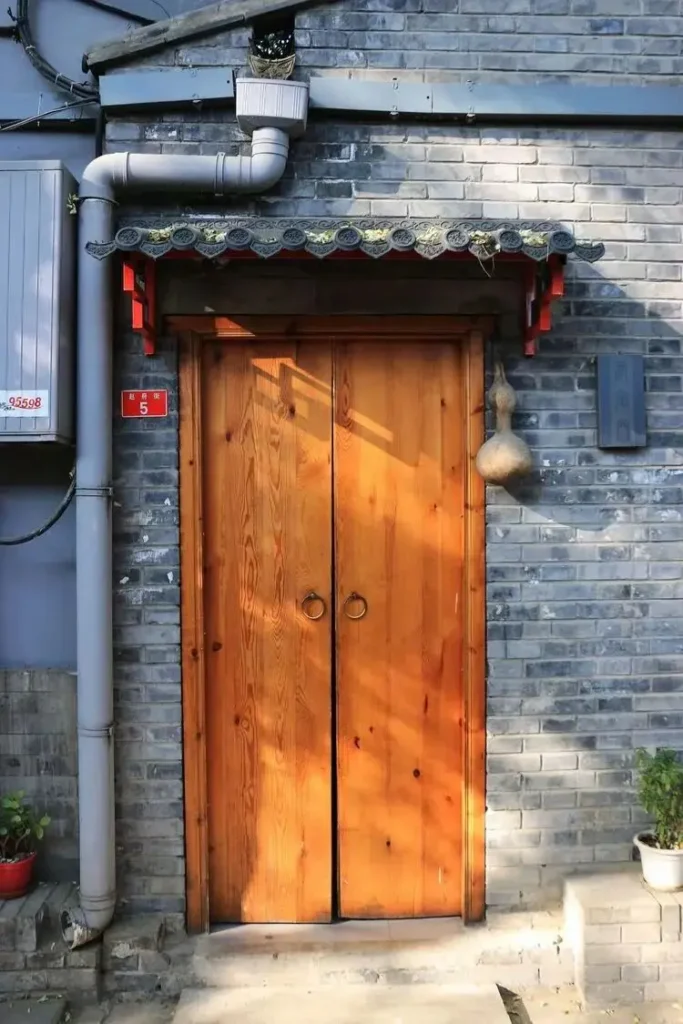
A gourd hangs at the entrance of Courtyard No. 5, playing on the homophone for “fortune and prosperity”—a common touch found in old Beijing households.
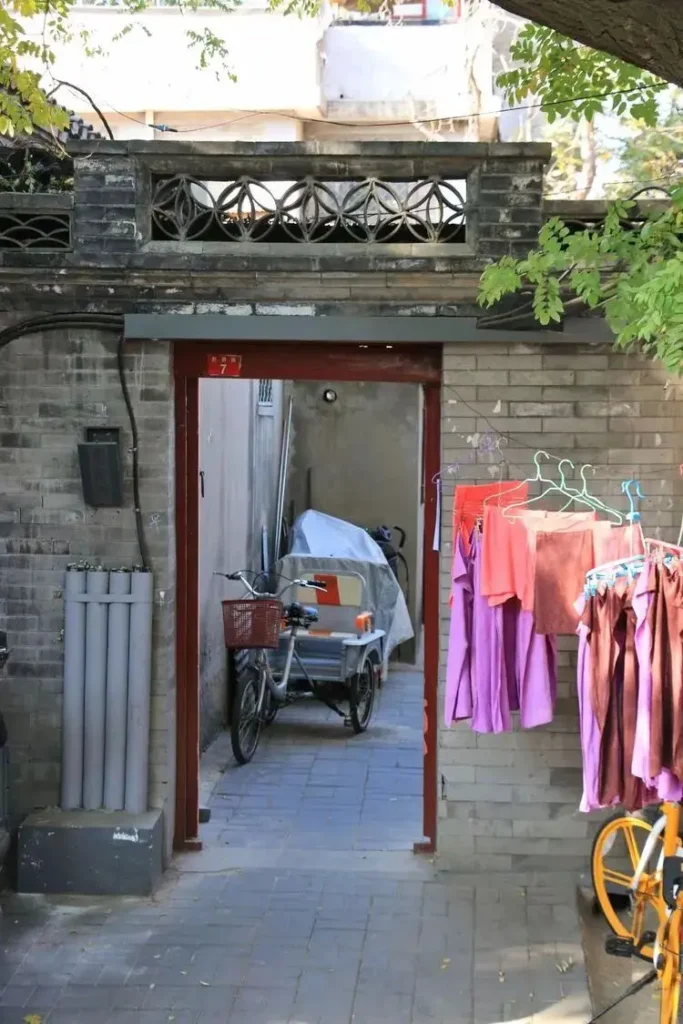
Further ahead, the lintel of Courtyard No. 7 is adorned with roof tiles arranged in the shape of copper coins, and clothes hang outside the red gate—the courtyard must be quite cramped.
The Communal Courtyard: Real Life in Courtyard No. 10
Courtyard No. 10 on the east side of the street presents a different scene. The main gate is simple and unadorned. Inside, self-built structures line both the north and south sides of the courtyard.
The passageway is cluttered with flower pots, metal buckets, and old stoves, piled high with cabbage and cardboard boxes, while clothes hang from the ceiling. It looks a bit chaotic, but this is everyday life in a communal courtyard.
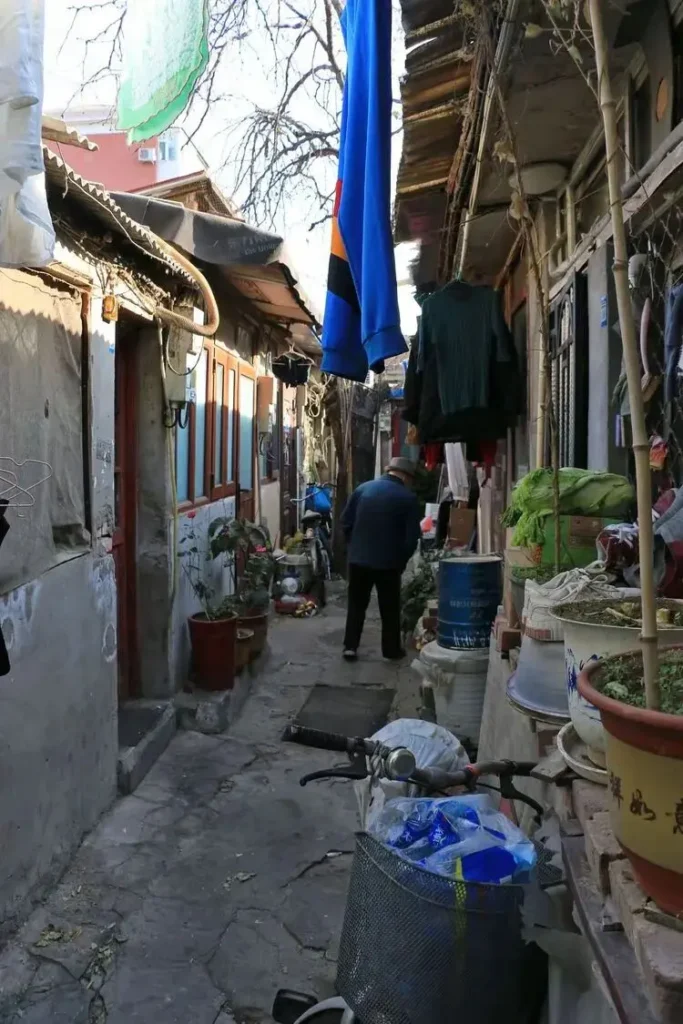
In the old Beijing hutongs, courtyards were once private siheyuan for a single household. Later, as the population grew, several families moved into a single courtyard. Each family built extensions on the open ground, making the space increasingly cramped and narrow, until it eventually became this kind of “mixed-use courtyard.”
Those cabbages are vegetables that Beijingers store for the winter—even though supermarkets have everything nowadays, the older generation is still accustomed to stockpiling some cabbage; it gives them a sense of security in their daily lives.
The Most Well-Organized Courtyard: Courtyard No. 9
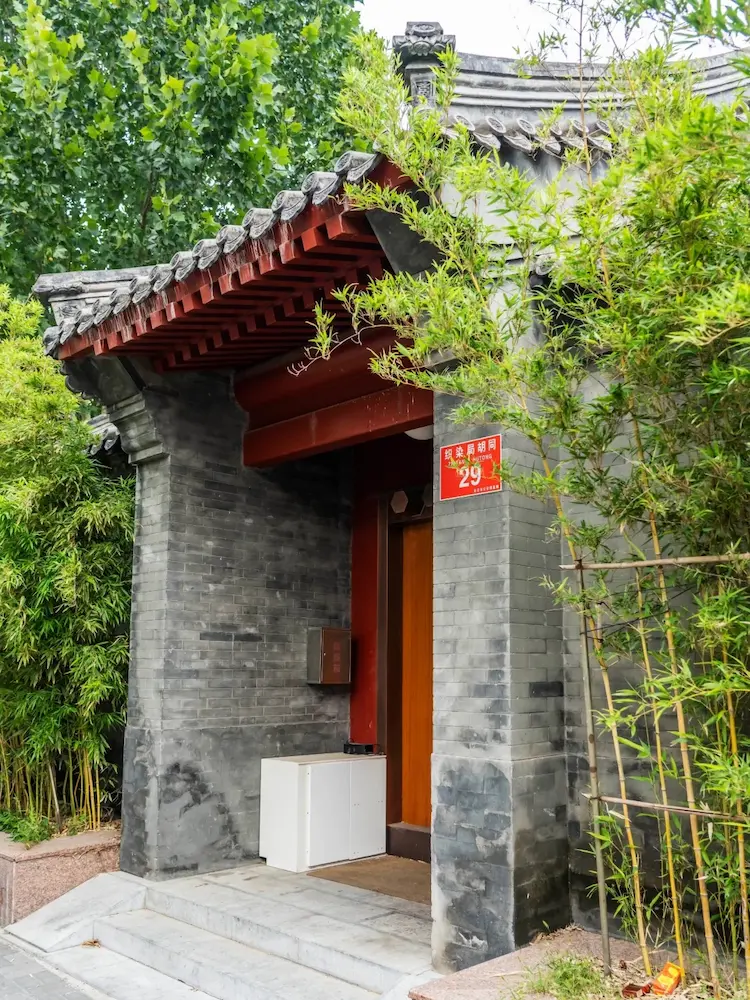
Courtyard No. 9, located on the west side of the street, is the most symmetrical courtyard on the entire street. Recently renovated, it features three rooms running north to south, with a ridge-and-hip roof. The main gate is centered in the wall—though this doesn’t strictly adhere to the traditional rules of a siheyuan (where the main entrance should be offset to the east, not directly in the center)—it still looks pleasing to the eye.
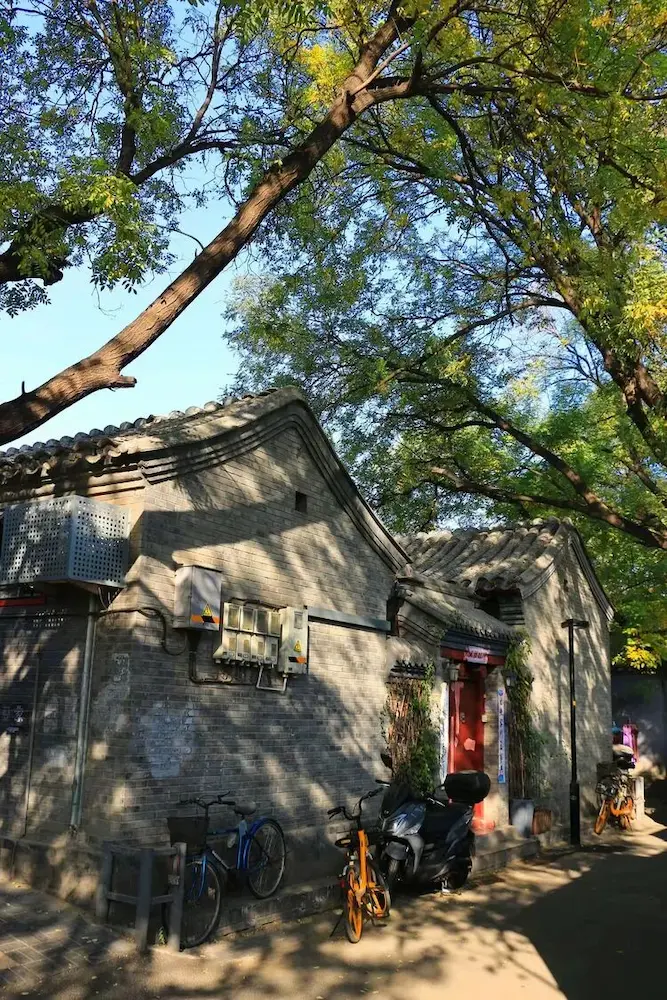
The double red doors are adorned with a pair of door pins, and metal lion-head door knockers (the copper plates beneath the door knockers, symbolizing the warding off of evil spirits) hang above them. The scorpion-tail ridge on the roof curves slightly—a traditional architectural feature where the ridge’s ends curve upward.
Although not strictly built according to ancient methods, it has a lively spirit. Plants are planted at the entrance, creating a quiet and peaceful atmosphere. This is the kind of courtyard where true Beijingers live.
Remnants of the Republic of China Era and Ancient Locust Trees: Courtyard No. 13
Influenced by the Republic of China era (1912–1949), Courtyard No. 13 on Zhao Fu Street incorporates some Western elements—such as arched windows and brick columns—which are still visible today.
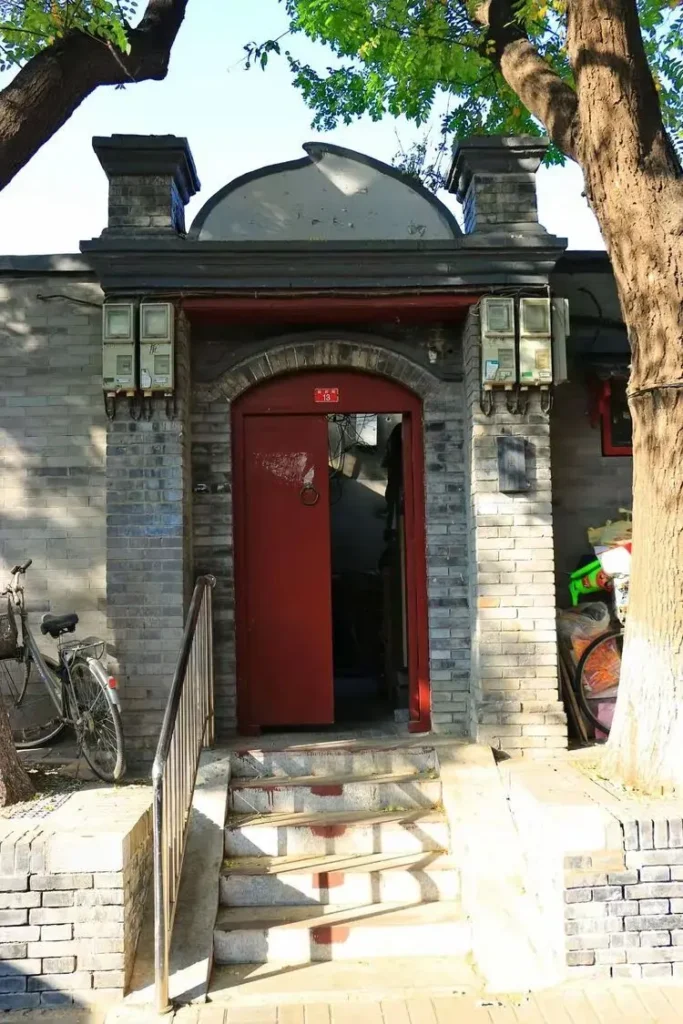
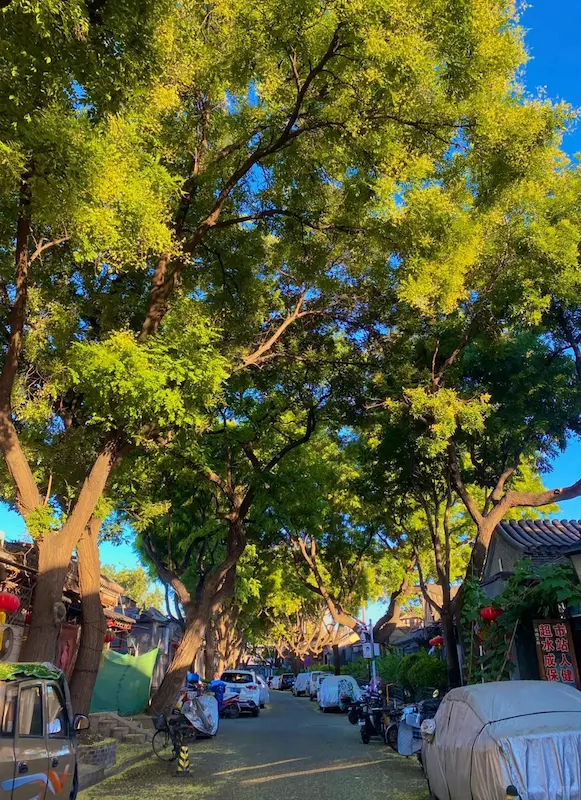
Two ancient locust trees stand at the entrance, their dense foliage shading half the doorway. Locust trees are particularly common in Beijing’s hutongs; in traditional Chinese culture, the word for “locust” (huai) is homophonous with “nostalgia” (huai), evoking a sense of longing for one’s homeland.
Many of the locust trees on Zhao Fu Street are over a century old; walking here in the summer feels like passing through a green tunnel.
One Intersection, Two Directions
When you reach the first intersection, Guosheng Hutong is to the east, and Yuge First Alley is to the west. You can turn into Yuge First Alley first to take a look—it’s so narrow that only one person can pass through at a time—then come back and continue north.
If you’d like to explore a few more hutongs, head east from Guosheng Hutong to reach [Baochao Hutong: A Bohemian Hutong Converted from a Yuan Dynasty Money Bag ], or turn into [Beiluoguxiang: A Rose-Lined Hutong a Hundred Times Quieter Than Nanluoguxiang]. Together with Zhao Fu Street, these three hutongs form a “grid-like” network of alleys north of the Bell and Drum Towers—enough to keep you exploring for a whole day without ever repeating a single path.
Isolated Enclaves: Courtyards 33 and 35
Continuing further, just before reaching the T-junction at Guowang East Alley, there is an area on the west side that resembles an isolated island—Courtyards 33 and 35 on Zhao Fu Street.
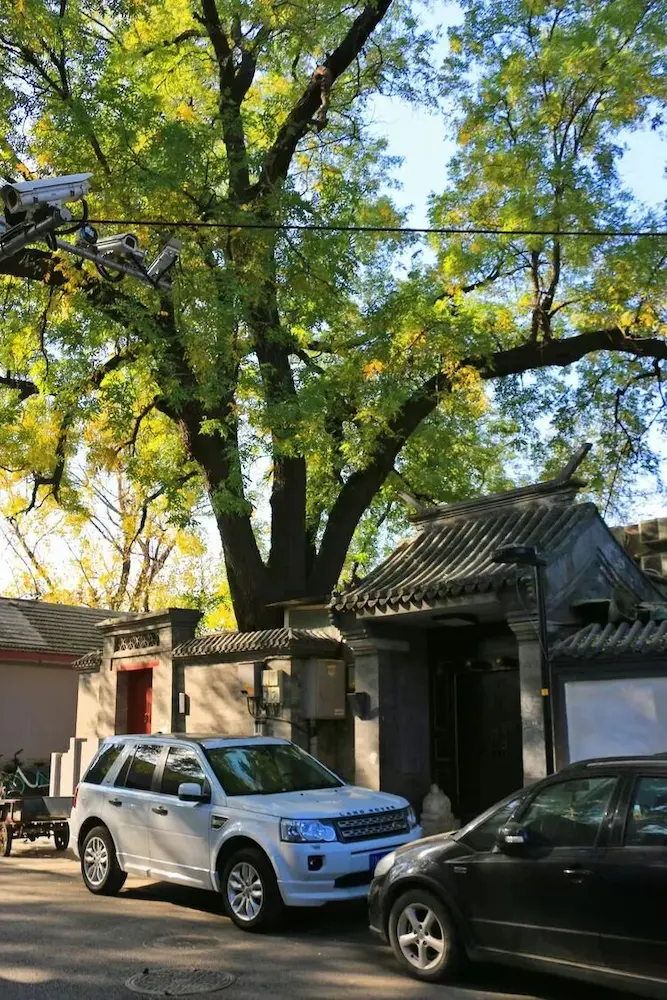
These two courtyards are adjacent to one another. The southern one features a wall-integrated gate, with roof tiles arranged in a coin-shaped pattern; the northern one is modeled after the “Manzi Gate” style, recently renovated with a black-lacquered main gate and a pair of lion-shaped gate pillars in front.
The Manzi Gate is a type of gate found in siheyuan courtyards, where the gate is installed on the outermost side. It is said to have been brought to Beijing by merchants from the south. The stone door pillars at the entrance—round stone drums represent military officials, while square ones represent civil officials.
However, both stone lions here are rolling embroidered balls, indicating they are both male lions (traditionally, male lions step on embroidered balls, while female lions cradle their cubs), which is somewhat irregular.
These two courtyards are somewhat unique, unlike ordinary residential homes. Some scholars speculate they may have served as the offices of the Ming Dynasty’s Bureau of Wine and Vinegar, but there is no documentary evidence to support this. Still, standing beneath that exceptionally tall locust tree, you can’t help but feel that this place is indeed a bit different.
By the time you reach this point, you’re roughly in the middle of Zhao Fu Street. The midday sun is slanting, its rays filtering through the treetops to cast dappled shadows across the walls on the west side of the street.
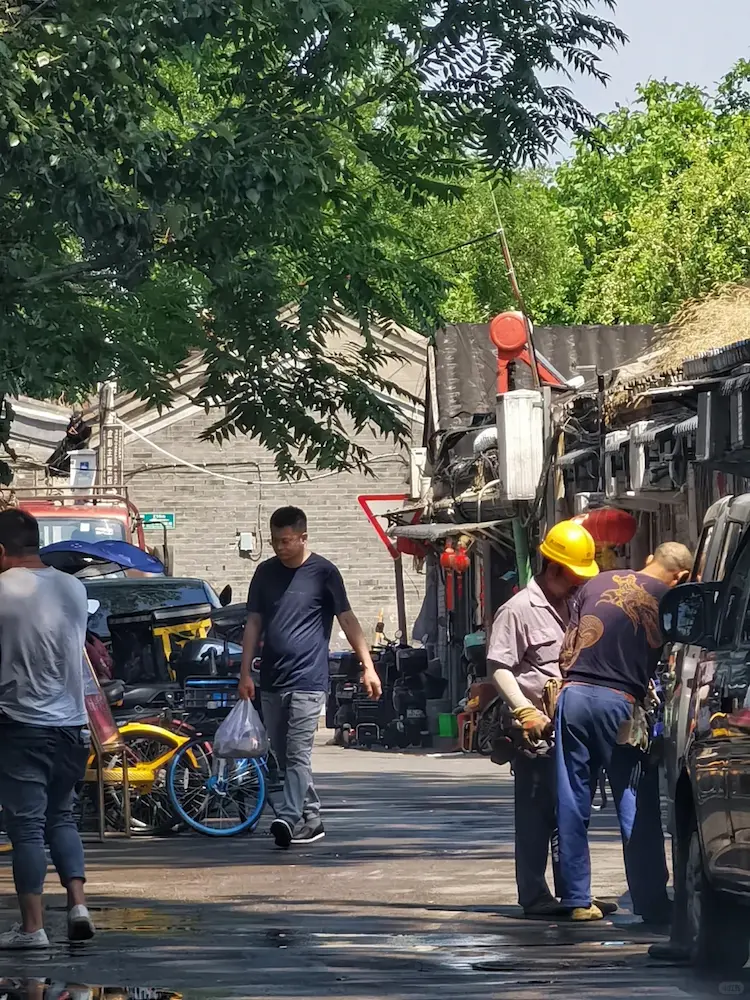
Tricycles and bicycles are propped against the walls, and the street has grown quiet; all you can hear are footsteps and the clicks of camera shutters. This is exactly how I remember the alleys from my childhood.
Zhao Fu Street Grocery Store: Soy sesame & peanut paste Vats That Take You Back in Time
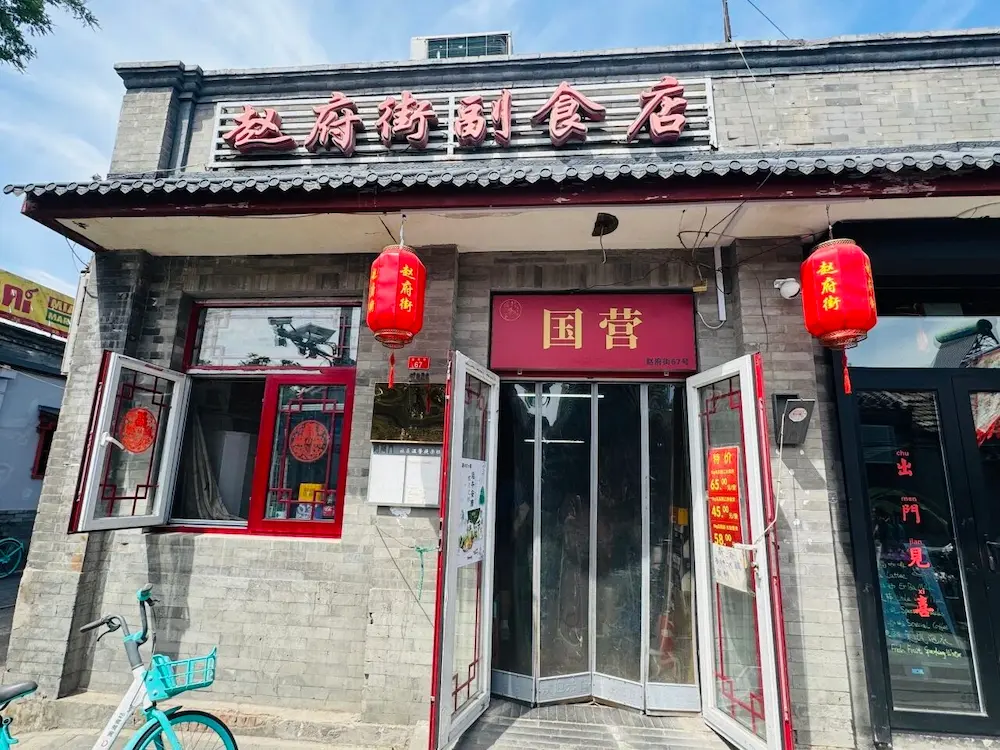
Finally, we arrived at No. 67 Zhao Fu Street—the Zhao Fu Street Grocery Store.
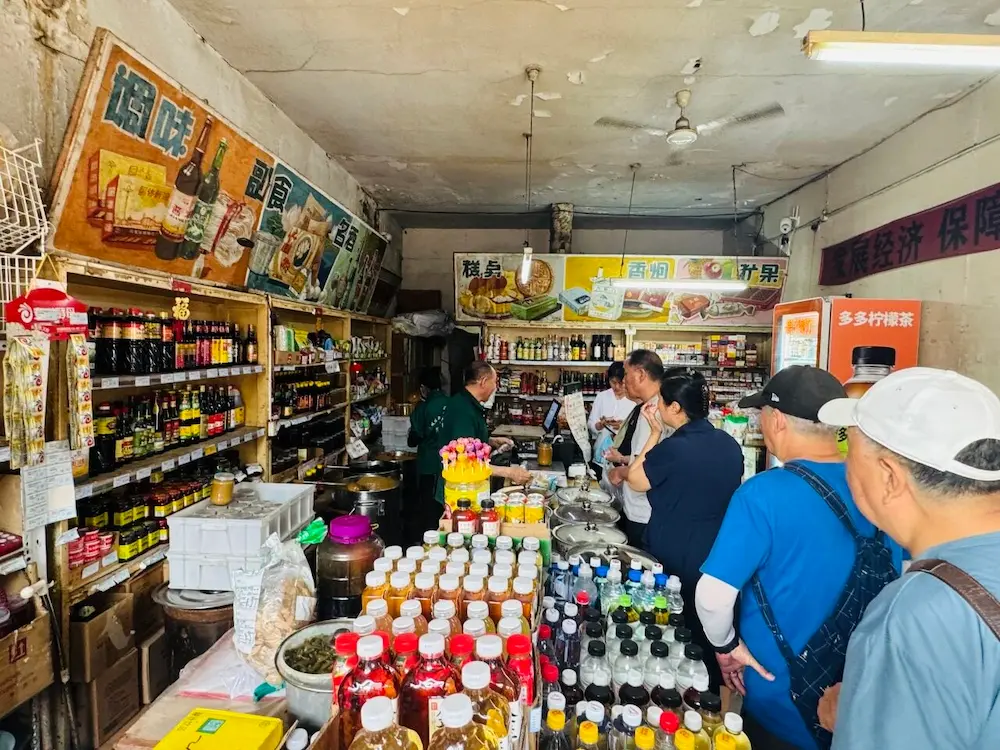
From the outside, the newly renovated sign bearing the words “Zhao Fu Street Grocery Store” is rather unremarkable. But the moment you push open the door, it’s as if you’ve stepped into another era.
The beige wooden counter, in use since the shop opened in 1956, has broken glass patched up with tape.
Behind the counter stand three large vats, each holding bulk soy, sesame & peanut paste, vinegar, and yellow bean paste.
Hanging on the wall are hand-painted gouache advertisements from the 1970s, depicting products like “solid soy sesame & peanut paste” and “lotus root starch substitute”—items that haven’t been produced for decades. The simplified character for “sugar” in the paintings uses an old style of writing that is no longer in use today.
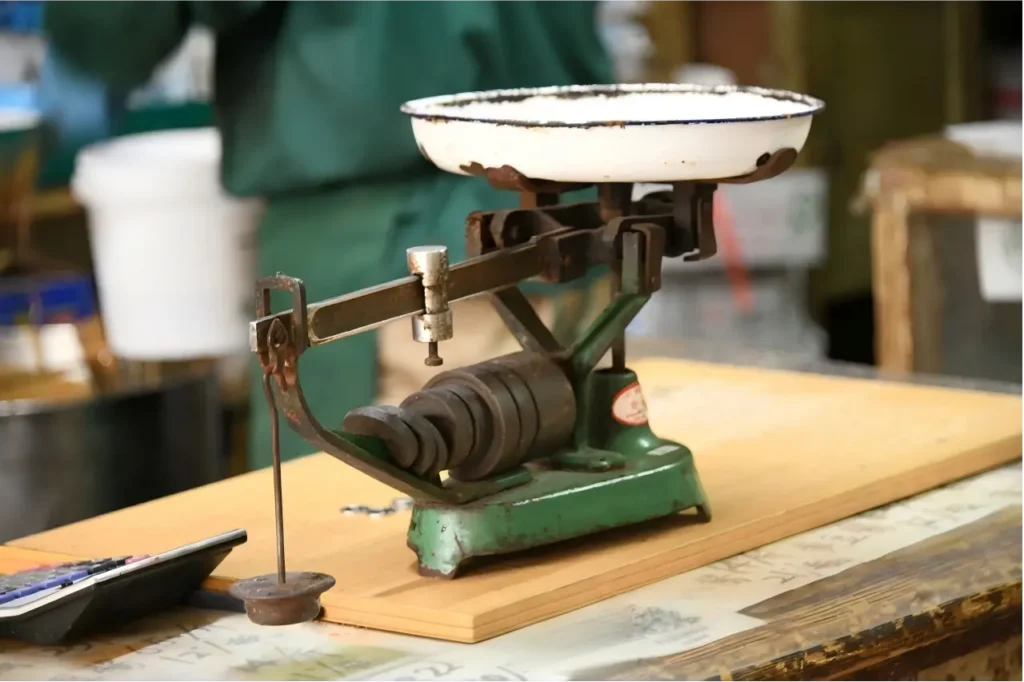
Weighing is done with a platform scale, and calculations are made with an abacus—no calculators, no electronic scales.
The store manager is Li Ruisheng, a true-blue native of Beijing. In 1956, residents in the neighborhood each contributed 50 cents to establish this “cooperative,” and more than 1,300 households from the surrounding alleys came here to buy groceries.
Initially, the store covered over 100 square meters. By the 1990s, market changes led to a gradual downsizing of the storefront, and by the early 2000s, it had shrunk to less than 40 square meters. In the 1990s, there were still four sales clerks; after 2000, only two remained.
In 2006, Li Ruisheng took over the store on a contract basis, serving as both manager and sales clerk while operating on a self-financing basis. His connection with the shop began in 1987 when he was temporarily assigned to help sell winter-stored Chinese cabbage—a bond that has lasted nearly four decades.
The shop has kept all its old items—electric fans, small milk pots, gas stoves—and he can’t bear to part with any of them.
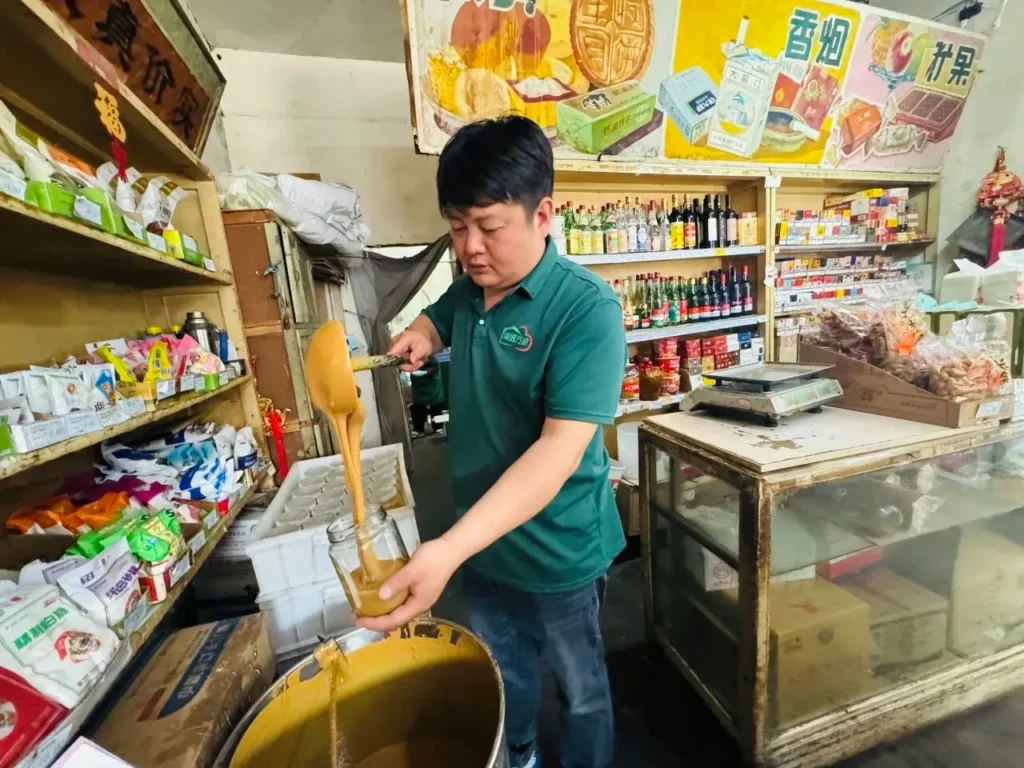
Photography Tip: If you snap a photo with your phone of a shop assistant scooping sesame paste from a large jar with a long-handled wooden spatula—that moment when the paste stretches into a thread—the “cinematic artisanal heritage” of the scene makes for a stunning shot. Switch to Portrait Mode, capture that instant, and post it on Instagram; it will definitely stand out more than a hundred photos of the Drum Tower.
Erba sesame & peanut paste: A Century-Old Flavor
The shop’s most famous item is “ Erba sesame & peanut paste”—a sesame paste made from two parts sesame seeds and eight parts peanuts. Why this ratio? Because pure sesame paste was too expensive for ordinary people to afford, peanuts were used to replace most of it. The result was surprisingly delicious—even more fragrant than pure sesame paste.
A 100-jin (50 kg) barrel of sesame paste can sell five or six barrels a day in the summer. I bought a bottle when I visited, and when I dipped my hot pot lamb in it at home, it was indeed delicious.
>2026 Payment Super Tip (Survival Tip):
Although this old state-owned shop looks like it’s stuck in 1956, its payment methods are right out of 2026. You can easily use WeChat Pay or Alipay linked to an international credit card (Visa/Mastercard) to scan the personal payment QR code at the counter and pay directly. A bottle of Erba sesame & peanut paste costs about 12–15 RMB (approx. $1.50–$2). Grab a bottle to take home—it’s definitely the most authentic culinary souvenir from your trip to Beijing.
If you haven’t linked your card yet, download the international version of Alipay or WeChat before you leave and follow the prompts to add your international credit card—the whole process takes less than 5 minutes. Once in China, you’ll find that almost everywhere accepts mobile payments, even the old grocery stores in the hutongs.
(Of course, if you happen to have cash on hand, you can use that too. But in Beijing in 2026, scanning codes is the norm.)
Business hours: Approximately 9:00 AM to 7:00 PM, but the shop owner may close early at times, so it’s recommended to visit in the morning or before 3:00 PM.
Jintai Sharing Land: From the Shanghai Building to an Arts and Culture Hub
After leaving the grocery store, walk a short distance south, and on the east side of the street, you’ll find No. 20 Zhao Fu Street—Jintai Sharing Land.
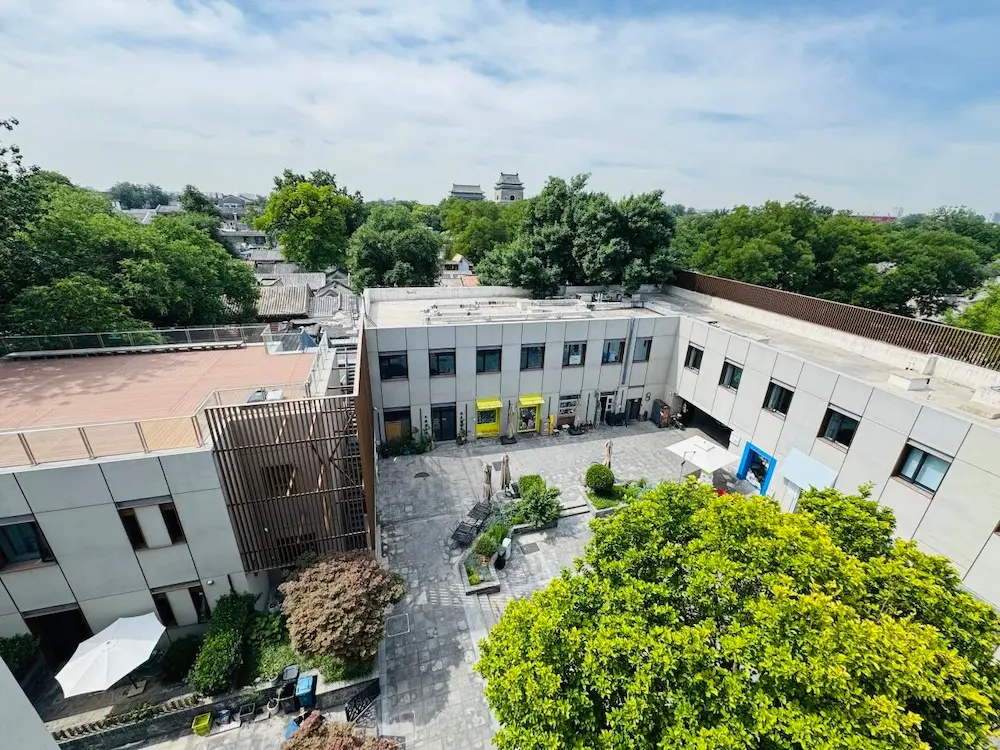
Some tourists might miss this spot, but it’s quite interesting. It was formerly the “Shanghai Building,” constructed in 1959, where 108 families from the Shanghai Documentary Film Studio once lived.
Following its renovation in 2022, it has been transformed into a complex that integrates art spaces, a small theater, restaurants, bars, cafes, creative workshops, and co-working spaces. If you want to see what the “ fusion of tradition and modernity” looks like in a hutong, this is the perfect example.
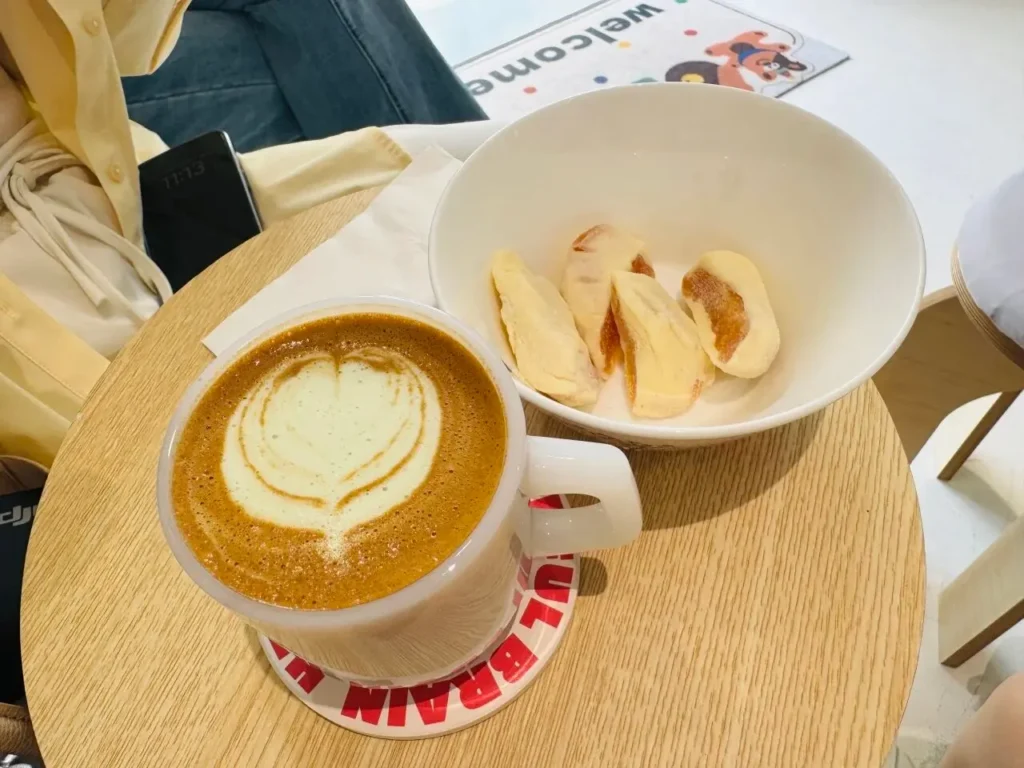
The architecture is Soviet-style—red brick, solid, and symmetrical—forming a striking contrast with the gray hutongs surrounding it. There’s a magnolia tree in the courtyard that’s especially beautiful when it blooms in spring. I took a stroll around the first floor; it was quiet and well-lit.
If you’d like to sit down for a cup of coffee, an Americano costs about 25–35 yuan (US$3.50–5.00), and you can pay via WeChat or Alipay linked to an international credit card.
Opening Hours: The complex is open all day, but some shops don’t open until the afternoon. I recommend visiting between 11:00 AM and 5:00 PM. It’s a great spot to rest your feet, charge your phone, or write in your travel journal when you’re tired from exploring.
Heading North: The Final Courtyard Gate
At the northern end of Zhao Fu Street, the gate of Courtyard No. 32 on the west side features an antique-style design, with the four gate pillars inscribed with the words “Good Fortune and Happiness.” The pair of stone lions at the entrance—again, both male—are each holding a silk ball. Inside the courtyard, the traditional siheyuan layout has been lost, replaced by a two-story building.
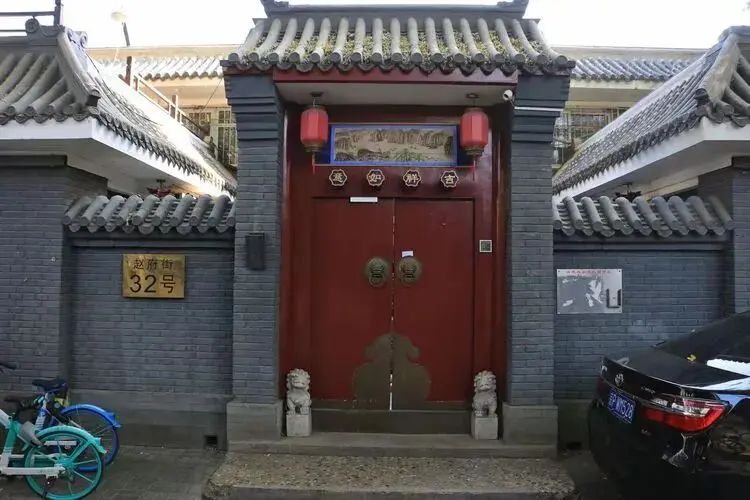
Courtyard No. 34 features a “Manzi Gate” structure; it has been recently renovated and no longer bears any resemblance to its original appearance.
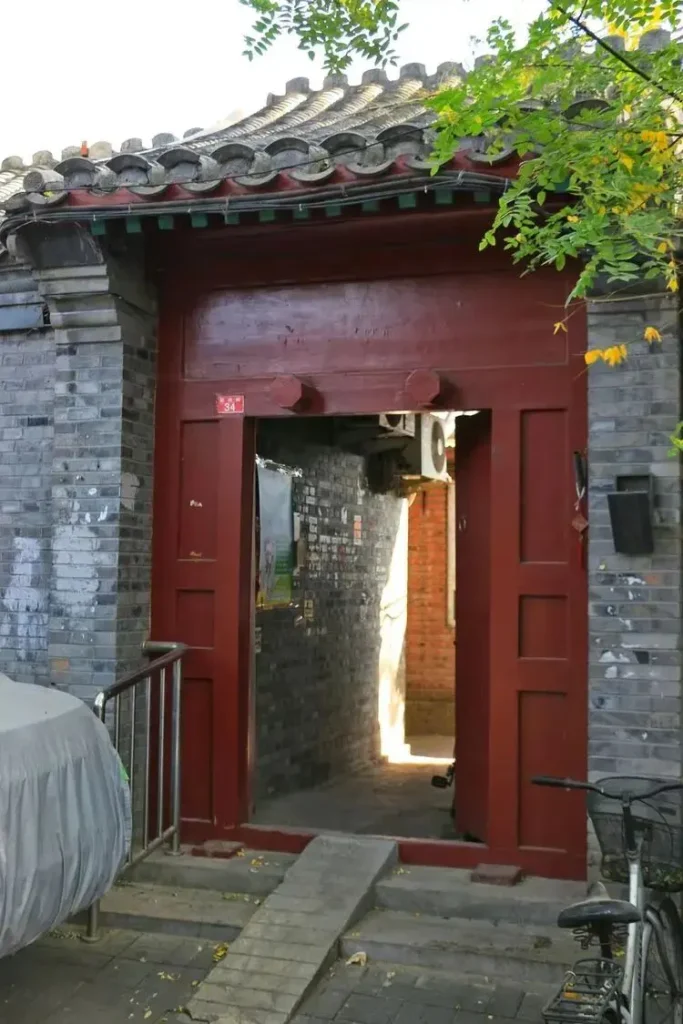
Walking the entire length of the street, you’ll find that Zhao Fu Street lacks the grand, secluded estates of high-ranking officials and nobles. It belongs to the common people; it’s ordinary, a bit chaotic, but precisely because of that, it feels authentic.
When is the best time to visit? How long does it take?
- Best seasons: Early winter (late November–December) or autumn (October). During these times, the leaves of the ancient locust trees turn yellow or remain lush and green, and sunlight filters through the canopy onto the gray brick walls, making for the most photogenic scenery.
- Best Time of Day: Weekdays from 9:00 AM to 11:00 AM.
- Duration: About 1.5 hours for a simple walk-through and taking photos. Add another hour if you stop to shop at the grocery store or have coffee in the park.
Recommended Route: Enter from the South Gate (near Doufuchi Hutong), walk north to the grocery store, then backtrack a short distance to Area 20, and finally exit through the North Gate. This route avoids retracing your steps.
After exploring Zhao Fu Street, you can turn directly into Zhongtao Hutong from the North Gate, or return to Doufuchi Hutong via the South Gate to continue exploring Hong’eng Temple and the Yang Changji Former Residence.
Frequently Asked Questions (FAQ)
Zhao Fu Street is too short—so short that it can’t hide any secrets. But precisely because it’s so short, the old neighbors have turned their daily lives into the most enduring companionship.
The cabbages piled at the doorways, the clothes hanging overhead, the old tricycles leaning against the walls, and that soy sesame & peanut paste jar in the grocery store that’s been in use for nearly seventy years—these things aren’t valuable, but together, they make up the real Beijing.
The sky was clear blue the day I walked the length of Zhao Fu Street. The grocery store I used to visit as a child half a century ago had long since been demolished, so I never expected to see an identical beige counter and the same tape on the glass here. To catch a glimpse of the past in the blink of an eye is truly moving.
If you come to Beijing, why not spend a morning strolling over from the [Bell and Drum Towers ]and take a bottle of Erba sesame & peanut paste home with you? Sample this flavor that hasn’t changed in over seventy years, and explore this quiet, unassuming working-class alleyway hidden behind the Bell Tower—a place so peaceful it hardly feels like a tourist spot.