Yongding Gate, Beijing: The Southern Starting Point of the Central Axis (Free Visit Guide 2026)
Where does Beijing’s Central Axis begin? It’s not Tiananmen Square, nor is it the Forbidden City—it’s this city gate tower that you may have only glimpsed from a car window: Yongding Gate (Yongdingmen).
Since its construction in 1553, it has weathered more than 470 years of history—though for 47 of those years, it vanished from the cityscape, only to be “rebuilt” in 2004.
It marks the southern starting point of Beijing’s Central Axis and serves as the “first piece of the puzzle” along the entire 7.8-kilometer axis. It’s accessible via Metro Line 8, admission is free, and you can explore it in about half an hour.
Table of Contents
Who Is It For? (3-Second Quick Guide)
- ✅ Ideal for: In-depth travelers interested in Beijing’s urban history and the culture of the Central Axis
- ✅ Ideal for: Visitors who want to check out the “starting point” while in the area around the Temple of Heaven or Xiannongtan
- ✅ Ideal for: Photography enthusiasts who love capturing city nightscapes and architectural reflections
- ❌ Not ideal for: People hoping to climb the gate tower for a tour (The city gate tower is not open to the public)
- ❌ Not for: People who have traveled a long way specifically to see a “tourist attraction” (it’s just a square and a city gate tower)
If any of the above apply to you, Yongdingmen is worth a quick detour while you’re exploring the Temple of Heaven or Xiannongtan.
Practical Information (Must-Read Before You Go)
| Item | Details |
| Name | Yongding Gate (English: `Yongding Gate`, meaning“Eternal Peace”) |
| Address | Yongdingmennei Street, Dongcheng District, Beijing; north of Yongdingmen Bridge on the South Second Ring Road |
| How to Visit | Outdoor plaza + exterior of the city gate tower; open all day free of charge; self-guided tour |
| Subway (Recommended) | Line 8, Yongdingmenwai Station (`Yongdingmenwai Station`); walk north for about 5 minutes after exiting the station. For information on how to use transit cards, ride the subway, and make electronic payments in Beijing, please refer to my [2026 Comprehensive Guide to Beijing Subway and Transit Payments] |
| Bus | Take Buses 2, 7, 17, 20, 36, 71, 72, 93, 120, 622, etc., and get off at the “Yongdingmennei” or “Yongdingmenwai” stop |
| Driving and Taxis | Driving is not recommended. Yongdingmen is located right next to the South Second Ring Road, and parking in the surrounding area is extremely difficult. When taking a taxi, set your destination to “Yongdingmen City Gate” or “Yongdingmen Nei Dajie.” Map Note: Google Maps may provide inaccurate directions in Beijing; we recommend using Apple Maps or Amap for navigation |
| Admission | Completely free; no reservation required |
| Hours | Open all day, year-round. Visitors are not permitted to climb the gate tower itself, but may freely explore the square and surrounding area |
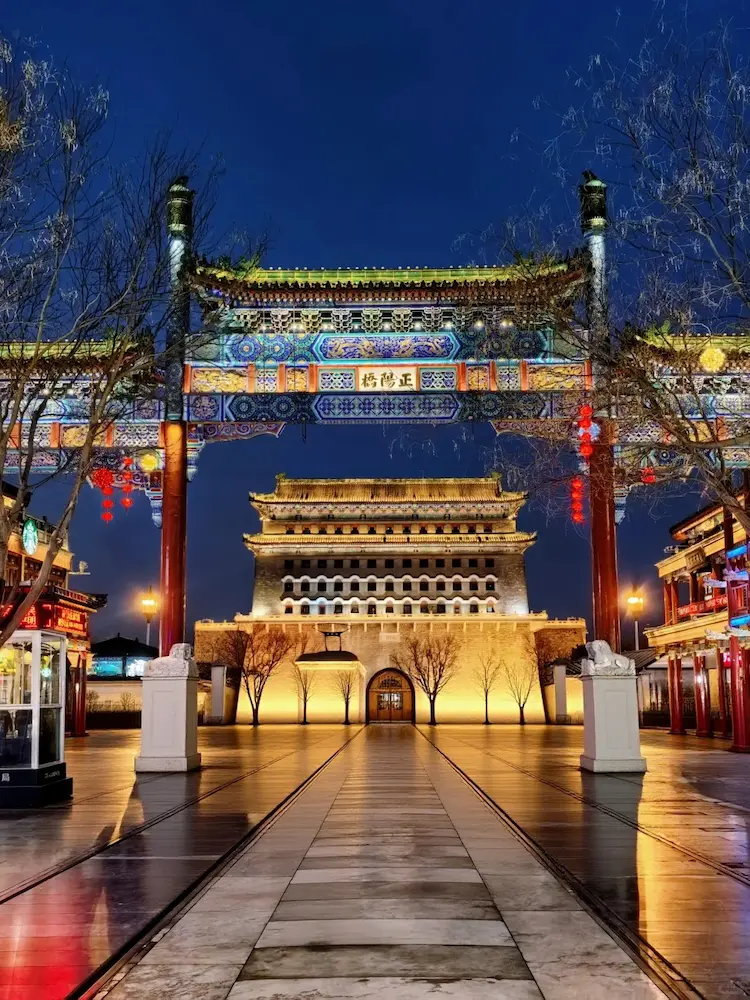
| Best Time to Visit | We recommend 9:00–11:00 a.m. or 3:00–5:00 p.m. Capture the sunset from Yongdingmen Square in the evening—the gate tower looks spectacular against the evening sky. The night view is also beautiful—once the gate tower is illuminated, its reflection on the moat makes for a must-visit spot for many photography enthusiasts |
| Recommended Duration | 30 minutes to 1 hour |
| Dress Code | Wear comfortable flat shoes. The square has a flat surface and is easy to walk on |
| Budget Guide | 0 yuan. Admission to the gate tower is free; nearby dining options cost approximately 30–80 yuan per person (about $4–$11). There are convenience stores around the square where you can buy bottled water |
| Photography | Absolutely. Panoramic views of the city gate, reflections of the city gate in the moat, and shots framing Yongding Gate with the buildings along the Central Axis in the distance all make for excellent photos |
| Language Support | Bilingual (Chinese-English) informational display panels are around the square. We recommend using a translation app on your phone for assistance |
Friendly Reminder: Yongdingmen is located next to Yongdingmen Bridge on the South Second Ring Road. Please be mindful of traffic safety when taking photos and do not step into the traffic lanes. The plaza is spacious, so feel free to take your time exploring.
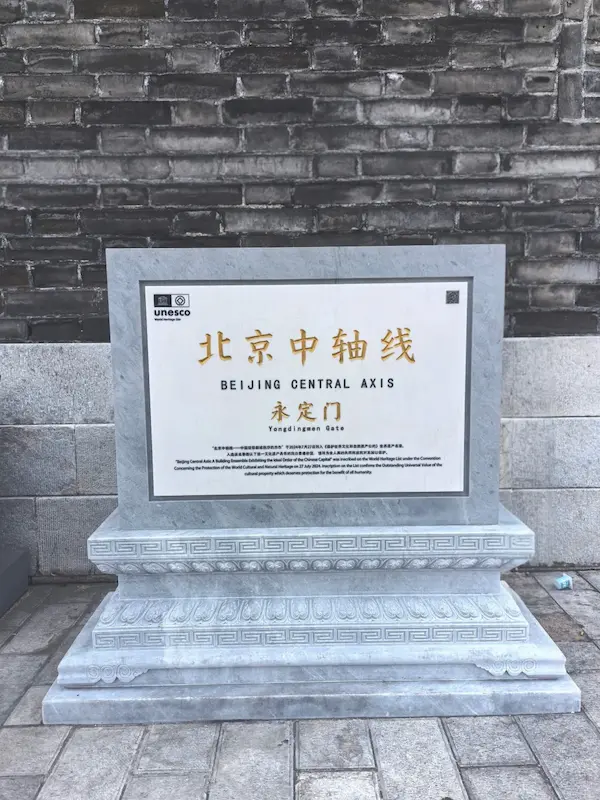
World Heritage Status:
In 2024, “The Beijing Central Axis—A Masterpiece of the Order of the Ideal Chinese Capital” was officially inscribed on the UNESCO World Heritage List.
As the southern starting point of the Central Axis, Yongdingmen is the “first piece of the puzzle” in this 7.8-kilometer-long urban backbone.
What Is Yongdingmen? It Marks the Starting Point of Beijing’s Central Axis
Yongdingmen was the main southern gate of Beijing’s outer city walls during the Ming and Qing dynasties, and it also serves as the southern starting point of Beijing’s Central Axis (7.8 kilometers long).
Starting from Yongdingmen and heading north, the route passes successively through Tianqiao, Qianmen, Tiananmen, the Forbidden City, Jingshan, and Wanning Bridge, finally arriving at the Bell and Drum Towers—Yongdingmen is the first piece of the puzzle along the entire Central Axis.
When was it built?
In the intercalary third month of the 32nd year of the Jiajing reign of the Ming Dynasty (1553), the Ming court began construction of the outer city wall to strengthen the capital’s defenses.
The original plan was to build an outer wall with a circumference of approximately 80 li around the outskirts of the capital, but due to a lack of funds, Yan Song, the Chief Minister of the Cabinet, proposed a solution: to construct only the southern section, with the eastern and western ends turning northward to connect with the southeast and southwest corner towers of the inner city wall.
As a result, Beijing took on a distinctive “凸” shape. Yongding Gate is the main southern gate of this outer wall.
Initially, only the city gate tower was built, without a watchtower or barbican. In the 43rd year of the Jiajing reign (1564), the barbican was added.
It was not until the 15th year of the Qianlong reign of the Qing Dynasty (1750) that the watchtower was added, and in the 31st year of the Qianlong reign (1766), the city gate tower was expanded to a seven-bay, triple-eave structure. More than 200 years elapsed between its initial construction and its completion.
Cross-Cultural Interpretation:
You can think of Yongding Gate as “the first cornerstone of Beijing’s Central Axis.” Just as the Arc de Triomphe in Paris marks the beginning of the Champs-Élysées, or the U.S. Capitol in Washington, D.C., serves as the geographic origin point of the city’s urban planning—Yongding Gate is the “starting point” at the southern end of Beijing’s Central Axis.
All the major buildings along the entire Central Axis are arranged in a northward line, with Yongding Gate as their starting point.
The Name of Yongding Gate: From “Yongan Gate ”to “Yongding Gate”
The three characters “Yongding Gate” mean “eternal stability.”
However, this name was not used from the very beginning. For the first decade or so after the gate’s completion, it was known as “Yongan Gate.” It was not until the 43rd year of the Jiajing reign (1564), when the barbican was expanded, that it was officially named “Yongding Gate.”
In ancient China, naming a city gate was a very serious matter. The two characters “Yongding” embodied the emperor’s hope for the eternal stability of the empire and for national prosperity and the well-being of the people.
Interestingly, although the name means “eternal stability,” over the course of several centuries, the gate has repeatedly witnessed the ravages of war—during the late Ming Dynasty, Huang Taiji led the Later Jin forces to the gates of Yongdingmen, where fierce battles raged between the Ming and Later Jin armies just outside the gate; in 1900, when the Eight-Nation Alliance invaded Beijing, Yongdingmen also bore witness to that humiliating chapter of history.
The Architecture of Yongding Gate: A City Gate That Disappeared and Was Reborn
Yongding Gate in History: A Complete City Gate Complex
During the Ming and Qing dynasties, Yongding Gate was not a solitary gate tower, but rather a complete city gate complex comprising a gate tower, arrow towers, a barbican, a stone bridge, and guardhouses:
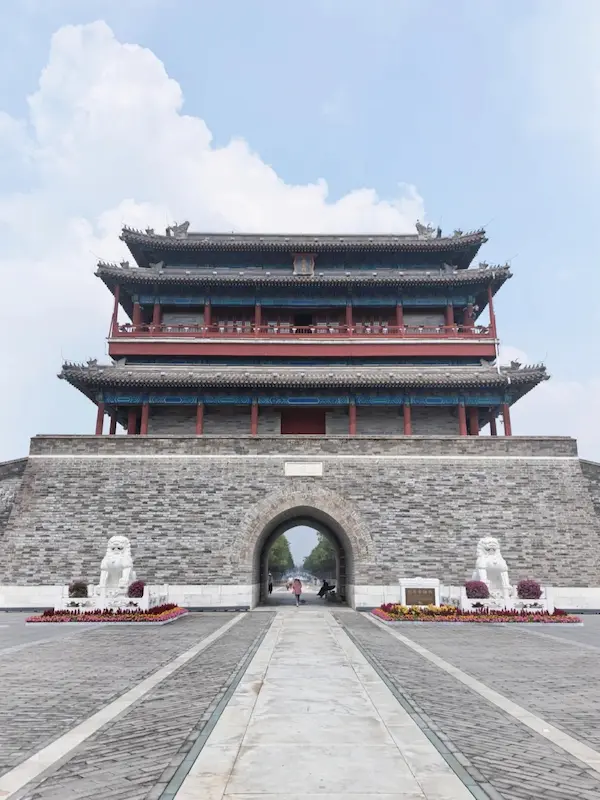
Gate Tower: The main structure of Yongding Gate, with a total height of 26 meters. It features a double-eaved hipped-and-gabled roof with gray cylindrical tiles accented by green glazed tile edging.
The structure is seven bays wide and three bays deep. The arched opening (city gate passage) at the center of the gate tower contains two wooden doors that open outward.
Barbican: Nearly square in shape, measuring 36 meters north-south and 42 meters east-west. It connects the gate tower and the arrow tower into a single unit, serving a defensive purpose akin to “catching a turtle in a jar”—once enemy forces breach the arrow tower, the defending troops can surround and annihilate them within the barbican.
Arrow Tower: The first line of defense for the city, featuring two rows of arrow slits on its southern side.
Yongdingmen Bridge: A single-span stone bridge spanning the moat.
When Swedish art historian Osvald Sirén surveyed Beijing’s city gates in the 1920s, he described Yongding Gate as follows: “Along the broad moat, reeds stood tall… and weeping willows swayed gently. The gate tower and the curved barbican, with their crenellated walls, rise abruptly and towering… The gate tower’s broad overhanging eaves seem to make it soar into the clouds, as if about to take flight.”
The *Kangxi Southern Inspection Paintings*, created in the 32nd year of the Kangxi reign (1693), clearly depict the appearance of Yongding Gate at that time—a double-eaved hipped-and-gabled roof, five bays wide, with a barbican but no arrow tower. This painting is an important historical document for studying the historical appearance of Yongding Gate.
The Demolition and Reconstruction of Yongding Gate
From late 1950 to early 1951, the barbican of Yongding Gate was demolished, leaving the main gate tower and the arrow tower as two isolated structures.
In 1957, due to urban development plans, the main gate tower and arrow tower of Yongding Gate were successively demolished. This iconic southern gateway temporarily vanished from Beijing’s urban landscape.
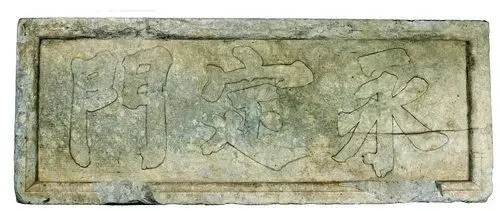
Fortunately, in 2003, the Beijing Municipal Government officially launched the Yongdingmen reconstruction project. Before reconstruction, workers discovered a well-preserved stone plaque from Yongdingmen under an ancient cypress tree at the entrance to the Beijing Museum of Ancient Architecture at Xiannongtan—it was the original plaque installed when Yongdingmen was first built in the 32nd year of the Jiajing reign of the Ming Dynasty (1553).
In 2004, the Yongdingmen Gate Tower was rebuilt at the southern end of the Central Axis, following the architectural style of the Qianlong era and incorporating surveying data from the Republic of China period.
The stone plaque embedded above the gate arch is a replica modeled after the original Ming Dynasty plaque that was unearthed. The original plaque is currently housed at the Capital Museum.
Since the original sites of the arrow tower and the barbican have been occupied by the South Moat and the South Second Ring Road, reconstruction at their original locations is not feasible.
However, differences in the materials and colors of the pavement precisely mark the complete boundaries of the barbican and the original site of the arrow tower.
Cultural Insight:
You might be curious—what does the “foundation” of Yongding Gate look like? The answer is: it does not have the deep concrete pile foundations typical of modern buildings; instead, the city gate platform was built directly on a foundation of layer upon layer of compacted lime-soil.
Through repeated tamping, the ancients made the foundation extremely dense, relying on the weight of the city platform itself and the load-bearing capacity of the rammed earth to maintain stability.
This construction method may seem simple, but it actually reflects the ancient craftsmen’s profound understanding of soil properties.
What Can You See from Yongdingmen Square?
1. Yongdingmen Gate Tower (Reconstructed)
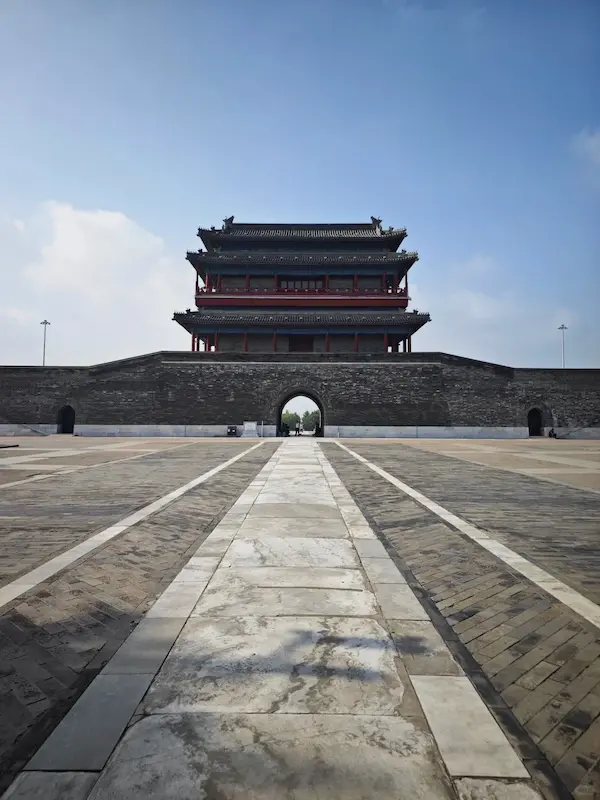
Looking up from the square, you’ll see the reconstructed Yongdingmen Gate Tower. The tower stands 26 meters tall, featuring a double-eaved hipped-and-gabled roof with gray cylindrical tiles accented by green glazed tile edging.
Above the gateway arch is a stone plaque inscribed with “Yongdingmen”—a replica of the original Ming Dynasty plaque.
2. Ground Markings—the “Shadows” of the Barbican and Arrow Tower
On the south side of the gate tower, the paving materials and colors on the square’s surface show distinct differences. These differences are not construction errors but intentional—they precisely mark the complete historical boundaries of the barbican and the original site of the arrow tower.
Cross-Cultural Interpretation:
You can think of these ground markings as Beijing’s “architectural ghost footprints.” Due to the constraints of modern roadways, the Arrow Tower and the barbican cannot be rebuilt on their original sites, but the dark paving stones on the square precisely outline the locations where the ancient defensive walls once stood.
Standing on them is like stepping on an invisible 18th-century architectural blueprint.
As you stand on the square, the ground beneath your feet marks the very spots where the Arrow Tower and the barbican once stood.
3. Yongdingmen and the Central Axis in the Same Frame
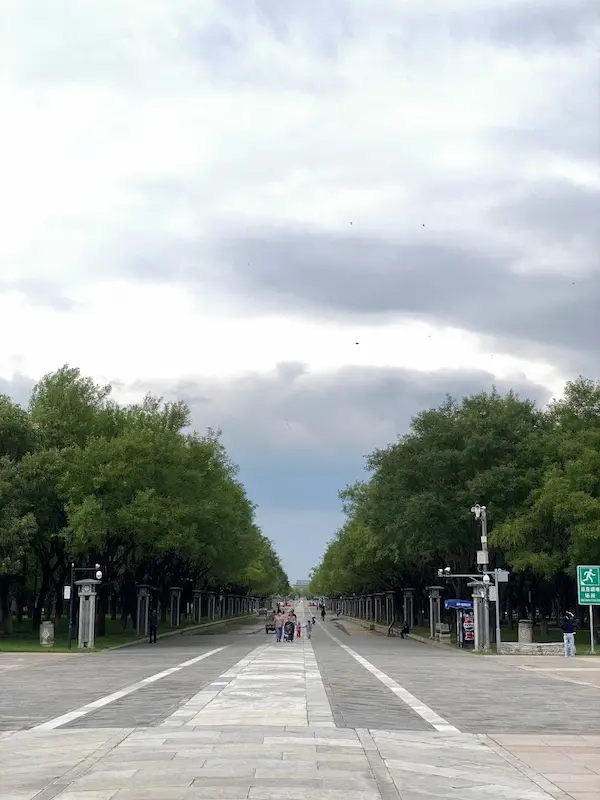
Standing on Yongdingmen Square and looking north, you can see Tianqiao, Qianmen, Zhengyangmen, Tiananmen, and the Forbidden City in succession…The entire Beijing Central Axis begins right at your feet and extends 7.8 kilometers to the north.
4. The Moat and Its Reflection
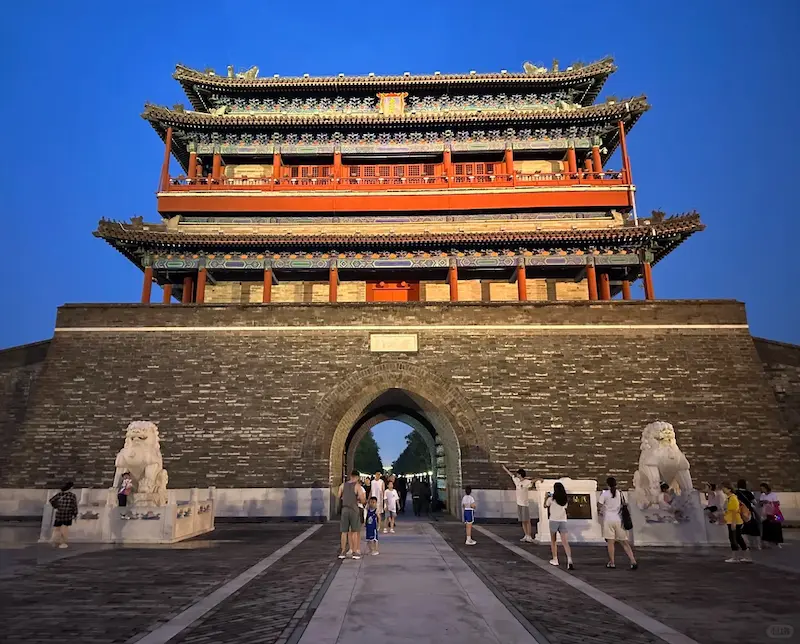
The moat lies just south of the gate tower. On clear days, the gate tower’s reflection glistens on the water’s surface, making for a stunning photo opportunity. After the lights come on at dusk, the night view becomes a must-shoot subject for many photography enthusiasts.
Recommended Tour Route (Approx. 30–60 minutes; can be flexibly combined)
Starting Point: Exit at Yongdingmenwai Station on Metro Line 8 and walk north for about 5 minutes to reach Yongdingmen Square.
First Stop: Stand in the center of the square (about 5 minutes). Look up at the reconstructed Yongdingmen Gate Tower and take note of the stone plaque reading “Yongdingmen” above the gateway.
Second Stop: Look down at the pavement (about 5 minutes). Find the areas with different colors and materials—they mark the historical locations of the barbican and the arrow tower. Experience the wonder of these “architectural ghost footprints.”
Third Stop: Walk to the moat on the south side of the gate tower (about 10 minutes). Take a photo of the gate tower’s reflection on the water.
Stop 4: Stand at the northern end of the square (about 5 minutes). Look north and take in the awe-inspiring sight of “Beijing’s Central Axis beginning right here.”
Afterward: Yongdingmen is less than 1 kilometer from the Temple of Heaven, so you can continue north to explore the Temple of Heaven (combined ticket: 34 yuan); or walk north for about 15 minutes to Xiannongtan (Beijing Museum of Ancient Architecture) to see “China’s most beautiful coffered ceiling.”
Photography Guide
| Shooting Spot | Location | Best Time to Shoot | Tips |
| Full-View Panorama of the City Gate | Slightly south of the center of the square | Morning or afternoon | Stand directly in front of the city gate to capture the entire structure and the “Yongdingmen” stone plaque in the frame |
| Reflection of the City Gate | North bank of the moat (south side of the city gate) | Dusk or after lights-on in the evening | The city gate’s reflection on the water makes for a very photogenic shot. It looks best during the blue hour at dusk |
| Ground Markings | South side of the square | All day | Photograph the differently colored paved areas—they represent the “shadows” of the barbican and the arrow tower |
| View Along the Central Axis | North end of the square | Morning | Shoot northward, using the Yongdingmen Gate Tower as the foreground and Zhengyangmen and Tiananmen in the distance as the background |
Exploring the Surrounding Area: A One-Day Tour of the Southern Section of the Central Axis
Yongdingmen is located at the southern end of Beijing’s Central Axis, within walking distance of several World Heritage Sites and historical and cultural attractions:
| Attraction | Direction | Walking Time | Highlights | Admission |
| Temple of Heaven | Slightly north-east | 10 minutes | Site where Ming and Qing emperors performed sacrifices to Heaven; World Cultural Heritage Site | Combined ticket: 34 yuan (approx. $5) |
| Xiannongtan (Beijing Museum of Ancient Architecture) | Slightly north-west | 10 minutes | Site where Ming and Qing emperors offered sacrifices to the god of agriculture; home to “China’s most beautiful coffered ceiling” | 15 yuan (approx. $2) |
| Tianqiao | North | 15 minutes | Birthplace of Old Beijing’s folk arts | Free |
| Natural History Museum | Slightly north-east | 12 minutes | One of China’s most famous natural history museums | Free (reservation required) |
Recommended Half-Day Itinerary (Approx. 4–5 Hours)
Exit at Yongdingmenwai Station on Subway Line 8 → Yongdingmen (30 minutes; view the city gate tower, ground markers, and reflections in the moat) → Walk north for 10 minutes to the Temple of Heaven (2–3 hours; view the Hall of Prayer for Good Harvests, the Echo Wall, and the Circular Mound Altar) → Have lunch near Tianqiao → Visit Xiannongtan in the afternoon (1.5–2 hours; see the “Heavenly Palace” coffered ceiling and the “One Mu and Three Fen” plot) → End of tour
Traveling 7.8 kilometers north from Yongdingmen, at the other end of the Central Axis, spanning the canal, lies the bridge we previously introduced in [“Beijing’s Wanning Bridge: A 700-Year-Old Living Fossil on the Central Axis”].
FAQ
Many tourists visiting Beijing head straight for the Forbidden City, the Temple of Heaven, and the Great Wall, but few know that—right next to Beijing’s South Second Ring Road—there is a city gate tower that’s free to visit, and it is actually the true starting point of Beijing’s central axis.
More than 470 years ago, it was first erected here. Originally called “Yonganmen,” it was later renamed “Yongdingmen.” It was eventually demolished but was rebuilt in 2004.
Starting from Yongdingmen and heading north for 7.8 kilometers, you’ll pass Tianqiao, Qianmen, Tiananmen, the Forbidden City, Jingshan, Wanning Bridge, and the Bell and Drum Towers—it is the first piece of the puzzle along the entire central axis.
Standing on Yongdingmen Square and looking north, you’ll see an invisible line—it passes through Zhengyangmen, Tiananmen, the Forbidden City, and Jingshan, extending all the way to the Bell and Drum Towers. This is the backbone of Beijing. And right beneath your feet lies the starting point of this backbone.
If you visit Beijing, don’t limit yourself to the Temple of Heaven and the Forbidden City. Spend a moment at Yongdingmen Square and soak in the feeling that “the Central Axis begins here.” It’s free, it’s open to the public, and it’s one of the city’s most easily overlooked—yet most underappreciated—spots.