Wanning Bridge: Beijing’s Oldest Central Axis Bridge (2026)
Where does Beijing begin? Not at the Forbidden City, nor at Tiananmen Square, but at an ancient bridge you’ve likely passed by without ever noticing—Wanning Bridge.
It’s over 700 years old, yet countless cars, bicycles, and pedestrians still cross it every day. It’s the only ancient bridge from the Yuan Dynasty in Beijing that’s still in regular use.
If you look down into the bridge’s arch, you can still spot the water-suppressing beasts left behind by the Yuan Dynasty 700 years ago. It’s accessible via Metro Line 8, admission is free, and you can explore it in just half an hour.
Table of Contents
Who Is It For? (3-Second Quick Guide)
- ✅ Ideal for: In-depth travelers interested in Beijing’s urban history and canal culture
- ✅ Ideal for: Visitors looking to discover a “hidden gem” while exploring the Shichahai or Drum Tower area
- ✅ Ideal for: Families visiting Beijing with children (free, 30-minute visit, rich in storytelling)
- ❌ Not for: People traveling from far away specifically to see a “tourist attraction” (it really is just a bridge)
- ❌ Not for: People hoping to go indoors or see a large exhibition (the entire experience is outdoors)
If any of the above applies to you, Wanning Bridge is worth a quick detour while you’re exploring Shichahai or Drum Tower.
Practical Information (Must-Read Before You Go)
| Item | Details |
| Name | Wanning Bridge (English: `Wanning Bridge`), commonly known as “Back Gate Bridge” or “Hai Zi Bridge” |
| Address | Di’anmenwai Street, Xicheng District, Beijing, approximately 450 meters directly south of the Drum Tower |
| How to Visit | Outdoor bridge; open 24 hours a day, free admission; self-guided tour |
| Subway (Recommended) | Line 8, Shichahai Station (`Shichahai Station`); walk south for about 5 minutes after exiting the station. For information on how to use transit cards, ride the subway, and make electronic payments in Beijing, please refer to my [2026 Step-by-Step Guide to Beijing Subway and Transit Payments] |
| Bus | Take Buses 5, 60, 82, 107, 124, etc., and get off at the “Drum Tower” stop |
| Driving and Taxis | Driving is not recommended. Di’anmenwai Street is a major thoroughfare with no parking available for tourists. When taking a taxi, ask the driver to navigate to “Wanning Bridge” or the “intersection of Di’anmenwai Street and Shichahai.” Map Tip: Google Maps may provide inaccurate directions in Beijing; we recommend using Apple Maps or Amap for navigation |
| Admission | Completely free; no reservation required |
| Hours | Open 24 hours a day, 365 days a year |
| Best Time to Visit | We recommend 9:00–11:00 a.m. or 3:00–5:00 p.m. In the afternoon, the slanting sunlight illuminates the bridge and the water-suppressing beasts, making it the best time for photos |
| Recommended Duration | 30 minutes to 1 hour |
| Dress Code | Wear comfortable flat shoes. You can walk both on and under the bridge; the stone pavement is very even |
| Budget Guide | 0 yuan. Admission to the bridge is free; nearby dining options cost approximately 30–100 yuan (about $4–14) per person. There are convenience stores near the bridge where you can buy bottled water |
| Photography | Absolutely. The bridge itself, the water-suppressing beasts, and the white marble railings all make for excellent photo subjects |
| Language Support | There are no informational signs on the bridge itself; it is recommended to research the site in advance or use a mobile translation app |
Friendly Reminder: Wanning Bridge is a traffic bridge that is still in regular use. Please be mindful of passing vehicles and pedestrians when taking photos. The bridge deck is not very wide, so please do not stand in the middle of the road for extended periods.
World Heritage Status:
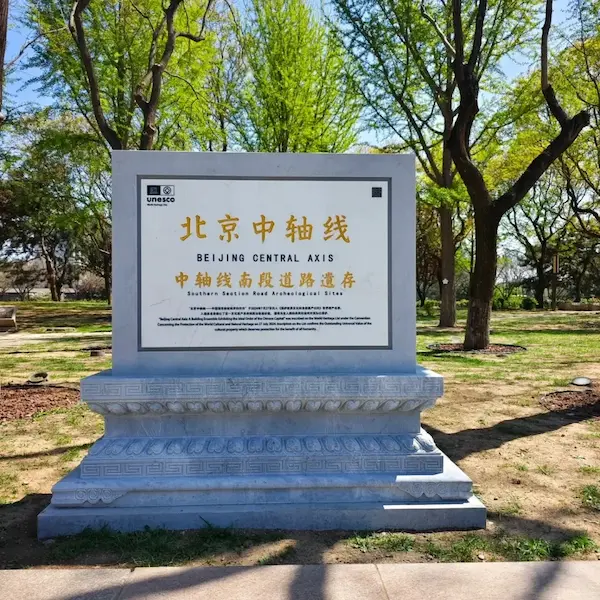
Wanning Bridge is one of the component sites of the “Grand Canal of China” World Cultural Heritage site (inscribed in 2014), and it is also one of the 15 component elements of the “Beijing Central Axis” World Cultural Heritage site (to be inscribed in 2024).
A single bridge bearing two World Heritage designations—this is extremely rare worldwide.
What is Wanning Bridge? Why is it considered the starting point of Beijing?
Wanning Bridge was first built in the 22nd year of the Zhiyuan era of the Yuan Dynasty (1285). It was originally a wooden bridge called “Haizi Bridge.”
Later, to facilitate the passage of grain transport boats, it was rebuilt as a stone bridge and has stood for over 700 years.
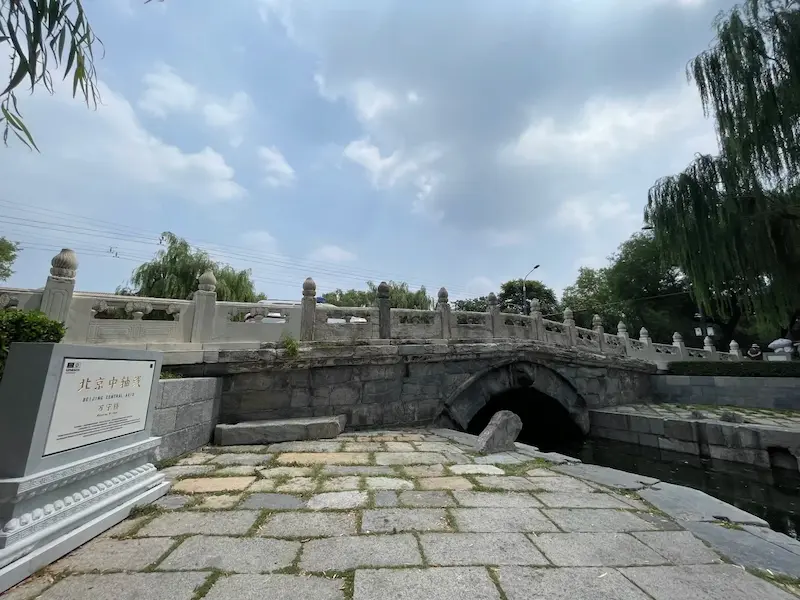
Spanning the area between Shichahai and the former course of the Yu River, it is the oldest bridge on Beijing’s central axis and is hailed as “the First Bridge of the Central Axis.”
Why is it so important?
In 1266 AD, Kublai Khan, the founding emperor of the Yuan Dynasty, decided to build the Yuan Dadu (the predecessor of Beijing).
Liu Bingzhong, who was responsible for planning the capital, did not reuse the old city walls of the Jin Dynasty’s Zhongdu, but instead laid out a new city to the northeast.
At that time, Shichahai was still a vast lake (known in the Yuan Dynasty as “Jishuitan” or “Haizi”). Liu Bingzhong drew a tangent line along the eastern shore of the lake, and this line became the central axis of the Yuan Da Du.
The starting point of this tangent line is precisely where Wanning Bridge stands today.
Mr. Hou Renzhi, a renowned historical geographer and professor at Peking University, once pointed out: “Wanning Bridge is the reference point of Beijing’s central axis.”
The construction of the Yuan Dadu was based on Wanning Bridge to determine the position of the central axis running north to south through the entire city.
In other words, when the planning of Beijing as the capital began, the location of Wanning Bridge had already been designated as the “zero point” of the entire city.
Consequently, a popular saying holds that “Wanning Bridge came first, followed by the central axis.” Later, Emperor Chengzu of the Ming Dynasty, Zhu Di, relocated the capital to Beijing and rebuilt the city on the foundation of the Yuan Dynasty’s Dadu.
Although the central axis—running through the Forbidden City, Tiananmen Gate, and Yongdingmen Gate—extended southward, its northern end retained the Yuan Dynasty’s alignment.
Wanning Bridge remains the bridge directly south of the Drum Tower on the central axis, a position that has remained unchanged for seven hundred years.
Cross-Cultural Interpretation:
You can think of Wanning Bridge as the “foundation stone” of Beijing. Just as London’s “London Stone” once served as the starting point from which the Romans measured all roads, or the dome of the U.S. Capitol in Washington, D.C., marks the geographic origin point of the city’s planning.
Wanning Bridge is that “origin point” for Beijing; the entire city of Beijing “grew” out from the location of this bridge.
Heritage Protection Status: In 1984, Wanning Bridge was designated a Beijing Municipal Cultural Heritage Site; in 2013, it was designated a National Key Cultural Heritage Site.
The Three “Roles” of Wanning Bridge
Identity 1: The Terminal Point of the Grain Transport System for the Yuan Dynasty’s Dadu
During the Yuan Dynasty, the renowned scientist Guo Shoujing oversaw the excavation of the Tonghui River, extending the Beijing-Hangzhou Grand Canal all the way to the Yuan capital, Dadu.
Just west of Wanning Bridge lies the site of the Chengqing Upper Lock—a crucial structure for regulating the water level of Jishuitan and ensuring the smooth passage of grain transport ships.
Wanning Bridge features an integrated lock-and-bridge structure, with the bridge and lock combined into a single unit. It served as the final lock through which grain transport ships passed before reaching the docks at Jishuitan (now Shichahai), the terminus of the Grand Canal.
In those days, as grain transport ships passed through here to enter Jishuitan, they had to pass through a series of locks to gradually raise the water level, much like a“water elevator.”
According to historical records, during the peak of the grain transport system, “ships filled the water”—grain, silk, and porcelain from the Yangtze River Delta region traveled north via the Grand Canal and were ultimately unloaded here.
In those days, the area was lined with masts and teeming with hundreds of ships racing downstream, making it the busiest port in the Yuan Dynasty’s capital, Dadu.
Cross-Cultural Interpretation:
The combination of Wanning Bridge and the Chengqing Lock was equivalent to“London Bridge and the Thames Docks” in medieval London—it was the lifeline for the city’s supplies. Without this bridge and this lock, the grain supply to the Yuan capital would have been cut off.
You can think of the Chengqing Lock as a“ship lock”—just like the locks in today’s Panama Canal, which allow ships to pass by regulating water levels.
Identity 2: “Houmen Bridge” at the Back Gate of the Imperial City
Wanning Bridge is located just outside Di’anmen—the northern gate of the Imperial City of Beijing during the Ming and Qing dynasties (commonly known as “Houmen,” or Back Gate). For this reason, older Beijingers have traditionally called it“Houmen Bridge.”
Located directly north of the Imperial City, it lies opposite Tiananmen Gate. For hundreds of years, ordinary people have never called it “Wanning Bridge,” but only “Back Gate Bridge”—a name that feels more familiar and down-to-earth.
Identity 3: Beijing’s Only Ancient Bridge Still in “Service”
Take the Zhaozhou Bridge and the Lugou Bridge, for example—they have both been preserved and no longer serve as routes for daily traffic. But the Wanning Bridge is different: cars, bicycles, and pedestrians cross it every minute of every day.
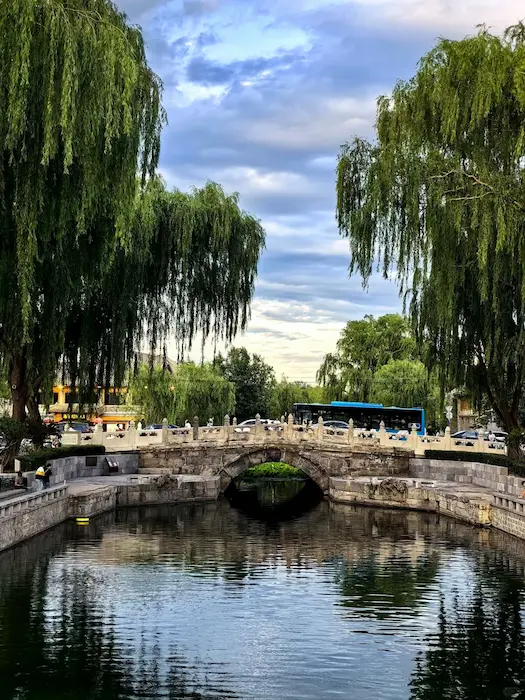
It is both a part of a World Cultural Heritage site and a genuine, functioning transportation bridge.
What Can You See from the Bridge?
1. White Marble Railings: A 700-Year Contrast Between Old and New
The railings of Wanning Bridge are made of white marble. If you look closely, you can see distinct joints: the central section is dark, has an aged texture, and shows severe weathering and erosion—the original structure from the Yuan Dynasty, which has stood here for more than 700 years.
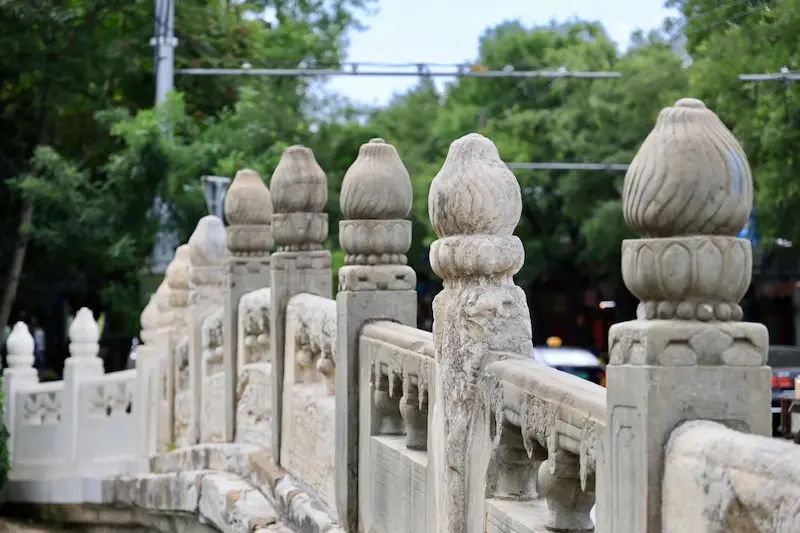
The sections on either side, however, are made of brand-new, smooth white marble that was added later. The old and the new stand side by side on the same bridge.
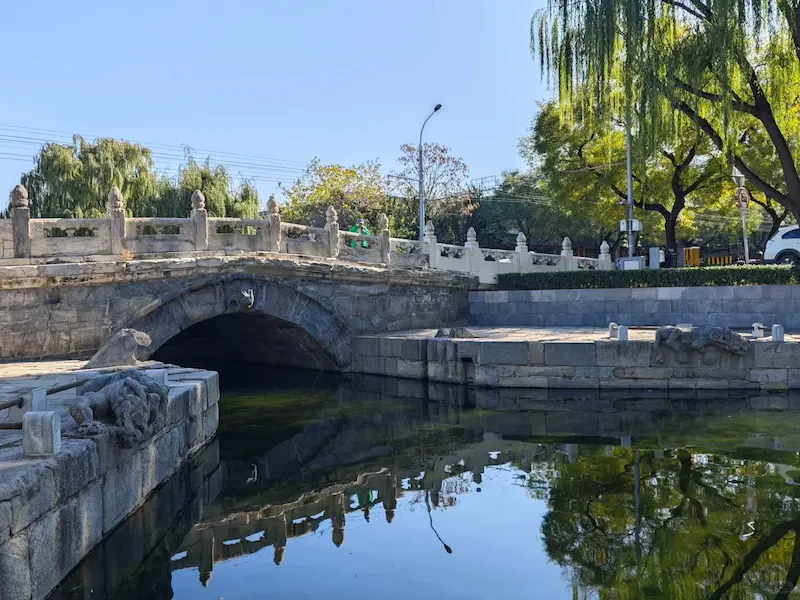
The bridge is built primarily of green sandstone. It is 34.6 meters long and 17 meters wide, with a clear span of approximately 7.2 meters and an arch height of about 3.5 meters.
2. Water-Suppressing Beasts: One of the Nine Sons of the Dragon + Ancient Water Level Gauge
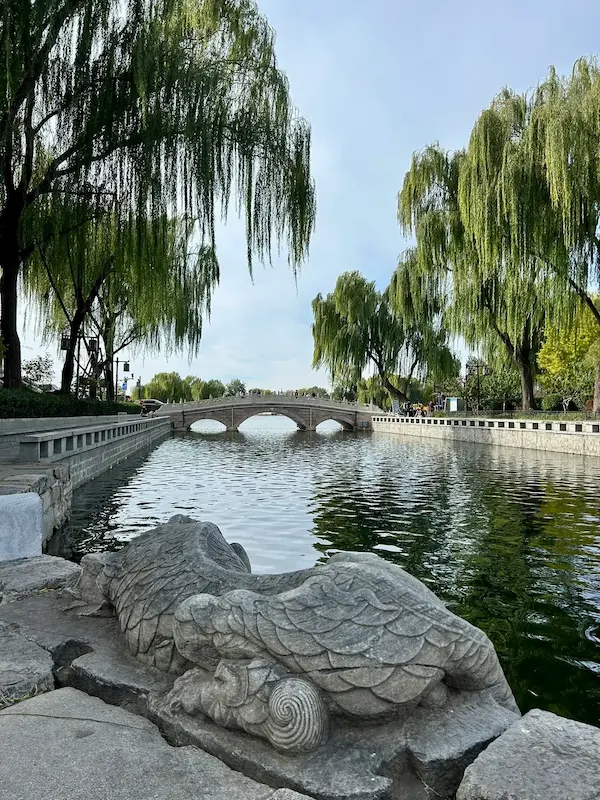
A total of six water-suppressing beasts crouch on the embankments on both sides of the bridge—four on the west side and two on the east side. They are one of the nine sons of the dragon—the Baxia (also known as the centipede-dragon).
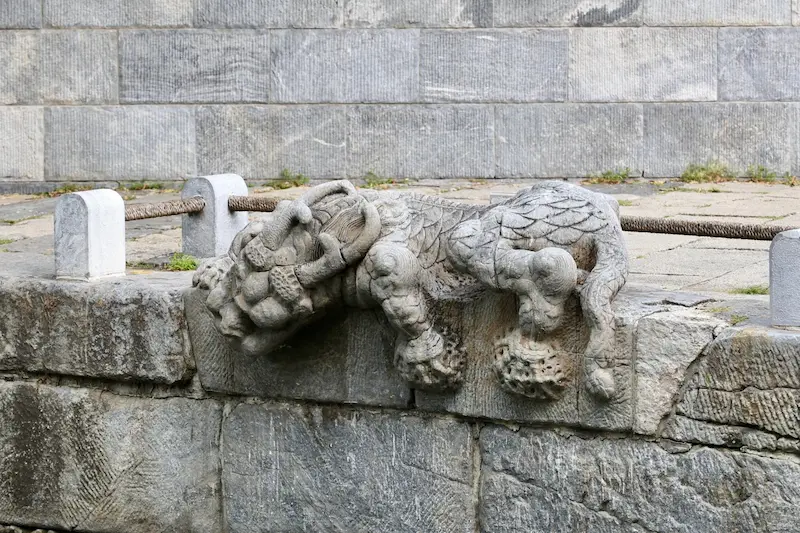
Legend has it that the Baxia loves water by nature and can ward off floods, making it an auspicious symbol that ensures favorable weather and bountiful harvests for the region.
The figure on the embankment at the northeast corner of the bridge has a mottled and blurred body—it is the original Yuan Dynasty statue that has stood guard here for over 750 years.
The others, with their clearly defined scales, were carved during the Ming Dynasty to replace earlier versions.
Cross-Cultural Interpretation:
You can think of these stone creatures as Beijing’s ancient “water-guarding dragon deities that also serve as water level indicators.”
Just as the gargoyles on the walls of Notre-Dame Cathedral in Paris were designed to drain water—European gargoyles divert rainwater away from buildings—China’s water-guarding beasts were designed 750 years ago to guard canals and monitor water levels.
One drains water from the sky, while the other monitors water on the ground; the ancient peoples of the East and West offered different wisdom through their stone carvings.
These water-guarding beasts also served a practical function: marking water levels. When the water level submerged the beast’s claws, it signaled high water and the need to prepare for flooding; when the water level dropped below the beast’s head, it indicated that the water was too low, making navigation difficult.
Ancient people could determine whether water levels were normal simply by observing the eyes and claws of these stone beasts—a form of hydrological monitoring wisdom dating back 700 years.
3. The Chengqing Upper Sluice Site: The Final Kilometer of the Grand Canal
To the west of Wanning Bridge lies the Chengqing Upper Sluice Site. This was a crucial hydraulic structure built by Guo Shoujing to regulate the water level of Jishuitan Lake.
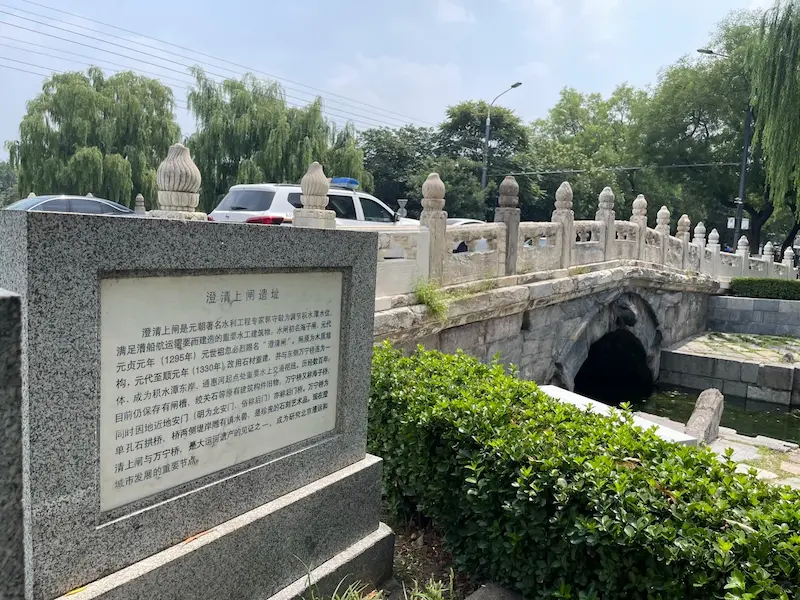
Originally named “Haizi Sluice” during the early Yuan Dynasty, it was renamed “Chengqing Sluice” in 1295 by Kublai Khan, the founder of the Yuan Dynasty.
Original architectural components, such as the sluice channel and the stone gate mechanism, are still preserved today.
4. The Surrounding Scenery
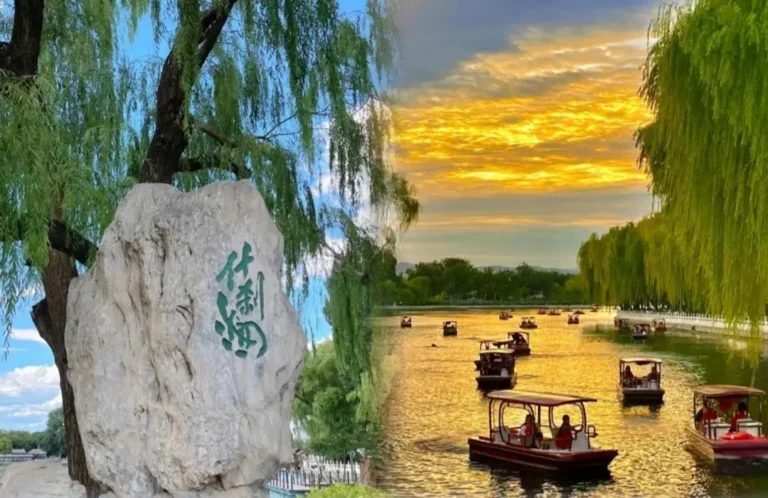
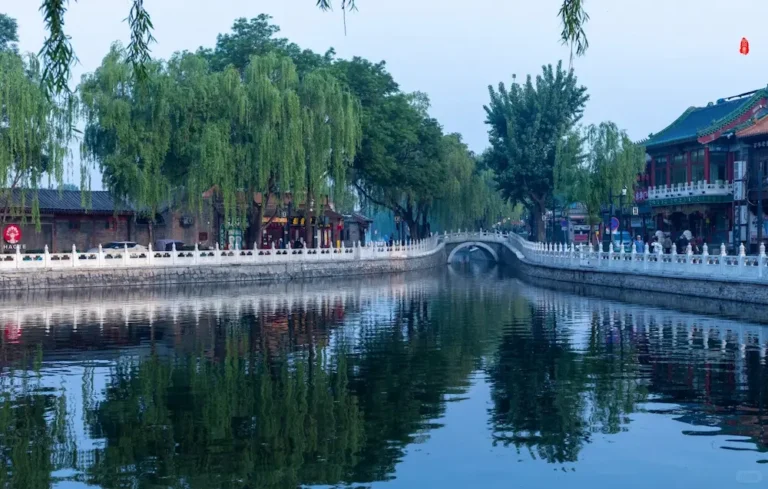
Looking west: Shichahai glistens in the sunlight, with weeping willows lining the shore. The ancient bridge, weeping willows, and lake waters come together to form a classic Chinese landscape painting.
At the northwest corner of the bridge stands the Temple of the Fire God. With its gray tiles and red walls, the air is filled with the scent of incense.
Built during the Tang Dynasty, this temple has a history of nearly 1,400 years. To this day, it remains a place of worship where devotees come in a steady stream to offer prayers.
Looking north: The silhouettes of the Bell and Drum Towers appear on the horizon.
Looking south: The central axis leading to Jingshan Hill and the Forbidden City stretches out before you.
Recommended Tour Itinerary (Approx. 30–60 minutes; can be flexibly combined)
Starting Point: Exit at Shichahai Station on Subway Line 8, then walk south along Di’anmenwai Street for about 5 minutes to reach Wanning Bridge.
First Stop: Stand on the bridge (about 5 minutes). Observe the joints where old and new sections of the white marble railing meet, and touch the stone railing that dates back 700 years. Look west to see the azure waters of Shichahai, and north to view the soaring eaves of the Bell and Drum Towers.
Second Stop: Walk to the northeast corner of the bridge (about 5 minutes). Find the original Yuan Dynasty water-suppressing beast—its body mottled and weathered, having stood guard for over 700 years. Take a close-up photo.
Stop 3: Walk to the west side of the bridge to view the ruins of the Chengqing Upper Lock (about 10 minutes). Look for the lock chamber and the stone gate. Imagine the scene 700 years ago when grain transport boats lined up here to pass through the lock.
Stop 4: The Fire God Temple is located at the northwest corner of the bridge (about 10–15 minutes). You can go inside to burn a stick of incense or simply admire the ancient architecture.
Afterward: Wanning Bridge is only a few hundred meters from the Drum Tower, so you can continue north to explore the Drum Tower and Bell Tower, or turn west into Shichahai to stroll along Houhai Bar Street and Yandai Xiejie.
Photography Guide
| Shooting Spot | Location | Best Time to Shoot | Tips |
| Panoramic View of the Bridge | Stand at the south or north end of the bridge | Morning or afternoon | Frame the entire bridge, the white marble railings, and the Bell and Drum Towers in the distance |
| Contrast Between Old and New White Marble Railings | Central section of the bridge railing | All day | Take a close-up: Contrast the deep-colored, heavily weathered Yuan Dynasty stone railing with the smooth new stone railing next to it |
| Yuan Dynasty Water-Suppressing Beasts | Northeast corner of the bridge | Afternoon | Close-ups of the mottled, weathered bodies of the beasts convey the greatest sense of history. In the afternoon, the slanting light illuminates the stone beasts, making their textures clearer |
| Chengqing Upper Sluice Site | West side of the bridge | Any time of day | The sluice channel and the stone gate are original structures from 700 years ago; close-ups capture their unique charm |
| Fire God Temple and the Bridge in the Same Frame | Northwest side of the bridge | Morning or evening | The Fire God Temple with its gray tiles and red walls, combined with the ancient bridge and the lake, evokes the authentic atmosphere of old Beijing |
Exploring the Surrounding Area: Half-Day Itinerary
Wanning Bridge is centrally located between Shichahai, Drum Tower, and Nanluoguxiang, allowing you to visit multiple attractions on foot:
| Attraction | Direction | Walking Time | Highlights | Admission |
| Drum Tower & Bell Tower | North | 5 minutes | Iconic landmarks on Beijing’s Central Axis; climb the towers for panoramic views | Combined ticket: 30 yuan |
| Shichahai | West | 2 minutes | Beijing’s largest open body of water, featuring bars, boat tours, and night views | Free |
| Yinding Bridge | West | 8 minutes | From the bridge, you can gaze upon the Western Hills, known as “ Yinding View of the Mountains” | Free |
| Yandai Xiejie | Head east | 5 minutes | One of Beijing’s narrowest shopping streets, featuring traditional Beijing snacks and cultural and creative goods | Free |
| Nanluoguxiang | Head east | 10 minutes | Beijing’s most famous hutong shopping street | Free |
Recommended Half-Day Itinerary (Approx. 2–3 Hours)
Exit at Shichahai Station on Subway Line 8→Wanning Bridge (30 minutes; view the bridge, the water-suppressing beasts, the Chengqing Gate, and the Temple of the Fire God)→Walk north for 5 minutes to Drum Tower (climb the tower for a panoramic view, approx. 40 minutes)→Walk west for 2 minutes to Shichahai (stroll along the lake, about 30 minutes)→Continue west to Yinding Bridge (stand on the bridge and gaze west toward the Western Hills to experience the “Yinding View of the Mountains,” about 15 minutes)→Exit via Yandai Xiejie (browse the small shops, about 20 minutes)→End of tour
FAQ
Many tourists who visit Beijing go to the Forbidden City, the Great Wall, and the Temple of Heaven, yet few know that—on the south side of the Drum Tower and the eastern shore of Shichahai—there is an unassuming stone bridge that is actually the true“starting point” of Beijing.
More than 700 years ago, the planners of the Yuan Dynasty’s capital stood here and drew a line along the eastern shore of the lake. This line became the central axis of Beijing. The city of Beijing literally “grew” out from the location of this bridge.
More than 700 years later, Wanning Bridge still stands there. Cars drive across it, bicycles ride across it, and pedestrians walk across it—it remains the same bridge as 700 years ago, still a living, “working” bridge.
In 1984, it was designated a Beijing Municipal Cultural Heritage Site; in 2013, it became a National Key Cultural Heritage Site; in 2014, it was included in the “Grand Canal of China” World Cultural Heritage site; and in 2024, it became a component of the “Beijing Central Axis” World Cultural Heritage site. A single bridge bears the weight of two World Heritage sites.
If you visit Shichahai, don’t just focus on the bars and sightseeing boats. Slow down and stand on Wanning Bridge for a few minutes.
Look down at the weathered, faintly visible water-suppressing beast at the northeast corner of the bridge—it has stood guard here for more than seven hundred years and knows the story of Beijing better than you, me, or most people in this city.