Guide to the Thirteen Ming Tombs in Beijing: How to Understand the 600-Year-Old Imperial Tombs of the Ming Dynasty Itineraries for Shenlu, Changling, Dingling, and Zhaoling
If you’ve already visited the Forbidden City and the Great Wall in Beijing and are looking for a place with fewer tourists where you can immerse yourself in ancient Chinese history, the Thirteen Ming Tombs are an excellent choice.
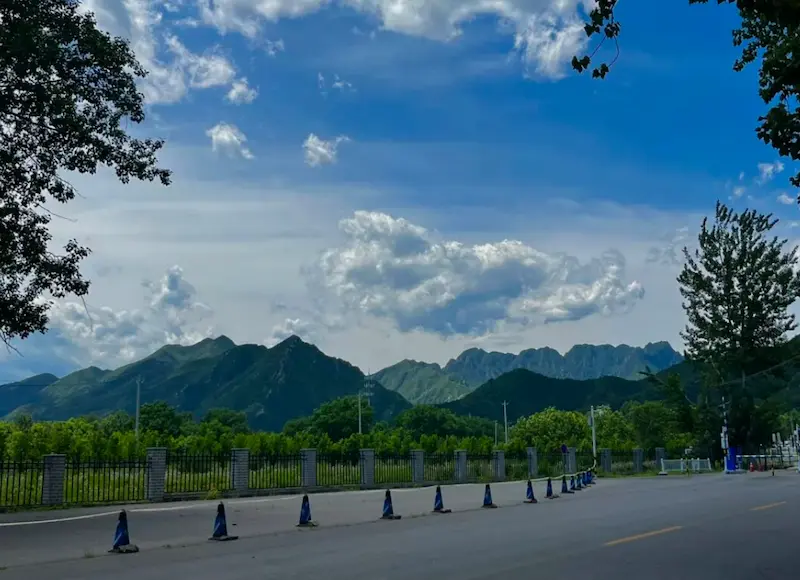
Many people know only that the Ming emperors are buried here, but may not realize that starting in 1409, Emperor Chengzu Zhu Di selected Mount Tianshou north of Beijing as the site for the imperial mausoleums. Over the next two hundred years, several Ming emperors successively built their tombs here.
The Thirteen Tombs we see today are not 13 isolated tombs, but rather a vast imperial necropolis designed to serve imperial authority, family rituals, and the emperors’ vision of the afterlife.
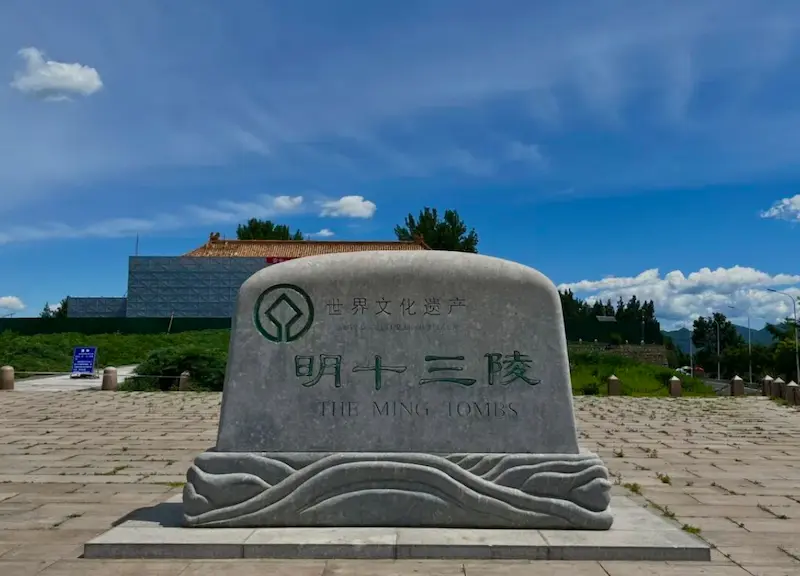
Table of Contents
Are the Ming Tombs worth visiting?
Highly recommended if you enjoy:
- Ancient Chinese history and imperial court culture
- Historic architecture, stone carvings, archaeological sites, and tomb culture
- Light outdoor hiking
Not highly recommended as a top priority if you:
- Are on a short 2-day trip to Beijing
- Have little interest in historical sites
- Dislike long walks and prefer the bustling cityscape
Tip: In this case, we recommend prioritizing a visit to the Forbidden City and the Great Wall, and visiting the Thirteen Tombs if you have time left over.
The Thirteen Ming Tombs in 30 Seconds (Quick Guide)
1. Thirteen Ming Dynasty emperors are buried here, dating back over 600 years.
2. Listed on the World Heritage List in 2003.
3. The entire tomb complex shares a single Sacred Road as its ceremonial axis.
4. Four sites are currently open to the public: the Sacred Road, Changling, Dingling, and Zhaoling
5. Sacred Processional Road: The ceremonial entrance to the mausoleum complex, featuring vivid stone carvings and statues
6. Changling: The ancestral mausoleum, where visitors can admire well-preserved Ming Dynasty imperial above-ground structures
7. Dingling: The only mausoleum with an underground chamber open to the public, linked to significant archaeological history in China
8. Zhaoling: Rarely visited by tourists, making it ideal for a comprehensive view of the overall layout of the Ming Dynasty mausoleum complex
Why Are Only 13 of the 16 Ming Dynasty Emperors Buried in the Thirteen Tombs?
The Ming Dynasty had a total of 16 emperors, three of whom were not buried in the Thirteen Tombs complex on Mount Tianshou:
1. Zhu Yuanzhang (Taizu of Ming, the founding emperor): While the capital was still in Nanjing, he was buried at the Ming Xiaoling Tomb in Nanjing;
2. Zhu Yunwen (Emperor Jianwen): His whereabouts remained unknown amid the turmoil of the Jingnan Campaign, and no imperial mausoleum was constructed for him;
3. Zhu Qiyu (Emperor Daizong of the Ming): After the change in imperial power, he was stripped of his imperial status and was buried in the Western Hills of Beijing.
The remaining 13 emperors were successively interred on Mount Tianshou, which is now known as the Thirteen Tombs of the Ming Dynasty.
Additional background: When Zhu Di moved the capital to Beijing, he not only relocated the imperial palace but also established the imperial mausoleum complex in the northern suburbs of Beijing; the Changling Mausoleum marked the beginning of this system.
Highlights of Each Attraction
| Attraction | Key Highlights | Recommended for |
| Sacred Path | Stone archways, stone statues, Dragon-and-Phoenix Gate; the ceremonial pathway through the entire mausoleum complex | A must-see for all visitors |
| Changling | The ancestral mausoleum of Emperor Chengzu of the Ming Dynasty (Zhu Di); the Ling’en Hall, a massive ancient structure built of golden-threaded nanmu wood | Enthusiasts of ancient architecture and Ming Dynasty history |
| Dingling | Visitors can descend into the underground palace; site of numerous excavated Ming Dynasty artifacts and a major case study in Chinese archaeology | The vast majority of first-time visitors |
| Zhaoling | A well-preserved mausoleum complex with a serene, uncrowded atmosphere | Visitors seeking an in-depth tour and wishing to avoid crowds |
The Sacred Way (Shenlu)—The Ceremonial Red Carpet of the Thirteen Tombs
The Sacred Way serves as the central axis and main entrance of the entire tomb complex. Stretching 1.5 kilometers in length, it was the mandatory route for the coffins of ancient emperors to enter the tomb complex, and it also served as the imperial processional route for later generations paying their respects at the imperial tombs.
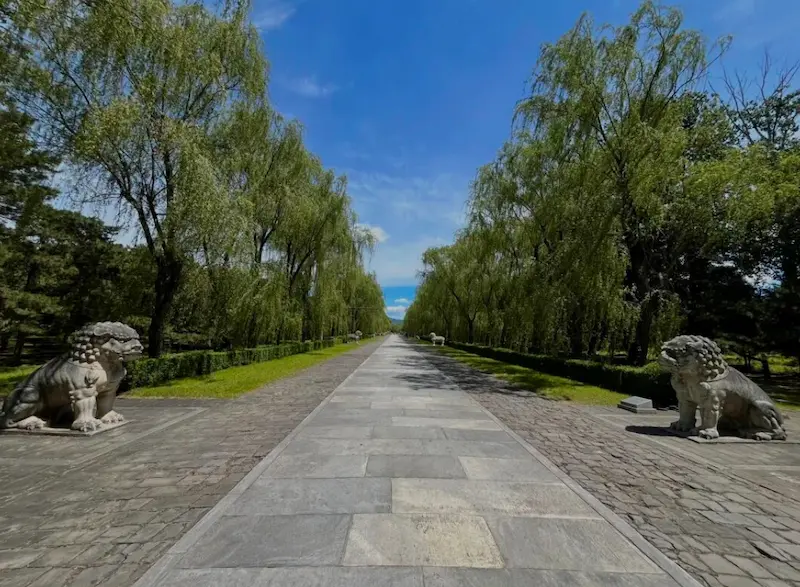
Why was it necessary to have such a road at the imperial tombs?
The Sacred Way was not an ordinary thoroughfare; it served as the setting for the entire suite of imperial funeral and sacrificial rituals. Ancient people believed that the spirit of a deceased emperor needed to travel along this path to complete the journey from the mortal world to his final resting place.
Visiting Route: Enter through the Grand Palace Gate (at the southernmost end), proceed straight north along the Sacred Way, and exit at the Dragon-and-Phoenix Gate.
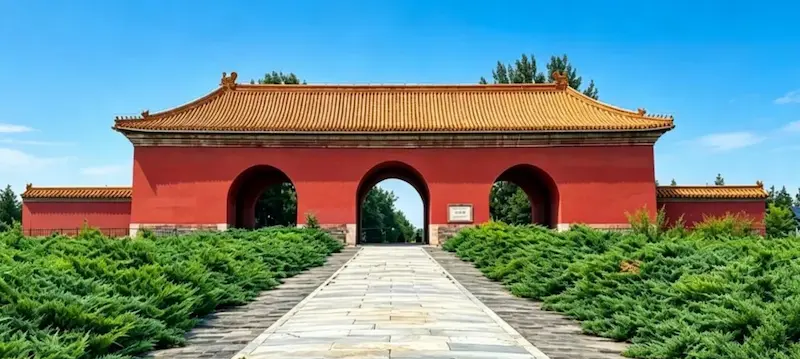
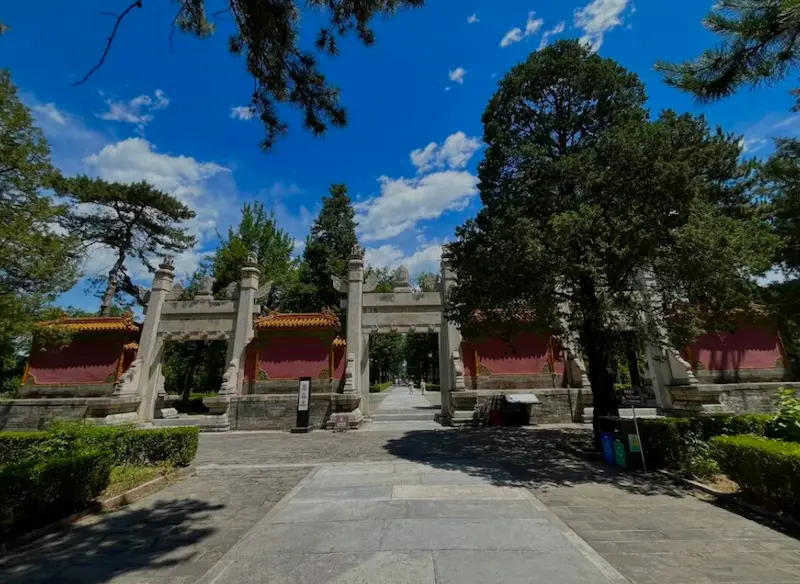
👑 Ming Tombs Private Tour: Sacred Way, Underground Palace & Changling Uncover the secrets of the Ming Dynasty emperors. Walk the majestic Sacred Way lined with stone statues, explore the underground palace of Dingling, and marvel at the massive Nanmu pillars of Changling.
👉 Book Ming Tombs Private Tour with Hotel Pickup
- ✔ Private Air-Conditioned Vehicle Included
- ✔ Deep Historical Storytelling by Expert Guide
- ✔ Stress-Free Door-to-Door Service
Highlights
1. White Marble Archway: Built in the 19th year of the Jiajing reign of the Ming Dynasty (1540), this large archway features a stone structure designed to mimic wood and is entirely carved from stone.
2. 18 Pairs of Stone Statues: Thirty-six stone statues are arranged in rows on both sides of the road, including 12 pairs of mythical beasts and 6 pairs of human figures. All were carved from single massive blocks of stone; despite 600 years of exposure to the elements, the carvings remain clearly defined.
- Lions: Symbolize imperial majesty
- Xiezhi: Represents judicial fairness
- Camel: Symbolizes distant territories and transportation
- Elephant: Symbolizes strength and auspiciousness
- Qilin: A mythical beast of ancient times
- Steed: Associated with imperial travel and military might
- Following these are stone statues of military generals, civil officials, and meritorious ministers, representing the civil and military officials attending the emperor.
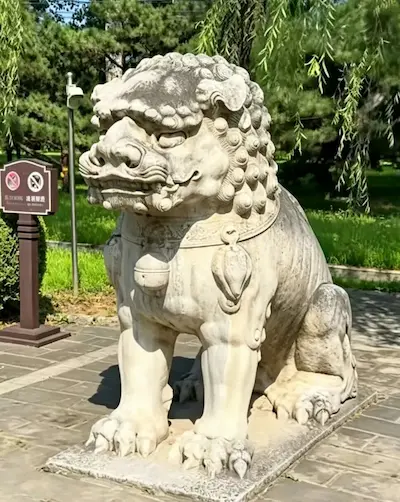
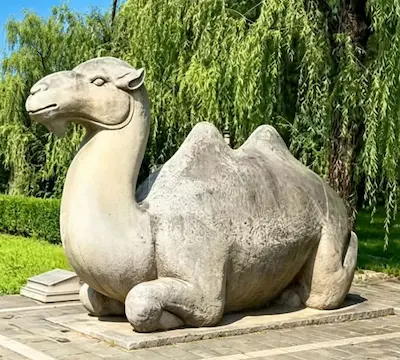
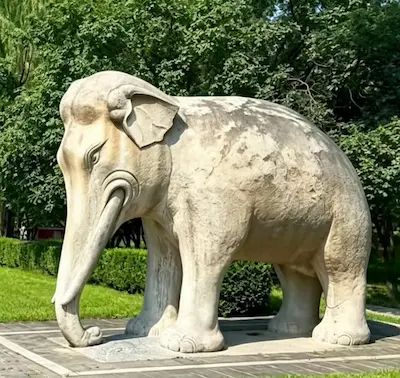
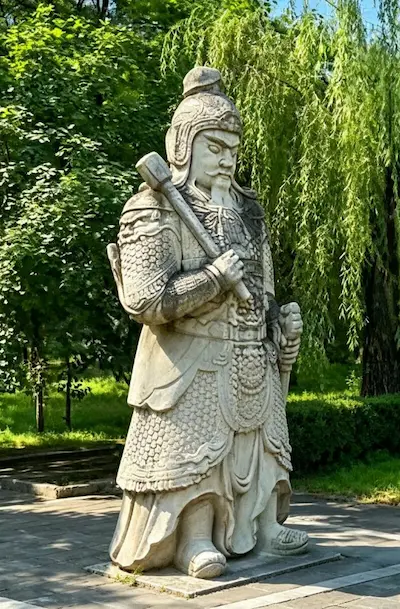
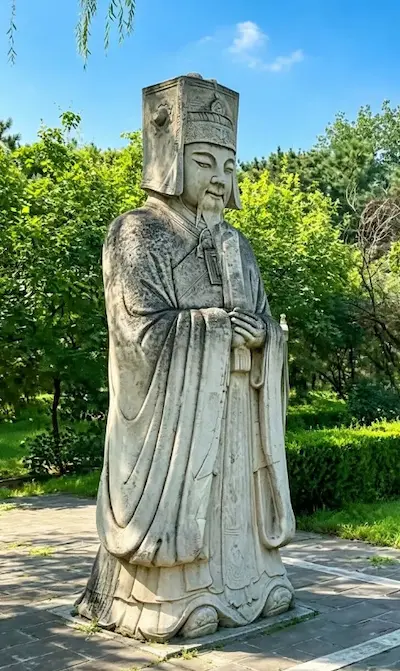
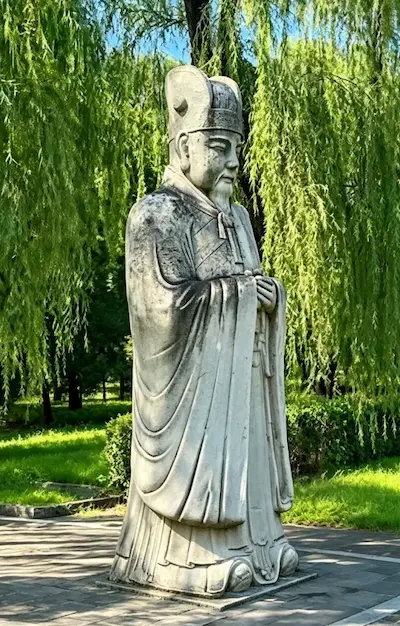
Fun fact: As you walk along the Spirit Way, try to identify these six types of stone beasts.
3. Dragon-Phoenix Gate (Three Gates, Six Pillars): Each of the three gates serves a specific purpose. The central Divine Gate is for the emperor’s spirit to pass through; the Imperial Gate on the left is for the reigning emperor to use when coming to offer sacrifices; and the Royal Gate on the right is for princes, dukes, and high-ranking officials.
Personal Reflections on the Visit: Strolling along this ancient path, with 600-year-old stone statues standing quietly on either side and only the sound of the wind rustling through the pine trees echoing through the valley, it feels as though I’ve traveled back in time to the Ming Dynasty.
Recommended visit duration: 40 minutes to 1 hour. There’s no need to rush—take your time to appreciate the details of the stone carvings.
Tip: The 1.5-kilometer walk is quite strenuous. If you’d rather not walk, you can purchase a one-way shuttle ticket at the entrance and exit via the North Gate.
Changling—The Ancestral Tomb of the Thirteen Tombs of the Ming Dynasty
Changling is the first tomb in the Thirteen Tombs complex. It is the final resting place of Emperor Yongle, Zhu Di. Construction began in 1409, and it is the imperial tomb with the highest status in the entire complex and the best-preserved above-ground structures.
Why is Zhu Di’s tomb of such exceptional importance?
Zhu Di was no ordinary emperor: he seized the throne through the Jingnan Campaign, oversaw the relocation of the capital to Beijing and the construction of the Forbidden City, and sponsored Zheng He’s voyages to the Western Seas, profoundly shaping the history of the Ming Dynasty.
Many of Beijing’s iconic landmarks—including the Forbidden City, the city of Beijing itself, and the Thirteen Tombs—are closely tied to this emperor.
How to Get There: After completing the tour along the Sacred Road, take the Chang 78 scenic area shuttle bus to reach Changling.
👑 Ming Tombs Private Tour: Sacred Way, Underground Palace & Changling Uncover the secrets of the Ming Dynasty emperors. Walk the majestic Sacred Way lined with stone statues, explore the underground palace of Dingling, and marvel at the massive Nanmu pillars of Changling.
👉 Book Ming Tombs Private Tour with Hotel Pickup
- ✔ Private Air-Conditioned Vehicle Included
- ✔ Deep Historical Storytelling by Expert Guide
- ✔ Stress-Free Door-to-Door Service
Highlights
1. Ling’en Hall (The Essence of Changling)
The main hall follows a high-status architectural layout with a front width of nine bays and a depth of five bays. In traditional Chinese ritual systems, the numbers “nine” and “five” are often used to symbolize the supreme level of imperial authority. The scale of the hall is comparable to that of the Hall of Supreme Harmony in the Forbidden City.
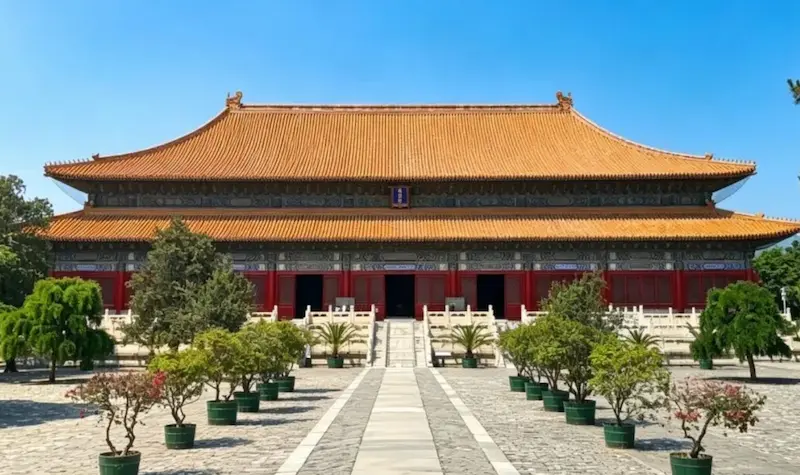
Inside the hall stand 60 massive solid pillars carved from golden-veined nanmu wood—built without joints or iron nails—each with a diameter of over one meter.
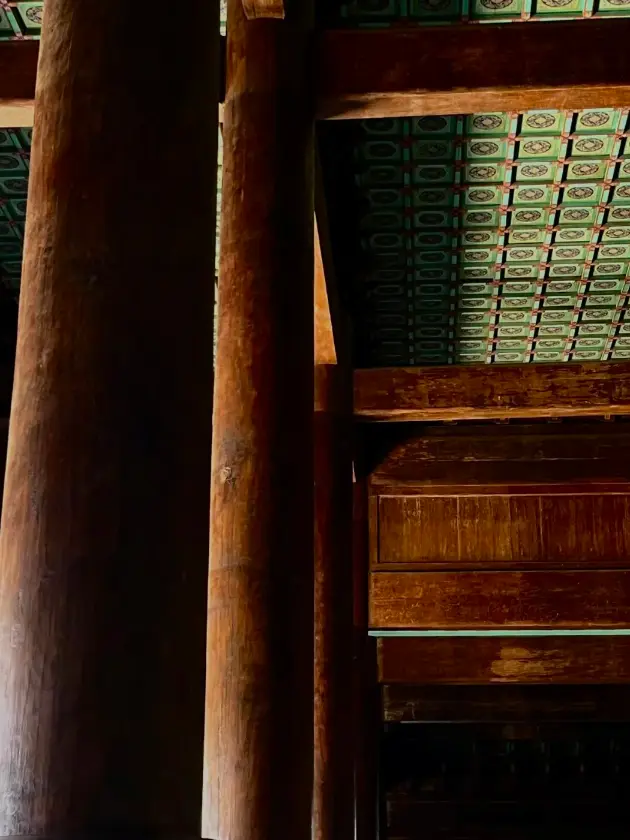
Golden-veined nanmu was a building material highly prized by the imperial court in ancient times; these giant trees were sourced from the deep mountains of southwestern China, and their transportation and construction during the Ming Dynasty constituted a massive undertaking.
As sunlight streams into the hall, one can still catch the subtle, serene woody fragrance of the ancient nanmu timber.
2. Cultural Relics Exhibition Hall: The hall displays a large collection of imperial artifacts from the Ming Dynasty.
Note: The underground palace at Changling is not open to the public; the tour focuses primarily on the above-ground ancient structures.

Recommended visit duration: Approximately 1 hour.
Dingling—The Imperial Underground Palace 27 Meters Below Ground
Dingling is the final resting place of Emperor Wanli (Zhu Yijun) of the Ming Dynasty. He reigned for 48 years, making him the longest-reigning emperor of the Ming Dynasty and the central figure in the historical account of the “Wanli Period of Political Neglect.”
Dingling is the only imperial tomb among the Thirteen Tombs where the underground palace has been archaeologically excavated and opened to the public.
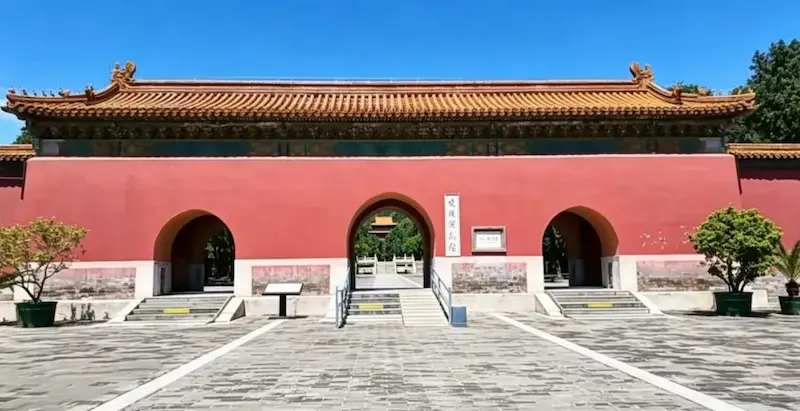
How to Get There: Take the Chang 78 shuttle bus from Changling and head southwest to reach Dingling.
An interesting historical detail: Dingling took six years to build and consumed a vast amount of silver from the imperial treasury. After the mausoleum was completed, Emperor Wanli lived for another full 30 years, leaving this underground palace vacant for three decades until the emperor’s death, when it finally welcomed its owner.
👑 Ming Tombs Private Tour: Sacred Way, Underground Palace & Changling Uncover the secrets of the Ming Dynasty emperors. Walk the majestic Sacred Way lined with stone statues, explore the underground palace of Dingling, and marvel at the massive Nanmu pillars of Changling.
👉 Book Ming Tombs Private Tour with Hotel Pickup
- ✔ Private Air-Conditioned Vehicle Included
- ✔ Deep Historical Storytelling by Expert Guide
- ✔ Stress-Free Door-to-Door Service
Key Highlights
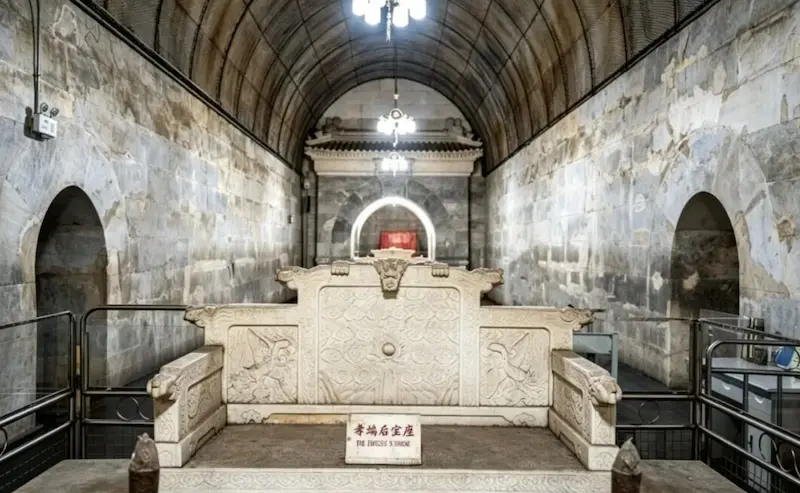
1. The underground mausoleum, located 27 meters below ground—a depth roughly equivalent to a 9-story building—is constructed entirely of massive stone arches without a single beam or column. Covering an area of 1,195 square meters, it consists of five halls designed to mimic the “front court, rear quarters” layout of the Forbidden City.
Descending the stone steps, the temperature gradually drops until you find yourself inside this magnificent stone palace.
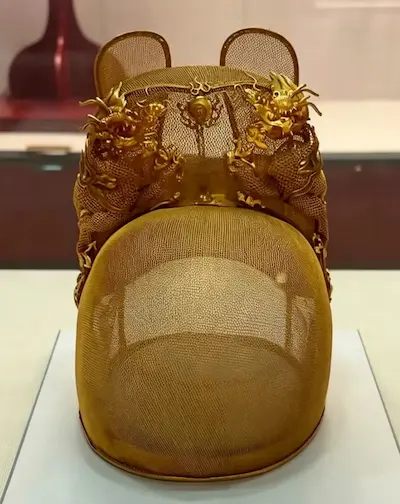
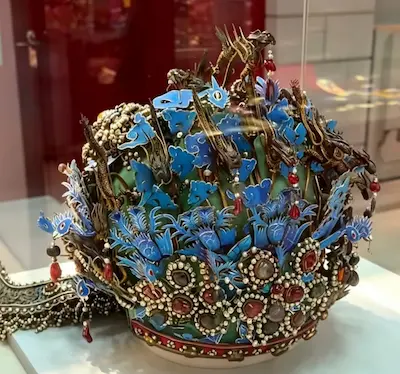
2. Unearthed Artifacts: Archaeological excavations at Dingling have unearthed more than 3,000 Ming Dynasty artifacts, including the “Golden-Threaded Yishan Crown” and the “Twelve-Dragon, Nine-Phoenix Crown.” These exquisitely crafted pieces are considered pinnacles of Ming Dynasty craftsmanship.
3. The Golden Well: The layer of undisturbed loess at the center of the coffin platform in the rear hall served as a key feature in the Ming imperial tombs’ feng shui philosophy, designed to channel the earth’s vital energy.
Why is Dingling unique? It transformed the approach to archaeological excavations of Chinese imperial tombs.
In 1956, archaeologists initiated a proactive excavation of Dingling—the first such excavation of an imperial tomb in China. Because of the limitations of cultural heritage preservation technology at the time, many unearthed artifacts suffered irreversible damage.
Since then, the Chinese archaeological community has adhered to the principle of not proactively excavating imperial tombs, and the remaining twelve Ming imperial tombs have been preserved intact underground.
Personal Reflections on the Visit: Standing beneath the deep, dimly lit stone chamber and reflecting on the history of the Wanli reign, I felt a profound sense of awe at the passage of time over the centuries.
Recommended Visit Duration: 1–1.5 hours.
Zhaoling—A Serene and Well-Preserved Ming Dynasty Mausoleum
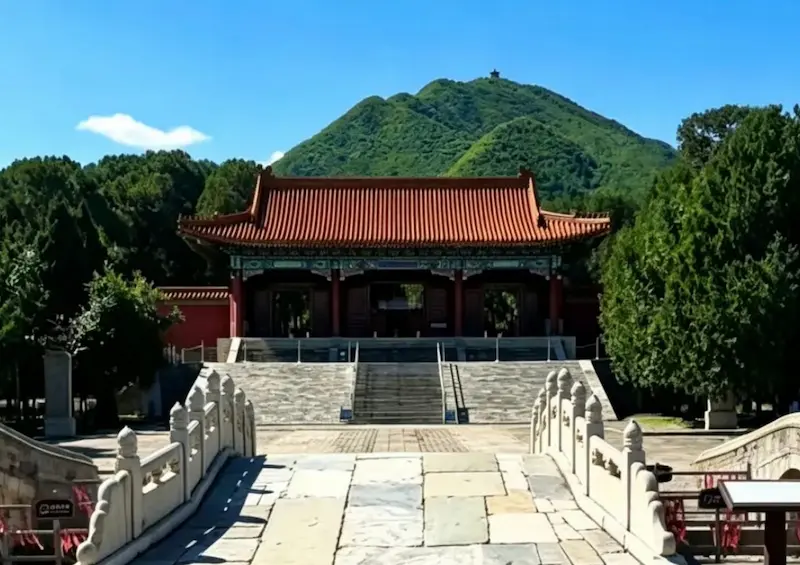
The interred figure at Zhaoling is Zhu Zai’ao (Emperor Longqing), known as Emperor Muzong of the Ming Dynasty—the son of Emperor Jiajing and the father of Emperor Wanli. He reigned for only six years, sandwiched between two renowned emperors.
Although the structures have been restored and renovated over the centuries, the mausoleum’s overall layout retains the Ming Dynasty’s original design. Few tourists visit here, making for a quiet and peaceful environment.
Why is it worth visiting Zhaoling after seeing Changling and Dingling?
If you want to avoid the crowds and fully appreciate the layout of a complete set of Ming Dynasty imperial mausoleums, Zhaoling is an excellent addition to your itinerary. There’s no need to visit just to check it off your list; if you’re short on time, you can skip it altogether.
Recommended visit duration: 45 minutes–1 hour.
How to Get to the Thirteen Tombs on Your First Visit? Choose a Route Based on Your Schedule
Reminder: The Thirteen Tombs aren’t just a “check-in” attraction—there’s no need to force yourself to visit all four sites. If you spend too much time at Changling or Dingling, you can skip Zhaoling altogether.
Just 3 hours (for those short on time)
- Itinerary: Divine Path + Changling
- Best for: First-time visitors to Beijing with a casual interest in history.
Half a day (about 5 hours) (Top choice for most visitors)
Itinerary: Divine Path + Changling + Dingling
This itinerary balances ancient architecture with underground palace experiences and is chosen by most travelers.
Full Day, 6–7 Hours (For History Enthusiasts)
Itinerary: Divine Path → Changling → Dingling → Zhaoling
The entire route involves about 20,000 steps, so be sure to wear comfortable shoes.
Complete Sample Itinerary (One-Day Version)
- 8:30 a.m. Deshengmen Bus Stop: Take Bus No. 872
- 10:00 a.m. Arrive at Dagongmen (southern end of the Sacred Way); tour the Sacred Way
- 11:00 a.m. End of the Sacred Way; wait at the exit for the Chang 78 shuttle bus
- 11:30 a.m. Arrive at Changling; tour
- 12:30 Tour of Changling ends; have lunch
- 1:30 PM Take the Chang 78 bus to Dingling
- 3:00 PM Tour of Dingling ends
- 3:30 PM Take the Chang 78 bus to Zhaoling
- 4:30 PM Tour of Zhaoling ends; return to Dagongmen
- Board the last outbound bus (Route 872) before 4:30 PM
Transportation Options (Three Ways to Get There)
Option 1: Bus (Best Value)
Bus Route 872
- Boarding Location: Deshengmen Bus Stop
- Fare: 5 yuan
- Frequency: Approximately every 30 minutes
- Travel Time: About 1.5 hours, passing through Shenlu, Changling, and Dingling
⚠️ The last bus back departs at 4:30 PM—this is crucial! If you miss it, you’ll have to take an expensive taxi back to the city. We recommend setting an alarm on your phone and double-checking the bus schedule before you leave.
Based on personal experience: Taking the expressway, the trip from Deshengmen to Dagongmen takes about 50 minutes, and you can rest briefly on the bus.
Option 2: Subway + Scenic Area Shuttle
Take the Changping Subway Line to “Changping Xishan Kou Station,” then transfer to the Chang 78 scenic area shuttle bus upon exiting the station.
Suitable for visitors staying near a subway station. The Chang 78 runs approximately every half hour; however, the intervals are long, making it difficult to time your trip precisely.
Option 3: Driving (Offers the Most Flexibility)
Use your navigation app to search for “Ming Thirteen Tombs,” then take the Beijing-Tibet Expressway and exit onto Changchi Road.
Parking for passenger cars costs 5 yuan per day.
Tip: Traffic jams are common during peak hours in the city, so it’s recommended to leave early.
Key Point: Chang 78 Scenic Area Shuttle Bus
- Fare: 2 yuan
- Frequency: Runs approximately every 30 minutes, connecting the main scenic spots of Shenlu, Changling, Dingling, and Zhaoling
From personal experience: The tombs are 1–3 kilometers apart. While that may not seem far, walking between them is very tiring and takes up a lot of sightseeing time, so I don’t recommend walking back and forth between them—it’s better to take the shuttle bus.
If you happen to miss a bus, you’ll have to wait half an hour, so it’s a good idea to plan your time at each site accordingly.
Tickets, Reservations, and Hours of Operation (Updated for 2026)
Important Reminder: Tickets are not sold on-site. You must make a reservation and purchase tickets in advance via the “Changping Culture and Tourism Group” WeChat mini-program. The mini-program’s interface is primarily in Chinese; international visitors are advised to ask their hotel front desk for assistance.
Ticket Prices
Combined Ticket (Best Value): Shenlu + Changling + Dingling + Zhaoling
- Peak Season (April 1–October 31): 120 yuan
- Off-Season (November 1–March 31 of the following year): 98 yuan
Single-Site Ticket Prices:
- Divine Path: 30 yuan
- Changling: 45 yuan
- Dingling: 60 yuan
- Zhaoling: 30 yuan
Discount Policies: Students receive half-price admission with a valid ID; active-duty military personnel, veterans, eligible seniors, doctors, police officers, teachers, and others receive free admission with a valid ID; students from Hong Kong, Macao, and Taiwan are also eligible for the half-price student rate.
👑 Ming Tombs Private Tour: Sacred Way, Underground Palace & Changling Uncover the secrets of the Ming Dynasty emperors. Walk the majestic Sacred Way lined with stone statues, explore the underground palace of Dingling, and marvel at the massive Nanmu pillars of Changling.
👉 Book Ming Tombs Private Tour with Hotel Pickup
- ✔ Private Air-Conditioned Vehicle Included
- ✔ Deep Historical Storytelling by Expert Guide
- ✔ Stress-Free Door-to-Door Service
Hours of Operation
- Peak Season (April 1–October 31): 8:30 a.m.–6:00 p.m., last admission at 5:30 p.m.
- Off-season: November 1–March 31 of the following year: 8:30 a.m.–5:00 p.m., last admission at 4:30 p.m.
Note: From May 17, 2026, to April 30, 2027, some areas may be closed due to construction. We recommend checking the daily opening status online before your visit.
What to Eat Near the Thirteen Tombs?
Food options at the snack bars inside the scenic area are limited, and prices tend to be high, so we recommend bringing your own drinking water and snacks.
Kangling Spring Pancake Feast (Highly Recommended): A local specialty featuring thin pancakes wrapped around a variety of meat and vegetable dishes. The price is 60 yuan per person for groups of three or fewer, and 50 yuan per person for groups of three or more. The portions are generous, and this is a very representative local farmhouse-style meal.
You can choose other farmhouse-style restaurants as needed, but we recommend prioritizing your sightseeing first.
Budget Guide (Per Person)
- Budget Option (Public transportation + combined ticket + light meals): 150–190 yuan
- Comfort Option (Subway/taxi + admission tickets + full meals): 220–300 yuan
- Chartered vehicle with private guide: Cost calculated separately.
Travel Preparation Checklist
1. Comfortable shoes—you’ll be doing a lot of walking during the day
2. A light jacket for the chilly underground chamber of Dingling Mausoleum
3. Drinking water and portable snacks
4. A power bank—taking photos drains your battery quickly
5. Sunscreen—there’s little shade along the Sacred Road
🧳 Planning Your Trip to Beijing? Looking for one-day tours, day trips, private transfers, or show tickets in Beijing? Check out the full catalog of trusted local travel products on KKday.
👉 Explore All Beijing Travel Tours & Services on KKday
- ✔ English Support & Trusted Local Operators
- ✔ Easy Cancellation & Mobile Booking
Eight Historical Trivia Facts
1. The Significance of the Sacred Way: It was a ceremonial space—not merely a path for travel—designed to serve the posthumous rituals for the emperor.
2. The Symbolism of the Stone Figures: The stone beasts and figures represent all things in the universe and the civil and military officials, who eternally serve the departed emperor.
3. The Imperial Tomb’s Location Against a Mountain: Tianshou Mountain is surrounded on three sides by mountains, embodying the feng shui principles of the Ming Dynasty.
4. Why the Underground Palace Mimics the Imperial Palace Layout: Ancient people believed that emperors, even after death, should continue to live in a palace just as they did in life.
5. Ming Dynasty Emperors Built Their Tombs in Advance: Many emperors began construction on their mausoleums immediately after ascending the throne.
6. Why Dingling Is the Only One to Have Been Excavated: A regrettable archaeological incident led to the current principle of not actively excavating imperial tombs.
7. Why the Qing Dynasty Did Not Destroy the Thirteen Tombs: To demonstrate the legitimacy of their rule, the Qing Dynasty guarded and restored the Thirteen Tombs of the Ming Dynasty.
8. The World Heritage Value of the Thirteen Tombs: They fully showcase the imperial tomb system and architectural art of China’s Ming Dynasty.
FAQ
Many tourists feel that the Thirteen Tombs are far from the city center and that the attractions are scattered. Yet it is precisely through taking the bus, waiting for shuttle buses, and walking from place to place that one can more easily connect with six hundred years of history.
Standing on the Sacred Path, listen to the wind rustling through the pine trees in the valley as it brushes past the stone statues; descend into the deep, secluded underground chamber of Dingling and reflect on the lives of the Ming emperors.
The Thirteen Tombs are not merely a place to check off a list; they are a window through which, by exploring each imperial tomb, one can gain insight into the imperial authority and ritual systems of the Ming Dynasty, as well as the historical lessons revealed by archaeology. Slow down, and you’ll discover a different side of Beijing.
🧳 Planning Your Trip to Beijing? Looking for one-day tours, day trips, private transfers, or show tickets in Beijing? Check out the full catalog of trusted local travel products on KKday.
👉 Explore All Beijing Travel Tours & Services on KKday
- ✔ English Support & Trusted Local Operators
- ✔ Easy Cancellation & Mobile Booking