Zhiranju Hutong: The Imperial Dyeing Workshop Hidden Behind the Forbidden City + Wang Guowei’s Former Residence + How to Get There (2026)
Last Updated: Aug. 2026
Zhiranju Hutong is a quiet alley just 300 meters long, nestled right next to the Forbidden City and Jingshan Park. During the Ming Dynasty, this was the place where fabrics were dyed and garments made specifically for the emperor; the silk woven here 600 years ago predates Paris Fashion Week.
Later, the renowned scholar Wang Guowei also lived here, and today the alley still hides a small garden and a century-old elementary school. Take Metro Line 8 directly there—the entire trip is free.
Table of Contents
Practical Information (Must-Read Before You Go)
| Item | Details |
| Name | Zhi Ran Ju Hutong (Pinyin: `Zhi Ran Ju Hutong`, literally “Hutong of the Weaving and Dyeing Bureau”) |
| Address | Dongcheng District, Beijing; west of Dongbanqiao Street to Shuibojihutong (near Di’anmen East Street) |
| Subway | Line 8, Shichahai Station (`Shichahai Station`), Exit C, about an 8-minute walk; or Line 6, Nanluoguxiang Station, about a 12-minute walk from the northwest exit. After exiting Shichahai Station, walk eastward and cross Dongbanqiao Street to reach the western entrance of the hutong. |
| Bus | Routes 3, 13, 42, 60, 118, and 612; get off at the “Di’anmen East” or“Luoguxiang” stop |
| By Car | Not recommended. The hutong is narrow, and there are virtually no tourist parking lots nearby. If taking a taxi, use the destination “ West Entrance of Zhiranju Hutong ”or“ Intersection of Dongbanqiao Street and Zhiranju Hutong.” |
| Admission | Free throughout. There are no paid attractions, and you can explore at any time. |
| Opening Hours | The hutong is open 24 hours a day, 365 days a year. It is recommended to visit during the day, as lighting is insufficient at night and residents need rest. |
| Best Time to Visit | Weekdays from 9:00 AM to 11:00 AM or after 3:00 PM. The morning light is ideal for capturing the old-Beijing charm of the blue-gray bricks and tiles; the afternoon is quieter, perfect for a stroll and photography. Weekends are slightly busier, but it’s not as crowded as Nanluoguxiang. |
| Recommended Duration | 1–1.5 hours (about 30 minutes for walking, plus 30–40 minutes for photography and exploring the surrounding area) |
| Dress Code | Wear comfortable flat shoes; the hutong paths are paved with asphalt and flagstones, making them easy to walk on. |
| Budget Guide | The hutong is free to visit. Lunch nearby costs about 30–80 RMB (approx. $4–11), and coffee is about 35–50 RMB (approx. $5–7). |
| Photography | Absolutely. You can take photos outdoors throughout the entire hutong; the old gray-brick and gray-tiled houses look particularly charming when bathed in light and shadow. However, most of the siheyuan courtyards here are home to residents, so please avoid taking photos directly at people’s windows or into their courtyards. |
| Language Support | No English-speaking guides or English-language signage. We recommend downloading a translation app on your phone. |
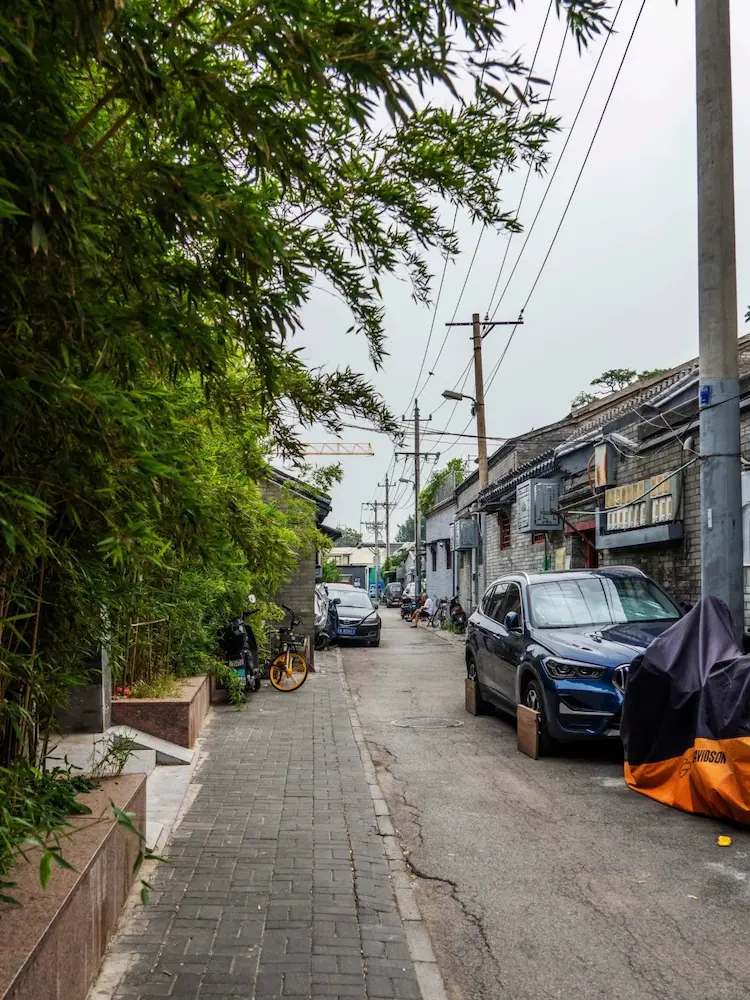
Friendly Reminder: Zhiranju Hutong is a real residential area for Beijing locals, not a commercial tourist attraction. Please speak softly, walk slowly, avoid loud noises, and do not enter private homes. Many elderly residents live here, and they will warmly welcome polite visitors.
How to Get There: Walk Over from Shichahai or Nanluoguxiang
Zhiranju Hutong is very easy to find, located right in the heart of Beijing’s most popular attractions. We highly recommend adding it to your “Shichahai → Nanluoguxiang” walking route—it’s a perfect stop along the way.
Recommended Route (approx. 2–3-hour walking tour):
Exit Shichahai Subway Station → Walk along the lake to Yinding Bridge (15 minutes, lakeside scenery) → Head south on Dongbanqiao Street (5 minutes) → Zhiranju Hutong (explore for 30–40 minutes) → Exit the east gate and head south, passing through Beihe Hutong to the north entrance of Nanluoguxiang (10 minutes) → Nanluoguxiang (1-hour stroll)
This route lets you experience lakeside scenery, hutong history, and bustling commercial streets all in one go.
You can also take the reverse route: After visiting the Shenwu Gate of the Forbidden City or Jingshan Park, walk north for about 15 minutes, pass through Beihe Hutong, and you’ll find Zhiranju Hutong.
The Origin of the Hutong: The Imperial Factory That Dyed Cloth for the Emperor
The name “Zhiranju Hutong” may be a bit of a mouthful, but its meaning is actually quite simple: “zhi” means “weaving,” “ran” means “dyeing,” and “ju” refers to an administrative department of the ancient government. Put together, it means “the hutong where the government office responsible for weaving and dyeing was located.”
During the Ming Dynasty (1368–1644), there was an institution in Beijing called the “Inner Weaving and Dyeing Bureau.” Its mission can be summed up in a single sentence: to produce and dye all silk textiles for the emperor and the imperial court. The emperor’s dragon robes, the empress’s phoenix robes, and the silk curtains and canopies in the palaces were all handled here.
The Imperial Weaving and Dyeing Bureau was one of the “Twenty-Four Imperial Bureaus” of the Ming Dynasty, a highly influential court institution. Because it served exclusively the imperial palace, the character “内” (meaning “within the palace”) was added to its name, making it the “Imperial Weaving and Dyeing Bureau.”
While there were multiple such bureaus during the Ming Dynasty, this was the highest-ranking one, serving the most distinguished clientele.
At the time, this site housed not only the bureau’s administrative offices but also a dedicated Buddhist chapel where eunuchs working there could burn incense and pray.
This raises a question: if this was the Weaving and Dyeing Bureau, where were the actual factories located?
The Weaving and Dyeing Bureau was an administrative department; the actual dyeing workshops were located elsewhere. One was the “Outer Factory” (which no longer exists) outside Chaoyang Gate, and the other was called “Lan Dianchang,” which specialized in cultivating and processing plants used to make blue dye.
This name has been in use ever since; if you look at a map of Beijing, you can still find a place called “Lan Dianchang” near the West Fourth Ring Road.
Zhiranjü Hutong took shape as early as the Ming Dynasty. During the Qing Dynasty, it was part of the Imperial City, and it was officially named Zhiranjü Hutong during the Qianlong era. In the Xuantong era, it was abbreviated to “Zhiranjü,” but during the 1965 place-name rectification campaign, the name “Zhiranjü Hutong” was restored and has been in use ever since.
In 2022, this alley was officially included in the List of Traditional Place Names for Protection in the Capital’s Core Functional Area—effectively an official certification of its status as an “old place name of significant historical value.”
Highlights
1. Heizhima Hutong Primary School (Zhiranju Campus) (formerly Compound No. 5): 600 Years, From Buddhist Hall to School
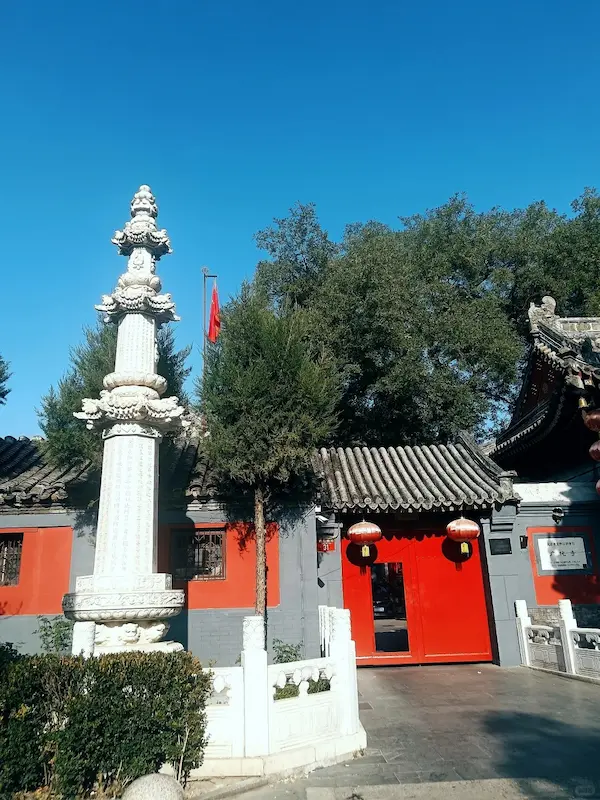
Walking to the southern end of the western section of the alley, you’ll see an old red-brick building with a sign hanging at the entrance: Heizhima Hutong Primary School (Weishanju Campus). If you search for “Weishanju Primary School” on a map, you might not find it, because in 2016 it merged with Heizhima Hutong Primary School and is now one of the latter’s campuses. However, the school hasn’t moved; it’s still in the same location.
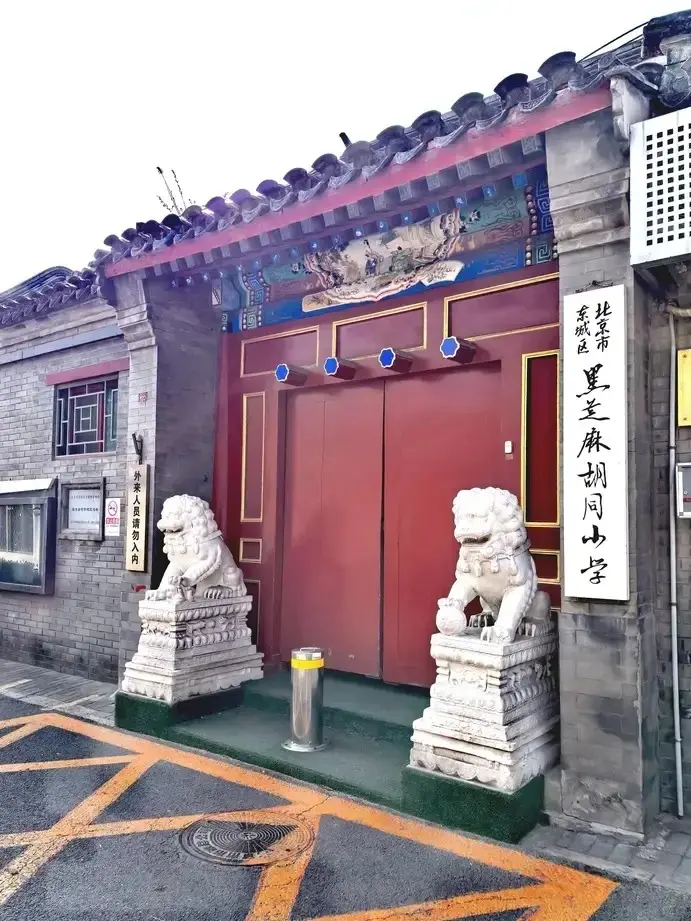
This building was not originally a school, but a temple called “Huayan Temple.”
During the Ming Dynasty, the eunuchs who worked here needed a place to burn incense and worship Buddha, so they built a Buddhist chapel within the courtyard of the Imperial Weaving and Dyeing Bureau. After being renovated in the early Qing Dynasty, it was renamed Huayan Temple.
In other words, hundreds of years ago, this place served as a “spiritual retreat” for the eunuchs, where they would dye fabrics and weave silk for the emperor at the Weaving and Dyeing Bureau during the day, and then go to the adjacent Buddhist hall after work to pray for peace and safety.
In 1958, the Buddhist hall was converted into an elementary school, first named Huayan Temple Elementary School, and later renamed Weaving and Dyeing Bureau Elementary School.
After a merger in 2016, it became the current Black Sesame Alley Elementary School (Weaving and Dyeing Bureau Campus). An old Beijing saying: “First came the Banners’ Official School, then came Heizhima Hutong Primary School”—the school’s origins can be traced back to the first year of the Shunzhi reign (1644) during the Qing Dynasty, when it was an official school specifically for the children of the Eight Banners. Later, the renowned writer Mao Dun inscribed the school’s name.
Thus, this building has undergone three transformations:
- Ming Dynasty: A Buddhist chapel for eunuchs within the Imperial Weaving and Dyeing Bureau (where incense was burned and Buddha was worshipped)
- After 1958: A public elementary school (dedicated to teaching and nurturing students)
- Since 2016: A campus of Heizhima Hutong Primary School (still in operation)
Current Status: The site is currently a functioning school and is not open to the public for tours. You can stand outside and look at the red-brick building, imagining—on an evening hundreds of years ago, a eunuch who had just finished dyeing cloth walked into the Buddhist chapel and lit three sticks of incense; and today, centuries later, a group of children with backpacks run out of the same doorway, laughing and shouting, “Goodbye, teacher!”
On the same piece of land, the scent of incense has given way to the sound of children studying, yet that sense of “people seeking solace here” seems to have remained unchanged.
Photo Tip: The red wall and gate sign at the school entrance are worth a close-up shot; with residents’ drying quilts and the shadows of old locust trees in the background, it captures the authentic flavor of hutong life. But please do not walk inside or disturb the classes.
2. Wang Guowei’s Former Residence (No. 29, North Side of Xikou Road): The Home of the Last Scholar
Entering from the west end of the alley (on the Dongbanqiao Street side), you’ll find Courtyard No. 29 on your right. This was once the home of Wang Guowei, a truly remarkable scholar in modern Chinese history.
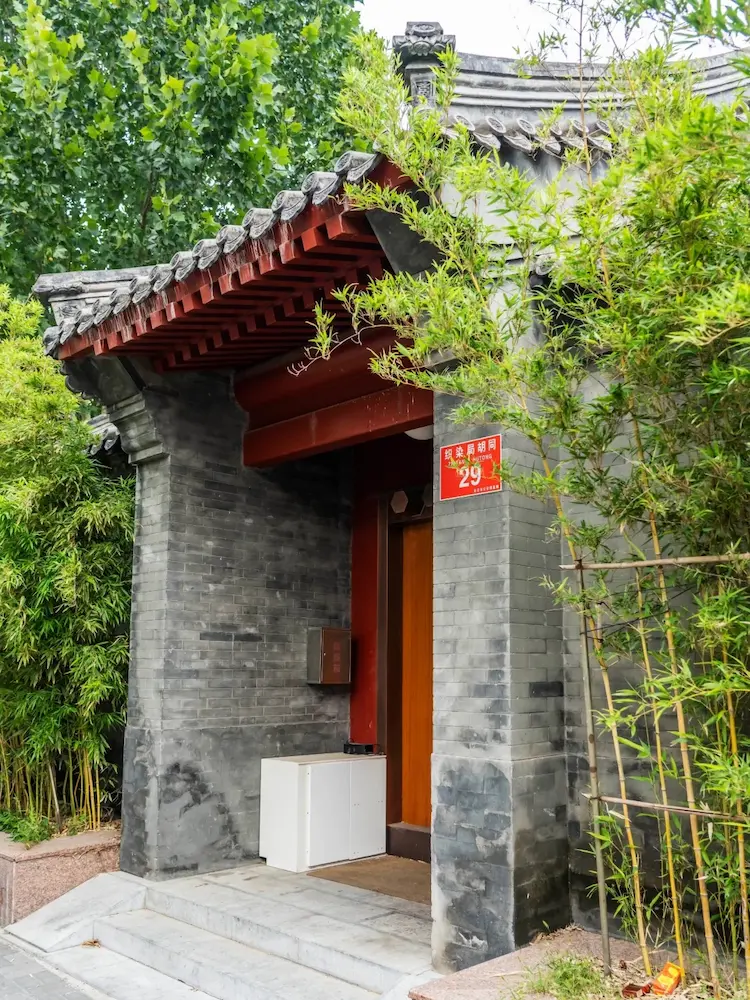
Cultural Insight: Who was Wang Guowei (1877–1927)? He was one of the most accomplished scholars of modern China, a polymath with expertise in philosophy, literature, history, ancient script, archaeology, translation… virtually every field of the humanities you can think of.
In 1925, he was appointed as a professor at the Institute of Chinese Studies at Tsinghua University. Together with Liang Qichao, Chen Yinke, and Zhao Yuanren, he was known as one of the “Four Great Mentors of Tsinghua”—akin to the “Four Great Kings” of Chinese humanities in the early 20th century.
Wang Guowei was also one of the pioneers in the study of oracle bone script, which is currently recognized as the earliest mature form of Chinese writing ever discovered.
He authored a book titled A Critique of Chinese Lyric Poetry (Renjian Cihua), in which he proposed the “Three Stages of Achievement” in both scholarship and life; it remains a classic work of Chinese literary criticism to this day.
From 1923 to 1925, Wang Guowei lived in Courtyard 29 on this very alley. At that time, he had been invited by Puyi (the last emperor of the Qing Dynasty) to serve as a “South Study Attendant”—a title that sounds like a stroll but was actually an official position as a cultural advisor to the emperor.
During his two years living in Zhiranju Hutong, Wang Guowei would spend his days at the Forbidden City (Puyi was still residing there at the time) and return to his small courtyard in the hutong at night, leading a quiet life that was half courtly and half ordinary.
Later, Feng Yuxiang expelled Puyi from the Forbidden City, and with that, the last emperor’s special status vanished.
Wang Guowei felt deeply saddened, believing he no longer had anyone to whom he could pledge his loyalty. In 1925, he accepted an offer from Tsinghua University and moved from Zhiranjü Hutong into the Tsinghua campus.
What is even more poignant is that, just before Wang Guowei moved in, another professor had lived in this very courtyard—Wu Yu, a “pioneer of anti-traditionalism” who fiercely criticized Confucian thought. These two scholars, whose views were opposed, moved into the same courtyard one after the other, yet may never have met.
Current Status: Courtyard No. 29 is now a residential building and is not open to the public. However, simply glancing at the house number from the outside and imagining a scholar poring over oracle bone inscriptions by the light of a kerosene lamp on a night a century ago is a truly magical experience.
3.“Erqi Meiyuan”: A Pocket Garden in an Old Beijing Hutong
In the middle of the hutong lies a small garden called “Erqi Meiyuan,” which is the most charming part of the 2023 revitalization of Zhiranju Hutong.
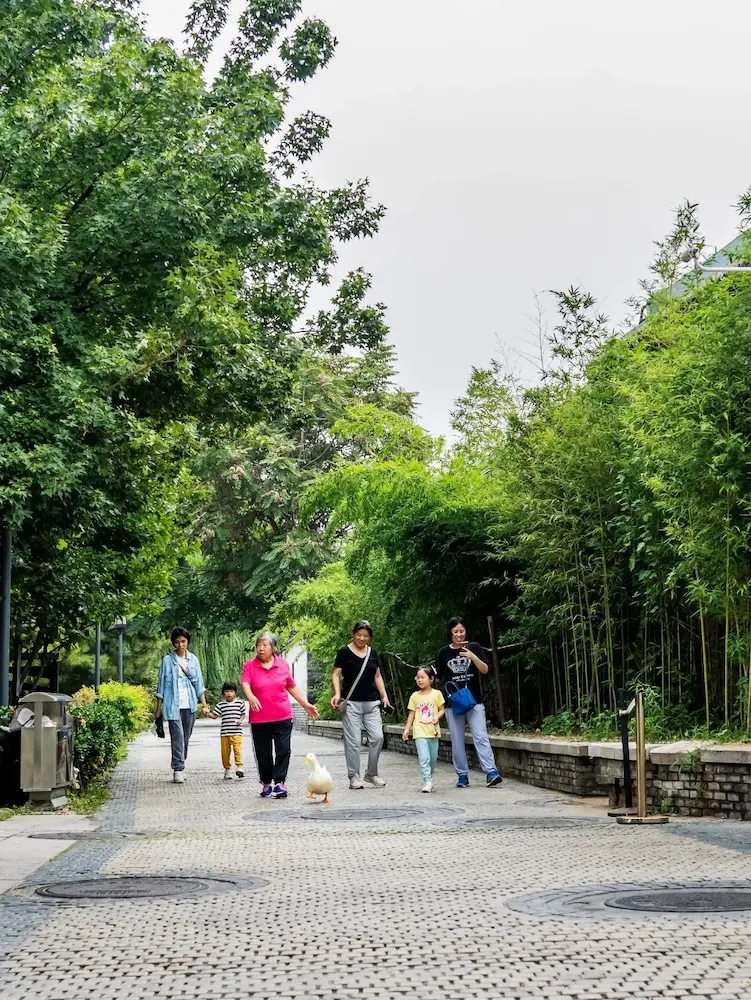
In 2023, the Jingshan Subdistrict Office launched the “Micro-Garden” project, encouraging residents to take matters into their own hands and beautify unused vacant lots within the hutongs. The design, plant selection, and daily maintenance of each small garden are all handled by the residents themselves.
“Erqi Meiyuan” was selected by neighbors as one of the most beloved entries in that year’s “Most Beautiful Micro-Garden” contest, which is how it earned its name.
Cultural Insight: This “micro-renewal” project is a microcosm of urban governance in China. Instead of large-scale demolition and reconstruction, the government provides seed funding and plants, allowing residents to personally participate in planning and construction.
In the densely populated, land-scarce hutongs of old Beijing, every small garden is like a sofa—a cozy community living room built for neighbors in a place where every inch of land is precious.
4. The Hutong Itself: Old Beijing Life Amid Blue Bricks and Gray Tiles
The most appealing aspect of Zhidanju Hutong is, in fact, the hutong itself.
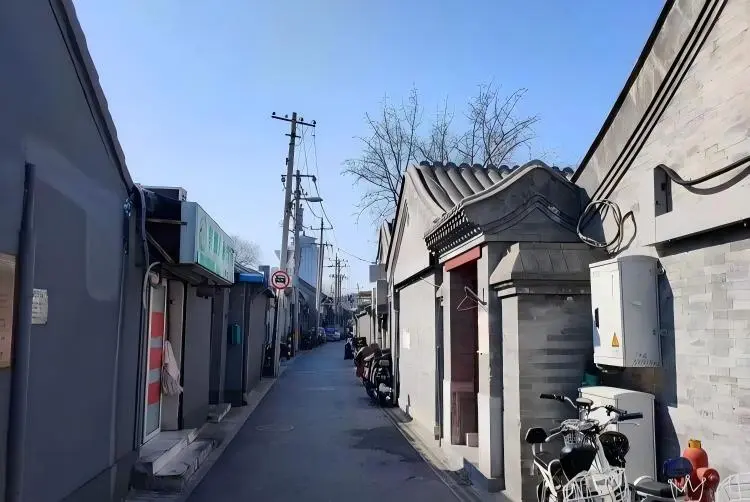
It is approximately 320 meters long and 5 meters wide, with an asphalt surface that makes for a comfortable walk. The hutong isn’t a straight line; it has a few bends, so as you walk, you’ll come across unexpected turns.
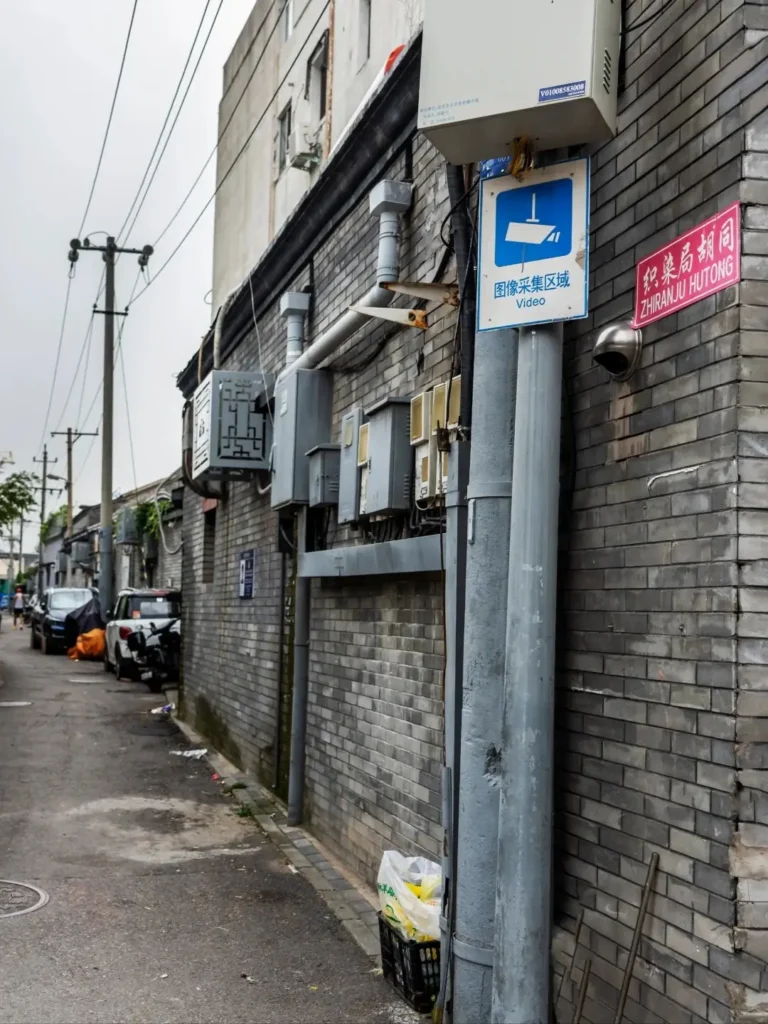
Old locust trees line the street; in summer, their lush foliage filters the sunlight into delicate golden patches scattered across the pavement. Most of the houses on either side feature gray, blue-brick walls and red wooden doors, with occasional glimpses of traditional brick carvings above the door lintels.
Since this area hasn’t been turned into a commercial street or demolished for redevelopment, what you see here are the authentic homes where ordinary Beijingers have lived for hundreds of years.
Zhiranju Hutong is also hailed as the perfect choice for “finding tranquility amidst the hustle and bustle of the hutongs”—it’s very close to Shichahai and Nanluoguxiang, yet walking through it, you’ll feel none of the noise typical of tourist areas.
Photography Guide
| Shooting Spot | Location | Best Time to Shoot | Tips |
| Old Blue-Brick Walls | Mid-section of the alley (near Shuiboji Hutong) | 10–11 a.m. | Take half-body portraits against a backdrop of gray bricks and tiles for a classic Old Beijing vibe |
| “Erqi Meiyuan” | Near Courtyard 27 | Afternoon | The small garden isn’t large, but it has a lively, everyday atmosphere—perfect for detailed close-ups |
| Entrance to Zhiranju Primary School | Former Courtyard 5 | Morning | Stand outside the gate and frame the address plaque against the red wall to capture the sense of time and space as a century-old temple transformed into a school |
| West Entrance to the Hutong | Intersection of Dongbanqiao Street and Zhiranju Hutong | Before sunset | Use the east-west light as a leading line to capture the depth of the hutong—it has a very cinematic feel |
| Entrance to Wang Guowei’s Former Residence | Courtyard 29 | All day | The house number is worth a close-up; imagine the scholars and literati coming and going in days gone by |
Nearby Attractions: 5 Landmarks Within Walking Distance
Zhiranju Hutong is located right in the heart of the city, just a short walk away from several of Beijing’s classic destinations:
| Attraction | Walking Time | Rating | Brief Description |
| Shichahai | 8 minutes | ⭐⭐⭐⭐⭐ | Beijing’s “urban lake”—boating in summer, ice skating in winter, lined with bars and restaurants, especially beautiful at sunset |
| Nanluoguxiang | 10 minutes | ⭐⭐⭐⭐ | Beijing’s liveliest hutong shopping street; though crowded, it’s worth a visit for first-time visitors to Beijing |
| Jingshan Park | 12 minutes | ⭐⭐⭐⭐⭐ | Climb to the top for a panoramic view of the Forbidden City! Admission is 2 yuan— It’s hands-down the best value viewpoint in Beijing |
| Shenwu Gate of the Forbidden City | 15 minutes | ⭐⭐⭐⭐⭐ | The northern gate of the Forbidden City; after touring the Forbidden City, simply head north to reach the Zhiranju Hutong area |
| Drum Tower | 10–12 minutes | ⭐⭐⭐⭐ | One of the iconic landmarks on Beijing’s central axis, surrounded by restaurants and trendy shops |
Suggested Itineraries:
– Itinerary A (Artistic and Tranquil Route): Shichahai (stroll along the lake) → Yinding Bridge → Walk along Dongbanqiao Street → Zhiranju Hutong (stroll) → Head south on Beihe Hutong → Nanluoguxiang (lively finale)
– Route B (Forbidden City Extension): Exit through Shenwu Gate at the Forbidden City → Jingshan Park (climb to the top for a panoramic view of the Forbidden City) → Exit through the East Gate of Jingshan Park and head north → Walk along Shatan North Street to Beihe Hutong → Zhiranju Hutong
Joint Recommendation: After exploring Zhiranju Hutong, head north from the eastern entrance to visit the location I previously covered in “Doufuchi Hutong: Yang Changji’s Former Residence + Bell and Drum Towers Guide.”
There, you’ll find Hong’eng Temple (within the temple grounds) and the courtyard where Mao Zedong once lived. Both hutongs are tucked away behind Jingshan Hill and Shichahai, share a similar atmosphere, and can be explored in a single day.
Dining Recommendations (5–10-minute walk)
| Name | Location | Features | Price per person |
| Small Eateries Along Gulou East Street | Near Gulou | Hot pot lamb, braised offal, and fried sauce noodles—authentic Beijing flavors | 40–80 RMB |
| Shichahai Bars/Light Meals | Along Shichahai | Western-style light meals and cocktails; live music in the evenings | 80–150 RMB |
| V7 COFFEE | Near Beiluoguxiang | Japanese-style dark-roast flannel pour-over coffee, very quiet | 40–50 RMB |
| Nanluoguxiang Snacks | Main Street of Nanluoguxiang | Lightning-style cream puffs, yogurt ice cream, and Old Beijing-style tripe | 20–40 RMB |
Frequently Asked Questions (FAQ)
A 600-Year-Old Hutong Awaits Your Discovery
Zhiranju Hutong is a quintessential “low-key Beijing hutong.”
There are no crowds of tourists, no souvenir shops hawking overpriced goods, and no dazzling neon lights. What you’ll see here is how the Imperial Weaving and Dyeing Bureau bustled during the Ming Dynasty 600 years ago; how great scholars like Wang Guowei read and wrote in small courtyards; how kind-hearted Beijing elders transformed a weed-choked, abandoned corner into a pocket garden bursting with flowers; and how children, backpacks on their backs, walk into classrooms built within a century-old temple.
Zhiranju Hutong has never been a Beijing “stage” for your viewing. It is Beijing.
Next time you leave the Forbidden City and climb Jingshan Hill to overlook the Imperial City, why not walk north for 15 minutes? Turn into Beihé Hutong and step into this 320-meter-long alley, so quiet you can almost hear your own footsteps.
There, the gray walls and tiles, the old locust trees, and the cats basking in the sun will place a more authentic, everyday Beijing right into your hands.