Guide to Dongchang Hutong in Beijing: 600 Years of History, Must-See Spots, and Walking Routes (2026)
Less than 320 meters long, Dongchang Hutong has served various purposes over the past 600 years, including as the headquarters of the Dongchang, the residences of powerful officials, the presidential residence, and an academic institution. Today, it remains an ordinary Beijing hutong where residents live.
️Important Note: Dongchang Hutong is not a fully preserved historic architectural site. The original Ming Dynasty Dongchang buildings no longer exist, and many of the later courtyards have undergone multiple demolitions and renovations. When you visit here, you’ll be exploring the original historical site, a few remaining relics, and the living urban fabric of old Beijing—not a complete Ming Dynasty archaeological site.
If this is your first visit to Beijing, Dongchang Hutong isn’t worth making a special trip for; however, if you’re already touring Wangfujing, the National Art Museum of China, or Peking University’s Red Building, it’s an excellent spot to set aside 30–45 minutes for a historical “CityWalk.”
Visitors who enjoy hutongs and modern history will find it particularly rewarding; if your schedule is very tight, you may want to prioritize core landmarks such as the Forbidden City, the Great Wall, and the Temple of Heaven.
Dongchang Hutong is less than 320 meters long and takes just five minutes to walk through, yet over the past six centuries, it has served as a secret police headquarters, a private garden, a presidential residence, and a center of learning.
It’s a five-minute walk from the subway station, and admission is free. There are no signs of commercialization here—only authentic history and the genuine daily lives of residents.
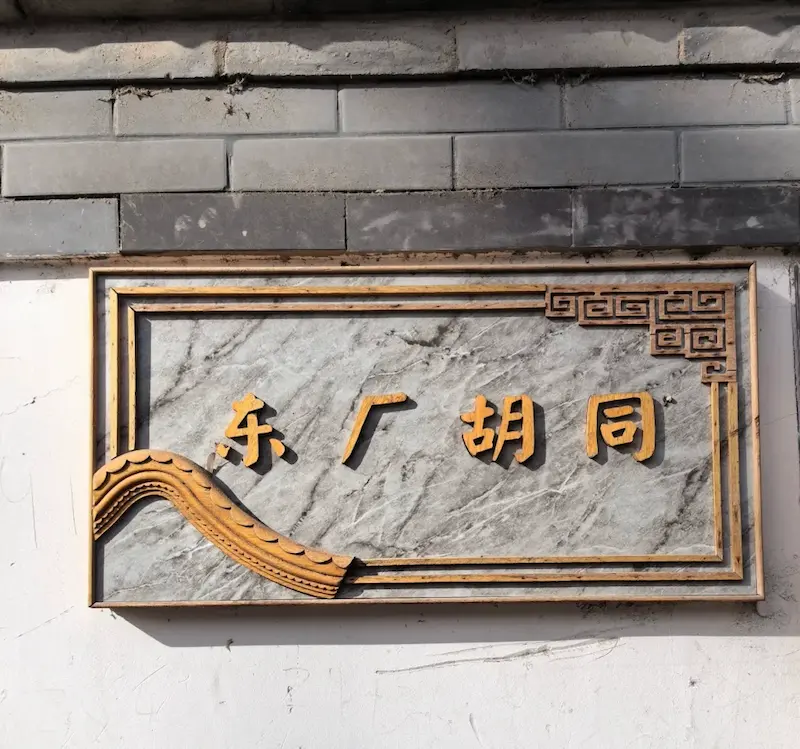
Table of Contents
Practical Information (Must-Read Before Departure)
| Item | Details |
| Name | Dongchang Hutong (Pinyin: `Dongchang Hutong`) |
| Address | Dongcheng District, Beijing; runs east-west from Wangfujing Street in the east to Donghuangchenggen South Street in the west, bordering Anju Li to the south and Dongchang North Alley to the north; total length 319 meters, width 7 meters; paved with asphalt |
| Subway | Line 8, National Art Museum of China Station, Exit A. After exiting the station, head south across the intersection (Ping’an Street/Wusi Street) and enter Donghuangchenggen South Street. The Imperial City Wall Relics Park is located on the east side of this street. Walk straight south along the east side of the park for about 5 minutes; the western entrance to Dongchang Hutong will be on your left (east side). The total distance is approximately 300 meters. |
| Bus | Take Buses 104, 108, 111, etc., and get off at the “Art Museum” stop; or take Buses 2, 60, etc., and get off at the “North of Shatan Road Intersection” stop |
| By Car | Not recommended. There are virtually no parking spaces for tourists within the hutong. If taking a taxi, use the destination “West Entrance of Dongchang Hutong (Donghuangchenggen South Street)” or “East Entrance of Dongchang Hutong (Wangfujing Street)”; entering from the Wangfujing Street side is more convenient for getting out |
| Admission | Free throughout. The hutong itself is an open street, accessible 24/7. |
| Hours | The hutong is open 24 hours a day, 365 days a year. However, please remain quiet in residential areas and avoid disturbing residents. |
| Best Time to Visit | Before 10:00 AM or after 3:00 PM on weekdays. The morning offers good lighting for photography; the afternoon is less crowded, making it ideal for a quiet stroll. Walking the entire length of the hutong takes about 5–10 minutes. |
| Recommended Visit Duration | ✅ 5–10 minutes: Just a quick walk through the hutong; ✅ 30 minutes: West Entrance + Courtyard No. 28 + Central Section + exterior of No. 27 Wangfujing Street; ✅ 45–60 minutes: All highlights + photo opportunities + a quick stroll through Cuihua Hutong |
| Dress Code | Wear comfortable flat shoes. The hutong’s pavement is asphalt and very flat and easy to walk on. |
| Budget Guide | The alley is free to visit. There are no dining options within the alley; if you plan to eat on Wangfujing Street, lunch costs range from 30 to 150 yuan (approximately $4–$20). |
| Photography | Photography is permitted. You may take photos outdoors throughout the entire alley. However, most courtyards are now private residences or office spaces, so please do not enter without permission and avoid photographing residents’ windows. |
| Language Support | There are no English information boards within the hutong. We recommend researching in advance or using a mobile translation app. |
| On-Site Reminder | The main gate at No. 27 Wangfujing Street (formerly No. 1 Dongchang Hutong) is currently guarded by security personnel, and the interior is not open to visitors. Please view the gate from the outside and take photos of it; do not attempt to force your way into the office area. |
Friendly Reminder
The eastern entrance of Dongchang Hutong connects to Wangfujing Street, while the western entrance connects to Donghuangchenggen South Street (Imperial City Wall Ruins Park). There are many attractions to explore in both directions.
Most of the courtyards within the hutong are residential, so please keep quiet and respect the residents’ privacy.
Additionally, this hutong still houses some research institutes and scholar dormitories of the Chinese Academy of Social Sciences. As you walk here, behind the gray walls and tiles you see, there may be a historian researching archives related to the very hutong you are walking on.
If It’s Your First Visit to Dongchang Hutong, Make Sure to See These 4 Spots First
① West Entrance of Dongchang Hutong
At the entrance on Donghuangchenggen South Street, start by looking at the stone signpost in the hutong to use as your starting point and get your bearings along the entire length of the hutong. View the area only from the street; do not enter the courtyards.
② Courtyard No. 28 (Former Site of the Japanese Military Prison)
This is the site with the most prominent historical traces along the entire alley; it was originally a building requisitioned by the Japanese military during their occupation. You may only observe the remains of the building’s exterior walls from the public road.
The courtyard now houses both residential and office spaces; entry is strictly prohibited. The small windows in the low iron grating at the base of the wall have been described in related reports as the original food-delivery and ventilation openings from that era; they are for external observation only.
③ Mid-section of the Alley (Area of the Former Ronglu Mansion)
This area marks the site of the late Qing dynasty Ronglu Mansion. Today, it is a mix of office spaces and residential units; most buildings have been altered in later periods. There are no exhibition areas open to the public; visitors can only experience the atmosphere of the original site from outside the alley.
④ No. 27 Wangfujing Street (formerly No. 1 Dongchang Hutong)
This is the most significant historical landmark along the entire hutong, situated on the site of the Ming Dynasty’s Dongchang, which has undergone several transformations over the years. The compound is guarded by security personnel and is not open to the public; visitors can only view it from outside the main gate.
Why Is It Called Dongchang Hutong?
The character “厂” here does not refer to a factory, but rather to an ancient government office. The full name of “Dongchang” is “Dong Jishi Chang,” a secret intelligence agency established by the emperors of the Ming Dynasty that reported directly to the emperor.
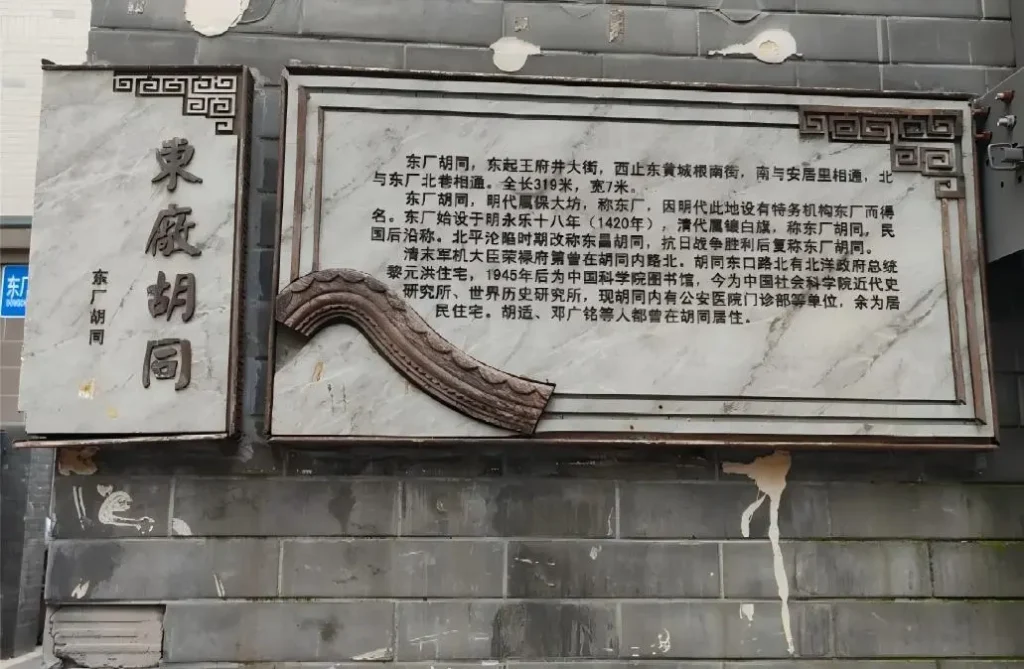
The Dongchang was overseen by eunuchs in the emperor’s inner circle and possessed immense power, allowing it to arrest and interrogate individuals directly without approval from regular judicial authorities.
During the Tianqi era at the end of the Ming Dynasty, Wei Zhongxian held power, and the Eastern Factory reached the height of its influence, orchestrating numerous wrongful prosecutions. Officials such as Yang Lian were persecuted, making it one of the most controversial institutions in the political history of the Ming Dynasty.
A Brief 600-Year Timeline of Dongchang Hutong (Perfect for Screenshotting and Saving)
1420, Ming Dynasty | The Dongchang was established; this site served as the headquarters of the Ming Dynasty’s investigative agency
↓
Qing Dynasty | Successively served as the residences of Alan Tai and Rui Lin; the private garden Yiyuan (later renamed Yuyuan) was constructed here; in the late Qing Dynasty, it became the residence of Rong Lu
↓
Republic of China | Yuan Shikai purchased the property and gifted it to Li Yuanhong, who used it as his official residence as President of the Republic of China
↓
During the Japanese Occupation of the War of Resistance | Requisitioned by Japanese forces, which established cultural institutions here; Courtyard No. 28 served as a secret prison
↓
After 1945 | Assigned to Peking University’s Institute of Humanities, where Hu Shi resided; later became the headquarters for several research institutes of the Chinese Academy of Social Sciences
↓
Today | An urban hutong where residential homes and research and office facilities coexist
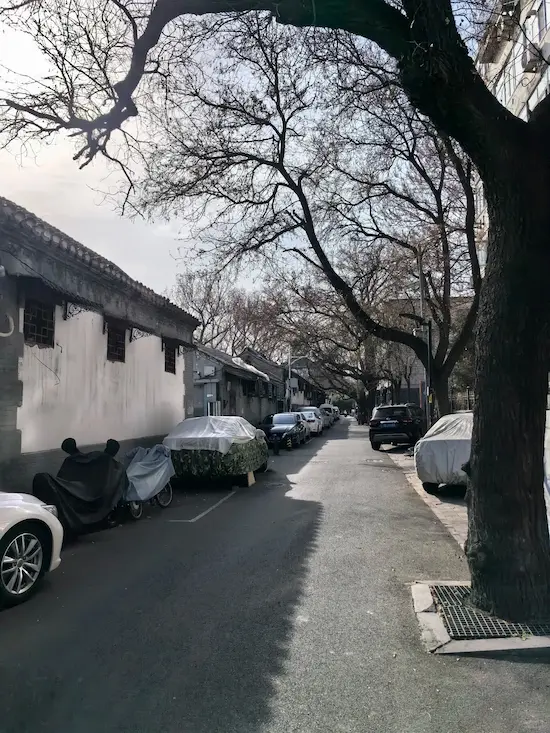
Six Hundred Years of Dongchang Hutong: A 319-Meter Walking Tour
The story of Dongchang Hutong is like a revolving door—push it open, and you step into a completely different era.
1. Ming Dynasty (c. 1420–1644): Site of the Imperial Investigation Agency
In the 18th year of the Yongle reign (1420), Zhu Di moved the capital to Beijing and established the Dongchang, an investigative agency under the emperor’s direct control; its offices were located in this alley. A portrait of Yue Fei hung in the main hall, symbolizing “loyalty and devotion to the nation.” The agency was headed by eunuchs and comprised various types of investigative personnel.
During Wei Zhongxian’s reign of power in the late Ming Dynasty, the Dongchang carried out a massive purge of dissidents, and ministers such as Yang Lian were persecuted. With the fall of the Ming Dynasty, the Dongchang was abolished, but the place name has been preserved.
2. The Qing Dynasty (c. 1644–1912): From a Terrifying Government Office to a Private Garden for the Powerful and Privileged
After the Dongchang agency was abolished, the land was converted into private residences for the powerful and privileged. During the Kangxi reign, Alan Tai lived here; during the Daoguang and Xianfeng reigns, Grand Secretary Rui Lin built a mansion and a private garden in the Jiangnan style, known as Yiyuan.
In 1900, during the Boxer Rebellion, the garden was requisitioned by German troops and used as a field hospital. After the war, Rui Lin’s descendants restored the garden and renamed it Yuyuan, signifying “survival after a catastrophe.” In 1904, Yuyuan opened to the public, becoming one of the earliest gardens in Beijing to be accessible to the general public.
According to relevant records, Rong Lu’s residence was one of the earliest in Beijing to be equipped with electric lighting.
Rong Lu, a high-ranking official of the late Qing dynasty, resided in this mansion.
3. Late Qing Dynasty to the Republic of China (c. 1900–1949): Presidential Residence and Hub of Japanese Culture
After the Xinhai Revolution, Yuan Shikai purchased this residence and presented it to Li Yuanhong. When Yuan Shikai proclaimed himself emperor, he conferred the title of Prince of Wuyi upon Li Yuanhong, but Li Yuanhong flatly refused. Following Yuan Shikai’s death, Li Yuanhong held his presidential inauguration ceremony at this residence.
The compound subsequently changed hands several times, serving as the residence of various officials.
After Japanese forces occupied Beiping, the hutong was renamed Dongchang Hutong, and the Oriental Cultural Affairs Committee was established there; Courtyard No. 28 was requisitioned and used as a secret prison to detain anti-Japanese activists.
Biography: Li Yuanhong was a prominent political figure during the Republic of China era and served twice as President of the Republic.
4. From the End of the War of Resistance to the Present: From the Presidential Palace to the Academic Hall
Following the victory in the War of Resistance, the hutong was restored to its former name, Dongchang Hutong. Peking University took over the site to establish the Institute of Humanities, and Hu Shi resided there. Scholars such as Fan Wenlan, Deng Guangming, and Tang Yongtong conducted their research there.
After the founding of the People’s Republic of China, the site became the headquarters for institutions such as the Institute of Modern History at the Chinese Academy of Social Sciences. In 2019, the Institute of Modern History relocated its main operations, though some research units remain on the premises.
Key Highlights: A 319-Meter Walk Through Six Centuries, from West to East
Dongchang Hutong is very short; it takes only about ten minutes to walk from the west end to the east end at a leisurely pace. But if you want to pause and take in the history, be sure to pay attention to the following spots in order:
1. The West End of the Hutong and Courtyard No. 28 (Former Site of the Japanese Military Prison)
Upon entering from the west end, on your right (north side of the street), you’ll find a compound consisting of three small gray two-story buildings—this is Courtyard No. 28. It is also the only place in this section of the hutong that bears the “cold, grim mark” of modern history.
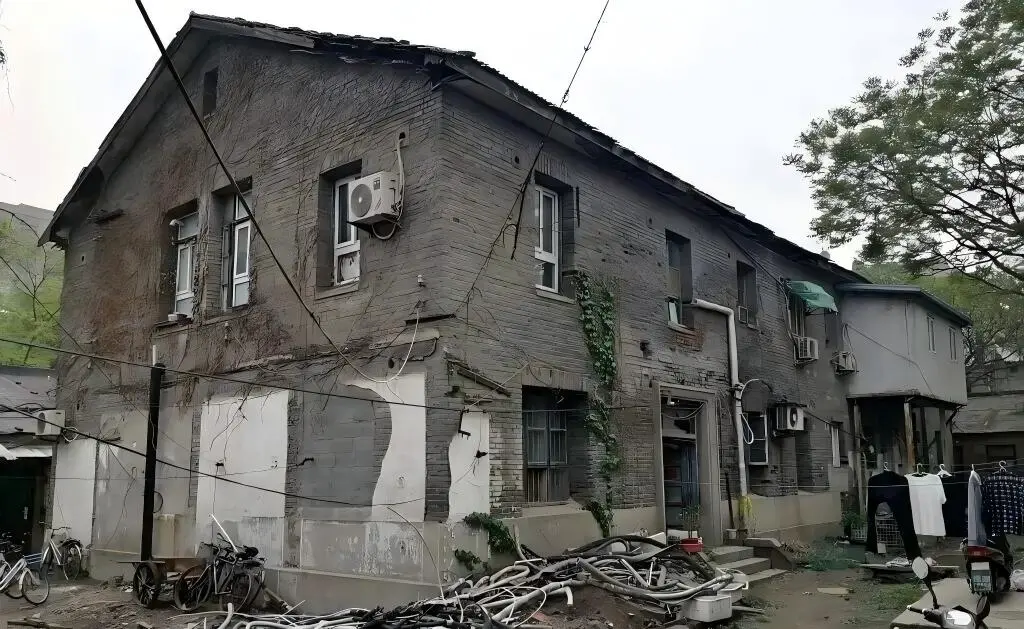
On-Site Viewing Guide: As you walk past Compound No. 28, please look for the small, low iron-barred windows near the ground. According to related reports, these are remnants of ventilation and meal-serving openings from the prison era.
⚠️ On-site Note: Courtyard No. 28 is currently home to ordinary residential units and offices; it is not open to the public. Please do not enter without authorization. Simply view the exterior of the building from the alley.
2. The Middle Section of the Hutong (Ronglu Mansion Area)
Walking eastward from the west entrance to the middle section, the large compound on the north side of the street was once Ronglu’s residence—the first place in Beijing, aside from the Forbidden City, to have electric lighting.
Today, this area is a mix of research institutes affiliated with the Chinese Academy of Social Sciences and residential buildings, and it is not open to the public. Standing in the alley, one needs only imagine the old incandescent lights that illuminated the Imperial City walls on a late night a century ago.
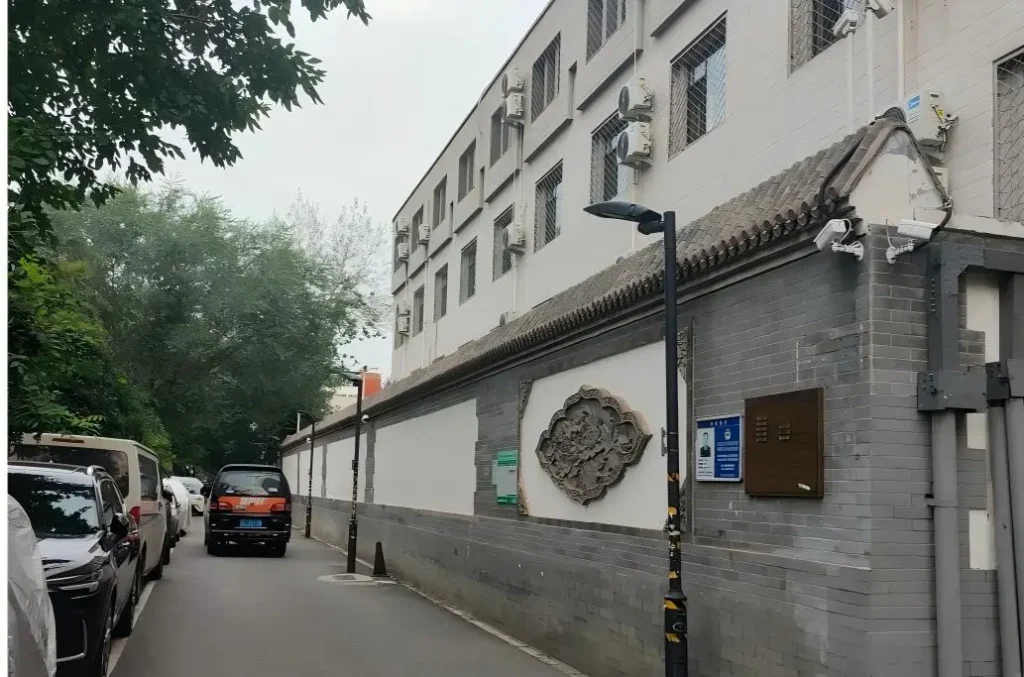
3. Compound No. 27 Area (No. 1 Dongchang Hutong / No. 27 Wangfujing Street)
Located at the eastern entrance of the hutong, this large compound—whose main gate faces Wangfujing Street—is the most significant historical landmark in the entire hutong. It has two street addresses: No. 1 Dongchang Hutong and No. 27 Wangfujing Street, both referring to the same area.
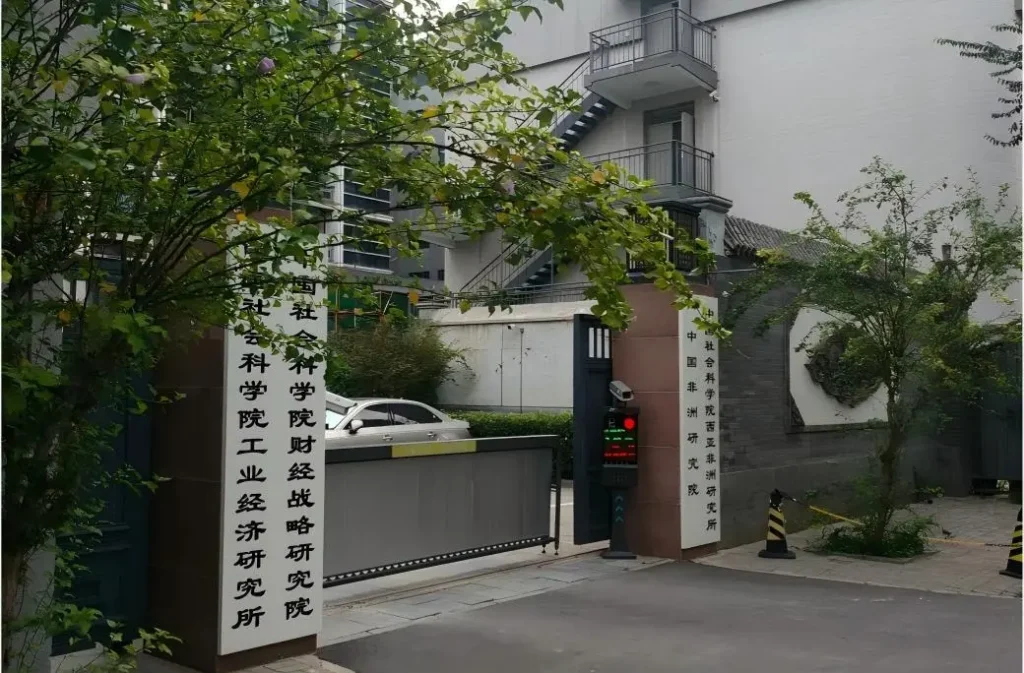
This compound has undergone the following transformations:
Ming Dynasty Dongchang Bureau → Qing Dynasty Rui Lin Residence → Rong Lu Mansion → Residence of Republic of China President Li Yuanhong → Japanese Army Oriental Cultural Affairs Committee → Peking University Institute of Humanities → Former Residence of Hu Shi → Institute of Modern History, Chinese Academy of Social Sciences → CAS Building Complex
The evolution of this courtyard’s functions creates a fascinating historical contrast: the site was originally associated with a Ming Dynasty investigative agency and, in modern times, served for many years as the office of a historical research institution.
Current Situation: The western half of this area is currently home to several research institutes of the Chinese Academy of Social Sciences, while the eastern half consists of faculty housing. In 2019, the Institute of Modern History relocated its main operations, though some departments remain on site. The compound’s main gate is at 27 Wangfujing Street; there is no direct access from inside Dongchang Hutong.
⚠️ On-site Note: Security personnel are stationed at the main gate, and the interior is not open to visitors. Please view the building from the outside and do not attempt to force your way into the office area.
4. The Hutong Itself: Authentic Old Beijing Life
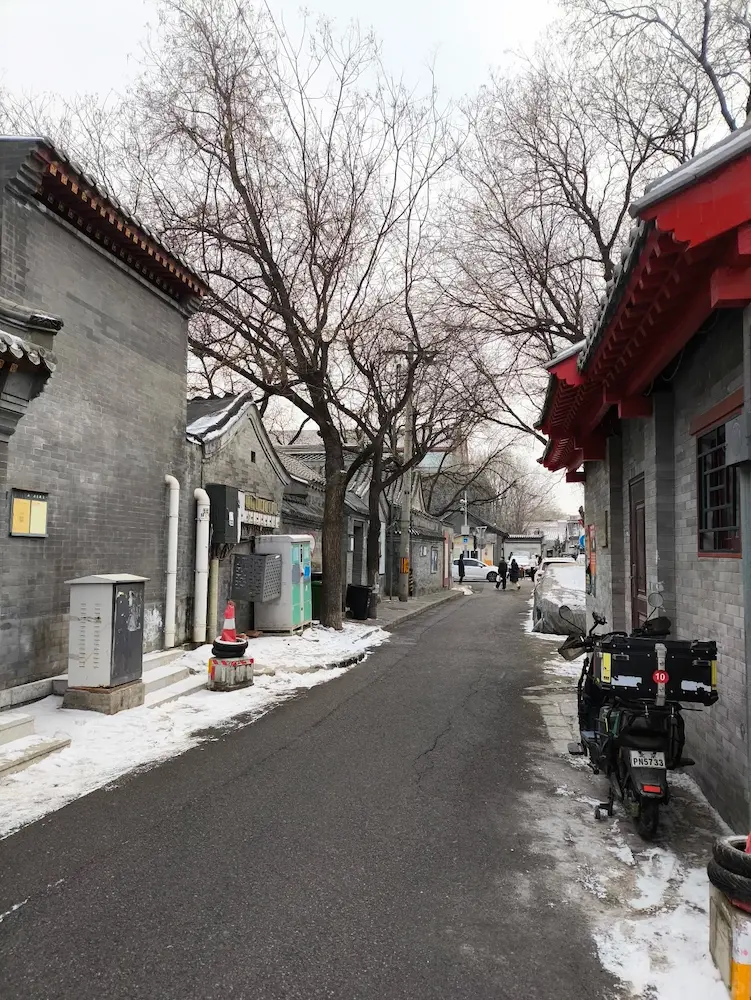
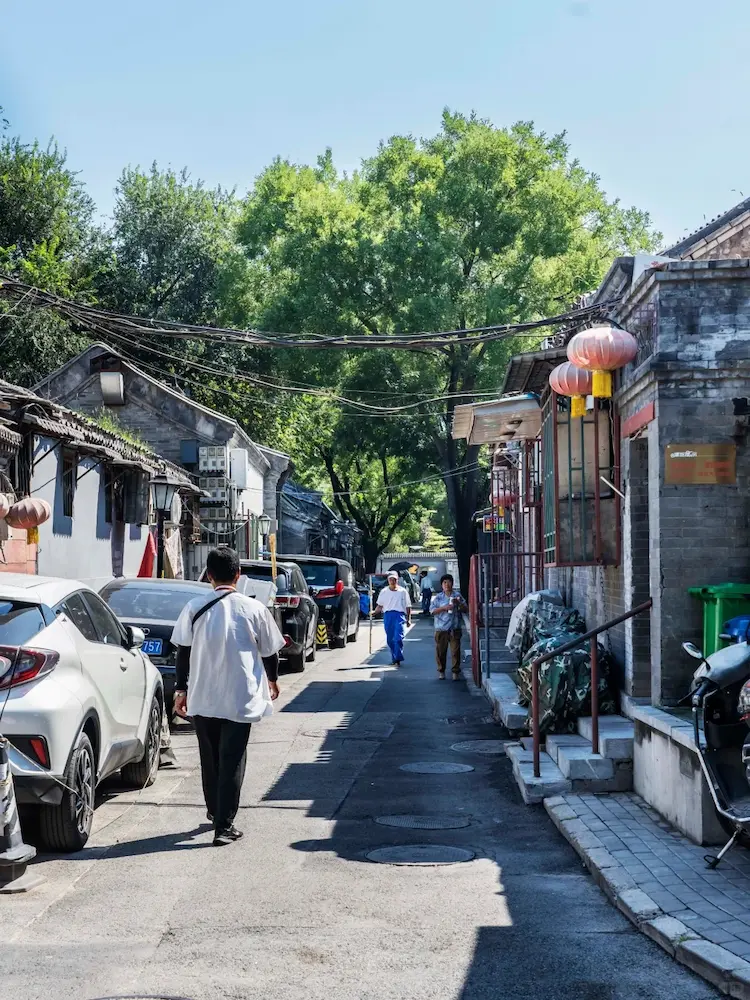
Perhaps the greatest charm of Dongchang Hutong lies not in any specific “attraction,” but in the hutong itself. Here, no street vendors are hawking their wares, no souvenir shops with cookie-cutter interiors, and no crowds of tourists.
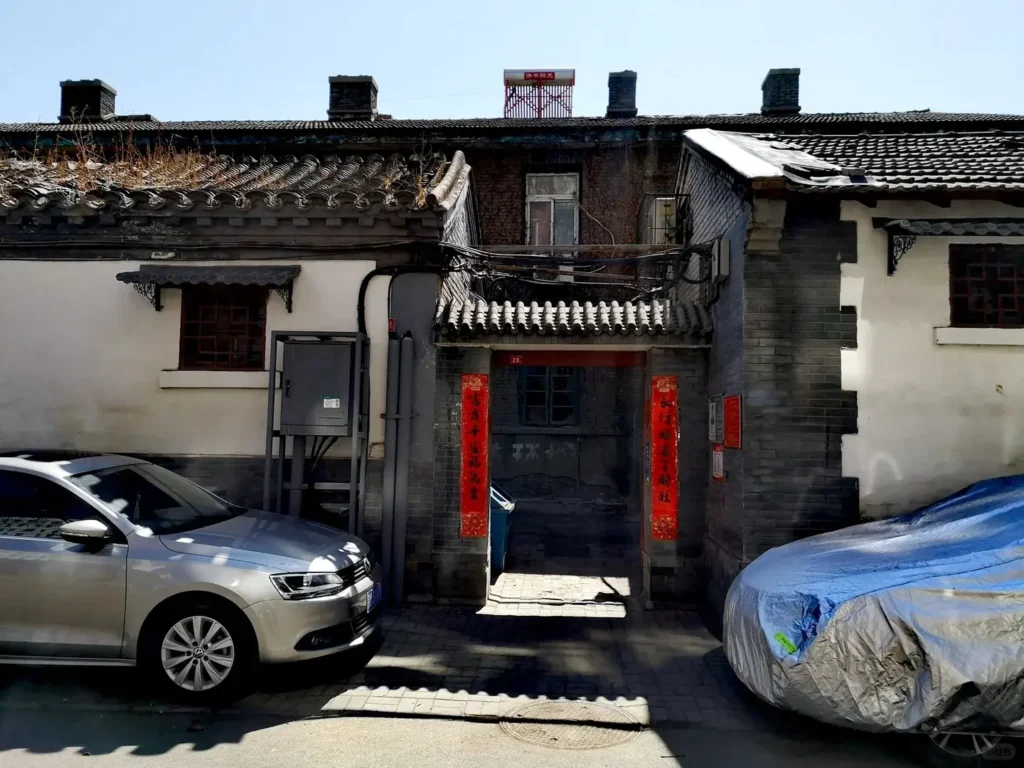
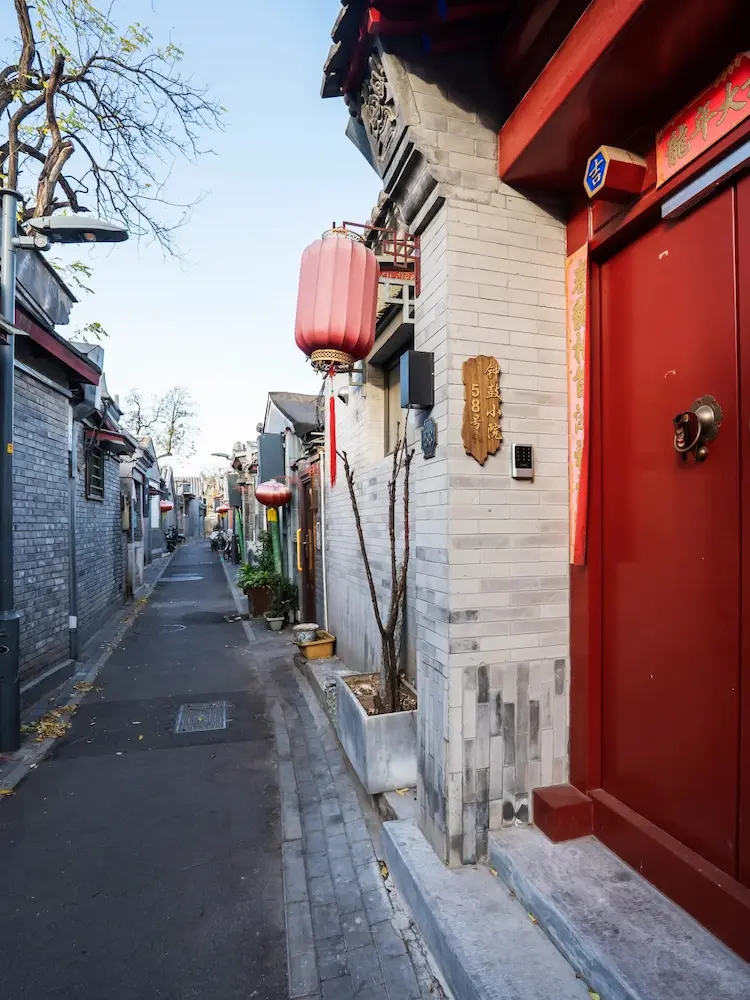
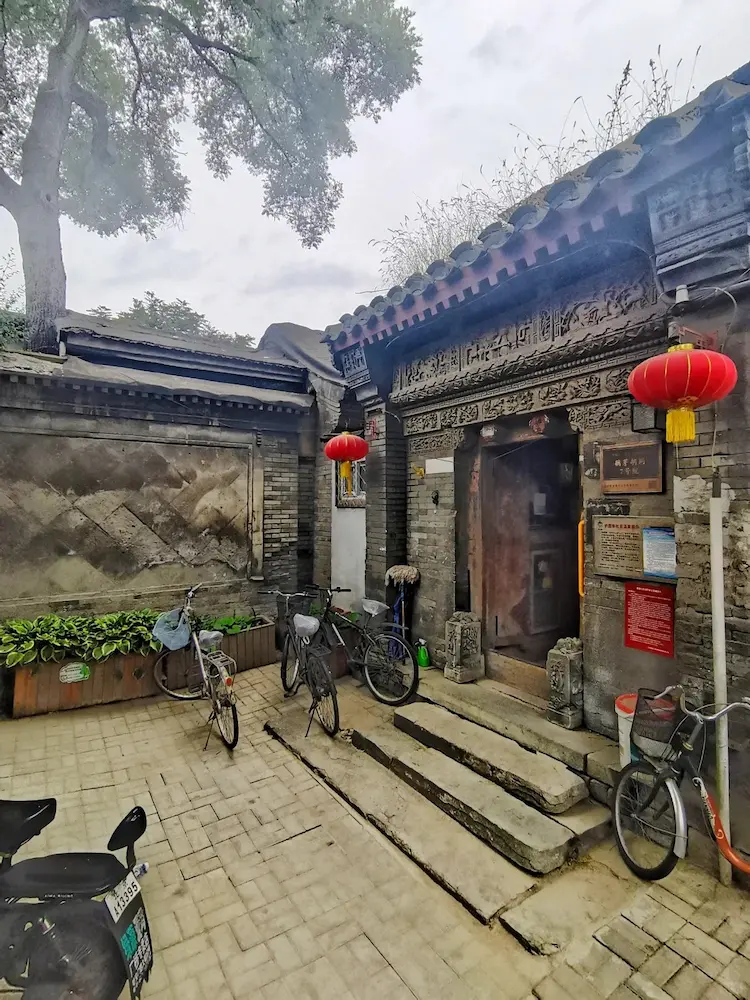
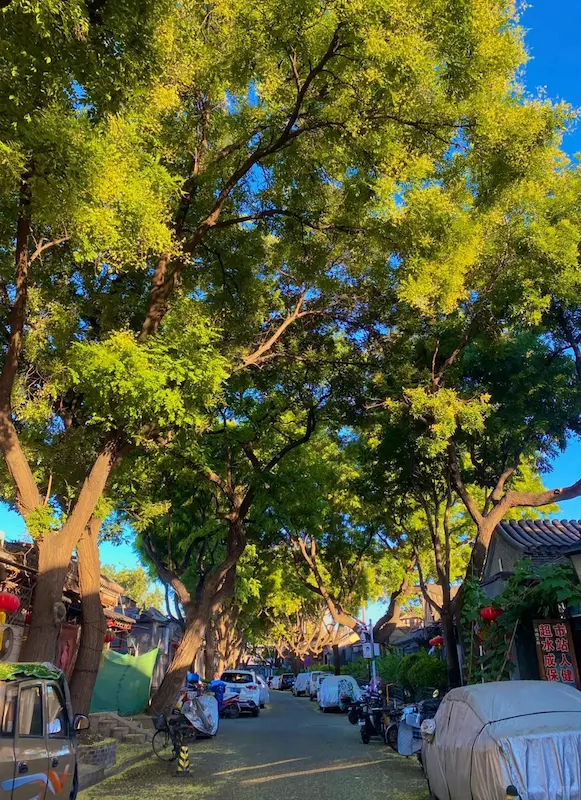
What you see are the homes where ordinary Beijingers have lived for hundreds of years—gray brick walls, red wooden doors, ivy climbing the walls, quilts drying at the door, and flower pots on the windowsills.
Photography Tips and On-Site Observation Guide
| Shooting Location | Location | Best Time to Shoot | Observation & Photography Tips |
| Stone Sign at the West Entrance of the Hutong | Entrance to Donghuangchenggen South Street | Morning or evening | Photograph the stone sign at the entrance of the hutong, the starting point of the tour, to document the hutong’s landmark |
| Gray-brick Building in Courtyard 28 | North side of the street (western section) | Morning | Observe the gray-brick exterior walls and remnants of low iron-grilled windows; frame shots only from the street side—do not photograph residents’ interiors |
| Old Locust Tree in the Middle Section of the Hutong | North side of the street in the middle section | Afternoon | Capture the interplay of light and shadow on the gray-brick walls and tree leaves to capture the everyday atmosphere of an old Beijing hutong |
| Intersection with Dongchang North Alley | Entrance to the northern side alley in the middle section of the hutong | All day | Photograph the depth of the narrow alley and capture the vibrant, everyday atmosphere of the hutong |
| Eastern Section of the Hutong | Near the eastern entrance | Late afternoon | Shoot from the depths of the hutong toward the eastern entrance to capture the contrast between the old hutong and the modern buildings of Wangfujing |
Note: Please do not take photos inside any residential courtyards; respect the residents’ privacy.
Dongchang Hutong CityWalk Itinerary (Three Ready-to-Follow Routes)
Route A|30–45 minutes (Best choice if you’re short on time)
National Art Museum of China → Dongchang Hutong (Enter at the west entrance, exit at the east entrance) → Wangfujing Street
Route B|1.5–2 hours (Recommended for Most Visitors)
National Art Museum of China → Full tour of Dongchang Hutong → 2-minute walk to Cuihua Hutong → Tour of Cuihua Hutong → Wangfujing Street
A 2-minute walk takes you seamlessly to [In-Depth Guide to Cuihua Hutong: The Free Hutong Next to Wangfujing and China’s First Privately Owned Restaurant]
Route C | Half-Day In-Depth Historical CityWalk
National Art Museum of China → Dongchang Hutong → Cuihua Hutong → Peking University Red Building → Wangfujing
Additional Notes on Nearby Sites:
- Peking University Red Building: Walk north from the east entrance of Dongchang Hutong (Wangfujing Street), then west along Wusi Avenue for about 5 minutes to reach it. The birthplace of the May Fourth Movement and a landmark of the New Culture Movement; free admission with reservation.
- Shenwu Gate of the Forbidden City / Jingshan Park: Walk west from the western entrance of Dongchang Hutong for about 15 minutes to reach Jingshan Park. From the Wanchun Pavilion on Jingshan Hill, you can enjoy a panoramic view of Beijing’s central axis.
- Zhiranju Hutong and Doufuchi Hutong: Accessible by walking north; ideal for visitors with ample time who wish to extend their hutong loop further north.
Where to Eat After Exploring Dongchang Hutong?
There are no restaurants inside the hutong.
1. Top Choice: Cuihua Hutong, a 2-minute walk south from a side alley in the middle section of Dongchang Hutong. Yuebin Restaurant, located at No. 43 Cuihua Hutong, is a well-known, long-established home-style restaurant in Beijing.
2. Second Choice: Wangfujing Street. The eastern entrance of the hutong leads directly to Wangfujing Commercial Street, which offers a full range of dining options to suit every budget.
3. Alternative: The area around Shatan Back Street and Beiheyan Street. Head north from the western entrance to find numerous small restaurants and coffee shops.
Tip: Mobile payments are widely used in China. International visitors are advised to have a translation app on hand; please follow the payment rules posted at each establishment.
FAQ
Dongchang Hutong is only 319 meters long, and it takes just a few minutes to walk from the west end to the east end. Yet every step of those 319 meters spans six centuries—spies, dignitaries, presidents, and scholars have all witnessed, one after another, the most dramatic upheavals in the history of Beijing and indeed all of China.
It requires no admission fee and no reservation. It lies quietly between Wangfujing Street and the Imperial City Wall, free from the overcommercialization of Nanluoguxiang and devoid of the contrived packaging of “red tourist sites” or “imperial aura.”
It is living history. Behind the red-lacquered wooden doors, an elderly woman hangs out her bedsheets, while a senior scholar from the Chinese Academy of Social Sciences rides an old bicycle through the narrow alley on his way to work.
Six hundred years ago, agents of the Dongchang walked here; a hundred years ago, Li Yuanhong and Hu Shi walked here; and today, you walk here—all of you treading the same path of gray bricks and tiles.
When exploring Dongchang Hutong, don’t rush to finish. Walk a little slower, look up at the street signs on the walls, and reflect on the immense changes and continuities in China and the world from 1420 to 2026. Then turn into Cuihua Hutong for a plate of garlic-marinated pork hock; just 500 meters away lies the bustling Wangfujing.
This is the charm of Dongchang Hutong: it never stops for anyone, nor does it let history be buried. It stands right in the heart of Beijing’s bustling city center—unassuming, unassuming, waiting for every one of you willing to slow down.