Outer Jinshui Bridge: One of the Seven White Marble Bridges on the Central Axis—Take the Wrong One and You’ll Be Beheaded (2026 Guide)
Nine out of ten visitors to Tiananmen Square will cross one of these seven white marble bridges. But many people don’t know that the bridge beneath their feet has an official name—Outer Jinshui Bridge (Wài Jīnshuǐ Qiáo).
It spans the Outer Jinshui River in front of Tiananmen Gate and marks the starting point of the “Imperial City Ceremonial Route” along Beijing’s Central Axis. On July 27, 2024, the Outer Jinshui Bridge was inscribed on the World Heritage List as part of“Beijing’s Central Axis—A Masterpiece of the Order of China’s Ideal Capital.”
For 600 years, only the emperor was allowed to walk on the central span; princes walked on the side spans; officials of the third rank or higher walked on the outer spans; and those of the fourth rank or lower were restricted to the two outermost bridges—choosing the wrong one was a capital offense.
Today, all seven bridges are open to visitors. Standing on the bridge and looking north, you see the Tiananmen Gate; looking south, you see the Monument to the People’s Heroes and the Chairman Mao Memorial Hall.
This is also one of the best spots on Tiananmen Square for taking photos—it’s completely free, requires no reservation, and is accessible via Metro Lines 1 or 2.
Table of Contents
Before You Go, Make Sure You Know These Things
Admission: Completely free; no reservation required.
How to Enter the Square Area: The Outer Jinshui Bridge is located within the Tiananmen Square area, and you must pass through security checks to enter. There are two ways to do this:
1. Make a reservation 1–9 days in advance via the WeChat mini-program“Tiananmen Square Visit Reservation.”
2. If you’ve already booked tickets for attractions such as the Forbidden City, the National Museum of China, or the Tiananmen Gate Tower, you can use your booking confirmation to enter the square area without making a separate reservation. For information on booking attractions, see the [Beijing Attraction Booking Guide].
Reminders for foreign visitors regarding Square reservations:
1. The interface of the WeChat mini-program “Tiananmen Square Visit Reservation” is entirely in Chinese. If you do not understand Chinese, please use WeChat’s built-in “Long-press to Translate Image” feature or your phone’s screen translation function to assist with the process.
2. When entering ID information, foreign visitors should select “Passport” (look for the word “Passport” in the ID list) and enter their name exactly as it appears on the first page of their passport.
3. If you find making a separate reservation for Tiananmen Square too troublesome, here’s an easier option: simply book a visit to the Forbidden City or the National Museum. Your reservation confirmation will grant you access to the Tiananmen Square area as well, allowing you to visit an additional attraction.
Hours: Jinshui Bridge itself is open 24 hours a day, but access to Tiananmen Square is subject to time restrictions; you must enter during the time slot specified in your reservation. Opening hours are typically earlier in the summer, and the area is cleared in the evening.
Best Times: Early morning (around flag-raising time)—with fewer people and good lighting, you can capture photos of Jinshui Bridge and the Tiananmen Gate Tower together; late afternoon (around sunset)—when the lights come on and the bridge is reflected in the water, creating a very photogenic scene.
Recommended Duration: 15–30 minutes—enough time to take photos and learn about the history.
Transportation:
- Subway (Recommended): Take Line 1 and get off at Tiananmen East or Tiananmen West Station. After exiting the station, walk south toward the square.
- Bus: Routes 1, 2, 5, 8, 10, 20, 52, 82, 120, etc. Get off at the “Tiananmen East” or “Tiananmen West” stop.
- Driving (Highly Not Recommended): The area around Tiananmen Square has Beijing’s strictest traffic restrictions, and parking is extremely difficult.
For information on how to use public transportation in Beijing, see [The Best Ways to Get Around Beijing (Practical Guide for Foreign Visitors 2026)].
Dress Recommendations: Wear comfortable flat shoes; the square is very large, and you’ll be doing a lot of walking.
What Is the Outer Jinshui Bridge? The “First Gate” of Imperial City Etiquette
The Outer Jinshui Bridge is located directly in front of the Tiananmen Gate Tower, spanning the Outer Jinshui River, and is one of the central segments of Beijing’s central axis.
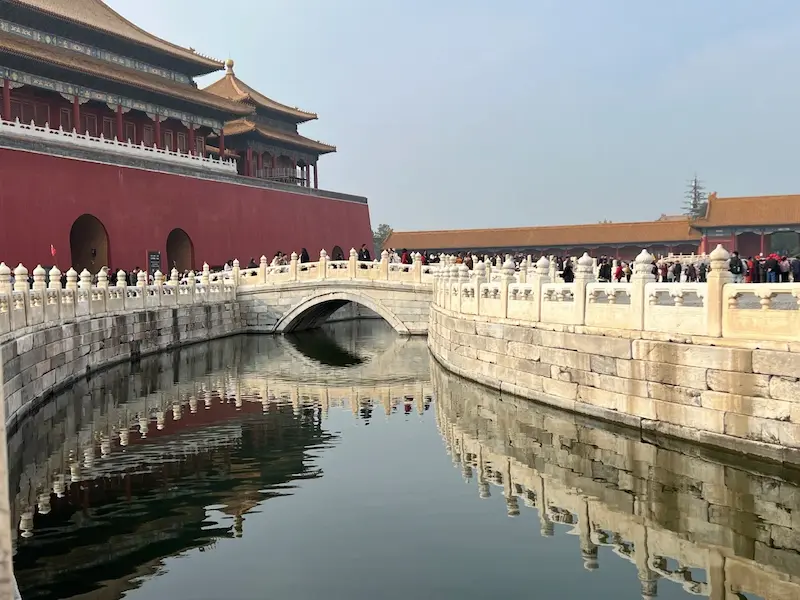
Where does the name “Jinshui River” come from?
The water of the Jinshui River is drawn from Yuquan Mountain in the western suburbs of Beijing. In ancient Chinese philosophy’s theory of the Five Elements, “Metal” represents the west. Since this river flows from the western suburbs of Beijing, it was named the “Jinshui River.”
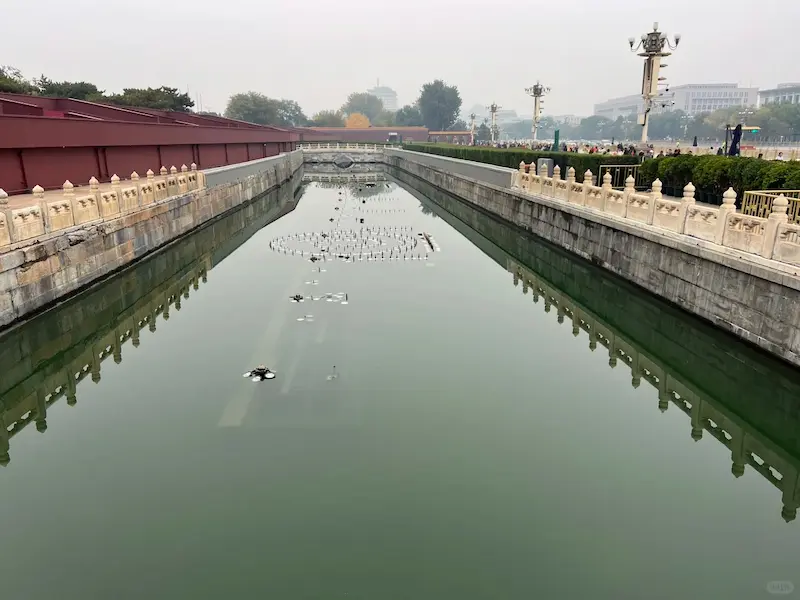
The section in front of Tiananmen is called the “Outer Jinshui River,” to distinguish it from the “Inner Jinshui River” in front of the Taihe Gate of the Forbidden City.
When was the Outer Jinshui Bridge first built?
The Outer Jinshui Bridge was first built during the Yongle era of the Ming Dynasty; it was originally a wooden bridge but was converted to a stone bridge during the Jingtai era.
In the first year of the Chenghua era (1465), it was expanded from three spans to five. Together with the two “Gongsheng Bridges” in front of the Imperial Ancestral Temple and the Altar of Land and Grain, this formed the current configuration of seven bridges.
The existing main structure was rebuilt in the 29th year of the Kangxi era (1690) during the Qing Dynasty.
Seven Bridges, Seven Roles: Ancient “Passes”
There are a total of seven Outer Jinshui Bridges. The five bridges in the center, directly in front of Tiananmen Gate, align with the five gateways of the Tiananmen Gate Tower. There is one bridge on each of the eastern and western sides, located in front of the Imperial Ancestral Temple (now the Palace of Working People’s Culture) and the Altar of Land and Grain (now Zhongshan Park), respectively.
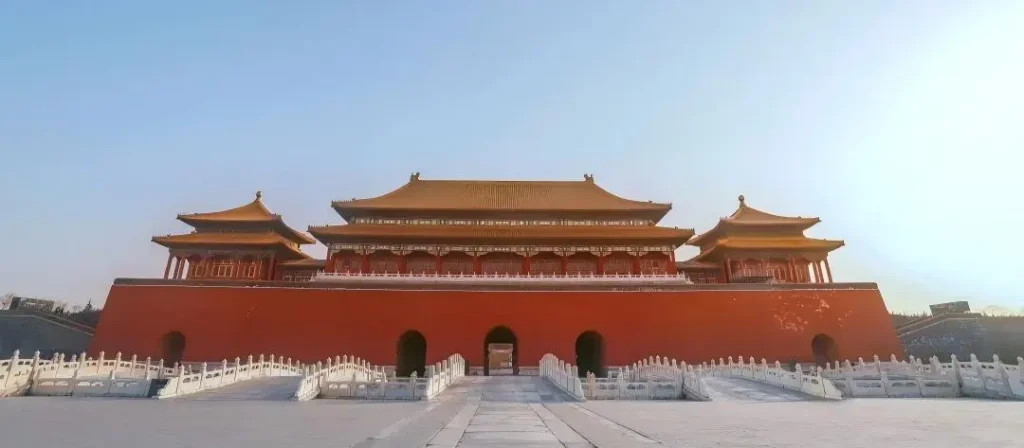
These seven bridges vary significantly in rank:
| Bridge Name | Location | Width | Who May Cross |
| Imperial Path Bridge | Center | Widest (approx. 8.55 meters) | Emperor only |
| Princes’ Bridge | One on each side of the Imperial Path Bridge | Second widest (approx. 5.78 meters) | Princes of the Imperial House |
| Rank Bridge | One on each side of the Princes ’Bridge | Second widest (approx. 4.55 meters) | Civil and military officials of the third rank and above |
| Commoners’ Bridge | Outermost (in front of the Imperial Ancestral Temple and the Altar of Land and Grain) | Narrowest | Officials below the fourth rank, soldiers, and laborers |
- The most prestigious “Imperial Bridge”: The central bridge, with the widest deck and balustrade capitals carved with coiled dragons gazing upward, was reserved exclusively for the emperor.
- The “Princes’ Bridge” for royal princes: The two bridges flanking the Imperial Bridge on either side, slightly narrower in width and featuring balustrade capitals carved with lotus flowers, were designated for use by princes of the imperial family.
- The “Rank Bridges” for officials: The two bridges on the outer sides of the Princes’ Bridges are even narrower and also feature lotus carvings; they were reserved for civil and military officials of the third rank and above.
- The outermost “Commoners’ Bridges”: The two bridges at the very outer edges, located in front of the Imperial Ancestral Temple and the Altar of Land and Grain, were the smallest in scale and were used by officials of the fourth rank and below, as well as guards and laborers.
Cross-cultural interpretation: You can think of the Outer Jinshui Bridges as an “ancient version of a VIP lane”—the one in the very center is the “Presidential Lane”, while the ones on either side are the “Cabinet Members’Lane,” the “Parliamentarians’ Lane,” and the “General Staff Lane, ”respectively. Taking the wrong bridge had serious consequences—in ancient times, doing so was punishable by decapitation.
Were these bridges used daily?
Generally not. They were only put into use during major imperial events, such as grand court ceremonies.
On ordinary days, civil and military officials used the two outermost bridges, known as the “Gongsheng Bridges,” to attend court or pay their respects to the emperor.
When the emperor left the Imperial City to perform sacrificial rites at the Temple of Heaven or the Xiannongtan in the southern suburbs, he would always pass over the Outer Golden Water Bridge.
What Can You See from the Bridge?
1. Seven White Marble Bridges
The Outer Jinshui Bridge is a three-span arched white marble bridge, with the bridge body constructed of granite blocks. The bridge deck forms a “工” shape—narrow in the middle and wider at both ends—resembling a jade sash stretching across the river.
Standing on the bridge and looking down, you can see the arch structure of the bridge and its reflection in the river.
2. Tiananmen Gate Tower
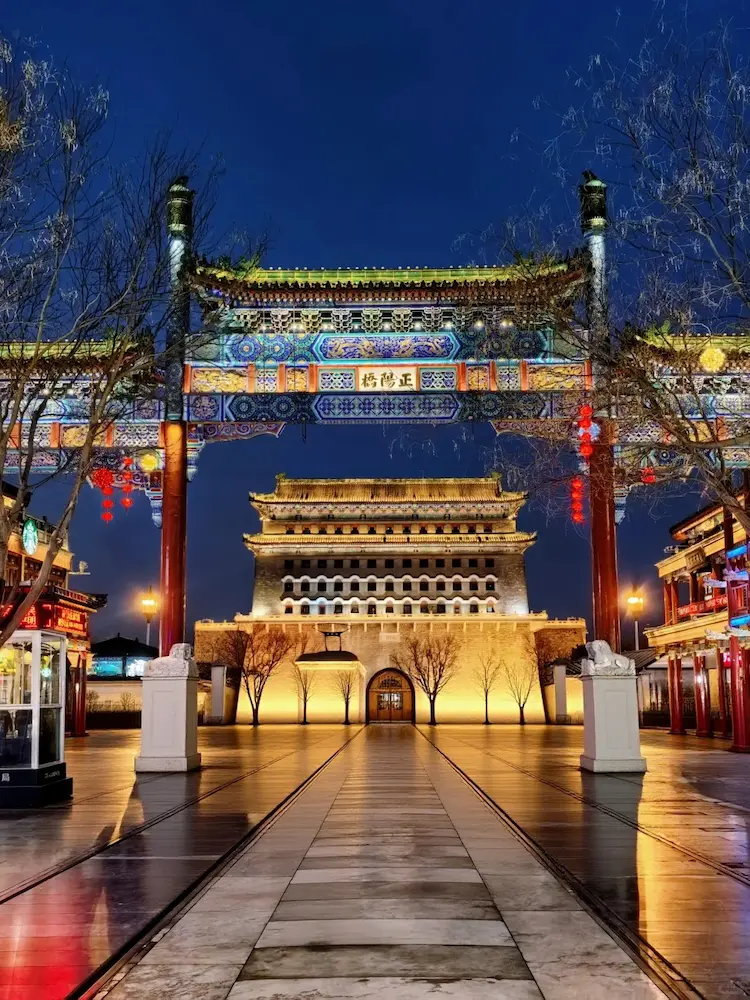
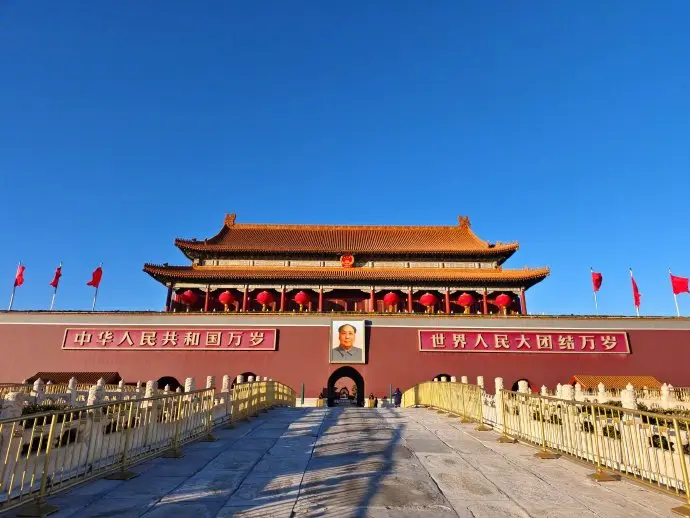
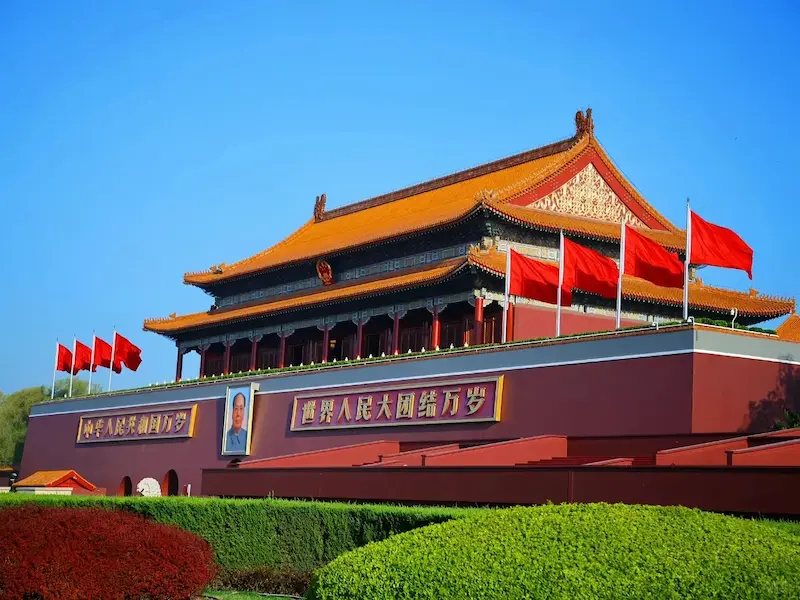
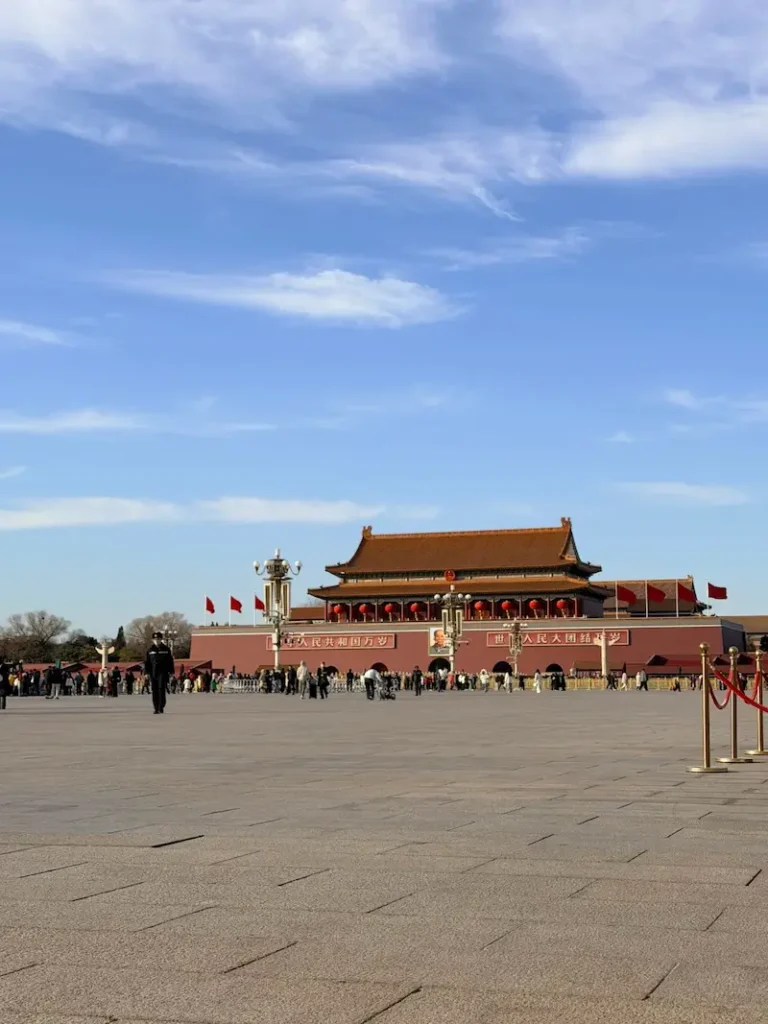
Looking north, you’ll see the Tiananmen Gate Tower—the national symbol of the People’s Republic of China. The five main bridges align precisely with the five gateways of the Tiananmen Gate Tower, with the central axis running through the center of the Imperial Way Bridge.
3. Huabiao Pillars and Stone Lions
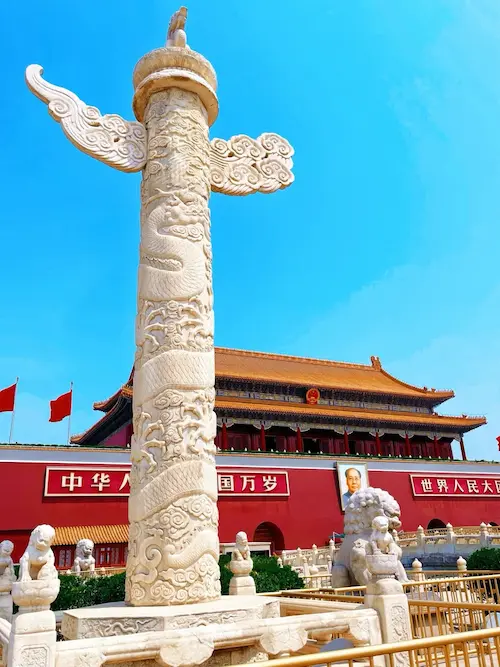
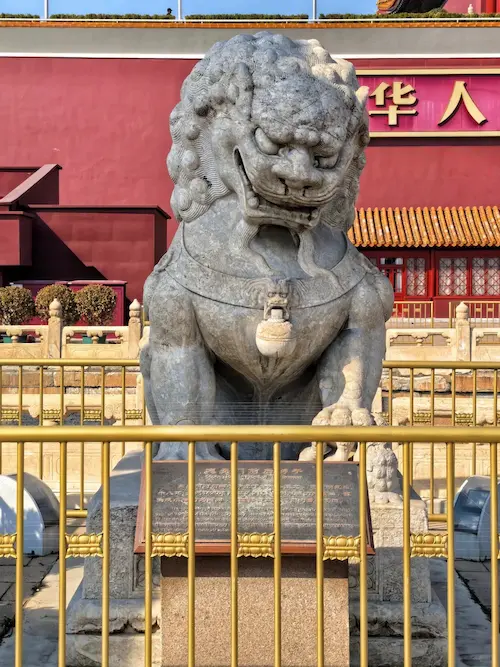
On either side of the Outer Golden Water Bridge in front of Tiananmen Gate stand a pair of huabiao pillars and a pair of stone lions—iconic sculptures that marked the ceremonial spaces of the imperial city during the Ming and Qing dynasties.
4. Tiananmen Square
Looking south, you’ll see Tiananmen Square—the world’s largest urban square. The Monument to the People’s Heroes, the Mao Zedong Memorial Hall, the Great Hall of the People, and the National Museum are arranged around its perimeter.
Recommended Tour Route (approx. 30 minutes)
Starting Point: Exit at Tiananmen East Station or Tiananmen West Station on Subway Line 1, pass through security, and enter the Tiananmen Square area.
First Stop: Stand on the south side of Jinshui Bridge (the side facing the square) and take a photo of the seven bridges and the Tiananmen Gate Tower together, looking from south to north (approx. 5 minutes).
Second Stop: Walk onto the Imperial Path Bridge (the one in the very center) and experience the “path once walked by the emperor” (approx. 5 minutes). Imagine that 600 years ago, only the emperor was allowed to stand on this bridge.
Third Stop: Walk to the center of the bridge and look down at the white marble railings and the carvings on the balusters (approx. 5 minutes). Try to spot the differences between the balusters carved with coiled dragons and those carved with lotus flowers.
Fourth Stop: Walk to the outermost Gongsheng Bridge and take a photo from a unique angle (about 5 minutes).
Afterward: You can continue north to visit the Tiananmen Gate Tower (reservation required; admission 15 yuan), or head south to explore Tiananmen Square, the Monument to the People’s Heroes, and the Chairman Mao Memorial Hall (reservation required).
Important Reminder: After crossing Jinshui Bridge to pass Tiananmen Gate, the route is one-way, and you cannot return to the south side of the square from the north. Be sure to complete your tour and take photos on the south side of the square before crossing the bridge.
Photography Guide
| Shooting Angle | Location | Best Time to Shoot | Tips |
| Panoramic View of the Seven Bridges | South side of Jinshui Bridge (square side) | Early morning or evening | Stand slightly south of the center of the square to capture all seven bridges and the Tiananmen Gate Tower in the frame. There are fewer people in the early morning, resulting in a cleaner shot |
| Close-up of the Imperial Bridge | The bridge in the very center | Morning | Capture the white marble railings and the coiled dragon pillar caps on the bridge deck—the details are exquisitely crafted |
| Bridges and Reflections | South side of Jinshui Bridge | After the lights come on in the evening | The lights from the bridges and the Tiananmen Gate Tower are reflected in the water, creating a very photogenic scene |
| Huabiao Pillars and the Bridge in the Same Frame | East or West Side of the Bridge | Morning or Evening | Capture the Huabiao Pillars, stone lions, Jinshui Bridge, and the Tiananmen Gate Tower all in the same shot |
Nearby Attractions: Half-Day Tour of Tiananmen Square and Beijing’s Central Axis
The Outer Jinshui Bridge is located at the heart of Tiananmen Square and is also one of the key points along Beijing’s Central Axis. From here, you can easily walk to several attractions:
| Attraction | Direction | Walking Time | Highlights | Admission |
| Tiananmen Gate Tower | North (just across the bridge) | 1 minute | Site of the founding ceremony of the People’s Republic of China; visitors can climb the tower for a tour | 15 yuan (reservation required) |
| Tiananmen Square | South | 2 minutes | The world’s largest urban square | Free (reservation required) |
| Monument to the People’s Heroes | South | 5 minutes | Commemorates martyrs of China’s modern and contemporary revolutionary history | Free |
| Chairman Mao Memorial Hall | South Side | 8 minutes | The final resting place of Chairman Mao Zedong | Free (reservation required) |
| National Museum of China | East side | 10 minutes | China’s largest national museum | Free (reservation required) |
| Palace Museum | North side (through the Tiananmen Gate) | 15 minutes | Imperial palace of the Ming and Qing dynasties, a UNESCO World Heritage Site | 60 yuan (reservation required 7 days in advance) |
Recommended Half-Day Itinerary (approx. 3–4 hours):
Exit at Tiananmen East Station on Subway Line 1 → Pass through security to enter Tiananmen Square → Outer Jinshui Bridge (30 minutes: take photos and learn about the history) → Cross the bridge to visit the Tiananmen Gate Tower (1 hour; reservation required) → Return to the square to visit the Monument to the People’s Heroes (15 minutes) → Visit the Chairman Mao Memorial Hall (30 minutes; reservation required) → Proceed to the National Museum (1.5 hours, reservation required) → End of tour
If you’d like to explore Beijing’s Central Axis in depth as you head north: Start at the Outer Jinshui Bridge, pass through the Tiananmen Gate Tower and the Meridian Gate, and you’ll reach the Meridian Gate of the Forbidden City. Continuing north, you’ll pass Jingshan Park, Wanning Bridge, and the Bell and Drum Towers—the entire Central Axis is a living history of Beijing.
FAQ
These seven unassuming white marble bridges in front of Tiananmen Square have stood here for more than 600 years.
Six hundred years ago, only the emperor was allowed to cross the central bridge; princes used the ones on either side; officials of the third rank or higher used the ones further out; and those of the fourth rank or lower were restricted to the two outermost bridges. A single bridge carved the entire imperial hierarchy into stone.
Today, you and I can freely walk across the Imperial Path Bridge, which once was reserved exclusively for the emperor. Looking north, you see the Tiananmen Gate Tower; looking south, Tiananmen Square. Six hundred years of rigid hierarchy have given way to today’s equality and openness.
When you visit Beijing, don’t just snap a photo at Tiananmen Square and leave. Slow down, walk across the Jinshui Bridge, look down at the white marble railings on the bridge deck, and look up at the Tiananmen Gate—this bridge knows the story of Beijing better than you, better than me, and better than most of the buildings in this city.